


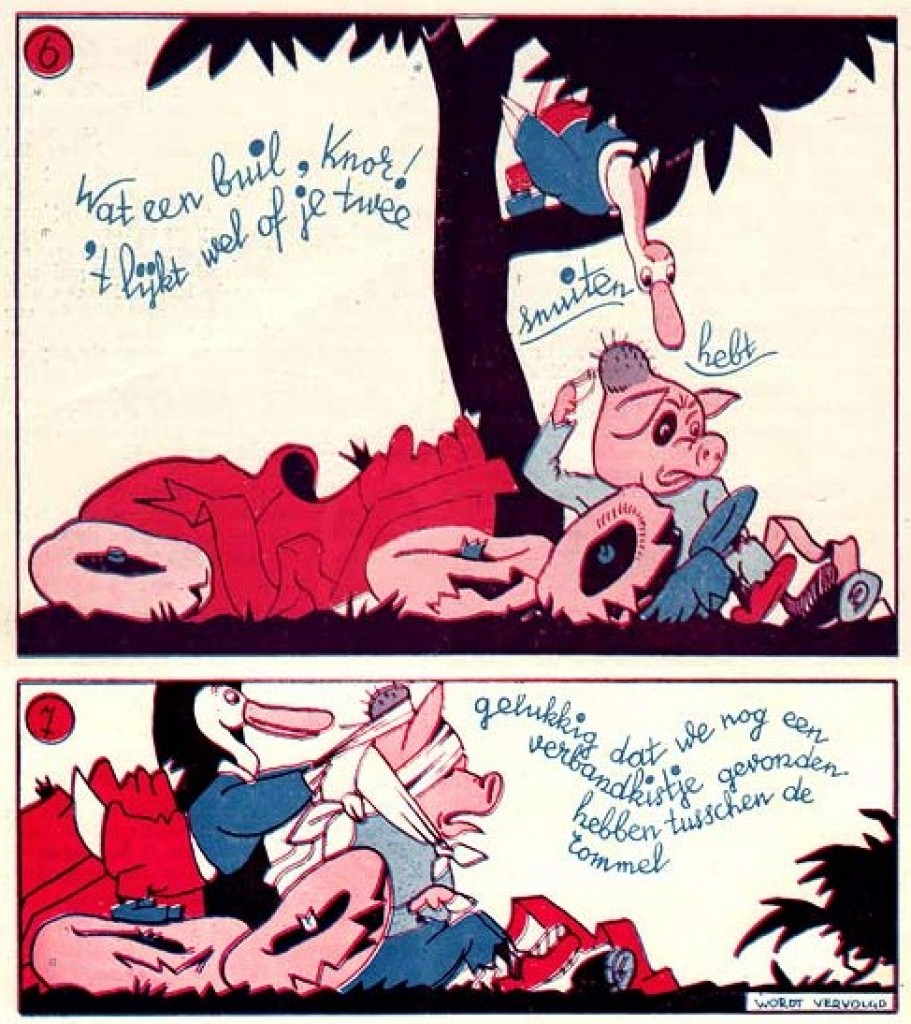

'Knor en Kwek', Zonneschijn, 1933.
Jan Kraan was a Dutch graphic artist and illustrator, who was best known in his home country for his 1930s advertising illustrations. He was also an illustrator and designer for the children's magazines Kie-ke-boe and Zonneschijn during this period. After 1938, he worked as an animator and cartoonist in Switzerland.
Early life and education
Jan Kraan was born in 1901 in Noordwolde, part of the municipality Westellingwerf in the province of Frisia. He knew from an early age that he wanted to become an illustrator, and avidly cut the illustrations of Louis Raemaekers and Albert Hahn from magazines. Together with a friend, the future woodcut artist Johannes Mulders (1899-1989), he received private drawing lessons from Harm Ellens, the director of the local reed braiding school ("Rijksrietvlechtschool") in Noordwolde. Afterwards, he was qualified to become a drawing teacher and, between 1923 and 1930, fulfilled this profession in Utrecht, while simultaneously studying at the Academy of Fine Arts in The Hague.
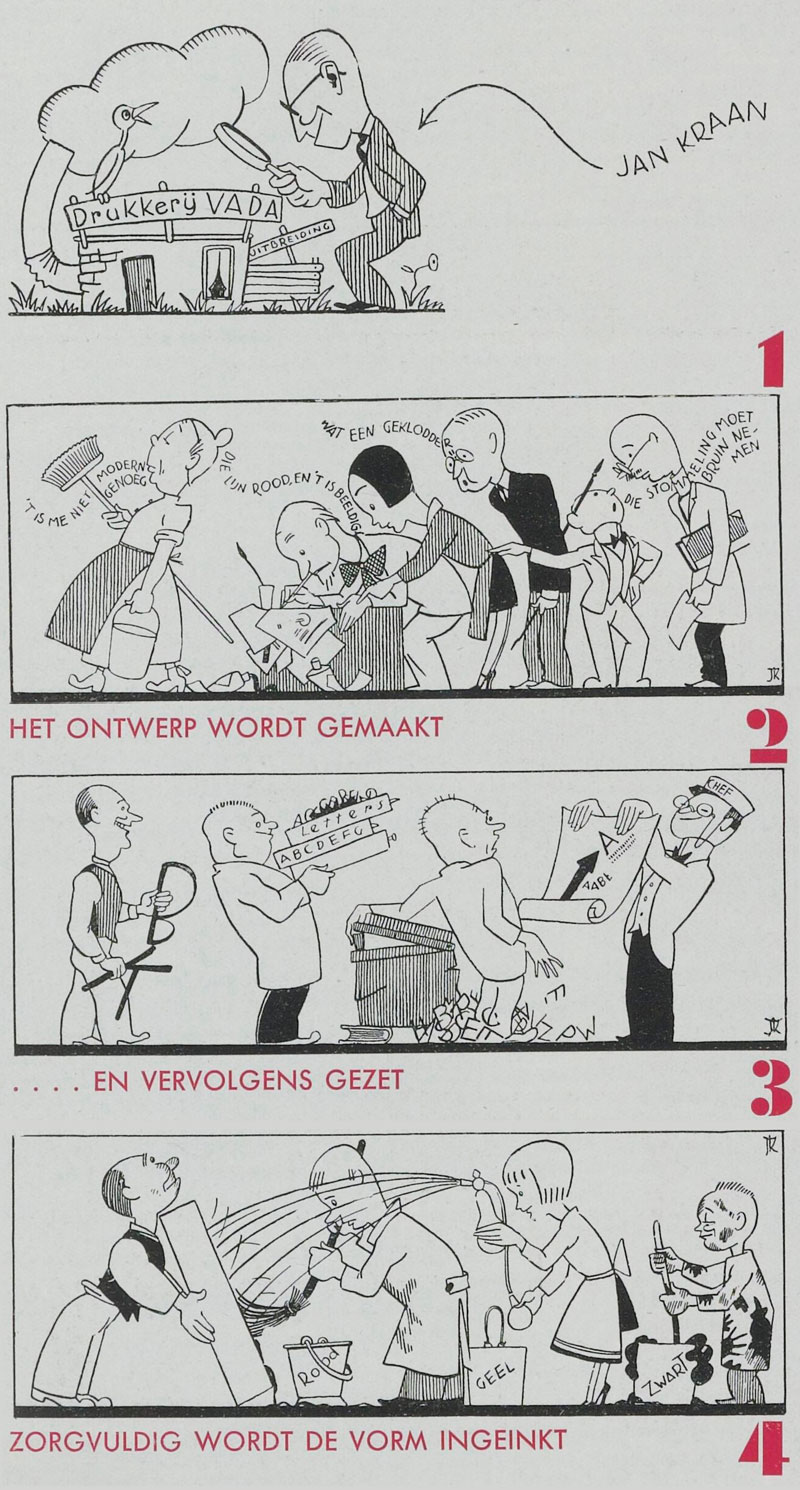
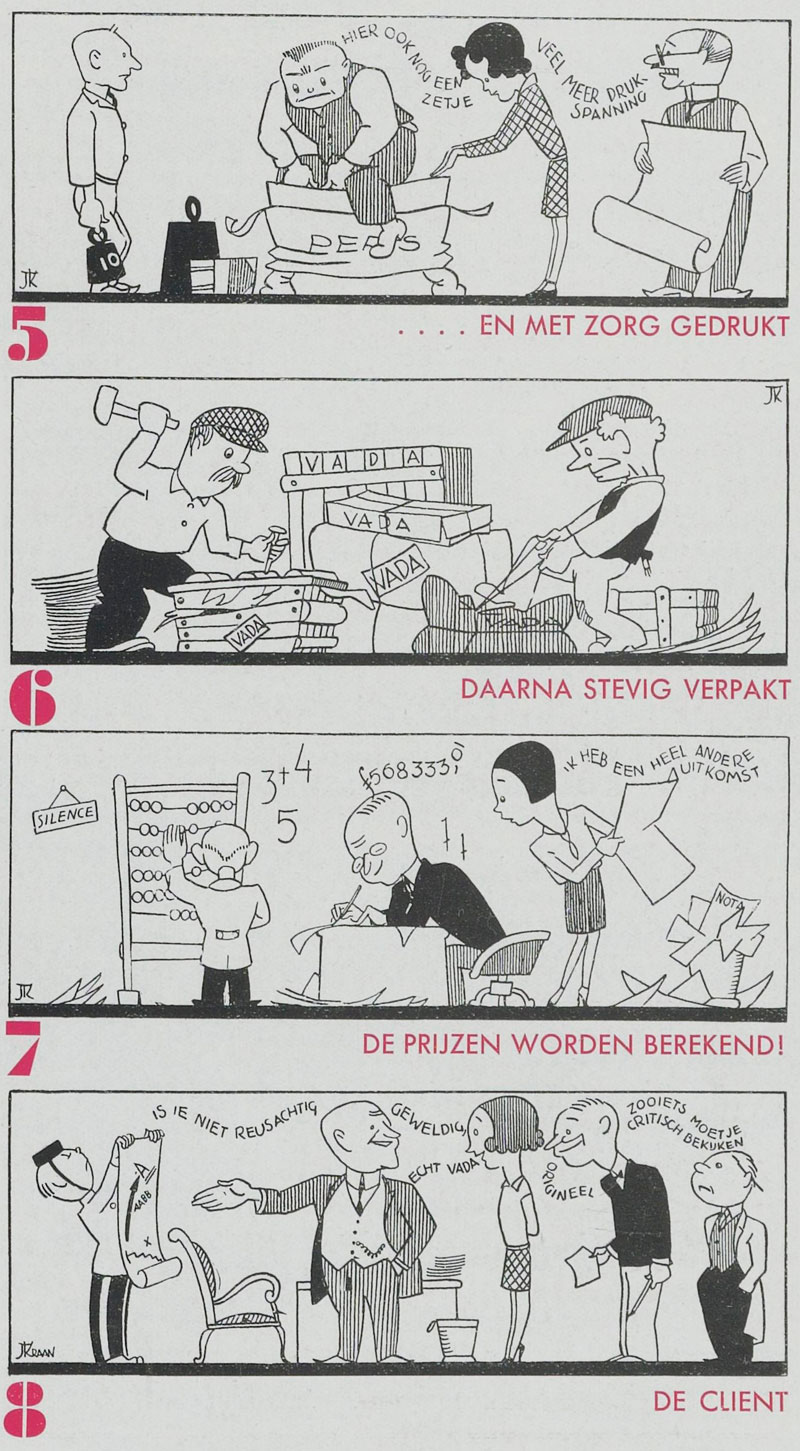
In 1933, Jan Kraan visualized the production process of the printing firm Vada in Wageningen.
Early graphic career
Increasing advertising and illustrations assignments allowed Kraan to quit his daytime job as teacher. After being employed as an ad illustrator by department store De Bijenkorf (1930-1932) he turned freelance. Among his major clients during the 1930s were the Dutch postal services PTT and the Niemeijer tobacco factory, for which he made several humorous advertisements. Another early client was the glossy monthly Nova, for which he illustrated text stories in 1930.

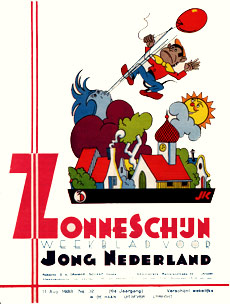
Cover illustrations for Zonneschijn.
Zonneschijn & Kie-ke-boe
Kraan also worked for the publisher W. de Haan from Utrecht. He was an illustrator and designer for the firm's pedagogically justified but otherwise independent children's magazines Kie-ke-boe and Zonneschijn, both edited by D.A. Cramer-Schaap. The magazines offered fairy tales, rhymes, activity pages and games. Kie-ke-boe was launched in 1930, and became a supplement of Zonneschijn in 1934. The first issue of Zonneschijn had appeared in 1924, and the magazine lasted until 1943. Kraan served as one of several illustrators, among which Jan Lutz, Rie Cramer, Anton Pieck, Hans Borrebach, Guus Hens, Freddie Langeler, J. B. Midderigh-Bokhorst and Tjeerd Bottema. Besides illustrations for covers and picture stories, Kraan was also the designer and typographer of Zonneschijn's section headers. Inspired by the "De Stijl" graphic movement of Piet Mondriaan and Theo van Doesburg, he also gave Zonneschijn a new cover design in the early 1930s. Among his other contributions to Zonneschijn were the funny animal picture stories about 'Knor en Kwek', respectively an anthropomorphic pig and duck.

Header for the Zonneschijn Club.

Header for Zonneschijn about animated cartoons, depicting Max Fleischer's Betty Boop, Pat Sullivan & Otto Messmer's Felix the Cat and Walt Disney's Mickey Mouse.
Children's books
Kraan also illustrated a couple of children's books, including some by Zonneschijn's editor D.A. Cramer-Schaap: 'De avonturen van Jopie Sprinter' (1938) for the Peijnenburg biscuit factory and 'Het Konijnenboekje' (1954) for publisher Veenman. Kraan also provided the illustrations for Ed. Hoornik and Wim Hora Adema's 'Joosje' (L.J. Veen, 1940).

Illustration by Jan Kraan, January 1932.
Move to Switzerland
By the end of the 1930s, Kraan found another calling. In 1938, he was asked to come and work on a Dutch animated film for a movie company in Bern, Switzerland. It took him one year before he became lead artist in the Trick Film Studio. There, he was in charge of the production of many films by commission from British, Italian and Swiss firms. He quit the movie industry in 1956, and became the regular illustrator for the Swiss daily newspaper Berner Zeitung for seven years. Kraan was a prominent figure in the minor Dutch community of Switzerland, being named chairman of the "Dutch colony" of Bern and of the Schweiz-Holland society.
Recognition
For his role as chairman of the Swiss-Dutch society, Kraan was knighted him 1978 in the Order of Orange-Nassau. At the occasion of his 80th birthday in July 1981, a small exhibition of his work was held in the Compagnonshuis in Noordwolde, called 'Jan Kraan, Een Tekenaar met Humor' ("Jan Kraan, An Artist with Humor").
Death
Jan Kraan passed away in Bern on 8 March 1988, one week after his 87th birthday.
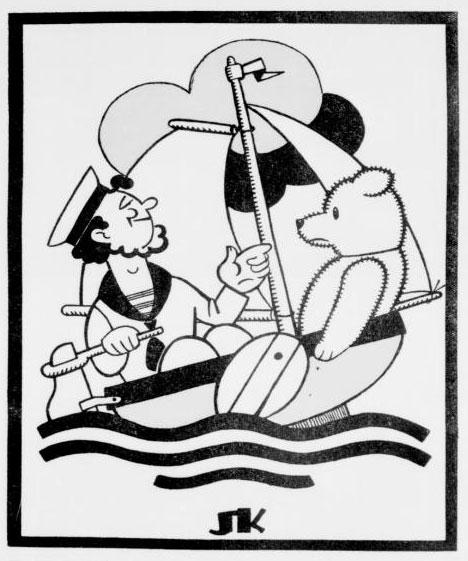
Illustration for Kiekeboe.