


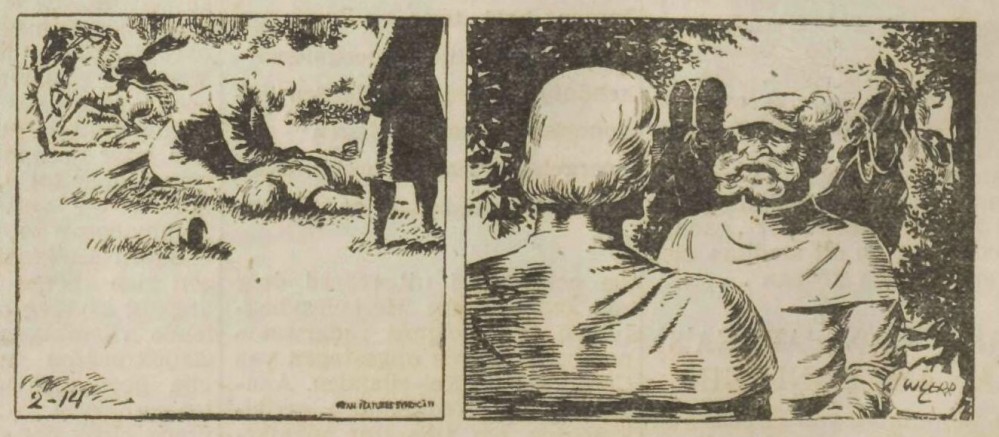
'Victor de Turenne' (De Vrije Zeeuw, 1962).
Dick de Wilde was a Dutch book and advertising illustrator, comic artist and graphic designer. An illustrator of children's literature from the 1960s through the 1980s, he was known for his well-documented historical drawings. The rare comic series he worked on also featured mainly heroic sword-slingers. Besides assisting Hans G. Kresse on 'Matho Tonga' and 'De Jeugd van Eric de Noorman' for the Belgian market, De Wilde most likely made his own newspaper text comic 'Victor de Turenne' during the 1950s and 1960s. He signed this work with W. Gerritsen or, shortened, "W. Gerr".
Early life and career
Dick de Wilde was born in 1905 in Rotterdam. At the age 18 he became a bookkeeper with a commercial office in the Belgian capital Brussels, before ending up as graphic designer at Unilever's in-house advertising agency Lintas. During evenings, he was for many years a teacher at the Rotterdam Academy of Fine Arts. On the side, he worked on illustration assignments. During the 1920s and 1930s, De Wilde's illustrations appeared in the children's magazine Zonneschijn. In 1938, he provided the illustrations for 'Van Dieren, Planten en Menschen' (Van Loghum Slaterus, 1938), a Dutch edition of one of the fairy tale storybooks by the Danish writer Carl Ewald. After World War II, he made the illustrations for 'De Gele Hel' (Wyt-Rotterdam, 1946) by H. Porte, a former prisoner of war of the Japanese and guerrilla fighter in the Philippines. Later, he also povided the cover and interior artwork for 'Wolfram, De Zoon van Graaf Ottokar', an advertising booklet for several Dutch savings banks, published in the summer of 1951. The text was written by noted children's book author A.D. Hildebrand. Wolfram was the first in a long line of historical heroes that De Wilde would draw.
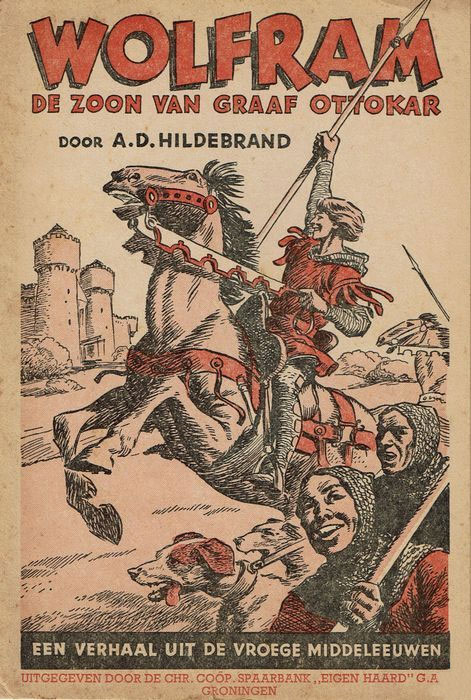
Cover illustration for 'Wolfram, De Zoon van Graaf Ottokar' by A.D. Hildebrand.
Work for Hans G. Kresse
In the early 1950s, De Wilde made his first venture into comics, when he assisted Hans G. Kresse on some of his productions. One of these was 'De Jeugd van Eric de Noorman', a serial about the younger years of Kresse's signature hero 'Eric the Norseman', which appeared as the cover feature of the Flemish newspaper supplement Pum-Pum from 1951 until 1955. Since Kresse had quickly lost interest in the project, De Wilde was brought in a ghost artist. Later installments of the series were drawn by Gerrit Stapel. Along with Stapel and also Piet Wijn, De Wilde also worked on the fourth installment of Kresse's series about Native American 'Matho Tonga', which appeared in Pum-Pum's parent paper Het Laatste Nieuws in 1954.
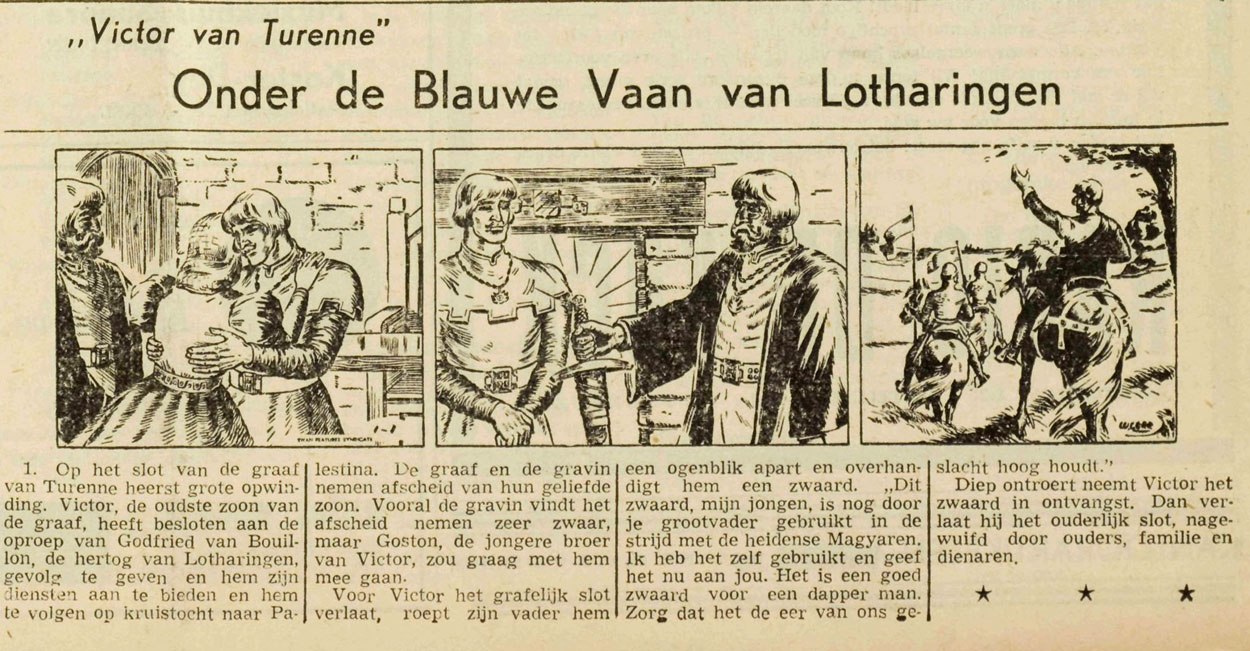
First episode of 'Victor van Turenne' (De Vrije Zeeuw, 26 April 1958).
Victor de Turenne
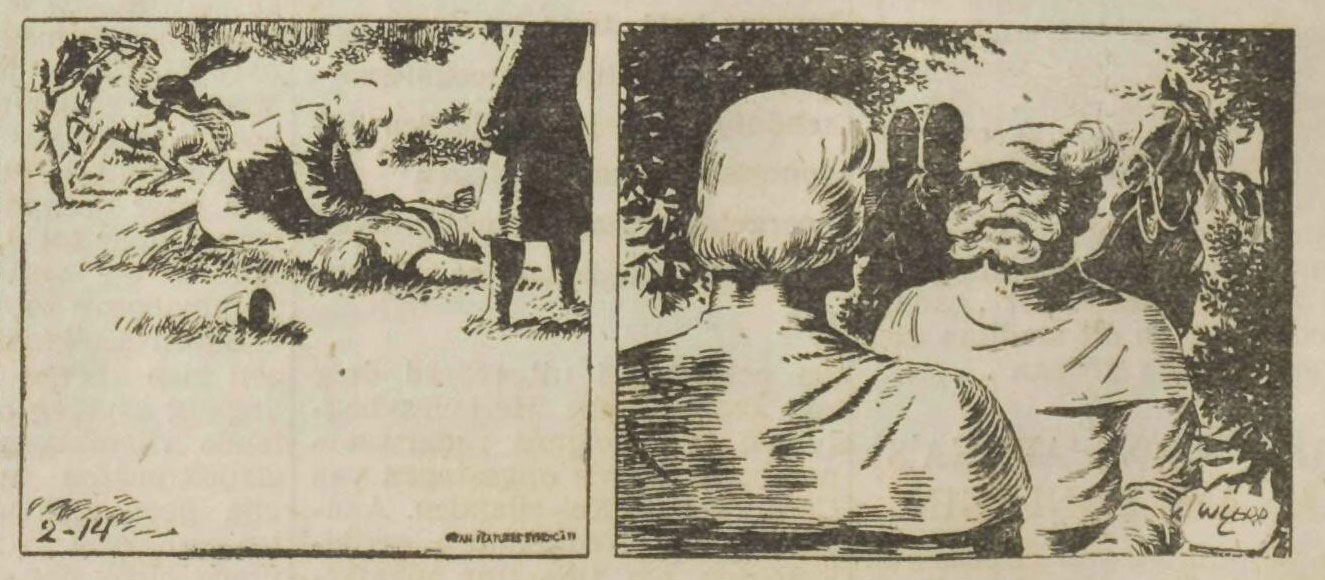
Research of the Dutch Comics Documentation Centre, affiliated with the Special Collections department of the University of Amsterdam, pointed out that Dick de Wilde was also responsible for the newspaper comic 'Victor de Turenne' (or 'Victor van Turenne'). De Wilde signed each episode with "W. Gerr", an abbreviation of his supposed pen name W. Gerritsen. He applied a style similar to that of Kresse and Stapel, while his detailed depictions of castles and his realistic brush work brings Hal Foster's 'Prince Valiant' to mind as an inspiration. In the late 1950s and early 1960s, this historical text comic appeared in Dutch regional newspapers through Anton de Zwaan's Swan Features Syndicate. The series stars the heroic Victor, eldest son of the count of Turenne (France), who joins Godfrey of Bouillon on his crusade to Palestine.
The Swan Features archives contain original artwork for stories 1, 2 and 15, indicating that there must have been at least fifteen stories. So far, only the first two stories have been traced back in Dutch newpapers. 'Onder de Blauwe Vaan van Lotharingen' appeared in De Vrije Zeeuw from 26 April until 9 July 1958, followed by 'De Schrik der Saracenen' from 31 July through 6 October 1962. In 1959, the series has also appeared in Groninger Courant.
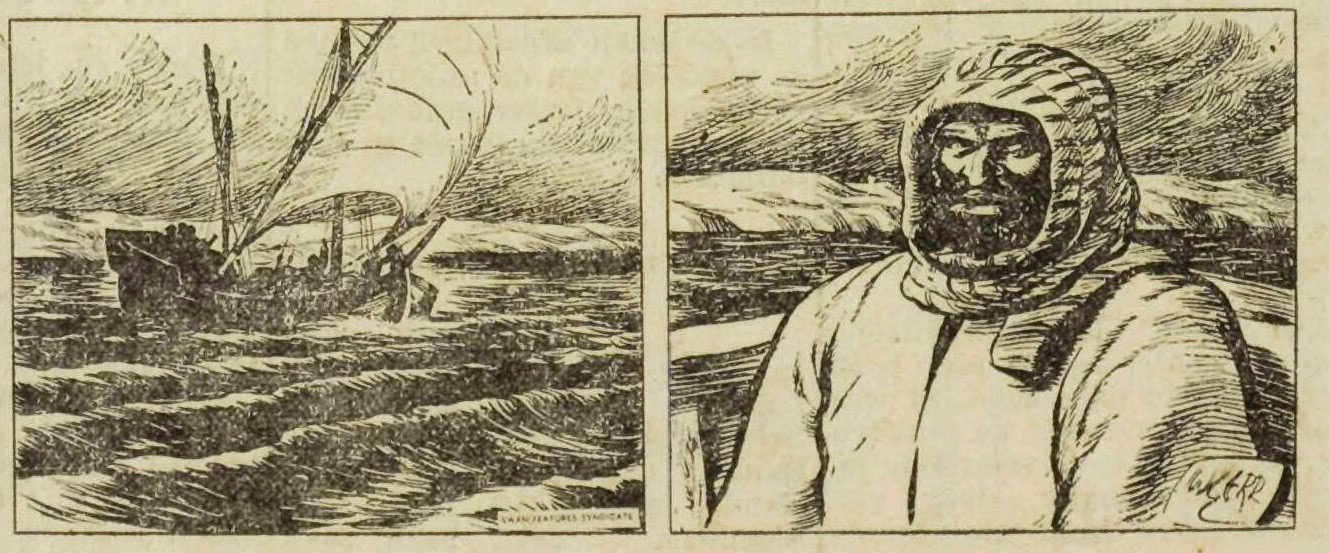
'Victor de Turenne' (De Vrije Zeeuw, 1962).
Children's book illustrator
By the time of his semi-retirement in the 1960s, Dick de Wilde began a productive second career as an illustrator of children's literature. He worked essentially on historical books, for which he took great care in the correct historical depiction and atmosphere, feeling that the sole purpose of the illustrations were supporting the text. From the start, he illustrated several (re)editions of popular books by Johan Fabricius, most notably the writer's best-known book 'De Scheepsjongens van Bontekoe' (1960), about three young boys who sail to the Dutch East Indies aboard the Nieuw Hoorn with captain Willem Bontekoe. Other Fabricius books with drawings by De Wilde were 'Het Geheim van het Oude Landhuis' (1965), 'De Wonderbaarlijke Avonturen van Bartje Kokliko' (1975) and 'Toontje Poland: Een Alkmaarse jongen in de Dagen van Napoleon' (1977). In addition, De Wilde illustrated Dutch editions of originally British books by Leon Garfield and Rosemary Sutcliff, as well as historical books by Henk van Kerkwijk ('De Ontvoering uit De Swaan', 1967) and Miep Diekmann ('Mens Te Koop', 1977). He provided the artwork for several books about Dutch medieval history by Piet Huurdeman, such as 'Het Beleg van Haarlem' (1979), 'Van Alkmaar De Victorie' (1980) and 'Leidens Ontzet' (1981), as well as Nanne Bosman's 'De Bedelaars' (1986), 'De Troubadour van Carcassonne' (1987) and 'De Duivelskater' (1989).
Final years and death
Dick de Wilde retired from all of his activities in 1988, and passed away in Breda on 12 September 1994.
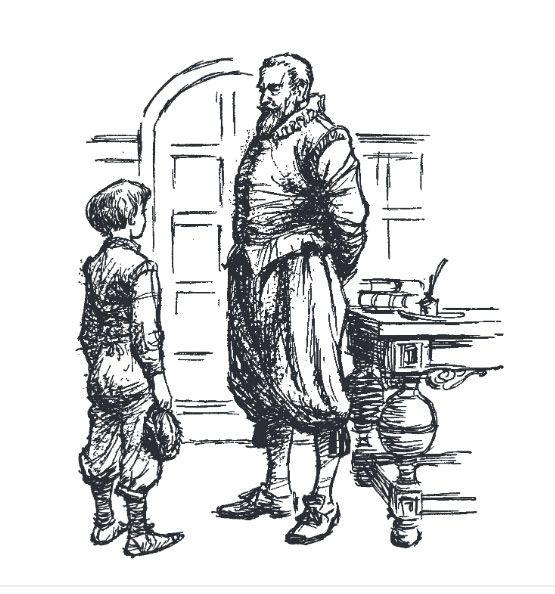
From: 'De Scheepsjongens van Bontekoe'.