

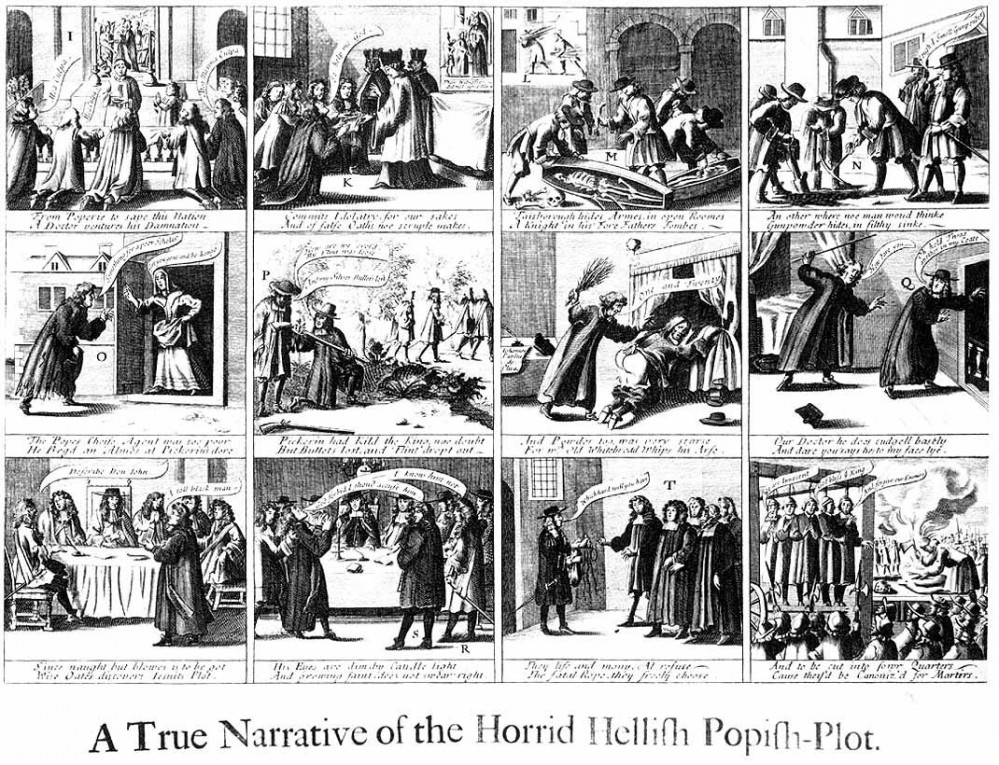
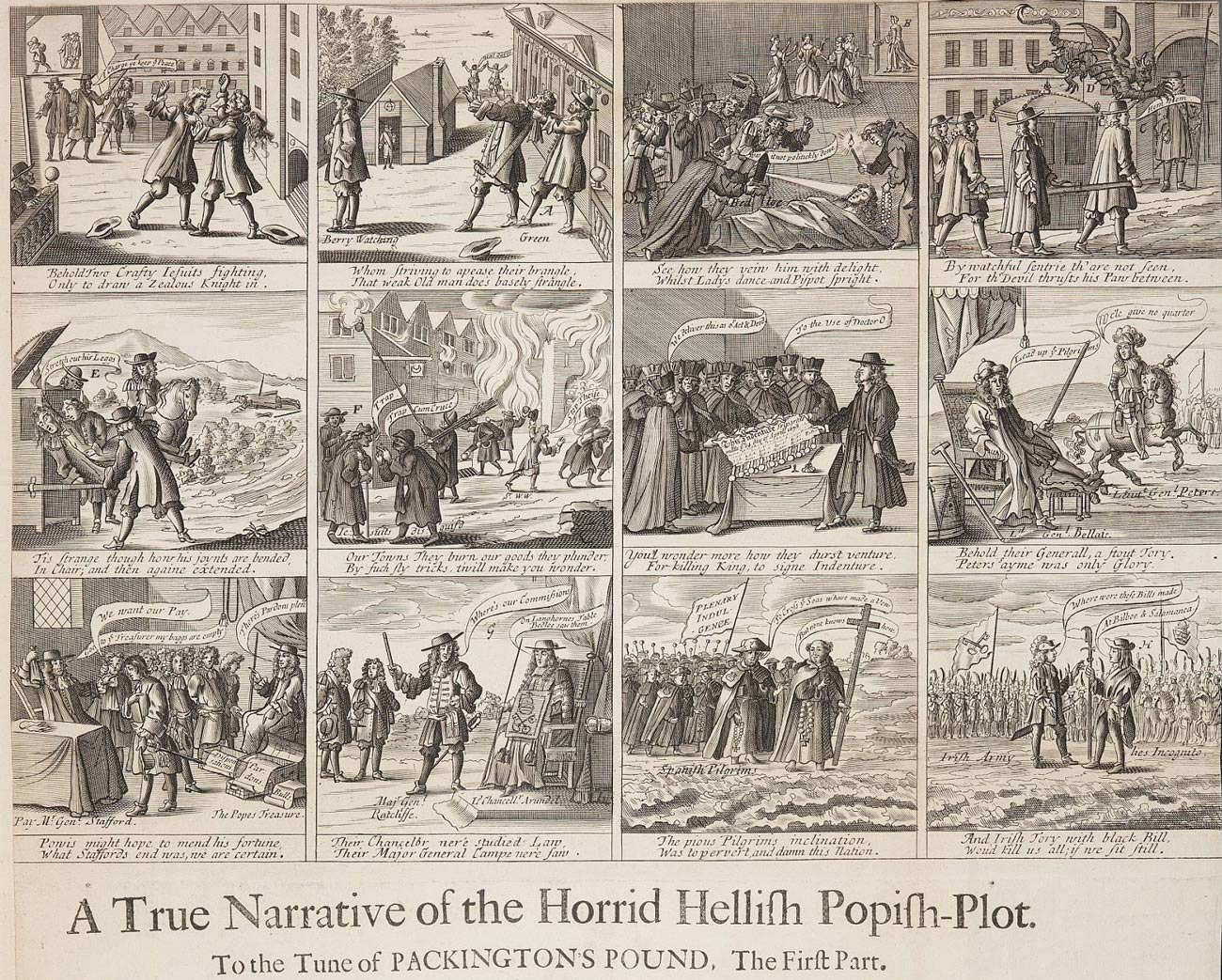
'The Horrid Hellish Popish Plot' (first part, 1682).
Francis Barlow was a 17th-century English painter, who was also active as a topical satirical cartoonist and prototypical comic artist. His cartoon 'The Cheese of Dutch Rebellion' (1673) and the picture story 'The Horrid Hellish Popish Plot' (1682) both make use of speech balloons. Particularly 'The Horrid Hellish Popish Plot' is historically significant, because it uses both a text comic and balloon comic format, divided in panels. Together with William Hogarth, Barlow ranks as the earliest known English prototypical comic artist whom we can identify by signature.
Life and career
Francis Barlow was born in 1626 around Lincolnshire and a pupil of the London artist William Sheppard, who specialized in painting portraits of both humans and animals. Soon Barlow became the leading bird and animal illustrator in 17th-century England. He decorated many ceilings for castles and worked on the Abbey of Westminster. One of his earliest works was 'Theophila or Love's Sacrifice' (1652), a series of 12 illustrations of a mystic poem by Edward Benlowe. In 1666, he also provided 110 illustrations for a publication of Aesop's 'Fables'. He died in 1704.
While celebrated in his own lifetime, Barlow's paintings have nowadays been mostly forgotten. To the modern observer, his animal paintings look less naturalistic compared with the more skilled artists who followed in his wake. Even artistically speaking, composition was not his strongest point. The animals in his works tend to be cluttered together in every possible frame.
The Cheese of Dutch Rebellion
What saves Barlow from total obscurity is his importance for the history of comics. In the late 17th century, he made many satirical cartoons which promoted the Whig party and his home country. A notable example is 'The Cheese of Dutch Rebellion' (1672-1673), which mocks the Third Dutch-English War (1672-1674). Many of the early battles ended in Dutch defeat. The English marines were supported by France and the German principalities Münster and Bavaria. Their combined forces made it difficult for the Dutch navy to fight back, particularly since they had barely recovered since the previous war. In the Netherlands, spirits were at such a low that people blamed their grand pensionary of Holland Johan de Witt, and his brother Cornelius. They were dragged out of their homes and lynched on the spot. As a result of these events, 1672 went into history as the "Rampjaar" ("Disaster Year").
Barlow's cartoon symbolizes The Netherlands as a huge cheese, back then already one of the country's major export products. However, the cheese is rotting, with toads and maggots nibbling at it below. Now vulnerable to outside forces, the Dutch parliament tries to escape through the cheese holes, but demons drag the politicians away to Hell. In the right lower corner, one parlementarian carrying his nation's flag rides a fish and moans: "Our fleet's disabled, and our Toadstool Throne is sinking now, for we are left alone". The biggest demon, who sits on top of the cheese (presumably Satan) shits the parlementarians' damned souls out. In the right upper corner, another devil plays the trumpet: "I doe proclain the Fall of Belgion States who for last Cent'ry were our intimates. But now soe proud, and impudent they're grown. They must be humbled to preserve our owne." 'The Cheese of Dutch Rebellion' is notable for its use of speech scrolls (a forerunner of speech balloons). Dutch artist Romeyn de Hooghe incidentally also made cartoons about the "Disaster Year" 1672 in a text comic format, naturally depicting it more as a tragedy.
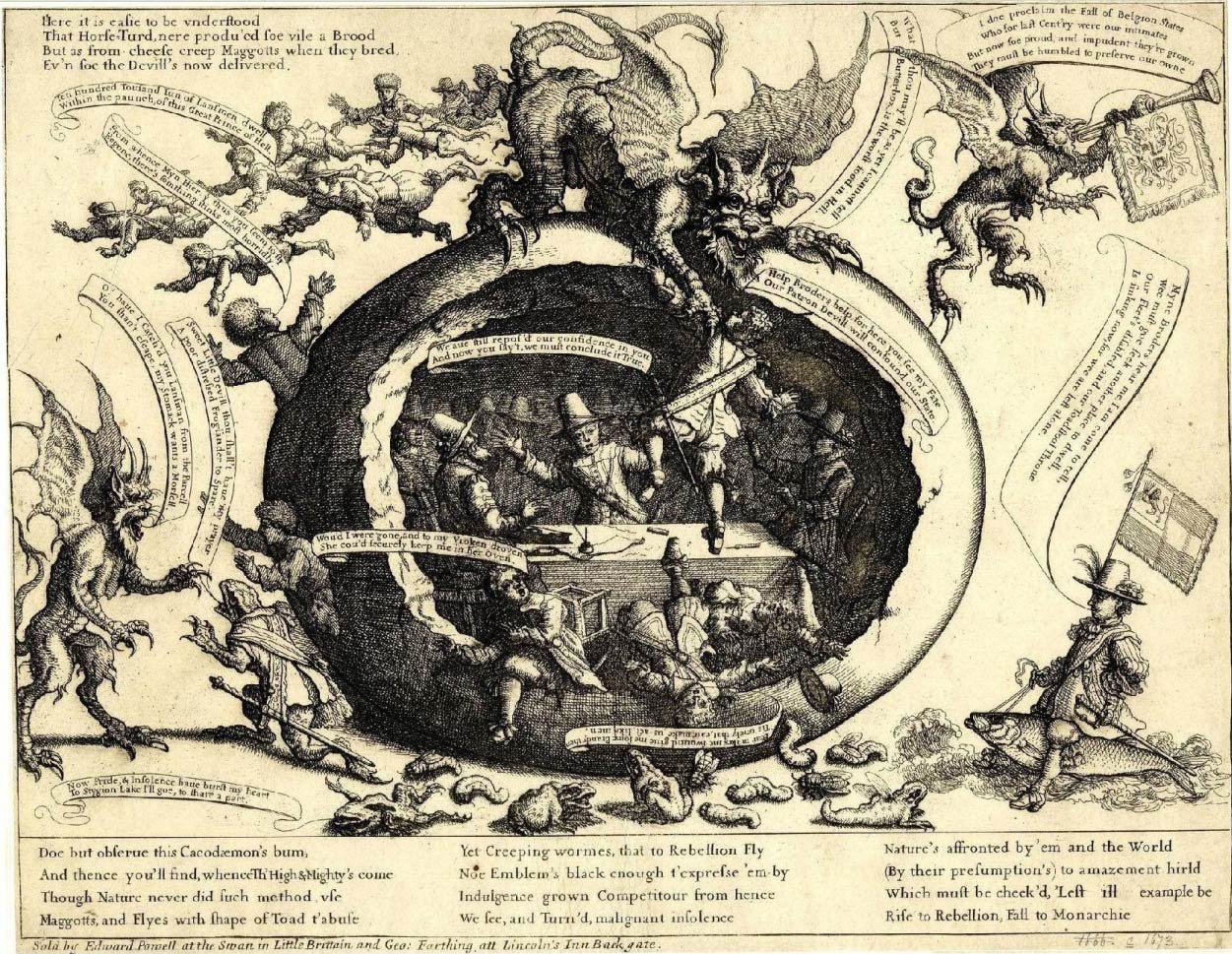
'The Cheese of Dutch Rebellion' (1672-1673).
The Horrid Hellish Popish Plot
Barlow also illustrated several packs of playing cards, depicting major national events from his own century. Some were also presented on broadside sheets, distributed all over the country. In 1682, Barlow was inspired by the Popish Plot (1678-1681), a series of events that dominated English politics for four years. Military chaplain and former priest Titus Oates claimed the Pope planned to murder English king Charles II. His accusations led to a witch hunt against Catholics, resulting in the executions of at least 22 people believed to be among the "conspirators". However, Oates was eventually revealed as a fraud, whose tall tales often contradicted one another and some of which were demonstrably false. By 1681, he even denounced Charles II and his brother James (the later James II), who was a Catholic. Oates was soon arrested for sedition. In 1685, James II became king of England and ordered Oates to be put on trial. The disgraced priest was pilloried and whipped for the crime of perjury, which, to his luck, was not punishable by death. In 1689, when the Protestant William or Orange and Mary became king and queen, Oates was pardoned, but remained an outcast until he passed away in 1705.
Barlow transformed Oates' rise and fall from grace into an ambitious picture story: 'A True Narrative of the Horrid Hellish Popish Plot' (1682). The entire tale is two pages long, with 12 panels on each, counting 24 panels in total. Oates' biopic is narrated in rhyme under each panel, while the characters talk by use of banners and scrolls (forerunners of speech balloons).
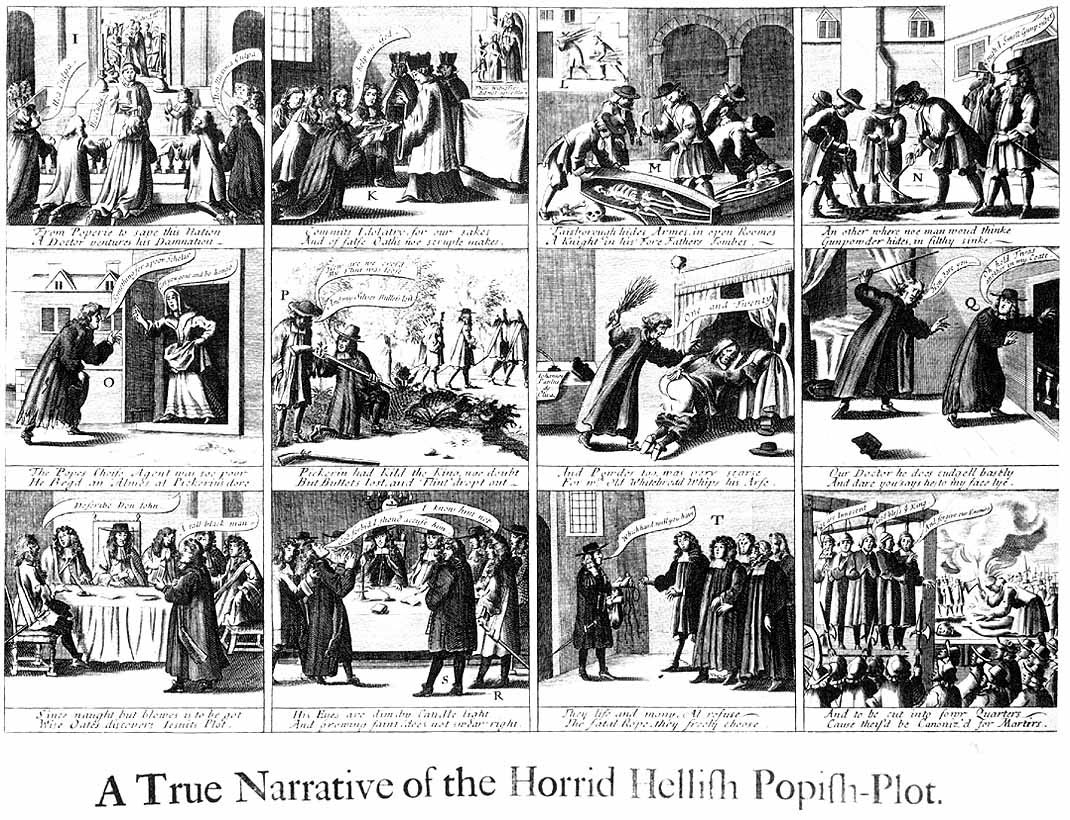
'The Horrid Hellish Popish Plot' (second part, 1682).
Legacy
Francis Barlow was not the inventor of picture stories, nor speech balloons and there have been some artists in centuries before him who used sequential narratives, such as late 15th-century and 16th-century German woodcarvings by artists like Johannes van den Aveele, Hans Burgkmair the Elder, Lucas Cranach the Elder, Jeremias Gath, Hans Holbein the Elder, Hans Holbein the Younger, Bartholomäus Käppeler, Caspar Krebs, Georg Kress, Hans Rogel the Elder, Hans Rogel the Younger, Erhard Schön, Johann Schubert, Hans Schultes the Elder, Lucas Schultes and Elias Wellhöfer and some works by Hieronymus Bosch, Pieter Bruegel The Elder, Frans Hogenberg's picture stories about 'The Spanish Fury' (1576) and the 'Murder of Henry III' (1589), Antonio Tempesta's 'Life of St. Laurentius' (1599) and 'Batavorum cum Romanis Bellum' (1612), Otto van Veen's 'De Bataafse Opstand' (1600-1613), Jacques Callot's 'Les Grandes Misères de la Guerre' ('Miseries of War', 1633), various 17th-century comic strip-like cartoons by Romeyn de Hooghe and William Hogarth's sequential paintings and engravings crafted between the 1720s and 1750s.
Still, Barlow's contribution to the history of comics should not be underestimated. His predecessors sparingly used speech balloons in illustrations, let alone sequences to tell a story. Most barely combined the two and even the few who did have remained anonymous. 'The Horrid Hellish Popish Plot' not only brings speech balloons, framed sequences and recurring characters together: it is also signed, thus making historians able to identify Barlow as a comic pioneer. Even after publishing this work few followed his example straight ahead. Some artists in the 18th century, like James Gillray, William Hogarth, Isaac Cruikshank, Isaac Robert Cruikshank and Richard Newton made use of speech balloons and/or sequential narratives, but rarely combined the two. In many cases, like with Richard Newton and Isaac Cruikshank, the speech balloons in those sequences are still just balloonless handwritten sentences floating above the characters heads. The first one to actually create something similar to Barlow's 'The Horrid Hellish Popish Plot' - and to sign his name underneath it - is Thomas Rowlandson with his work 'The Loves of the Fox and the Badger, or the Coalition Wedding' (1784), almost 102 years later!
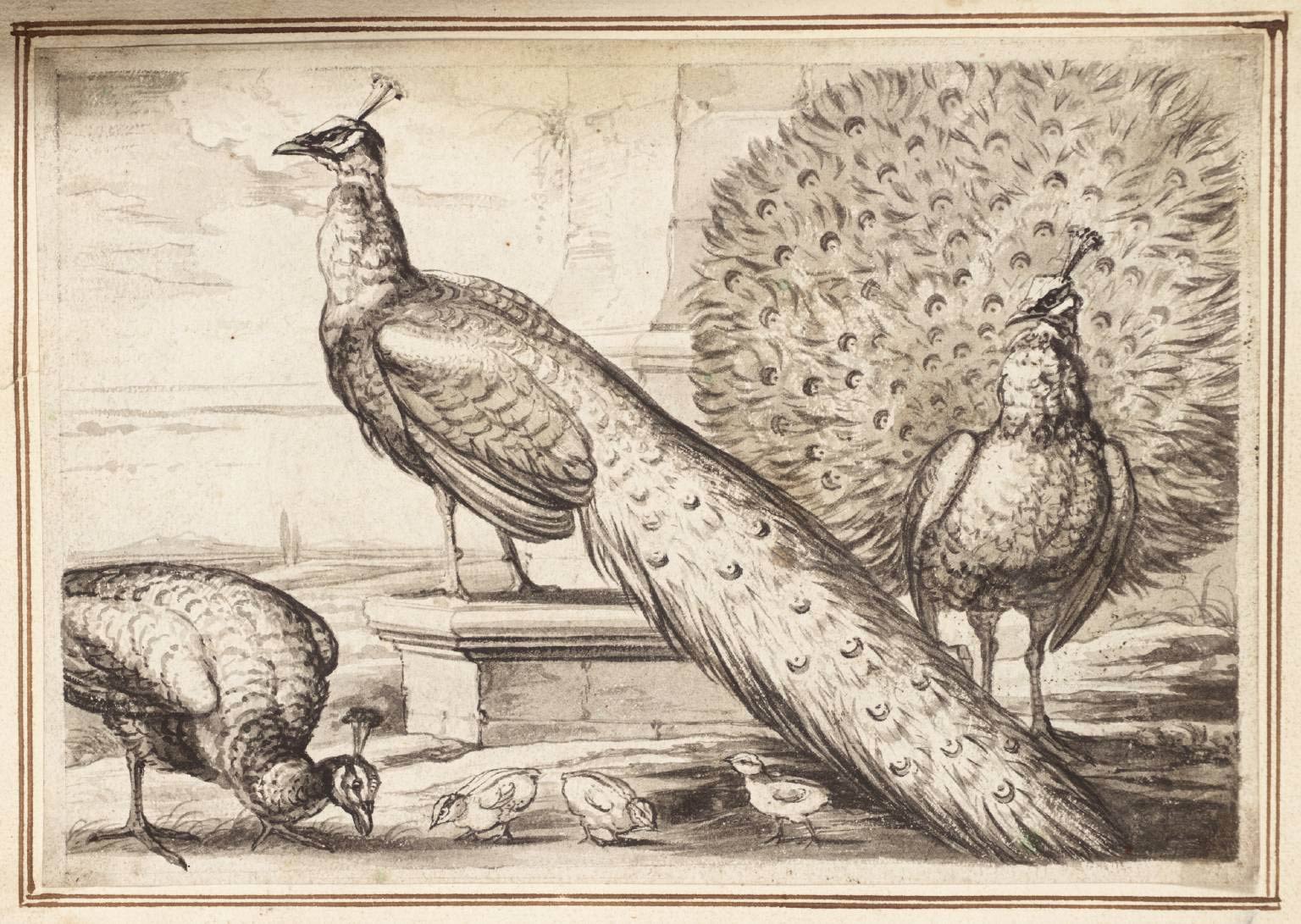
Illustration by Francis Barlow.