


Metafictional cartoon by Glen Baxter.
Glen Baxter, nicknamed "Colonel Baxter", was a British graphic artist, notable for his surreal spoofs of naïve, old-fashioned adventure stories. He presented supposed full-page illustrations from non-existent books, with stiff crayon artwork and equally stilted captions underneath them. The imagery, though, is deliberately strange, with intellectual references and dry, understated humor. Baxter's work polarized readers, who didn't always understand him and couldn't pigeonhole him as highbrow, nor lowbrow, let alone as an illustrator, single-panel cartoonist, writer, poet or comic artist. However, he won a global cult following, with his cartoons and books being translated into many languages and exhibited at various galleries.
Early life and career
Glen Baxter was born in 1944 in Leeds as the son of a welder. A typical British boy, he liked to watch movies in his local theatre, particularly B-Westerns, the science-fiction serial 'Flash Gordon' (based on Alex Raymond's newspaper comic) and comedies starring Buster Keaton, W.C. Fields or The Marx Brothers. Additional escapism was provided by youth adventure stories and comics, like Frank Hampson's 'Dan Dare' in Eagle magazine, and W.E. Johns' 'Biggles' book series. At a more mature age, he also enjoyed reading Franz Kafka, S.J. Perelman, Lewis Carroll, Raymond Roussel, the poetry of John Ashbery and Frank O'Hara, the plays of Samuel Beckett and Alfred Jarry, and the philosophies of Ludwig Wittgenstein. Baxter showed an early gift for art. At age four, he filled up two out of three of his nursery school's trestle tables with clay figures.

Cartoon by Glen Baxter.
In grammar school, Baxter developed a stammer, which made it challenging to recite texts in public. Interviewed by Olivia Hingley for It's Nice That (5 December 2024), he recalled that the Leeds City Council had a speech therapy program, which he followed: "(...) I was told to relax and, you know, just to calm down and to try and get the words in order. Because what happens if you've got a stammer, is there are certain words that are like the stumbling blocks, and you get this peculiar relationship with words where there's a kind of fear, and you have to devise a mechanism for avoiding these blocking words - you navigate around them in a sort of rather Byzantine way, which creates odd sentence structures." One day, Baxter had to get a collar stud at a haberdashery shop and practiced what he was going to say while walking to his destination. Once he arrived, he managed to get the words out, but absentmindedly had entered a furniture store, making the owner think he had lost his mind.


Parodies of the youth book illustrations Baxter enjoyed as a child.
When, between 1960 and 1965, Baxter studied painting and lithography at Leeds College of Art, he discovered Surrealism through the work of Giorgio de Chirico, André Breton, Max Ernst and René Magritte. It appealed to him because it reminded him of his stammering problem: "The right things were in the wrong place." Baxter particularly liked Max Ernst's collage novels. Interviewed by Emily Flake (The Comics Journal, 2016), Baxter recalled being fascinated by Ernst's "haunting and absurd" cut-and-paste illustrations: "All these old steel engravings from the Victorian era with a magisterial authority subverted by the artist. THIS is what I wanted to do - but Ernst had already done it, so how to proceed?" He found an answer in Magritte's paintings, which had a "bland, academic (...) style": "It's like sabotage. He lured people into what he was doing. That's how my work operates, hopefully. It's a style that touches everybody's collective memory. You don't see what's coming until the rug is pulled out from under your feet. I love that feeling of being misled and left to flounder." Other notable graphic influences on Glen Baxter's work were painters Adriaen Coorte, Paolo Uccello, Ed Ruscha, Walter De Maria, Man Ray and cartoonists Charles Addams, Ernie Bushmiller and James Thurber.
After graduation, Baxter taught art at the Victoria and Albert Museum in London between 1967 and 1974 and also at a primary school in Leytonstone, where he had moved to because Alfred Hitchcock was born there. Between 1974 and 1986, he was a part-time lecturer at London's Goldsmith's College, while he continued to write, draw, paint and travel. By that point, he and his wife lived in the Camberwell neighborhood of the British capital.
Baxter's early poems and short stories appeared in Adventures in Poetry, a stenciled magazine by New York poet Larry Fagin, and also in a New York underground magazine called Small Faeces. In 1974, he was invited to The Poetry Project in New York, where he could recite his work on stage. That night, a renowned U.S. poet had prepared a long poem about Coney Island, 'Funny Place' and Baxter was scheduled to appear after him on stage. At first, Baxter feared that he would bomb completely, since, as a stammerer, he couldn't compete with such a brilliant poem performed by a professional orator. However, as luck would have it, the poet asked to go first, since he had to catch an early train. He was in such a hurry that he didn't read 'Funny Place', but instead rushed through a far less engaging poem about the U.S. Civil War. When it was Baxter's turn, the Englishman decided to be cautious and leave long pauses between each word and sentence, to prevent himself from stammering. This gave his words more dramatic weight and he received thunderous applause, effectively launching his notability in the USA. He received an exhibition at the Gotham Book Mart, where his first book, 'Fruits of the World in Danger' (1974), was published in a limited edition.

Cartoon by Glen Baxter.
Cartooning career
In 1978, Glen Baxter began drawing his trademark surreal cartoons. A Dutch publisher, Jaco Groot, had enjoyed his poetry in The London Review and tracked him down. As such, Baxter's first book, 'Atlas' (1979), which already contained cartoons, was published in The Netherlands by Groot's company De Harmonie in Amsterdam. A year later, his work was exhibited at London's Institute of Contemporary Arts, receiving reviews in prestigious newspapers like The Times and The Guardian.
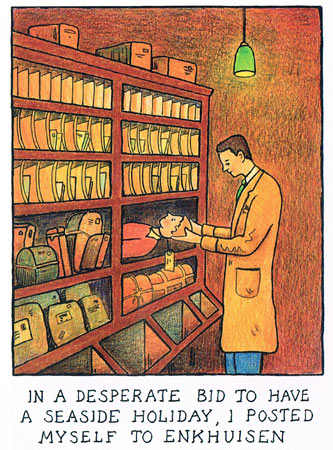
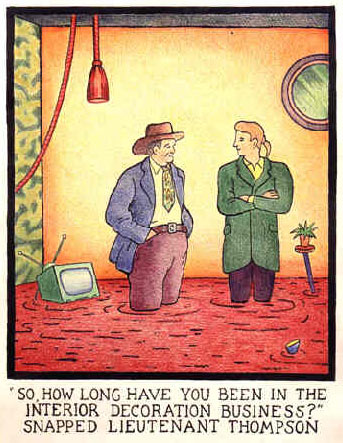
Cartoons by Glen Baxter.
Throughout the decades, Baxter's cartoons ran in the Sunday supplement of The Independent (The Independent on Sunday) and in The Observer. Outside of his home country, they were printed in magazines like Elle, Humo, Le Monde, The New Yorker, Vanity Fair, Variety, Vogue and Vrij Nederland, translated into Dutch, French, German and Finnish. They have been collected in books like 'The Impending Gleam' (1981), 'The Festive Ordeal' (1986), 'Welcome to the Weird World of Glen Baxter' (1989), 'The Billiard Table Murders' (1990), 'The Wonder Book of Sex' (1995), 'Glen Baxter's Gourmet Guide' (1997), 'The Unhinged World of Glen Baxter' (2002) and 'Ominous Stains' (2009), to name a few. His cartoons were also made available on greeting cards, ceramic plates and wristwatches.
Throughout his life, Baxter remained grateful to The Netherlands, the country that practically launched his cartooning career. In 2012, he presented his book 'Colonel Baxter's Dutch Safari' at Gallery Lambiek in Amsterdam, with Dutch comedian Wim de Bie (famous as one half of Van Kooten & De Bie) writing the foreword and giving the book additional promotion. For a while, he was also represented by the Dutch Comic House agency, managed by Hans Buying.
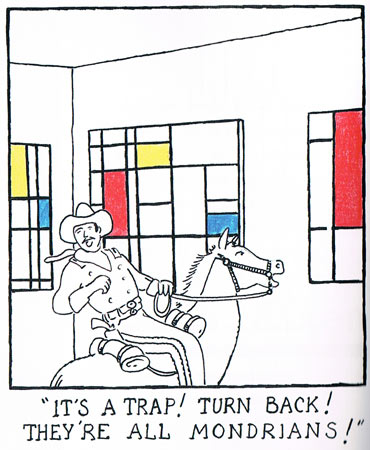
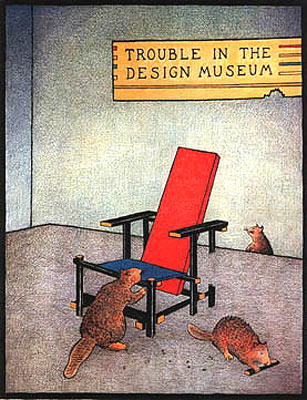
Cartoons by Glen Baxter, referencing the Dutch painter Piet Mondriaan and designer Gerrit Rietveld.
Style
Baxter's drawings are an odd combination of several things the artist held dear. They look like pages from old-fashioned illustrated novels, the ones he and so many other people from his generation grew up with. Many of these stories had stilted narration, with unwieldy, melodramatic sentences. The words were typically far too complicated for the juvenile target audience. Interviewed by Liv Sidall (5 August 2020), he recalled that 'Biggles' author W.E. Johns used words like "reconnaissance", while his characters didn't simply speak, but "opined", "blurted", "squeaked" or "whined". Every few pages in all these old books, a scene from the story received a dramatic or atmospheric illustration, with one intriguing caption printed below. Since these boys' adventure stories were basically pulp, the hired illustrators were often amateurs who treated these tasks as nothing more than a routine job. This led to simple drawings where the characters have expressionless faces, frozen in stiff, unconvincing poses with zero dynamism. But as a child, Baxter was fascinated by this wooden dialogue and crummy artwork. He recalled that paper and ink were so cheap that the colors tended to sink into the paper.
As an adult, he amassed a large collection of these pulp books, using them as reference material. At the academy, he had learned that lithography can create the same "soft graphic look" found in the books from his youth. In his drawings, he mimicked this style with crayon and ink. He also uses archetypes from these mass-produced dime novels, like belligerent boy scouts, cunning detectives, diligent cricketers, foul gangsters, innocent children, wise uncles, brave explorers, dashing knights, elegant swashbucklers and tough cowboys. To Baxter, these characters had universal appeal, since everyone can instantly recognize them. It was a shorthand way to "get into people's minds."

Sequential cartoon by Glen Baxter.
Beyond imitating the tales that mesmerized him in his youth, Baxter added a surreal, pseudo-intellectual atmosphere to his drawings. A huntsman tries to catch two lions in a fishnet. A teenager "supplements" his "meagre earnings" by smuggling tofu. Outlaws gather at night as members of the Jane Austen Society. A man is held hostage and treated on "an evening of my favorite limericks." Cowboys argue whether they have stumbled upon a work by Mark Rothko or hold each other at gunpoint over their use of "iambic pentameters". All these peculiar scenes are accompanied by dry, understated sentences with bombastic verbs ("snapped", "barked", "intoned") and dictionary vernacular ("Jedson was noted for his withering sidelong glances"). Baxter vividly remembered how at his academy abstract art was considered the norm and figurative illustration had no artistic value. His teachers and some of his fellow pupils didn't understand his nostalgia for juvenile pulp. Some lectured him that "cowboy drawings were silly." As an act of revenge, Baxter brought back the paper-and-ink heroes from his childhood, recreating them and only made them even sillier. He also deliberately forced complicated words into his captions to challenge and defy his stammering problem. Interviewed by Liv Sidall (5 August 2020), Baxter said that his mission in life was to "try and bring these words into general usage. Also, as an ex-stammerer, you're kind of reclaiming these words and letting power out of them. Revenge of the stammerer!"

Cartoon by Glen Baxter.
Above all, Baxter wanted to bewilder his audience. His drawings look like out-of-context imagery from non-existing stories, while even the captions appear to be wrong. In his youth, he frequently experienced this feeling of incomprehension personally. He read sentences or saw images he didn't quite understand. In theaters, he sometimes entered the hall where the previous movie was still being screened and so had no clue what was going on. Baxter recalled a moment when he walked in during a screening of the The Marx Brothers film 'A Night in Casablanca', right during a scene where Harpo Marx leans against a wall and is told by a policeman to scram, whereupon the entire building collapses. This gag (thought up by Frank Tashlin) left him completely stupified about what he had just seen. Likewise, Baxter's stammering also confused people, because his sentences sounded unnaturally forced, precisely because he was overthinking them so much.
His work is the sum of all these oddities. A strange clash between campy mass-produced books and references to well-known art, literature or philosophy movements and famous names like Alberto Giacometti, Marcel Proust or Jacques Derrida. On one hand, it's very accessible to read, since it's just one image and one sentence. On the other hand, the intellectual references and high brow language will go over most people's heads. Baxter's work is difficult to define. They are not quite book illustrations, because there is no story to go along with them. For the same reason, one can't call them comics either. Baxter rarely used sequences and none of his interchangeable characters reappear, since there isn't a narrative. Most readers, critics and publishers refer to him as a cartoonist. Indeed, his work follows the same format of a humorous one-panel cartoon. But again, there are no traditional punchlines. Interviewed by Olivia Hingley for It's Nice That (5 December 2024), Baxter elaborated: "(...) I'm totally against any form of pigeonholing, because it stops people from experiencing your art in a direct way. I mean, growing up, I never knew what was fine art and what was 'lower' art, I just thought of it as good or bad. So I didn't have that barrier. That freedom, I really appreciate it, and when people then start putting you into compartments, it kind of destroys your ability to connect on this level."
Foreign audiences often consider Glen Baxter's cartoons to be very British. People in tweed jackets stroll through libraries, play cricket or have polite, formal conversations with each other. There's a certain unease about them, a caricature of the stereotypical "stiff upper lip". His characters want to be taken seriously, but come across as repressed eccentrics. The refined drawings go hand in hand with typically British dry, understated comedy. Sex and violence are sometimes topics in Baxter's drawings, but presented in a chaste, bloodless manner. Ironically enough, Baxter wasn't quite as popular in his home country as abroad.

Cartoon by Glen Baxter.
Since Baxter's work is dry and strange, it often polarizes readers. Some audiences don't always get the "joke", or wonder whether it's supposed to be humorous at all. Others feel the comedy is too subdued, more intended for a gentle chuckle than a bellylaugh. For these same reasons, though, he easily became a cult artist. Baxter is popular with readers who are familiar with the kind of children's books he pastiches. He is also beloved among intellectuals, who appreciate his sophisticated humor and winks to well-known writers, painters and philosophers.
He sometimes nicknamed himself "Colonel Baxter", especially when appearing in public. This is a nod to the 'Biggles' stories he read as a child. In his 2020 interview with Liv Sidall, he recalled that 'Biggles' author W.E. Johns used to call himself "captain" on the back cover of the books, hinting that he too had been a R.A.F. aviator, like his signature character. Even as a child, Baxter saw right through this marketing lie, because the Royal Air Force doesn't even have "captain" as a rank. Therefore, he felt he could easily call himself a colonel too, despite having no military experience.

Sequential cartoon by Glen Baxter.
Graphic and written contributions
In 1974, Baxter exhibited at the Gotham Book Mart Gallery. In 1981, the artist contributed to the anthology '5x5', where among the other notable artists involved was Anthony Earnshaw. In Belgium, Baxter wrote a foreword to Kamagurka and Herr Seele's comic book 'Cowboy Henk in the Benelux' (1989). When Kamagurka and Seele made the absurd comedy sketch TV show 'Lava' (1989), Baxter occasionally had a segment where he recited surreal poems. One of these was also printed in the comic book 'Lava, Volume 4' (1989), presented in the style of a photo comic. In 1999, the French government commissioned Baxter to design a tapestry about Richard I, the "Lionheart", for the National Center of Printed Art in Châlus. Baxter collaborated with poet Clark Coolidge on the book 'Speech With Humans' (2008).
In 2014, he was one of many celebrities who signed a letter to The Guardian to express hope that Scotland would remain part of the United Kingdom after a referendum was held whether they wanted to become independent, or not.

Photo comic with Glen Baxter from 'Lava 4' (1989).
Recognition
In 1980, Glen Baxter's cartoons were exhibited at the London Institute of Contemporary Arts. In 1997, 1999 and 2002, exhibitions were held at the Chris Beetles Gallery, while the Flowers Gallery also displayed his work in 2012, 2015, 2017, 2020, 2022 and 2024. In 2010, his work could be admired at the Galerie Martine et Thibault de la Châtre in Paris and in 2017 at the Isabelle Gounod Gallery in Paris. According to several sources, Glen Baxter was also named a Chevalier dans L'Ordre des Arts et des Lettres in France.


21st-century cartoons by Glen Baxter.
Death, legacy and influence
In 2026, Glen Baxter passed away from carcinomatosis. He was 82 years old. Celebrity fans of his work have been cartoonists Benoît, Tonino Benacquista, Jeroom, Kamagurka, Herr Seele (who made a special tribute painting to commemorate Baxter's passing), Steve Michiels, Brecht Vandenbroucke, TV comedians John Cleese, Phill Jupitus, Wim de Bie (a collector of Baxter originals, who named himself "conservator of the Glen Baxter Museum"), novelist Salman Rushdie (who wrote the foreword to 'Billiard Table Murders') and even Prince Charles (the later Charles III). Edward Gorey once said: "Glen Baxter betrays all the ominous symptoms of genius."
Some Dutch surreal cartoonists whose style can be compared to Glen Baxter are Pieter Hermanides, Mark Smeets and Gummbah.

Glen Baxter signing at Gallery Lambiek on 23 March 2012.