


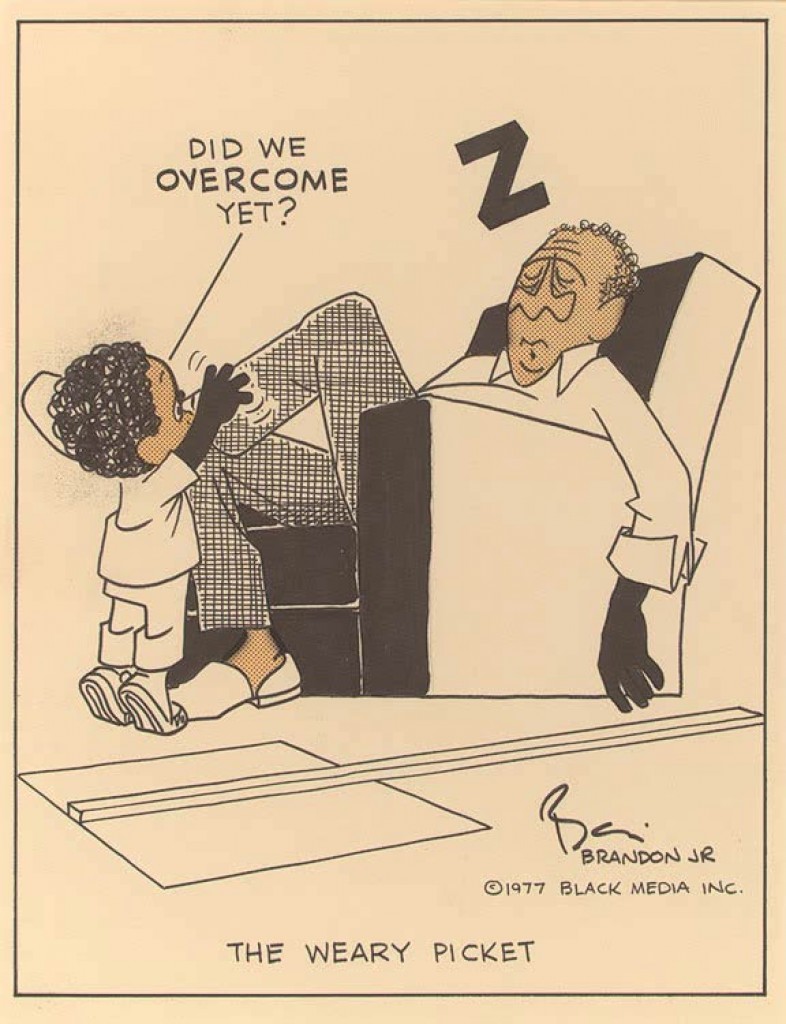
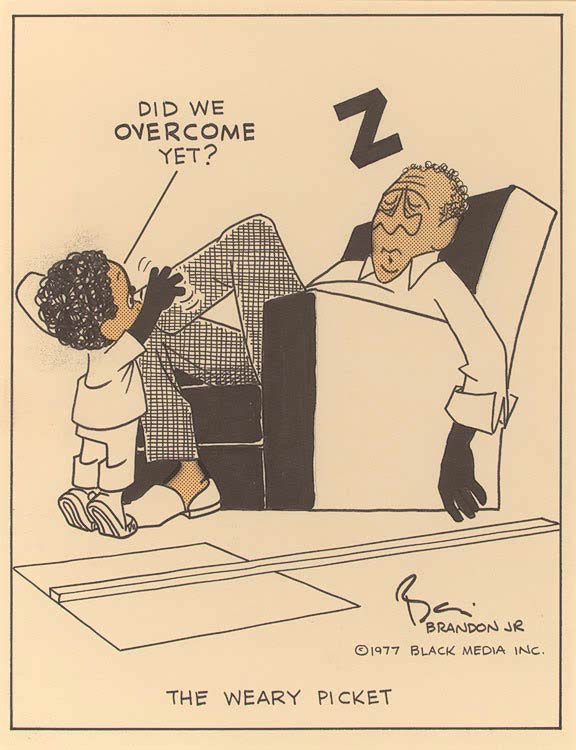
'Luther'.
The African-American cartoonist Brumsic Brandon Jr. was the creator of the long-running satirical newspaper comic 'Luther' (1968-1986). Along with Morrie Turner's 'Wee Pals' (1965), this was the first American newspaper comic starring black protagonists. 'Luther' was notable for its gentle satire of race relations and politics in the United States.
Early life and career
Brumsic Brandon, Jr., was born in 1927 in Washington, D.C., as the second of five children of Washington Union Station porter Brumsic Brandon Sr. and Pearl Brooks Brandon, a homemaker. Both his parents, as well as his high school teacher, encouraged him to further pursue his interest in drawing. In the early 1940s, while still at school, he started submitting comic strip ideas to local newspapers. Later, Brandon attended New York University, where he studied art for a short time. Subsequently, he was drafted into the U.S. Army, and stationed in post-World War II Germany. He climbed up to the rank of sergeant, before returning to civilian life. Back home, Brandon settled on Long Island in New York City and worked various jobs, including as an animator in the studios of RCA and J.R. Bray. His main graphic influence was the African-American cartoonist Oliver Harrington, also known as Ollie Harrington. After Long Island, Brumsic Brandon spent a few years in the Poconos of Pennsylvania, until finally settling in Cocoa Beach, Florida.

The '7 Deadly Sins', drawn by Brumsic Brandon Jr. for Freedomways quarterly #4 of 1972.
In 1945, Brandon saw his first cartoon published. After his military service, he spent most of the 1950s and 1960s combining his day jobs with working the evenings as a newspaper cartoonist and caricaturist. During this period, his work was picked up by multiple African-American media outlets, for instance Black Media and Black Resources, Inc. Between 1963 and 1986, Brandon appeared frequently in Freedomways, an African-American quarterly journal of politics and culture published by the Freedom Movement, which chronicled the civil rights and Black freedom movements. In 1963, the artist compiled 22 of his most socially conscious cartoons into the book 'Some Of My Best Friends' and distributed them personally. Another book collection of his early work was 'Damned If We Do, and Damned If We Don't' (1966), published by the San Jose, California chapter of the Civil Rights organization CORE and the Santa Clara Valley Friends of SNCC. Increasing his notability, the cartoonist even received praise from poet Langston Hughes.

'Luther' (The Tampa Times, 23 June 1976)..
Luther
The 1960s saw an intensification of African-American protests for civil rights, spearheaded by Martin Luther King and Malcolm X. In 1964, black citizens in the United States were finally guaranteed civil rights in the US Constitution. This increased more multicultural diversity in American comics, although mostly in the superhero genre. Morrie Turner was the first who created a U.S. newspaper comic with an all-black cast, but this only found publication in one small newspaper. Eventually, Turner remodeled his characters and added a few white protagonists too, along with children of other ethnicities. This version, renamed 'Wee Pals' (1965) was deemed more acceptable and thus got syndicated more easily. 1968 saw the creation of two other newspaper comics with black protagonists: John Saunders and Al McWilliams' spy series 'Dateline: Danger!' (1968-1974) and afterwards Brumsic Brandon Jr.'s 'Luther' (1968-1986). 'Luther' debuted in the New York newspaper Newsday, distributed on Long Island and syndicated through Newsday Specials. Two years later, when Times Mirror purchased Newsday, 'Luther' got a nation-wide syndication through the Los Angeles Times Syndicate.
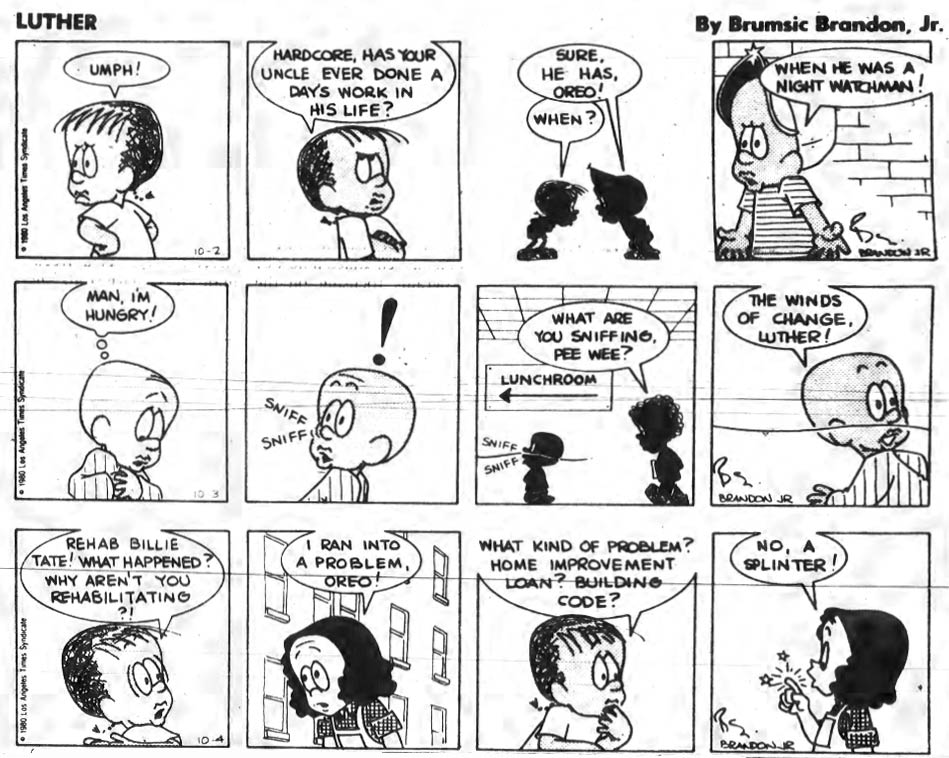
'Luther'.
The 'Luther' strip revolved around a group of small children. Luther is a bright, slightly sarcastic black boy. His best friends are Hardcore, little Pee Wee, Mary Frances and Oreo and the white girl Lily. Luther's name was a tribute to Dr. Martin Luther King, who was assassinated the same year the comic debuted. Hardcore owes his name to the term "hardcore unemployed", while Oreo is slang for people who act "black" on the outside, but "white" on the inside. The kids live in a typical US urban working class neighborhood. Much like Morrie Turner's 'Wee Pals', the feature has a satirical undertone and features striking social commentary about racism and multiculturalism. In one episode, Hardcore is late for school, but it turns out he was stopped in the street by a white cop. While critiqueing white racism, usually through the invisible character of the kids' third-grade teacher Miss Backlash, Brandon also addresses discrimination of whites by blacks and prejudice within black communities themselves.
By using a children's point of view, Brandon Jr. avoided coming across as heavy-handed, much in the tradition of Charles M. Schulz' 'Peanuts'. The cartoonist was determined to "tell it like it is", and through child protagonists he could keep his messages simple and gentle. Beyond the political-social commentary, 'Luther' also addressed more universal human drama like trying to survive in a tough world. In one gag, Luther notices his shabby apartment has a hole in the ceiling and mutters sarcastically: "Open housing". While Brandon predictably received angry readers' letters from bigots and racists, he also got a praising letter from US President Gerald Ford, who told him he liked 'Luther'.
Social consciousness
Brandon Jr. didn't keep his socially conscious messages restricted to his pencil and paper. He joined a protest against segregation of the Westbury School District, which eventually led to the schools becoming integrated. In 1967, he also made a board game, 'Cullud' (a slang pronunciation of "Colored"), which, in a parody of Monopoly, shows the many ways how you can't make it in society. A throw of the dice may land you on "Dropout (Go back to school)" or "Urban Renewal (Prepare to get out)". Both a "Riot" and "Non-Violent Protest" have the same outcome: "Go To The Hospital". The game came with set pieces like a beer stein, a wine bottle and a switchblade. 'Cullud' was distributed exclusively through Freedomways magazine, for which Brandon was acartoonist.
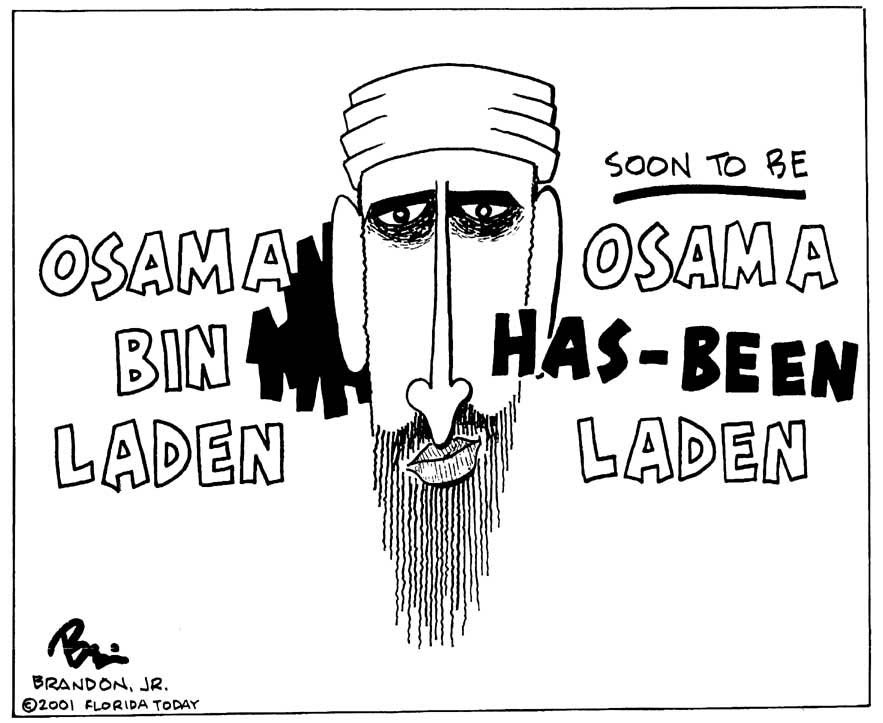
Political cartoon by Brumsic Brandon, 2001, depicting Osama Bin Laden.
Final years and death
Between 1970 and 1972, Brandon appeared regulary on the local New York children's TV show 'Joya's Fun School' (1970-1982), hosted by jazz singer Joya Sherrill, who used to perform with Duke Ellington's band. In the show, Brandon gave young viewers drawing lessons and provided animated sequences. He also had a puppet character, Seymour the Bookworm, which he designed and operated himself. After retiring 'Luther' in 1986, Brumsic Brandon kept creating political cartoons and columns to the newspaper Florida Today in his hometown Cocoa Beach, until Parkinson's disease forced him to put down his pencil permanently. The pioneering cartoonist passed away in 2014.
Family
Brumsic Brandon and his wife Rita were together for 64 years, and had three children, Barbara, Linda, and Brumsic III. In the late 1970s and 1980s, Barbara Brandon assisted her father a couple of times with his 'Luther' comic. Between 1989 and 2004, she had her own syndicated newspaper strip, 'Where I'm Coming From'. Interviewed in Rolling Out (28 April 2025), she recalled that her father always worked in the dining room, where she would watch him working every day.
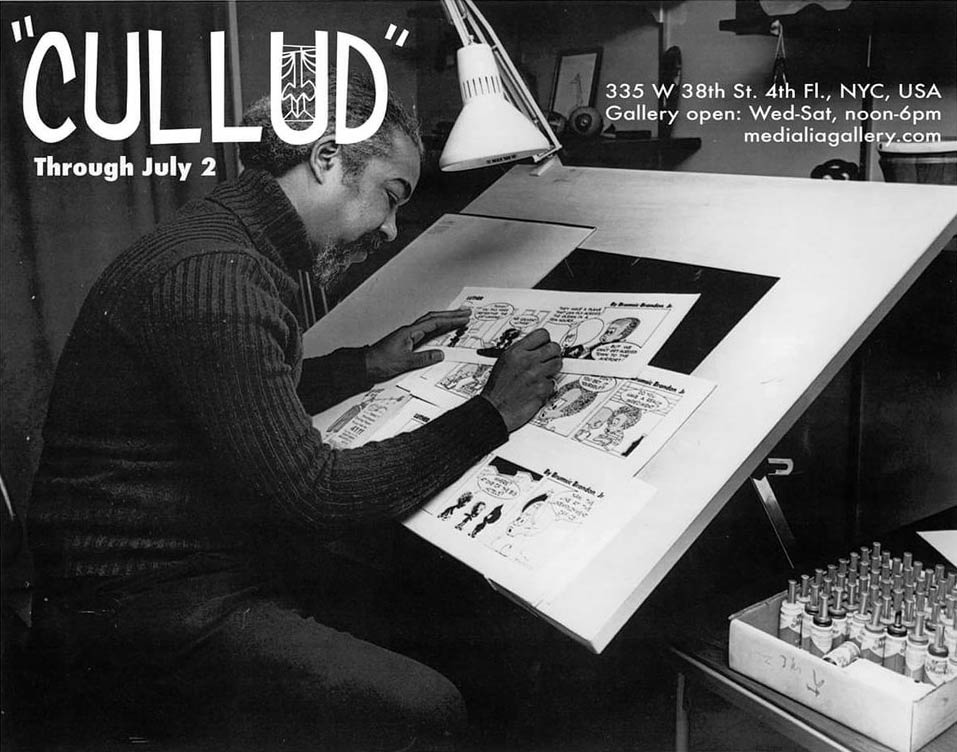
An exhibition of work by Brumsic and Barbara Brandon called 'Cullud' was held at the Medialia Gallery in New York in 2016. A second exhibition followed in 2017 under the name 'Soul'.