



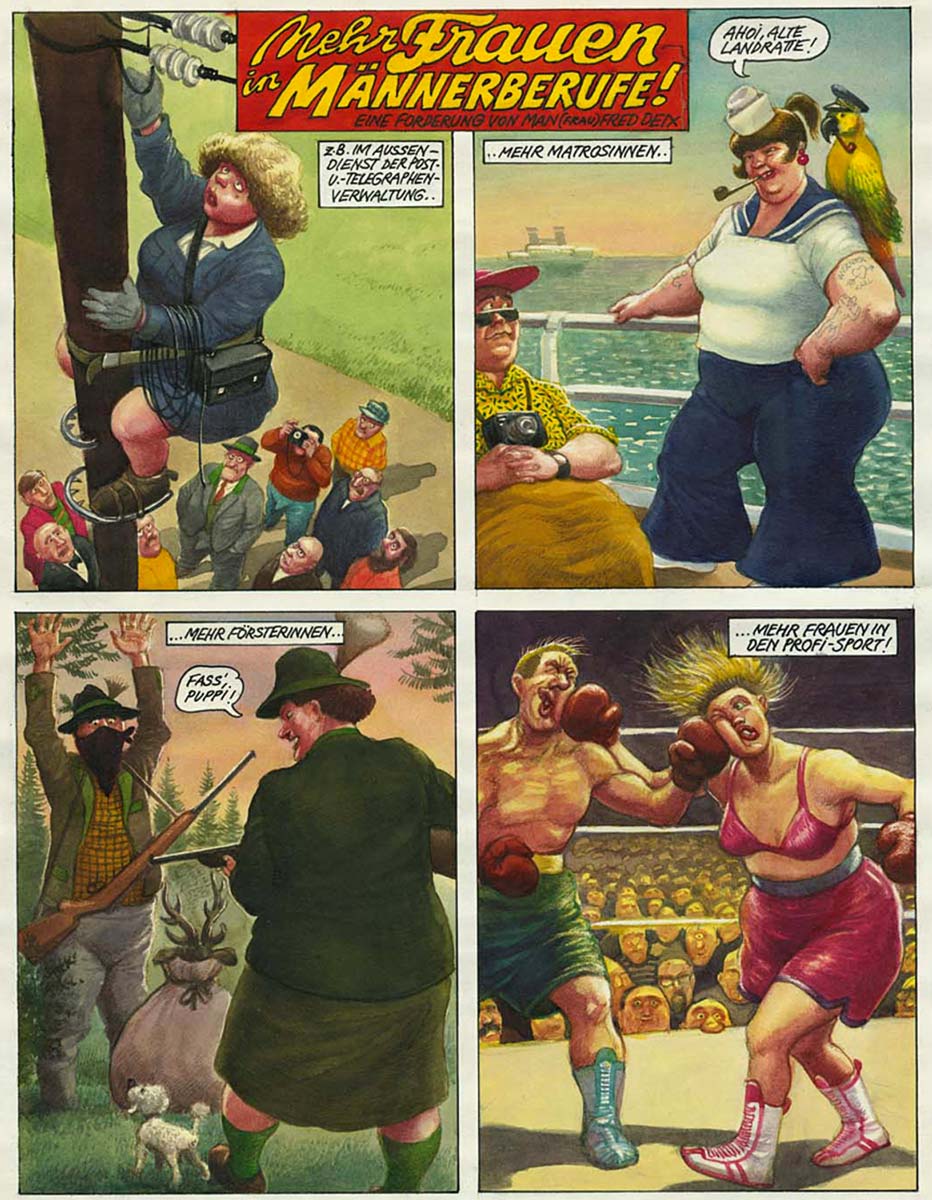
Manfred Deix cartoon from the 1980s. Translation: "More women in male professions!"
Manfred Deix was an Austrian caricaturist, illustrator, painter, editorial cartoonist and musician. His instantly recognizable style is characterized by gorgeously rendered watercolor illustrations, portraying chubby people with grotesque physical features. A masterful and vicious satirist, Deix's cartoons commented on real-life Austrian and international politicians, but also on more general portrayals of the ills of modern-day society. In his home country, his name even spawned an eponym ("Deixfigure") for people who look like his drawings. Deix's uncompromising and unflattering caricatures have often repulsed and outraged readers. Several times throughout his career, he was sued for defamation and blasphemy. He received death threats and was subject of protest letters and attempts to ban him. But simultaneously, he also gained a strong cult following and won various awards. One of his final projects was an animated feature film, partially based on his youth, presented in his familiar style. It was posthumously released as 'Rotzbub' (2021), becoming the first Austrian-made feature-length animated film.
Early life and career
Manfred Deix was born in 1949 in the Lower Austrian town of St. Pölten, as the second child of Johanna and Franz Deix. His father had lost an arm fighting in Russia during his military service in World War II. Originally a grocerer, he now ran an inn in Böheimkirchen, named "Zur blauen Weintraube". In this tavern, Deix witnessed sleazy barhoppers, pathetic drunks and itchy imbeciles who got aggressive under the influence of liquor. Even the village priest got drunk and enjoyed pinching the waitresses' buttocks on the sly. Whenever somebody had to babysit little Manfred, his parents brought them to their neighbors, a lesbian couple. Still, most people in his neighborhood were conservative and conventional Roman Catholics, some of whom hadn't fully given up their Nazi sympathies from the previous war. Several war veterans were invalid too. Growing up among such colorful, eccentric people influenced Deix' worldview and gift for observational comedy. Deix' brother Christian Deix (1964) also gained fame in adulthood as a musician.
While his parents hoped that their son would take over their inn, Deix was more interested in cartooning. At age nine, he already constructed an erotic flip book featuring 100 drawings of a woman undressing. He also sold nude drawings like these to his schoolmates. Ironically, none other than his Religion teacher helped him publish his first comic strip in the Roman Catholic weekly Niederösterreichischen Kirchenzeitung: 'Unter der Sonne Afrikas' ("Under the African Sun"). Deix was 11 at the time. The plot was based on a girl scout novel about a group of explorers who save an Arab boy from a group of Tuaregs, whereupon the kid predictably decides to become a Roman Catholic Priest. Interviewed by Peter Pisa for Kurier (12 November 2012), Deix later dismissed this deadly serious, preachy and moralistic text comic as "incredibly dull" and suggested that he only got the job because his religion teacher was a "closet pedophile who liked him, but suppressed his sexual urges".
In 1965, Deix enrolled at the Federal Graphic Education and Research Institute in Vienna, along with his friends Bernhard Paul, Josef Bramer and Gottfried Helnwein. Since they skipped so many lessons, they were kicked out after two and a half years. Deix continued his studies at the Akademie der Bildenden Künste Wien at Schillerplatz in Vienna, which he also left in 1975 after 14 unsuccessful semesters. His only motivation to be at the Academy was avoiding the military draft. His main graphic influences were Carl Barks, Wilhelm Busch, Robert Crumb and Erich Sokol.

Cartoon by Manfred Deix. Caption: "Horrifying: 2012 was the year of hunting accidents, when several hunters confused one another with wild."
Cartooning career
By 1972, Deix was publishing his first professional work in magazines like Profil, Trend and Economy. In November and December 1973, he adapted Wolfgang Kudrnofsky's novel 'Klappe, Mr. President' into a comic strip, serialized in Neue Freie Presse. He also made cover drawings for Stern, Der Spiegel, Pardon, Tempo, Titanic, Die Zeit, Charlie Hebdo and Playboy. Between 1991 and 1995, Deix appeared in Krone. From 1992 until March 2015, Deix had a weekly cartoon in the news magazine News. In 1980, his first book 'Cartoons von Manfred Deix' was published. Several collections followed, such as 'Cartoons de Luxe' (1983), 'Satiren aus Wien' (1985), 'Mein Tagebuch' (1986), 'Der dicke Deix' (2004) and 'Der heilige Deix' (2013). In 1994, his work was also released on CD-ROM.
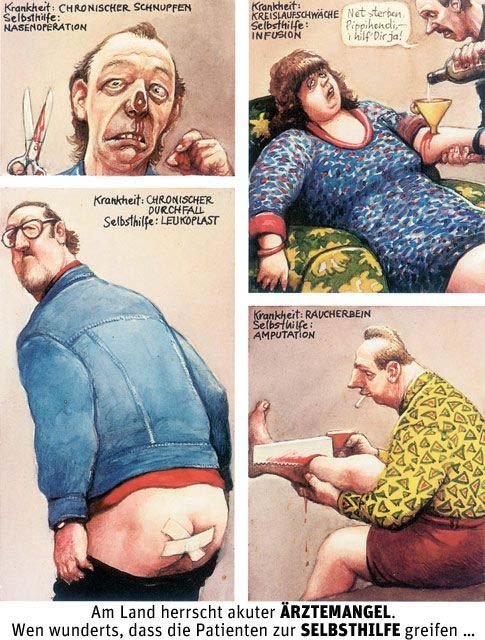
Cartoons by Manfred Dix. Translation: "There has been an accute shortage of doctors for a while. Unsurprisingly, patients resort to self-remedy."
Style
Manfred Deix made cartoons with gentle watercolors. He presented them in the style of children's picture stories, complete with rhyming sentences below the images (much like a text comic) and certain nouns printed in bold font type. However, the content is anything but child friendly. Many feature vicious satire, bloody violence, icky obscenity and other vulgarities. Most of his cartoons lampoon common people. While rooted in Austrian culture, they are equally universally recognizable human archetypes. He drew his characters with corpulent, flabby, pear-shaped bodies. In the German language, it spawned an eponym, "Deixfigur" ("Deix figure") to refer to people who look like they rolled from under his pencil. The term was even included in the German dictionary. It amused Deix that people often told him that "my neighbor looks just like one of your characters", all while not realizing how much they resembled one themselves. Stylistically, Deix' illustrations were often confused with fellow cartoonist Gerhard Haderer. Interviewed by Profil in 2009, Deix said that he therefore added a little crown on top of the "i" whenever he signed his art, to give more visual clarification that he drew it.

Cartoon by Manfred Deix. Translation: "Even in the Vatican one knows: the celibate is to blame for the lack of priests. So bring on the marriage and the women, before it's too late."
Deix's characters are depicted with booze-induced red cheeks, big noses, dumbo ears, protruding chins and teeth, saggy body parts, flabby breasts, beer bellies and warts, zits, wounds, ulcers and ejaculation stains. To push the ickyness, Deix also portrayed these lowlifes guzzling down booze, smoking like chimneys, stuffing themselves with junk food, masturbating, having sex, going to the toilet, throwing up, or getting severely wounded. These pathetic nincompoops are caricatured as sun-burnt beachgoers, mindless consumers, passive TV watchers, narrow-minded racists, gullible churchgoers, corrupt businesspeople, oafish police officers, sleazy porn addicts and fetishists and so on. A veritable gallery of grotesqueries, showing (Austrian) society at its least flattering... and most laughable.
Apart from the "man/woman in the street", Deix also drew more political-social cartoons, pointing his arrows at Austrian and international politicians. He also enjoyed mocking media celebrities, like Arnold Schwarzenegger. He additionally made equally offensive "realistic" portrayals of famous comic characters. Albert Uderzo's Obélix, for instance, was shown reading a porn magazine in the woods, while bloated teenage versions of Disney's Huey, Dewey and Louie confront their uncle Donald Duck.

Manfred Deix spoofing Donald Duck.
Controversy
Over the years, Deix' cartoons offended countless people. The satire itself was enough to set readers off, but the unflattering, naturalistic, flesh-colored aquarel drawings, complete with scenes of sex and gruesome violence, also repulsed many. In some magazines, disgusted and outraged readers instantly canceled their subscriptions. Others threatened Deix by phone, send him turds in his mailbox, or cut his car tires. Chief editor Hans Dichand of the Kronen Zeitung once fired him over a cartoon many readers considered blasphemous, but, as Deix added wrily, "...also because I wasn't punctual with my deadlines". Deix was sued at least six times. In 1994, for instance, over a cartoon ridiculing Jesus as a flirtatious, weepy individual, which led to a sentence for blasphemy, though he won his case in appeal. On 11 December 2009, three Catholic clerics in Vienna sued him again for two cartoons on the website NEWS.at, which satirized the prohibition against crucifixes in schools and depicted God.

Satirical comic made on the occasion of the 100th anniversary of Adolf Hitler's birthday (1989).
Deix frequently targeted real-life Austrian politicians, like the former Nazi Kurt Waldheim, who later became post-war President of Austria and secretary-general of the United Nations. Waldheim had lied about his membership of the S.A., later claiming he just had a "desk job", but was still able to remain in power. On 11 March 1986, Austrian Chancellor Fred Sinowatz said that Waldheim "hadn't been an official member of the S.A. cavalery, but his horse was." This led to Deix drawing a caricature of Waldheim in Nazi uniform, seated on a horse, telling the animal: "It's your fault if I later get in trouble, stupid asshole!" The cartoon caused colossal controversy, but also expanded Deix' international fame through reprints in many foreign media.

Jörg Haider cartoon by Manfred Deix, spoofing 'Little Red Riding Hood'. The caption reads: "F chef Jörg Haider has recently discovered his heart for the workman." The common worker asks: "Grandmother, why do you have such a 'worker friendly face'?" - Haider replies: "So that you can pick me out better, you moron!"
Another recurring target was far-right politician Jörg Haider (FPÖ). Deix had followed his career ever since Haider became a rising force within the FPÖ party in the 1970s, eventually gaining international notoriety in 2000, when the Austrian conversative party ÖVP formed a coalition government with the FPÖ, marking the first time since World War II that a far-right party was included in a European government. Haider felt deeply offended by Deix's cartoons and registered several complaints against his work. Other famous Austrians who vocally expressed their disgust over Deix's work were chancellor Bruno Kreisky, comedian Helmut Qualtinger (Remigio the bearded monk in 'The Name of the Rose', 1986) and writers Thomas Bernhard (of 'Correction' fame) and Elfriede Jelinek (of 'The Piano Teacher' fame).
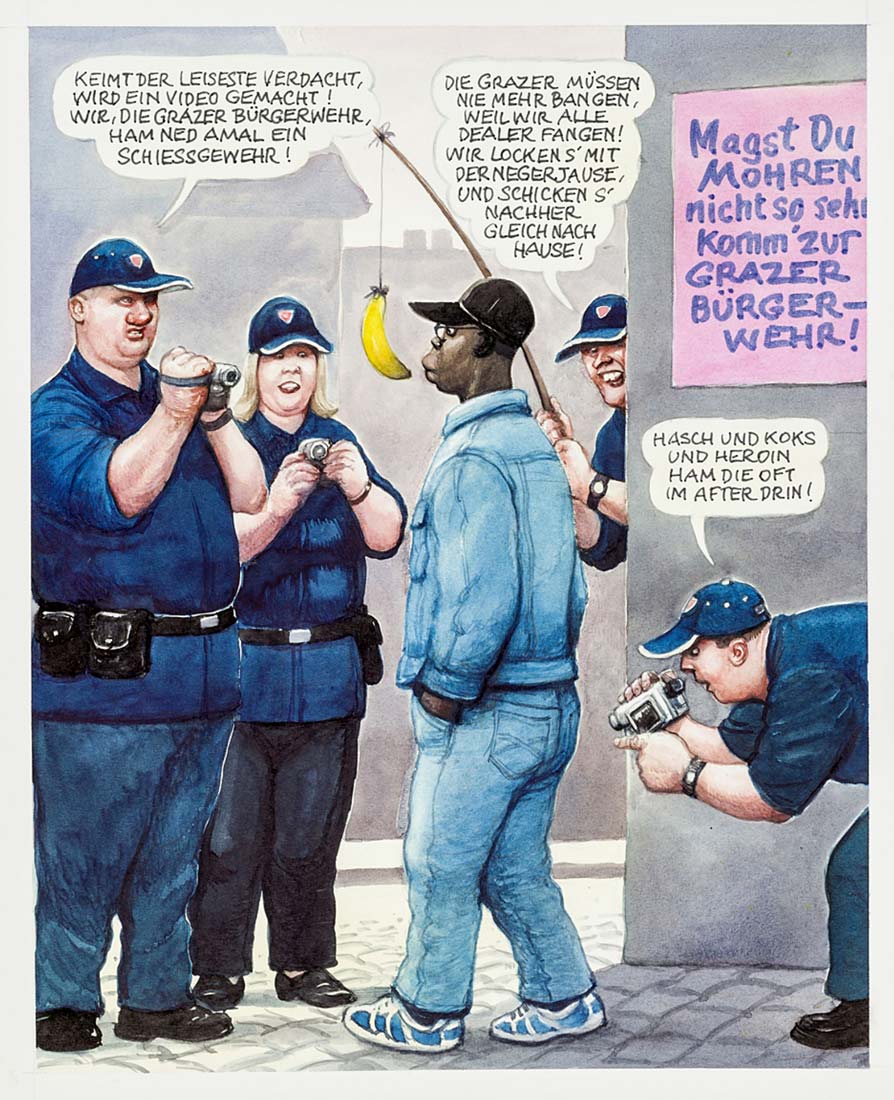
'Grazer Bürgerwehr', 2002. The police officers try to "catch" a drug dealer by using "a black man" as bait. To lure the bewildered passerby, they use a banana.
Graphic contributions
In 1987, Manfred Deix designed theater sets for the Bertolt Brecht play 'Arturo Ui', produced by the Viennese Burgtheater. That same year, he designed the facade of the Wind Palace at the Luna Luna theme park in Hamburg for multimedia artists André Heller and Walter Navratil. This latter attraction featured farcical drawings of people farting. To "heighten" the experience, Deix had a group of performers provide trumpet sounds and people imitating fart sounds into microphones to match his illustrations. To give the event a little class, a quote by Wolfgang Amadeus Mozart was printed on the walls, since the composer of 'Eine Kleine Nachtmusik' also loved toilet humor.
Deix also made masks for a 1990 performance of the Ernst Krenek satirical opera 'Kehraus um St. Stephan'. Between 2009 and 2010, he used his graphic talent to promote the animal welfare movement and Animal Rights Party. The lifelong chain smoker also saw no qualms in drawing ads for cigarette brand Casablanca.
Deix was a huge fan of The Beach Boys. The only time he ever traveled outside Austria was in 1984, to go to California, where he personally met the band. During a trip to Las Vegas that same vacation, he married his wife. In 1995, Deix covered some Beach Boys songs with his "Good Vibrations Band", albeit sung in Viennese dialect, and released them on the album 'Musik Aus America' (1995), for which he also illustrated the cover. Some were sung in duet with Austrian comedian Lukas Resetarits. During the Donauinselfest in Vienna (1999), Deix sang three songs on stage with The Beach Boys.

Manfred Deix's Beach Boys cover album.
Recognition
Deix received many awards throughout his career. The city of Vienna bestowed him with the Johann Nestroy Ring (1988) and Golden Medal of Merit (2005). The city of Kosterneuburg honored him with a Kulturpreis (2000), while the German province of Niederösterreich (Lower Austria) gave him the Golden Medal of Merit (2009). He also received the Swiss Golden Press Award (1997). In 1987, the Hamburg Fachhochschule für Gestaltung offered him a teaching position, but he did not take it. In 2009, the Austrian authorities (the province of Lower Austria) bestowed him with the honorary professional title "Professor". In 2012, Deix won the Österreichischer Kabarettpreis (Austrian Cabaret Award).
In 1986, Manfred Deix's cartoons were exhibited at the Gallery at the Berlin Chamissoplatz. In Vienna, they were on display in the Palffy Palace (1988), and in the City Museum of Heilbronn they could be seen during a 1990 expo. In 1991, Deix was subject of three exhibitions, held in the Wilhelm Busch Museum in Hannover, the Museum of Art & Industry in Hamburg and the City Museum of Ludwigshafen. In 2000, the 'Good Vibrations' expo was held at the Kunsthaus in Vienna. Deix' art was also on display in the Kunsthaus Köflach (2003), the Historical Museum of Frankfurt am Main (2004), the Wilhelm Busch Museum in Hannover (2007) and Ludwig Galerie Schloss in Oberhausen (2008). Between 21 February and 24 November 2017, the Kunstkammer Würth organized another exhibition dedicated to his work. Other posthumous exhibitions have been held in Castle Tabor (16 September - 22 February 2024).
Since 2001, Deix' work has been part of a permanent exhibition in the Caricature Museum in Krems. Over the years, they have organized several thematic expos based on his work. Near the museum, there is also a bronze sculpture of a typical Deix character.
Final years and death
For most of his life, Manfred Deix lived near Vienna with his wife and about 80 cats. His daily activities consisted of "drawing, smoking and boozing". In 1988, he had to be hospitalized because of a pulmonary emobilism. He moved to Klosterneuburg-Weidling, but didn't give up his unhealthy habits. In 1995, he collapsed again. In 2014, he suffered from a pulmonary infarction, which motivated him to quit smoking in favor of the e-cigarette. Despite everything, he never considered retirement. Interviewed for Profil by Wolfgang Paterno (16 February 2009), Deix explained that he was a compulsive artist and compared himself with rock musician Chuck Berry: "Chuck Berry is now 83 and still touring. He plays inferior, but his artistic urge to communicate is still intact."
On 25 June 2016, Manfred Deix passed away in Weidling from lung cancer. He was 67 years old. Some people shed crocodile tears over his death. Far-right politician Johann Gudenus (FPÖ) pretended to pay tribute to Deix on his Facebook profile, but mistakeningly used a caricature drawn by Gerhard Haderer. Many people were amused by this blunder, including TV host Armin Wolf, who satirically wrote "R.I.P. Manfred Deix" on his Twitter account, while using an image from Pablo Picasso's 'Guernica'. Deix is buried at the Wiener Zentralfriedhof cemetery. A sculpture of a cat with crown and royal robe has been erected on his tombstone.

From: 'Rotzbub'. The young protagonist with his parents.
Rotzbub
One of the final projects Manfred Deix had worked on before his death was the animated feature film 'Rotzbub', which was released in 2021. The film was a co-production of the Aichholzer Filmproduktion GmbH and the German Filmbüro Münchner Freiheit GmbH, and directed by Marcus H. Rosenmüller and Santiago López Jover. Loosely autobiographical, the plot revolves around a young teenager growing up in early 1960s Austria, more specifically the fictional town of Siegheilkirche, a place filled with sexual hypocrisy, Roman Catholic dogma and slumbering sympathies for Austria's Nazi past. The boy uses his graphic talent to liberate himself from his suffocating environment, while simultaneously finding his sexual awakening. All characters are animated in CGI, with the caricatural, flesh-colored graphics complimenting Deix' trademark graphic style. The protagonist's love interest of Roma descent, Mariolina, was deliberately modelled after Deix' own wife, Marietta.
Due to the COVID-19 pandemic, the release of 'Rotzbub' had to be delayed for a few months, since Austria was still under lockdown. The film eventually premiered in Annecy, France, during their annual film festival in June 2021, not receiving a full release in Austria until 24 March 2022. 'Rotzbub' did well at the box office, bringing more than 95,000 people to theaters. The picture also received excellent reviews and the Österreichischer Filmpreis (Austrian Film Award) for "Most Popular Theatrical Release".

From: 'Rotzbub', depicting Trude, the local loose woman.
Legacy and influence
Manfred Deix' work was admired by artist and painter Gottfried Heinwein, comedian Lukas Resetarits, circus director Bernhard Paul (who all three attended his funeral), Dutch cartoonist Willem, German cartoonist Gerhard Haderer, rock singer Bono (U2) and film director Billy Wilder ('Sunset Boulevard', 'Some Like It Hot'). Wilder once phoned Deix at three o'clock in the night, all the way from Hollywood, to ask him to buy an original drawing. The cineast also wrote the foreword for the fifth volume of Deix' cartoons, 'Augenschmaus'. Wilder said: "Deix makes neither lazy jokes nor simple cartoons. Deix comments on the human condition, and does so in a caustic way that hasn't been seen since Karl Kraus. His themes are that nauseating complacency that pretends nothing ever happens anyway, and the arrogance that proclaims that the waltz, the Gugelhupf cake, and the hand kiss were conjured up out of thin air, and that the Danube is as blue as ever."
The German TV host/entertainer Thomas Gottschalk wrote a preface to Deix' 'Der Männer-Report' (1991). Interviewed in 1993, U2 singer Bono compared his band's lyrics with the visual language of Deix' drawings. Other notable friends were politician Erwin Pröll and Formula 1 racer Niki Lauda.
Documentaries about Deix
For those interested in Deix' life and art, Peter Hajek's documentary, 'Küß die Hand, Österreich - Manfred Deix und seine Bilder' (1987), produced by ORF and ZDF, is highly recommended.

Self-portrait.