


'Manners at the Modern Dance' (31 January 1923). Haselden's lament that "the youth of today" just hangs around, smoking cigarettes.
W.K. Haselden was an early 20th-century British political cartoonist, illustrator, poster artist and comic artist, who published in The Daily Mirror and Punch. He is one of the artists credited as the father of the British newspaper comic. While Haselden made one-panel cartoons, he gradually put more emphasis on a comic strip format to provide his satirical social commentary. A prime example was his propaganda comic 'The Sad Experiences of Big Little Willie' (1914-1918), which ridiculed German emperor Wilhelm II and his son during the First World War. Many of Haselden's cartoons are an interesting time capsule on how people at the time reacted to specific historical events and societal changes, like the First World War, the influenza pandemic and women's right to vote. In the Internet Age, one particular 1919 comic by Haselden, 'The Pocket Telephone: When It Will Ring', has achieved notability for "predicting" the invention of the cell phone, almost half a century before the first prototype was realized.
Early life
William Kerridge Haselden was born in 1872 in Seville, Spain, where his British parents had met. His father Adolphe Henry Haselden was a civil engineer and head of the Seville Gasworks, but passed away in July 1878 from pneumonia during a holiday trip to their home country. Haselden was five years old at the time. Haselden's mother decided to stay with her five children in the United Kingdom, settling in Hampstead. For a while, they could live off family investments in mining, until they sold them in 1888. Although the boy studied at a private school in St. John's Wood, financial problems forced him to leave school at age 16 and get a job to support the family. Through a family friend, he was able to work as an underwriter at the insurance market Lloyd's in London. He despised this boring paperwork to the core, doodling away on the blotting paper.

Early cartoon for The Daily Mirror (1904).
Cartooning career
In 1902, W.K. Haselden's cartoons were accepted in the newspaper The Sovereign. He was hired as their political cartoonist, while also making drawings of theatrical stars for their review column. Unfortunately, the paper folded in April 1903, but he continued to publish his cartoons freelance in The Tatler and St. James' Gazette. To his luck, publisher Alfred Harmsworth had just launched a new newspaper, The Daily Mirror, and desperately wanted to boost sales. That same year, Haselden walked into the office of the paper's illustrated supplement with a portfolio of sample cartoons under his arm. The editor was so impressed that he published one the very next day, 'Only Waiting for the Torch'. From January 1904 until 1940, Haselden remained the Daily Mirror's house cartoonist. Between 1906 and September 1936, Haselden was also a regular in the satirical magazine Punch, where he made caricatures of theatrical actors and stage shows to liven up critical reviews.
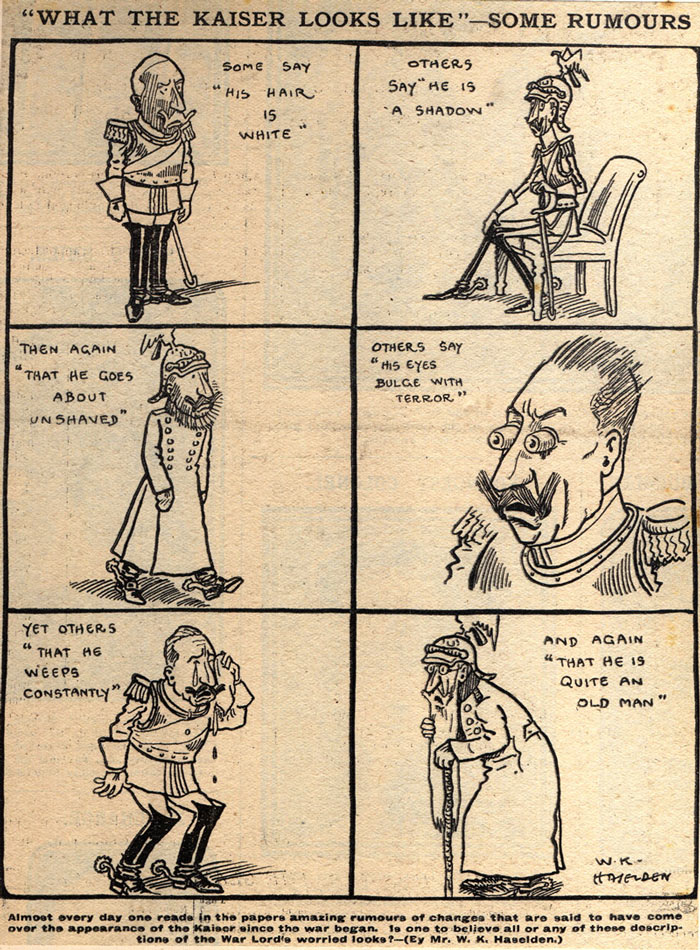
World War I comic strip by Haselden mocking German emperor Wilhelm II, A.K.A. 'The Kaiser'.
During his first three years at The Daily Mirror, Haselden drew the same kind of cartoons he had made for The Sovereign, namely about politics and illustrations of theatrical reviews. In line with his paper's ideology, he was politically conservative, supporting the monarchy, colonialism and the army. From 1906 on, when he shifted focus towards satire of everyday society, he stayed away from politics. Another topic he considered taboo was religion. Until the 1930s, his cartoons and comics provided a satirical look at the changing times. During the First World War, for instance, he commented on women doing men's jobs while their husbands were at the front, imagining what it would be if men suddenly did women's jobs. In 1918, he commented on the lockdown measures during the influenza pandemic. He was opposed to the suffragette movement and Emmeline and Christabel Pankhurst's demands for women's right to vote. He looked with scorn and ridicule at modern art movements. In one 1912 comic, he suggested "staring at the sun, getting blown between the eyes and standing on your head, painting left-handed" in order to paint a Futurist picture. Haselden also mocked the latest fashions and the behavior of young adults during the 'Roaring Twenties'.

'How to avoid Spanish influenza'.
Many of Haselden's cartoons and comics were churned out right before their deadline. Whenever he lacked inspiration, he went to the London Underground to "sit in a cold, horrid, dirty little dark room, and its gloomy surroundings come inspirations because I feel that I cannot sit there any longer than necessary." He kept the paper's sales high, as many readers bought a copy to laugh at his latest satirical reflections. From 1909 on, his drawings were collected in 29 compilation books, under the title 'Daily Mirror Reflections'.
A testament to Haselden's popularity at the time was the fact that in 1906 he had an affair with Eleanor Fyfe, the wife of his paper editor, Hamilton Fyfe, without getting fired or causing a scandal. Instead, Fyfe quietly divorced, left the paper, while she remarried to Haselden. The entire affair and divorce were hidden away from the public, very likely thanks to publisher Harmsworth's influence.

'Small Talk vs. Large Hats' (The Daily Mirror, 1910).
Comics innovation
While Haselden started out as a traditional one-panel editorial cartoonist, he gradually moved away from this format. From 1906 on and permanently from October 1907 on, he presented his political-social commentary in a multiple-panel format, while his characters used speech balloons. It allowed him to discuss current events and societal trends in humorous stand-alone scenes and comical narratives. This held readers' attention far better and longer than a single drawing. It also helped Haselden convey more than one comical idea. The innovation quickly caught on and Haselden made these kinds of satirical comics for the rest of his career.
Because of this innovation, comic historians have credited Haselden as the true father of the modern-day British newspaper comic. More and more papers in the United Kingdom started offering room for similar comic strip-like editorial cartoons, or comics in general.

'The Sad Adventures of Big and Little Willie' (7 October 1914), ridiculing German emperor Wilhelm II, A.K.A. 'Der Kaiser', and crown prince Wilhelm.
The Sad Adventures of Big and Little Willie
In 1914, the First World War broke out. The United Kingdom fought the war overseas in Belgium and France, while their navy and air forces kept German invading forces at a distance. Haselden joined the British propaganda press by launching a patriotic comic strip, 'The Sad Adventures of Big and Little Willie' (August 1914-1917), which lampooned German emperor Wilhelm II, nicknamed "Der Kaiser", and his son, crown prince Wilhelm. Gag after gag, the two politicians were portrayed as a bumbling duo, constantly humiliated by the mighty British army. By reducing the enemy to pathetic losers, Haselden stirred up his people's patriotism, while giving hope for victory.

'The Sad Adventures of Big and Little Willie' (1915), ridiculing German emperor Wilhelm II, A.K.A. 'Der Kaiser', and crown prince Wilhelm.
In early 1915, episodes were bundled in book format, 'The Sad Adventures of Big and Little Willie', published by the Fine Art Society and Chatto & Windus in London. According to the foreword in the book: "In common also with the great captains of caricature, Mr. Haselden never allows his satire to degenerate into venom, as witness the report that when one of these 'Willie' cartoons was passed the other day from ours into the German trenches it was hailed with uproarious laughter."
At the time, the comic was so well-known among English readers that when the British army introduced their prototype for what later became known as a "tank", they nicknamed it "Little Willie". In 1918, when the First World War came to an end and Germany was defeated, Wilhelm II abdicated and went into exile in The Netherlands. In one of his rare personal revelations, he said he was familiar with Haselden's comic strip and remarked that it had caused "irreparable damage" to his public image.
After 1915, Haselden created various fictional characters to support the British war effort, like the stuffy Colonel Dug-Out, fashion-savvy flapper Joy Flapperton and Burlington Bertie, but none really caught on. It seems that readers could relate more to real-life enemies being ridiculed than fictional creations.

'The Sad Adventures of Big and Little Willie' (January 1915), ridiculing German emperor Wilhelm II, A.K.A. 'Der Kaiser', and crown prince Wilhelm.
The "cell phone prediction" cartoon
On 5 March 1919, Haselden fantasized in one of his comics about a "pocket telephone". The comic in question, 'The Pocket Telephone: When Will It Ring?', reflected on a then-new phenomenon. Telephones were already commonplace in society since their 1876 patent. But owners still had to stay at home to receive their call, since each phone needed a wire and an electric socket. In 1919, the earliest "pocket telephones" were introduced, though not in the way we know them today. Owners had to carry their own wired phone and battery with them, so they could plug this object into a socket, if possible. Highly impractical, the invention never quite caught on. Haselden therefore found it fitting to visualize what a nuisance it would be if it actually became more efficient. He predicted that this "modern horror" would start ringing at inappropriate places, like inside a streetcar, at a concert or during a marriage ceremony, much to people's embarrassment and annoyance, including the actual owners.

'The Pocket Telephone: When Will It Ring?' (5 March 1919).
The cartoonist never lived to see this technological nightmare become reality. 70 years later after the creation of this cartoon, in 1979, the first cell phones were introduced. At the time, these wireless phones were still huge and so expensive that they were limited to only the wealthiest people. By the mid-1990s, they were reduced in size and became available for the general public, eventually forcing traditional wire-phones out of business. In the Internet Age, Haselden's cartoon was rediscovered and quickly shared by many people who were astounded by its foresightedness, especially about the fact that noisy cell phones indeed disrupt other people's quest for peace and quietness. One of the people who shared the comic on social media was the Indian politician Shashi Tharoor. Nevertheless, Haselden lacked the technological insight to predict all the evolutions in telecommunication. In a 1930 comic, he wondered what it would be like if more people would all have telephones, forcing book publishers to create entire libraries filled with telephone books.


Public transport advertisements by W.K. Haselden.
Graphic contributions
In 1908, W.K. Haselden also livened up the pages of 'The Globe By The Way Book - A Literary Quick-Lunch for People Who Have Only Got Five Minutes To Spare' (Globe Publishing), written by P.G. Wodehouse and Herbert Westbrook. Apart from his magazine work, Haselden also designed educational posters for The London Underground and their Electric Railway Company in the 1920s. Many of these illustrations were presented in a comic strip format.
Recognition
At one point in his career, Haselden was offered a knighthood by Prime Minister Stanley Baldwin. However, he refused the honor, since he "didn't want all the fuss".
Final years and death
In 1940, W.K. Haselden retired due to increasing deafness and moved from London to Aldeborough, Suffolk, where he had a holiday home. He died there in 1953. In their obituary, The Times hailed him as the "father of the British newspaper comic". Among the celebrity fans of his cartoons were British Prime Minister Stanley Baldwin, painters Paul Nash and Walter Sickert and Margot Asquith, the wife of Prime Minister Herbert Asquith. His personal archives are guarded by the University of Kent, Canterbury.

W.K. Haselden.