


'Jeremiah', #22 - 'Le Fusil dans l’Eau' (2001).
Hermann was a Belgian comic artist, ranking as one of the foremost and most influential creators of adult comics in Europe. He gained his earliest fame in Tintin magazine with the nautical adventure comic 'Bernard Prince' (1965-1980), scripted by Greg, and as the first artist of Jean-Luc Vernal's 'Jugurtha' (1967-1970), a series set in ancient Numidia. With Greg, he also made the groundbreaking western series 'Comanche' (1969-1982), which shocked Tintin's audience with its bloodshed and violence. In this series, Hermann began showcasing his trademark gritty, cynical, hard-boiled style. After leaving Tintin, he found his true form as a solo creator with the post-apocalyptic series 'Jeremiah' (1979-2026), starring the anti-heroes Jeremiah and Kurdy Malloy in a bleak, depraved world. His second solo series was the equally raw medieval saga 'Les Tours de Bois-Maury' (1984-1994) and its spin-off 'Bois-Maury' (1998-2021). On occasion, Hermann surprised audiences with notable breaks in style, such as his dream-influenced children's fantasy comic 'Nic' (script by Philippe Vandooren, 1980-1983) in Spirou magazine, or with stand-alone graphic novels that reflected his social engagement, like 'Sarajevo-Tango' (1995). Later in life, Hermann often collaborated with his son Yves H. as scriptwriter, resulting in a several graphic novels and the western series 'Dust' (2017-2023).
Early life and career
Hermann Huppen was born in 1938 in Bévercé, a town near the city of Malmedy in the Belgian Ardennes (Liège province). His father was a factory worker of German descent, his mother had French roots. Since his village was located in the Ardennes, near the German border, Hermann spoke French and German fluently. During World War II, when the Allied Forces and Nazis fought the exhausting Battle of the Ardennes, he experienced this military offensive very directly. At age five, his drawing talent once saved the mother of a friend out of a sticky situation. A group of Nazi guards wanted to confiscate her rooster, because the bird crowed too loud. In his naïveté, little Hermann offered the officers a drawing of a rooster, which melted their hearts to such a degree that they accepted this gift and told the mother to lock the bird up where it couldn't be heard. However, to downplay his own German roots during the Nazi occupation and the post-war years, Hermann was given the nickname "Armand" at the village school. It wasn't until his professional career took off that he reverted to his birth name Hermann, although his childhood friends always continued calling him by his "French" name.
After World War II, his parents divorced. His mother took Hermann, his brother Willy and sister Marie-Josée with her and moved to Brussels. Since everybody had to carry their weight in the uncertain post-war climate, Hermann was forced to take a speedy course in furniture design and worked in his profession for two weeks. He soon gave up and decided to take evening classes in architectural drawing and interior design at the Academy of Fine Arts in Saint-Giles, Brussels. During the day, he had a job in an architectural firm. Around 1956, Hermann headed for Montreal with his mother and brother, because his older sister Marie-Josée had moved there. In Canada, he got a job at an architectural firm specializing in interior design for restaurants. During this period, he became interested in Communism, but at age 22 abandoned these ideas after realizing the atrocities in many Communist countries. By 1960, Hermann was back in Brussels, working part-time for an architect, while spending his spare time developing his drawing talent.

Hermann's impression of "the city" in Jeremiah #12, 'Julius et Romea' (1986).
Influences and world view
World War II shaped Hermann's lifelong disgust of violence and authority. To his luck, the Special Contingent where he was supposed to receive his military training was suddenly dissolved, ending his army service there and then. He was likewise very happy to leave his boy scouts group, because the haughty patrol leaders "dehumanized" the children, including him and his brother. Hermann described his upbringing as tough, with a father who didn't care about his children and a devout, but bigoted, prudent and snobbish mother. After their divorce, she became even more controlling. Hermann's mother was originally a Roman Catholic, but later joined the Jehovah's Witnesses and considered this group her "true" family. To her, blind faith and hard work were the only values that mattered in life. When Hermann was 13, she discovered her son's drawings of naked women, after which she flew into a temper and started guilt-shaming him. Even at age 21, when he didn't come home that night, she called the police to look for him. It took until he was around 40 before he confronted her with the way she raised him. Despite feeling relief of getting it all off his chest, he remained a lifelong cynic, an attitude that also seeped into his comics.
Hermann hated books, comics and films that ended on a weak note, particularly "happy ends", since "these don't exist in real life". In his oeuvre, there are no "heroes". His characters are sneaky opportunists, roguish scoundrels, pathetic losers or downright merciless bastards. They all fight a seemingly endless battle to survive. Everybody is flawed, has questionable morals and nobody looks attractive. Most people in his comics are, at best, average, at worst, scrawny. Even women. Hermann defended himself: "I've never put bimbos in my stories. I prefer to give my women a bit of character." Hermann despised cities, having lived in both Brussels and Montréal. In his oeuvre, the urban world is always an ugly, filthy, sleazy, violent and apathetic hellhole. Streets are filled with garbage. People drink away their misery, get into fights or seek the companionship of prostitutes. It all adds up to a "warts and all" worldview that was as far removed from his mother's virtuous idealism as possible. And yet, Hermann wasn't a complete nihilist and misanthrope either. He could feel genuinely upset and outraged over real-life atrocities and felt the culprits ought to be arrested and executed instead of protected by "overly sympathetic laws." He didn't advocate dictatorships with law and order, but didn't appreciate utter lawlessness and chaos either.

Hermann's 1965 'Oncle Paul' story, with obvious Jijé influences.
As his earliest graphic influences, Hermann singled out Hergé and Jijé. As a boy, he even named his dog Milou, after Tintin's dog (Snowy in English). Later he also expressed admiration for Jean Giraud, Greg, Jean-Claude Mézières and his lifelong friend François Boucq. His own graphic style was a combination of realism and more caricatural, suggestive linework. The French comic historian Henri Filippini once said to Hermann that he wasn't a "realistic artist: there's an abstract element in your drawings." Hermann agreed and described himself as impatient. He didn't want to slave on every single background detail or waste time with never-ending research. Even in his historical comics, he didn't care whether certain elements were accurate or not, because it is impossible to imagine how people thought and behaved centuries ago, especially since we only know the historical facts in very broad strokes. What mattered to him most were plot, characters and atmosphere. Interviewed by Jean-Michel Lemaire and Yannick Bonnant in On a Marché Sur La Bulle issue #17 (October 2008), he elaborated that too much information or overly detailed drawings can be distracting, as the reading rhythm is most essential.

'Histoire... en Able' (Plein-Feu, February 1965).
Early comics
In 1964, Hermann married his girlfriend Adeline Vandooren. Three years later, their son Yves H. was born, with whom Hermann often collaborated on comic projects in later years. However, it was Adeline's brother Philippe Vandooren (1935-2000), a journalist, writer and editor, who proved instrumental in Hermann Huppen's comic career. During the first half of the 1960s, Vandooren edited the scouting magazine Plein-Feu, for which he asked his brother-in-law to draw a comic story of 21 pages, 'Histoire... en Able' (February 1965). Around the same time, Hermann was also one of the young artists to try out a short story in the educational-historical comic series 'Les Belles Histoires de l'Oncle Paul' in Spirou magazine. Written by Octave Joly, his 4-page installment, 'Livreuse d'Avions', was a biopic about female aviator and W.O. heroïne Maryse Bastié, and published in Spirou #1397 of 21 January 1965. Note that some sources have also wrongly attributed two previous 'Oncle Paul' stories from 1963 to Hermann Huppen, but these were actually drawn by François-Joseph Herman.
Studio Greg
In 1965, Hermann's story from Plein-Feu was noticed by Michel Greg, a prolific comics writer and artist for the magazines Tintin and Pilote, who invited Hermann to join his art studio. Among the other studio workers there at the time were the comic artists Jean-Marie Brouyère, Dany and Dupa. Although Hermann, by then in his late 20s, still made graphic errors, Greg felt he showed promise and paid him out of his own pocket during the first six months of his employment. While the other studio workers mostly worked as assistants on Greg's own comics, Hermann was directly put to work on a brand new series. For his new pupil, Greg developed a comic called 'Valéry Valérian, Détective Mondain', which they offered to Pilote editor René Goscinny. However, the comic was refused, and the project ended after two unpublished pages. For years, the proud Hermann held a grudge against Goscinny, until later admitting that the 'Astérix' co-creator had a point.

Illustration for text serial 'Le Fils du Facteur Chabot' (Tintin #9, 6 March 1969).
Instead, Hermann became one of the regulars in Tintin, the magazine of which Greg had just become editor-in-chief. There, Greg began scripting his first short stories with the adventures of 'Bernard Prince' (1965-1980) for his pupil, and later the Greg-Hermann tandem shocked the comic world with their groundbreaking western series 'Comanche' (1969-1983). During his early years with the magazine, Hermann also drew several of Tintin's biographical/historical comic stories of 4 to 6 pages, scripted by either Yves Duval or Pierre Step. Among them were 'Crazy Horse' (1966), 'Billy the Kid - La Guerre du Comté de Lincoln' (1966), 'La Première Chance de Louis Armstrong' (1966), 'Sitting Bull' (1966) and 'Les Dalton' (1967). In 2025, these early Hermann comics were collected in the book 'Les Inédits de Hermann 1965-1970' by BD Must. In addition, Hermann illustrated text stories for Tintin, notably the western serials about 'Dylan Stark' (1968-1971), written by Pierre Pelot. After about two or three years, Hermann left Greg's studio, and continued to work from home.

'Opération "Jeunes Mariés"', early short story with Bernard Prince from Tintin issue #10 (8 March 1966).
Bernard Prince
By 1966, Greg was editor-in-chief of Tintin magazine, which gave him control over its content. For Hermann, he developed a new comic feature, for which he retooled a previous concept. Eight years earlier, Greg had scripted the police comic 'Bob Francval et Djinn' (1958), drawn by Louis Haché, which ran in the French monthly IMA. It starred a special agent working for Interpol, with an Indian boy named Djinn as sidekick. In Tintin issue #1 of 1966 (4 January), the revamped feature debuted under the title 'Bernard Prince'. Like before, the protagonist was a young Interpol agent, who had adopted an orphaned Hindu boy named Djinn. Greg wanted Bernard to be white-haired, which prompted Hermann to model the protagonist after the German-American film actor Peter Van Eyck. Djinn's ethnicity is a bit muddled. Originally, it was said that he was born in Karachi (Pakistan), but in later stories he is identified as Indian. Hermann never liked Djinn, because he couldn't quite grasp him. In his opinion, the character always looked more Mexican than Indian. Greg often had to remind Hermann to include him in more scenes.

'Bernard Prince' - 'Les Pirates de Lokanga' (1967).
The early 'Bernard Prince' episodes were short crime-solving stories of 4 to 6 pages. Since Hermann was still working at Greg's studio, he wrote some of them himself, after which his taskmaster approved and adjusted the scripts. However, fellow Tintin creator Tibet complained to his editor that his detective comic 'Ric Hochet' already covered that theme in the magazine. Greg agreed, and transformed 'Bernard Prince' into an epic adventure series. In the seventh short story, 'L'Évasion du Cormoran', Bernard Prince retires from Interpol and inherits the yacht "Cormoran", allowing him to sail the seas and have adventures in exotic harbor towns all over the world. Starting with the 1967 episode 'Les Pirates de Lokanga', Bernard Prince and his companions appeared in longer serials. While Djinn became cabin boy, the cast was expanded with the bearded sailor Barney Jordan, who is grouchy, short-tempered and can't leave the bottle alone. However, he has enough life experience to guarantee successful journeys and serve as a father figure to both Bernard and Djinn. As Hermann felt that Barney was the most interesting character in the series, he also starred in a few solo stories. Cast-wise, the 'Bernard Prince' comic showed great similarities to Spirou magazine's nautical adventure series 'L'Épervier Bleu' by Sirius, which also starred a young adult (Eric), a red-haired, rough sailor (Laren) and a young Indian cabin boy (Sheba).

Bernard Prince #3 - 'La Frontière de l'Enfer' (1968).
In 'Bernard Prince', the three adventurers visit real-life locations, like New York City, as well as fictional countries in Africa, South East Asia and Latin America. There, they get involved in all kinds of dark intrigues involving modern pirates, private militia, sadistic prison guards, banana republic dictators and corrupt business people. Another enemy is nature, as the protagonists often have to cross parched dry deserts, volcanic areas and impenetrable rain forests. These settings were a request from Hermann, who wanted to draw more backgrounds with dramatic power than just the ocean. While the stories are realistic in tone, some plots feature more fantastical elements like the giant murene eel from 'La Loi de l'Ouragan' (1973).
In Kuifje, the Dutch-language edition of Tintin, 'Bernard Prince' ran under the same title, while in Germany the character was changed to 'Andy Morgan', with Djinn being renamed Ali. Besides Kuifje, the 'Bernard Prince' comic appeared in two other magazines from The Netherlands under different names, resulting in the character having three different names in the Dutch language! In Pep, the title was changed to 'Rob Palland', because editors feared the name 'Bernard Prince' would remind readers too much of Prince Bernhard, the husband of Queen Juliana. The new name was inspired by Pep editor Rob Aalpol and the musical duo Nina & Frederik van Pallandt. Around 1980, the character also appeared in Wham!, the Dutch edition of the German magazine Zack, where the German name Andy Morgan was maintained. The stories have also been translated into Italian, Polish, Spanish, Portuguese, Danish, Swedish, Serbian and Slovenian.

Bernard Prince #6 - 'La Loi de l'Ouragan' (1973).
Until 1978, Greg and Hermann collaborated on the first 'Bernard Prince' stories, which were collected by Le Lombard in 13 albums. Two shorter episodes were written by Hermann alone, 'Barney Voit Rouge' and 'Djinn à Disparu!'. Apart from the regular comic series, Hermann also illustrated 'Bernard Prince' text serials in Tintin, scripted by Jacques Acar. However, the artist gradually got tired of the series. As Hermann hated drawing ships, the nautical aspect was often downplayed in favor of more adventures ashore. Also, the artist disagreed with Greg's depiction of the Amazon Indians in 'Guérilla Pour Une Fantôme' as dangerous natives, since he regarded them more as victims. Tired of the predictable, sappy plots, Hermann left the series in 1978. Until the mid-1980s, 'Bernard Prince' was continued in Tintin with one serial and some sporadically appearing shorter stories by Greg with Dany as artist. In the 1990s, Edouard Aidans drew two additional albums, after which in 2010 Hermann surprisingly returned to the series for a one-time revival album, 'Menace Sur Le Fleuve' (2010). Created as a tribute to the late Greg, the script was written by Hermann's son Yves H. and marked the return of several of the early characters as a fan service.

Jugurtha #1 - 'Le Lionceau du Sable' (1967).
Jugurtha
Shortly after the start of 'Bernard Prince', Greg offered Hermann another comic to draw. This one was written by a certain Laymilie, the pen name for the young scriptwriter Jean-Luc Vernal. Debuting in Tintin #18 of 1967 (4 May 1967), 'Jugurtha' was set in North Africa in the 2nd century BC, and follows a Numidian prince who leads the resistance against the Roman oppressors. Loosely based on the real-life Numidian king Jugurtha, the narratives originally followed the historical events as closely as possible. However, while the historical Jugurtha was cruel and ruthless, the child-friendly comic version was softened into a valiant and heroic character who is forced to kill against his will. Hermann was not happy with this sugar-coated version, but at the time he was still a beginner, and not yet in the position to be picky.
Between 1967 and 1970, Vernal and Hermann collaborated on 13 story chapters for 4 to 8 pages. It wasn't until the following decade until they were collected in book format by Le Lombard under the titles 'Le Lionceau des Sables' (1975) and 'Le Casque Celtibère' (1977). After these stories, basically everything had been told. But at readers' demand, the series was picked up again by Vernal in 1976. By then, the pencil had been handed to Franz, who drew 'Jugurtha' for 15 years, delving more into general "sword and sandal" stories. The final album, published in 1995, was drawn by Michel Suro and published by Soleil Productions.

Comanche #1 - 'Red Dust' (1970).
Comanche
From the mid-1960s on, a new wave of more violent and gritty western films came about, exemplified by Sam Peckinpah in Hollywood and Sergio Leone and Sergio Corbucci in Italy. These movies had a strong impact on the western comics genre, especially in Europe where cowboy stories have always been popular. Jean Giraud and Jean-Michel Charlier's 'Blueberry', serialized in Pilote, spearheaded the change. During the 1960s, Hermann had drawn a few one-shot western comics, along with illustrations of Pierre Pelot's text serials about the gunslinger 'Dylan Stark', all printed in Tintin magazine. So when he asked Greg if he could draw another comic series, a cowboy serial was the obvious choice. 'Comanche' was basically Tintin's answer to Pilote's 'Blueberry'. To avoid being accused of plagiarism, the series was deliberately set in Wyoming and Montana, as far away as possible from Lieutenant Blueberry's adventures in Texas and Mexico.
In issue #50 of Tintin (18 December 1969), the first episode of 'Comanche' saw print, a short story with the title 'Red Dust'. Like with his other series, 'Comanche' started with short story chapters - later collected in the first two albums - until the 1972 episode 'Les Loups du Wyoming' kicked the comic off as a serial. Comanche is a female ranch owner who earns her nickname due to the fact that she is a white woman, raised by Native Americans of the Comanche tribe. She works on her farm with the grouchy old-timer Ten Gallons, the impulsive cowboy Clem Ryan (AKA "Tenderfoot"), his black best friend Toby (AKA "Dark Face"), the Cheyenne warrior Moonspot and the red-haired Red Dust, who was an outlaw in the past, but now wants to redeem himself. After Maurice Maréchal's 'Prudence Petitpas' (1957), 'Comanche' was one of the earliest comic series in Tintin with a female protagonist. Nevertheless, Comanche isn't really the main focus of the series, that role is fulfilled by Red Dust. He represents the Old West, when nature was savage and people had to survive by sheer determination. Comanche symbolized the slowly emerging modernisation of the West, when settlements "tamed" the wilderness. Despite having contrasting personalities, there is some romantic tension between Red Dust and Comanche.

Iconic, but controversial scene from Comanche #4, 'Le Ciel est Rouge sur Laramie' (1973).
Although Greg was the scriptwriter, Hermann had more say over the content in 'Comanche' than with their previous collaborations. He took it upon himself to give the main cast more personality and a back story, since Greg had kept this aspect rather vague. Hermann could also relate to the protagonists living on a ranch, since he had spent many childhood summers on farms. His backgrounds in 'Comanche' evoke the majesty of the rugged, scorched High Plains, while his action scenes have a cinematic quality. The artist also wrote one 16-page 'Comanche' story himself, 'Le Prisonnier' (1972), and was responsible for the most iconic and controversial moment in the entire series, namely the closing murder scene in 'Le Ciel est Rouge Sur Laramie' (1973). In this story, the outlaw Dobbs had gunned down many of Red Dust's friends and relatives and managed to escape several times. When Red Dust finally corners Dobbs in the back alley of a saloon, Dobbs' gun is empty. Instead of sparing his life, Red Dust riddles the unarmed scum with several bullets until he collapses amidst the trash. Greg had strong reservations about this gruesome, unethical scene, but it eventually ran uncensored in Tintin #49 of 4 December 1973, shocking many readers. Never before in a Belgian (western) comic had a hero killed an unarmed person. Some pitied Dobbs, especially since he croaked in such undignified circumstances. Many letters of complaint arrived, calling the scene "immoral". Some journalists accused Hermann of being a "fascist". Even Hermann's own family felt he had gone too far and announced that they would no longer read his 'Comanche' albums. Hermann, on the other hand, disagreed, feeling that Dobbs' death was "justified" and that he would have done the same, if he had the guts.
All in all, the scene illustrated that the maturation of the comics medium, which had its roots in the 1960s underground comix movement and a new wave of alternative comic magazines, had also found its way to the children's magazines of the 1970s. Simultaneously, Tintin's direct competitor Spirou had turned to hard boiled action in the equally violent 'Archie Cash' comic by Jean-Marie Brouyère and Malik.

Comanche #9 - 'Et le Diable Hurla de Joie' (1980).
'Comanche' was a success and translated into Dutch, German, Danish, Spanish, Italian, Polish, Serbian, Slovenian and Tamil, always with the same title, except for Denmark, where the comic is named 'Red Kelly', after Comanche's real name. Hermann liked 'Comanche' well enough to continue it until 1982, drawing 10 albums in total. By the end, it bothered him that Comanche started intermingling too much with high society, making her less likeable. For a while, Marvano was considered as the new artist of the series, but when Tintin publisher Le Lombard received a new owner and Greg refused to complete his script, this plan fell into the water. Between 1990 and 1997, Greg relaunched the series at the publishing house Dargaud with a different artist, Michel Rouge. When Greg became too ill to work on the series, Rodolphe completed Greg's final script into the concluding 'Comanche' story, released in 2002.
In 2024, Romain Renard created the one-shot graphic novel 'Revoir Comanche' about an elderly Red Dust, as as a tribute to Hermann and Greg.

Comanche #10 - 'Le Corps d'Algernon Brown' (1982).
Going solo
Throughout their collaboration, Hermann and Greg's professional relationship was shaky. In Greg's studio, Hermann had to endure his mentor's harsh criticism countless times. While he acknowledged his taskmaster's talent for dialogue and respected his high standards for improving his own comics, Hermann felt Greg wasn't a good teacher and often had trouble understanding his advice and guidelines. In terms of plot and taking risks, Greg and Hermann were on the same page, but they often argued on how to present these ideas to their audience.
As their discussions piled up, Hermann accused Greg of superficiality and a lack of critical sense, while Greg felt Hermann was too contrary and direct. One time, Greg famously called him "the missing link between wild boar and man". The characterization stuck, and Hermann eventually received the nickname "The Wild Boar of the Ardennes" ("Le Sanglier des Ardennes"), which he proudly carried.

Greg (left) and Hermann (right) at a comic convestion in New York (April 1972).
In an ironic twist of fate, Greg became so preoccupied with editing Tintin magazine, writing dozens of series and doing other projects, that his own scripts for others gradually went on a downward slide. By the mid-1970s, Hermann felt that Greg's plots for his comics were simply a formulaic obligation. The artist often received them too close to the deadline, forcing him to rush out his drawings. While Hermann had the ambition to write his own stories, Greg felt his young co-worker simply didn't have the chops. The few times Hermann tried, Greg wasn't impressed, leaving the artist feeling very belittled.
After Hermann quit 'Bernard Prince', he set out to launch a solo career. Although he continued to work with Greg on 'Comanche' in Tintin until 1982, he spread his wings and joined other magazines and publishers. In 1978, he began an association with the German Koralle-Verlag, a subsidiary of the Axel Springer Group, and the publisher of the comic magazine Zack. At the time, Zack magazine was branching out with international additions in France (Super As) and the Netherlands (Wham). To fill these titles, they hired away top artists from the leading Franco-Belgian publishing houses, for instance Jean Graton, Jean-Michel Charlier and Hermann. Their ambition to launch "The Great European Comic Magazine" was short-lived. Over the course of 1980, all the international editions were dropped. By then, Hermann was also appearing in Spirou.

Jeremiah #2 - 'Du Sable Plein les Dents' (1979).
Jeremiah
In Zack/Super As, Hermann launched his first completely self-written comic series, 'Jeremiah' (1979-2026), which would not only become his signature work, but also his longest-running comic. 'Jeremiah' is set in a post-apocalyptic version of the United States of America. On the remnants of the demolished nation, the survivors try to rebuild society, but corruption, opportunism and lack of empathy remain mankind's seemingly most unsolvable problems. The initial spark for the series was born when Hermann read René Barjavel's SF novel 'Ravage' ('Ashes, Ashes') and realized a post-apocalyptic society is a great source for drama, since it unearths the true nature of mankind. Initially, 'Jeremiah' felt like a futuristic version of a western, with characters roaming from place to place on horses. Hermann attributed this to the fact that he was simultaneously also working on his western comic 'Comanche', which he only ended in 1982. After that date, 'Jeremiah' grew more into a general road narrative, with horses gradually being replaced with motorcycles.
The title character Jeremiah is a young adult whose entire village was wiped out. He was modelled after actors Hardy Krüger and Steve McQueen. Hermann made him a flawed personality, out of dislike for the simple-minded "heroes" in most comics and Hollywood films. Starting out as an idealist, Jeremiah becomes increasingly embittered as the series progresses. He starts bending morals as it suits him, while not shying away from vices. Jeremiah's only living relatives appear to be his aunt Martha and uncle Lucas. But even they aren't a loving couple, since the duo often bicker. Martha is also snobbish and bigoted, directly inspired by Hermann's own mother.

Jeremiah #6 - 'La Secte' (1982).
Just like 'Comanche' is more about Red Dust than its title character, the true star of 'Jeremiah' is sidekick Kurdy Malloy, a tough, cynical and unmannered scoundrel. Having gone through a series of vaguely hinted traumas, he has pure disdain for anybody or anyone who tells him what to do. His crass- and impulsiveness often get him (and Jeremiah) into trouble and arguments. Kurdy has a tendency to talk before thinking and throw himself into situations he didn't quite think through. The renegade regards life as a series of opportunities you ought to take, because each day might be your last. Therefore he enjoys smoking cigarettes and is only interested in a quick buck or equally quick fuck. Many readers consider Kurdy their favorite character, because his human vices are relatable. He's cool, but at the same time short-tempered, spiteful and frustrated because he doesn't always get the female attention he aspires to. Kurdy has a characteristic helmet with a feather sticking out, which he rarely takes off, even while showering. His headwear was inspired by a side character in one of Claude Auclair's 'Simon du Fleuve' stories, who dies in an accident. Interviewed by Jean-Sébastien Chabannes (ActuaBD, 5 May 2015), Hermann misremembered that this character wore a helmet. He gave Kurdy one nevertheless and added a feather, since Jeremiah and Kurdy are somewhat comparable to a cowboy and Native American. Kurdy also wears a label around his neck which reads "mother", even though it is never revealed who she is, whether she is alive or if he even knew her at all.

Jeremiah #11 - 'Delta' (1985).
When they first met, Kurdy felt Jeremiah was a privileged boy who needed to learn a few things about the real world. He mocks his sense of ethics and considers him a fool for even trying. Gradually, the two become loyal friends, though more by opportunity and lack of other people they can trust in this cruel, harsh world. Hermann once described Kurdy as "somebody who would kill Jeremiah if he received a fortune to do so, even though he would instantly regret it afterwards. I see him as capable and tough enough to lead Jeremiah to his death, due to the reptile aspect in him." Hermann regarded Jeremiah and Kurdy as two opposites of his own personality. Like Kurdy, he was very cynical and freedom-minded and didn't have a strong emotional bond with his parents. Hermann shared Jeremiah's observant character. Despite it all, he related more to Jeremiah, "because Kurdy's lack of emotions would instantly get on my nerves in real life. There's always a Jeremiah in me to prevent me from becoming as nihilistic as Kurdy."
Another notable side character in 'Jeremiah' is Lena, a privileged, spoiled Asian girl from a rich family who has been shielded from the real world. She and Jeremiah were a couple for a few albums, but he eventually rejected the idea of marriage and raising a family. 'Jeremiah' has a recurring antagonist in Stonebridge, though in line with Hermann's disdain for Hollywood clichés, he is never directly in charge: he always works for more powerful despots and gangsters. He is also more pathetic than dangerous. Kurdy, who has known Stonebridge since yesteryear, often manages to doublecross and humiliate "his old friend", leaving him with nothing. The character serves more as a running gag than the typical revenge-seeking antagonist. In fact, Stonebridge would rather not meet Jeremiah and Kurdy again. Hermann modelled Stonebridge's looks after Belgian radio host Jacques de Pierpont, literally translating his name even (Pierpont was also active as a comic writer for Marianne Duvivier and Hervé Bourhis). When Pierpont shaved his beard, Hermann introduced Stonebridge's clean-shaven "younger brother" in the series.
Sometimes Hermann made references to real-life people in his 'Jeremiah' series, like Idiamh representing dictator Idi Amin ('Les Yeux de Fer Rouge', 1980), Inemokh being a stand-in for ayatollah Khomeini ('La Secte', 1982) and the Roman-like dictator Caesar being Benito Mussolini ('Avé Caesar', 1995). Some are more inside jokes, like the mysterious man carrying a cuckoo cluck, who often asks others if they know somebody who might be able to fix it. The character was based on Hermann's brother-in-law Bob, who repeatedly spent months trying to repair Hermann's clock, but once it was fixed, it soon broke again afterwards. The character of Emungalia was based on a Congolese fan of Hermann's comics who once expressed this love in a children's TV show and who, through Tibet, was brought in touch with Hermann. Although the fan wanted to become a cartoonist too, he later became a doctor. Hermann wasn't pleased with all the fans, though. Happy Mike, the snitchy oaf in 'La Ligne Rouge' (1992) was directly based on an annoying fan who turned up at every signing session.

Jeremiah #7 - 'Afromérica' (1982), featuring a characer modelled after the artist himself.
Despite being set in a post-apocalyptic universe, 'Jeremiah' doesn't differ much from the present-day world. The characters roam around in unpleasant cities, camps and prisons, where trash, rubble and waste are littered everywhere. Crime, prostitution, drug abuse, racism, cults and corruption are rampant. Hermann didn't shy away from depicting characters urinating, vomiting, dying violent deaths and having animalistic sex. It's a bleak world, where law and order barely exist. Uprisings bring no democracy, only new dictatorships. Jeremiah and Kurdy are anti-heroes in the most extreme definition of the word. Most of their adventures end in pyrrhic victories, achieving only a temporary positive change. The duo aren't role models either. They are unable to lead a different existence than the one they're used to. And still, Hermann could show moments of tenderness and compassion in the series. Kurdy is, for instance, very fond of his mule Esra. In 'Simon est de Retour' ("The Return of Simon", 1989), a man named Simon steals Esra and later gives the animal back, only painted in striped dots. In an act of revenge, Kurdy later kills Simon in cold blood and his psychiatrist too, because he can't stop threatening to sue him. Hermann included this scene after reading a newspaper article about a psychiatrist who had strived for the release of a convicted child rapist and murderer, because the criminal had seemingly learned the error of his ways. Only days after his release, the delinquent raped and murdered another child and was arrested again.
In September 1978, Jeremiah first appeared in the German Zack magazine, first under the title 'David Walker'. In the following year, the first 'Jeremiah' serial appeared in France in Métal Hurlant, after which the comic was transferred to Zack's French edition Super As for the second story. When the Zack/Super As titles disappeared, 'Jeremiah' became a direct-to-album series, although in 1983 the ninth story was serialized in Spirou. As early as 1979, Jeremiah appeared in the Yugoslavian magazine Strip Art, published by Hermann's friend and future agent Ervin Rustemagic. Later serializations happened in the Serbian magazines Stripoteka and Politikin Zabavnik. In French, the early books were published by Fleurus, and by 1981, the remnants of the Zack/Super As were picked up by the new publishing imprint Novedi. In the late 1980s, the Novedi titles were acquired by Dupuis, which remained the homebase of 'Jeremiah' from then on.

Jeremiah #20 - 'Mercenaires' (1997).
A critically acclaimed success, 'Jeremiah' was translated into Dutch, English, German, Spanish, Italian, Polish, Serbian, Slovene and Danish, where it is all known under the same title. Between 1980 and 1985, nine albums of the series received their moody coloring by the France-based Spaniard Raymond Fernandez (b. 1953), who adopted the pen name Fraymond. Despite a one-year collaboration with the Croatian colorist Željko Pahek, Hermann basically took over the coloring of the series himself, switching to painting his comic full-color. Above all, 'Jeremiah' proved that Hermann was capable of writing and drawing a comic series on his own. Even Greg later admitted that he was pleasantly surprised. On the back cover of the early 'Jeremiah' albums, a quote was printed, saying "When you can draw, you can write." Many people assumed it was a citation of Hermann, since it was placed next to his photo. In reality, the quote came from his brother-in-law Philippe Vandooren, and was added in the lay out without Hermann's consent.

Jeremiah #21 - 'Le Cousin Lindford' (1998).
In 2002, 'Jeremiah' was loosely adapted into a live-action TV series, produced by MGM. 'Beverly Hills 90210' star Luke Perry was cast as Jeremiah, while Malcolm Jamal-Warner (Theo from 'The Cosby Show') played Kurdy, despite being black. In the previously mentioned 2015 interview by Jean-Sébastien Chabannes, Hermann recalled that the Hollywood producers told him Kurdy was recast as a black man to appeal to all social classes, but wasn't allowed to wear a helmet, since this would be "impractical". The characters didn't use motorbikes, but instead travel in buses. The nuclear war that shaped the post-apocalyptic world the characters live in was also scrapped, because it might imply that the US government was responsible. As the final insult, Hermann's humor was considered too dark too. In hindsight, Hermann wondered why they even bothered to buy the rights for an adaptation. He distanced himself from the end result, which wasn't a success and understandably disappointed many fans of the comic series, quickly fading away in obscurity.

Nic - 'Petites Souris, Grands Soucis' (1981).
Nic
Between 1980 and 1983, Hermann additionally appeared in Spirou magazine with the comic series 'Nic', a considerable break with the realistic, hard-boiled comics he was known for. Scripted by his brother-in-law Philippe Vandooren under the pseudonym Morphée, the comic centers on a little boy who has very vivid dreams that transport him into a fantasy world. In his room, he has a box with plastic animals who, at night, transform into a group of talking beasts, threatened by Captain Bang who wants to put them in a zoo. Most of the stories are short and obviously inspired by Winsor McCay's early 20th-century newspaper comic 'Little Nemo in Slumberland', of which Vandooren was a huge fan. Originally, he considered Malik as the artist for this modern-day version, but this artist rejected the offer. When Vandooren asked Hermann, he wasn't very keen either, but eventually accepted the challenge after André Franquin liked his test pages.
'Nic' was serialized in Spirou and also ran under the title 'Nick' in its Dutch-language edition Robbedoes, while receiving an English translation in 2003. Compared with 'Little Nemo', the stories in 'Nic' are more humorous and refrain from using nightmarish imagery. Dupuis collected the stories in three albums. However, 'Nic' never quite caught on. Still, Hermann always remained fond of 'Nic', even though it was perhaps his most traditionalist, unrealistic comic and specifically aimed at young readers, the opposite of the kind of series most people associated him with.
Strip Art Features
An important associate of Hermann from the 1980s on was the Bosnian comic publisher Ervin Rustemagic (1952-2025) and his Strip Art Features agency. In the early 1970s, Rustemagic published his comic magazine Strip Art in Sarajevo. In 1972, he visited the Lucca Comics festival in Italy as head of the Yugoslav delegation, where he was first introduced to Hermann. The two struck a friendship, and from the 1970s on, Hermann and his family often visited Rustemagic in his home country and vice versa. Simultaneously, Rustemagic began running Hermann's comics in translation in his Yugoslav titles, including the first 'Jeremiah' stories in 1979. Since Rustemagic also ran the international publishing rights agency Strip Art Features, Hermann asked his friend to represent him on the international market. From 1982 on, Strip Art Features took care of Hermann's management for his own creations in all languages but French and Dutch.

'Les Tours de Bois-Maury', #2 - 'Eloïse de Montgri' (1985).
Les Tours de Bois-Maury
Shortly after joined Strip Art Features, Hermann was making plans with his agent Ervin Rustemagic for a book compiling the horror stories he had made for the fanzine Ran Tan Plan during the 1970s. As there was not enough material to fill the book, Hermann began working on a short back-up story. Since he had a lifelong fascination for castles - as a child he often played between the ruins of Reinhardstein Castle near Liège - he opted for a medieval tale, starring the wandering knight Aymar de Bois-Maury. In 26 pages, he made Aymar the witness of the tragic love story between farmer's daughter Babette and the mason Germain. When Germain is accused of killing the nobleman that attacked Babette, his hand is severly burnt by "divine judgment". However, through the intervention of Aymar, Germain is eventually released. After he had finished the story, Hermann was convinced by his brother-in-law Philippe Vandooren to turn it into a series. The compilation project was scrapped and Hermann extended his medieval tale to the first volume of what became the saga 'Les Tours de Bois-Maury' (1984-1994).
With the help of Rustemagic, Hermann managed to capture the interest of publishing house Glénat. After the first story was serialized in Circus magazine, the series became a regular feature in Vécu, Glénat's new magazine with historical comics. Throughout the initial ten-volume story cycle, Aymar de Bois-Maury and his squire Olivier remain the central characters. Driven from his castle of Bois-Maury since childhood, he roams the country and hops from tournament to tournament in order to acquire enough funds to reconquer his home. While Aymar and Olivier are the backbone of the series, in most stories they are often just witnesses or passersby amidst a host of other characters. In the early stories, the injured mason Germain remains a recurring character, who, unable to resume his trade, joins a group of circus performers with a preference for trickery and theft. The lord Yvon de Portel, who is so in love with a young girl that he throws his actual wife into a pit, is a nod to comic writer Yvan Delporte.

'Les Tours de Bois-Maury', #6 - 'Sigurd' (1990).
The ever-changing cast of characters allowed Hermann to introduce a variety of settings and story arcs, sometimes dabbling into fantasy, while painting an equally bleak image of the Middle Ages, comparable to his pessimistic view of the future in 'Jeremiah'. The historical era is portrayed as God-fearing, unequal and violent. Even Aymar isn't always noble. Although his squire is his best friend, he pretends to look down on him whenever other people are around, due to class rules. Sometimes Aymar lets his status go to his head. Hermann portrays him as a knight closer to Don Quixote than Prince Valiant. His quest to regain Bois-Maury becomes a fixed ideal. A dream that can never live up to his expectations, but simply keeps him going. In pure Hermann fashion, the original story cycle ends on a cynical note. After ten volumes, in which Aymar dreamt of seeing the towers of his beloved Bois-Maury again, the knight is killed by an arrow. To Hermann, it was clear from the start that Aymar would never see his castle again.

Bois-Maury #12 - 'Rodrigo' (2001).
After a four-year hiatus, Hermann picked up the narrative again for a new story cycle, published under the title 'Bois-Maury' (1994-2012). After the death of Aymar, the new stand-alone narratives follow the knight's descendants, carrying on up until the mid-16th century. From the 12th story on, 'Rodrigo' (2001), Hermann's son Yves H. became co-scriptwriter. The story 'Dulle Griet' (2006) was inspired by the artwork of Pieter Bruegel the Elder, particularly his painting 'De Dulle Griet' ('Mad Gret'). A final story, 'L'Homme à la Hache' (2021), was a prequel to the series, and again showed an episode from Aymar's life story.
Like with 'Jeremiah', Hermann initially worked with Fraymond to add the atmospheric colors to his gritty Rotring pen drawings. After three books, Hermann took on the coloring himself, eventually switching to full color artwork. The series was also translated into English ('The Towers of Bois-Maury'), Dutch ('De Torens van Schemerwoude'), German ('Die Türme von Bos-Maury'), Spanish ('Las Torres de Bois-Maury'), Portuguese, Italian ('Le Torri de Bois-Maury'), Danish, Finnish, Polish ('Wieze Bois-Maury'), Croatian, Serbian and Slovenian ('Stolpi Bois-Mauryja').

'La Vengeance', from 'Abominables' (1988).
Abominable
In addition to his series, Hermann also spent a large part of his career working on one-shot comics. In 1988, a book collecting his gruesome short stories eventually saw the light at Glénat under the title 'Abominable'. It contained four stories made between 1975 and 1987: 'Le Massacre', 'La Fuite', 'La Cage' and 'La Vengeance'. The oldest was 'Le Massacre', which originally appeared under the title 'L'Aimez-Vous Saignant où Bien Cuit?' in issues #35 and #37 of the Belgian fanzine Ran Tan Plan (1975, 1977). Initially published under the pseudonym "Hair-Mann", this story was created by Hermann to vent his anger and outrage over the 1969 Charles Manson cult murders. In this very gory story a group of criminals commit atrocious crimes and are afterwards, one by one, given a taste of their own medicine by a vigilante killer. The story 'La Cage' ("The Cage") originated from 1982, and was first published as a screen printed porfolio by Alain Littaye Editions. While 'Abominable' was popular enough to be reprinted in 1997 and 2014, Hermann never followed it up with a second volume, stating in an interview: "Stories concerned only with violence are a little like porn. Very soon, you realize you've had enough."

'Missié Vandisandi' (1991).
Missié Vandisandi
Instead of short stories, Hermann spent the rest of his career alternating his regular series with one-shot graphic novels. The first appeared in 1991 in the Aire Libre collection of publisher Dupuis. Once Hermann was travelling to the isle of La Réunion, when his plane made a short stop at the Seychelles. He liked the sight of these beaches with coconut trees so much that he took a trip to the Seychelles island Mahé a few years later. There, he talked with French people who previously lived in Africa until the post-colonial political situation had forced them to leave. This inspired his graphic novel 'Missié Vandisandi' (1991), starring the retired Karl Vandesande, who travels to Congo to research art objects. He discovers that the country isn't the same since he last visited it. During a trip on the Seychelles, he learns that a former assassin-for-hire lives on the island, after having escaped Congo during the 1960 War for Independence.

'Sarajevo-Tango' (1995). UN secretary-general Boutros Boutros-Ghali dances a tango with British politician David Owen, who was the negotiator on behalf of the European Union regarding Yugoslavia, during the War in Former Yugoslavia (1992-1995).
Sarajevo-Tango
Hermann's next installment in the Aire Libre collection was also his most political work. When visiting his Bosnian manager Ervin Rustemagic in Yugoslavia in the 1970s and 1980s, the artist already feared that the ethnic tensions in the country were a ticking time bomb. That fear became reality when the War in Former Yugoslavia (1991-1995) broke out. Rustemagic, who lived in Sarajevo at the time, saw his collection with original comic artwork go up in flames, while his mother was shot dead in front of her senior home. In between bombings, while hiding in his cellar, he sent faxes to Hermann and to Joe Kubert, two artists affiliated with his Strip Art Features agency. In 1994, Hermann visited Rustemagic in his new house in Celje, Slovenia. Both Kubert and Hermann used the horrific stories told to them by Rustemagic for pressing graphic novels, Joe Kubert's 'Fax from Sarajevo' was released in 1996, and Hermann's 'Sarajevo-Tango' (1995) one year earlier.
The main storyline of 'Sarajevo-Tango' revolves around Zronko Duprez, a man commissioned to take a little girl, Maja, from the war-torn city and bring her to safety in Switzerland. However, the second husband of her mother is opposed to this plan and hires an assassin to kill Zronko. Sarajevo is depicted as a city in shambles, where bombings and snipers cause abrupt outburst of violence, giving readers a real sense of unease. Other scenes are symbolic metaphors, for instance the apathetic Western citizens with cattle heads staring at news reports about the war from the safe distance of their own sofas. The newsreader wears a clown's nose, treating it all as a superficial, heavily filtered show. Meanwhile, UN secretary general Boutros Boutros-Ghali literally dances a tango with diplomats Lord Peter Carrington and David Owen instead of taking drastic action.

'Sarajevo-Tango' (1995).
Hermann made 'Sarajevo-Tango' to express his outrage, but also because the press didn't seem to be interested in all the eyewitness accounts obtained from Rustemagic. He knew that by turning them into a graphic novel his cause would receive more media attention. The book was indeed heavily discussed and debated in the press and copies were sent to various politicians and UN officials in the hope of putting more pressure to end the conflict. 'Sarajevo-Tango' was translated into Dutch, Swedish and Danish and, understandably, Bosnian. The book also marked the first time the artist used direct colors, something he would apply to all his future comics.
Aire Libre graphic novels
Less politically charged than 'Sarajevo-Tango' was Hermann's next Aire Libre book 'On a Tué Wild Bill' (1999), which marked the artist's return to the western genre. He drew the story out of dissatisfaction with 'Comanche', which he once liked, but now regarded as too Hollywood-esque. 'On a Tué Wild Bell' is raw, centering on the teenager Melvin Hubbard who witnesses his girlfriend and her entire family being murdered in the city of Deadwood. The book follows him plotting his revenge as he grows into an adult. The story was also translated in English under the title 'Wild Bill is Dead'.
'Lune de Guerre'.
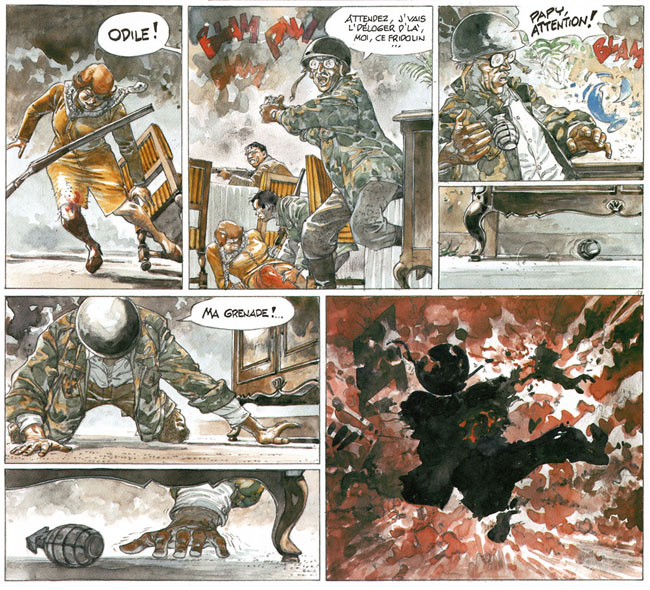
In 2000, Hermann teamed up with famous comic writer Jean Van Hamme to create 'Lune de Guerre' ("War Moon", Dupuis Aire Libre, 2000), an allegory on human warfare and the folly that goes along with it. The tale unfolds at a wedding, where the father of the bride complains to the restaurant owner that the salad "isn't fresh". A fight breaks out, which devolves into a full out brutal and violent escalation. The comic was translated into Dutch, English and Polish. In 2005, Dominique Deruddere adapted the graphic novel into the live-action film 'De Bloedbruiloft' ('The Wedding Party'), but the picture flopped.
Graphic novels at Le Lombard
While his first graphic novels appeared the Dupuis collection Aire Libre, Hermann also returned to his old homebase Le Lombard and its collection Signé. His first contribution to this collection was 'Caatinga' (Le Lombard, 1997). The story was inspired by a trip to Rio de Janeiro, where his wife bought a postcard depicting the Cangaceiros, late 19th-century/early 20th-century rebellious farmers who had organized themselves in gangs. This provided the spark for the comic book, set in 1930s Brazil. Diamantino and his younger brother Mané are two farmers whose father was murdered at the commission of a land owner. This kicks off a bloody vendetta and the siblings eventually flee and join the Cangaceiros movement. Interviewed by Jean-Michel Lemaire and Yannick Bonnant in On a Marché Sur La Bulle issue #17 (October 2008), Hermann said some Brazilians complimented him for the story: "How is it possible that a Belgian is able to portray the Brazilian climate so convincingly?"

'L'Homme Nylon' (2007).
In 2007, Hermann drew 'Afrika' (Le Lombard, 2007), about safari ranger Dario, who gives a reporter, Charlotte, a ride in a reservation. They witness a foreign entity bombing a rebel camp and later Dario discovers that the bombing was ordered in the name of a contingent he used to work for in the past. The book was also translated into Danish.
With Hans-Michael Kristein as scriptwriter, Hermann made the humorous one-shot, 'La Vie Exagérée de Homme Nylon' (Le Lombard, 2007). The absurd story was only partially written by Kristein, who had never penned down a comic script. Therefore Hermann took his loose ideas and turned them into an absurd comedy narrative, adding as much silly nonsense as possible.
Collaboration with Yves H.
In the 21st century, Hermann began working more extensively with his son Yves H. Their first joint project had been the one-shot book 'Le Secret des Hommes-Chiens' (Dupuis, 1995), for which Yves had provided the artwork himself and Hermann collaborated on the inking and coloring. As it had been a commercial failure, father and son later teamed up with a new division of labor: Yves H. writing the script and Hermann taking care of the artwork. Their first new effort was 'Liens de Sang' ("Blood Ties", Le Lombard, 2000), a remarkable story about patricide and organized crime, set in a large US city between the 1930s and 1950s. Some characters were modelled after Hollywood actors, like Josh (Marlon Brando), Vandenbosch (James Woods), Gladys (Rita Hayworth), Beaumont (Humphrey Bogart), Sam (James Dean) and the Boss (Orson Welles). The book was also translated into Dutch and English.

'Manhattan Beach 1957' (2002).
'Manhattan Beach 1957' (Le Lombard, 2002) follows a man traumatized by the death of his beloved girlfriend Daisy in 1957, and who is still lost and depressed two decades later. The book was also translated into English. With 'Zhong Guo' (Dupuis Aire Libre, 2003), father and son made a spy story with science fiction elements. The Chinese secret service abducts a Chinese-American CIA agent, while the CIA retaliates by putting agent Ditto on the case. However, Ditto realizes he is merely used as a disposable pawn and plots revenge. In 'The Girl From Ipanema' (Le Lombard, 2005), two girlfriends arrive in Hollywood hoping for a film career, but are pulled into an abyss of sheer terror. This book was also translated into English.
Hermann and Yves H. delved into more horror with 'Sur Le Traces de Dracula: Vlad L'Empaleur' (Casterman, 2006), a biopic about Romanian Count Vlad Tepes, AKA Vlad II Drakul. Published in three volumes, Hermann provided the artwork for part one, the other installments were drawn by, respectively, Séra and Dany. The trilogy was translated into Dutch, Danish and Serbian. Hermann & son continued on their historical route with the piracy two-parter 'Le Diable des Septs Mers' ("The Devil of the Seven Seas", Dupuis Aire Libre, 2008-2009), in which Harriet and her friend Conrad go on a treasure hunt to buy back her late father's plantation, facing the vicious buccaneer Robert Murdoch. Hermann consulted genre specialist Patrice Pellerin for advice on how to draw sail ships, but eventually decided to simply use a less detailed graphic style, to keep plot and narrative at the forefront. 'Une Nuit de Pleine Lune' (Glénat Grand Format, 2011) was a dark thriller about a bunch of youngsters who try to rob a retired couple in the countryside, but find themselves in an unforeseen mess. The story was later adapted into the film 'The Owners' (2020), directed by Julius Berg.

'Station 16' (2014).
With 'Retour au Congo' (Glénat Caractère, 2013), Hermann and Yves H. made an unofficial sequel to Hergé's controversial album 'Tintin Au Congo'. The protagonist, Rémy Georget (an anagram of Hergé's real name Georges Rémi) travels back to Congo, where he meets a lot of Tintin-esque characters and has a series of farcical adventures. In 'Station 16' (Le Lombard, 2014), the action is set in Novaya Zemlya, where Soviet nuclear tests were held in the 1950s and 1960s. The plot mixes science fiction with horror and was inspired by a documentary on Arte about Novaya Zemlya, where most of the activities during the Cold War were top secret and in 1961 the biggest nuclear bomb, the "Tsar Bomba", was brought to ignition. 'Sans Pardon' (Le Lombard, 2015) marked Hermann's return to westerns. A young boy, Buck Carter, witnesses his entire family being murdered and becomes victim of rape. He starts killing the culprits, but during his vengeful quest he makes a chilling discovery. Both 'Station 16' and 'Sans Pardon' were also translated into Polish.

'Le Passeur' (2016).
Hermann owned a few ancient photos depicting lynchings of African-Americans in the US South, which inspired his graphic novel, 'Old Pa Anderson' (Le Lombard, 2016), in which a white policeman rapes and murders a black girl. Old Pa goes searching for his missing daughter in racially segregated Mississippi, because he wants to find out the truth, despite the dangers. The same year, Hermann and Yves H. also made 'Le Passeur' (Dupuis Aire Libre, 2016), about a young couple in a desolated world who search for a better life on the basis of a travel folder they found on a corpse. As a little nod, Jeremiah and Kurdy from Hermann's signature series 'Jeremiah' can be seen in one panel, far in the background near the remnants of a bus wreck.
A more extensive collaboration between father and son was 'Duke' (Le Lombard, 2017-2023), a seven-volume western series set in Ogden, Colorado, and the South West of the US during the 1860s. The title character is a sharpshooter who hates guns, but since it's the only talent he has, he accepts a job as deputy sheriff. After 'Duke', the team made another historical series, the two-volume 'Brigantus' (Le Lombard, 2023-2025), set in Scotland during the Roman invasion of Britannia. Melonius Brigantus is a Roman legionnaire who is scarred by all the bloodshed he was forced to witness during his life. At the same time, other soldiers don't respect him much either, since he isn't a true Roman, but had a mother who was a "barbarian" Pict.

Duke #4 - 'La Dernière Fois que jai Prié' (2020).
Commercial art and graphic contributions
In 1968, Greg and Hermann made the advertising comic book 'L'Etoffe d'un Crack' for the clothing brand Pipo. Hermann was one of several artists paying homage to Tibet's western comic 'Chick Bill', in the one-shot gag 'Si Tibet n'Avair Pas Créé Chick Bill' (1973), published in Tintin. In later years, he contributed homage drawings to celebrate aniversaries for Hergé's 'Tintin' (1978), Derib's 'Buddy Longway' (1982 and Dupa's 'Cubitus' (1992), all in Tintin, as well as a graphic salute to Daniel Kox' 'Agent 212' in Spirou (2001). In Fluide Glacial issue #27 (1978), Hermann illustrated a gag thought up by Gotlib about a beach guard whose mouth-to-mouth resuscitation is morbidly extreme.
In addition, Hermann made storyboards for the 1986 Roman Polanski film 'Pirates', since the director admired his "cinematic" comics. Three years later, Hermann also made ten illustrations for a Swiss tourist agency, under the title 'L'Atelier du Voyage' (1989). In the same vein, he contributed to 'Carrément Bruxelles - Ronduit Brussel' (Glénat, 2005), a series of graphic homages to the city of Brussels, drawn by various notable artists.

'Le Plus Fort', gag for Fluide Glacial #27 (28 August 1978), scripted by Gotlib.
In 1990, a telethon was organized on Belgian television to bring attention and final support to patients with neuromuscular diseases. At the initiative of Peyo, 31 comic artists adapted stories of child patients with this disease into short comics, collected in the book 'Telethon: La B.D. du Défi (Lombard, 1990), including Hermann. Hermann was also one of the contributors of a "dirty fairy tale" to the Perrault volume of scriptwriter Yann's 'Sales Petits Contes' series (Dupuis, 1998). In 2003, he made a graphic contribution to the collective album 'Aux Portes du Passé: Histoires d'Alsace' (Demgé Productions), scripted by teenagers between 14 and 18. In 2004, Hermann was one of many artists to contribute to 'Tintouin à Tibet' (A.L.I.E.N., 2004), a protest album against the Chinese occupation of Tibet. He was one of several artists to complete 'L'Arbre des Deux Printemps' (Lombard, 2001), the final graphic novel of the comic artist Will, whose death in 2000 had left it unfinished.
For the 2017 edition of the Angoulême Comics Festival, Hermann designed a rather unusual poster, depicting hats and objects associated with his signature characters near a coffin, with Jeremiah sitting in the distance. He made this macabre image as an allegory for the festival.

Hermann's 2017 Angoulême poster.
Recognition
In 1970, Claude Moliterni's Phénix magazine awarded Hermann the Prix Phénix for 'Bernard Prince'. His 'Comanche' story 'Les Loups du Wyoming' received the 1973 Prix Saint-Michel Award for "Best Realistic Artist", and the 'Jeremiah' album 'La Nuit des Rapaces' won the 1980 Prix Saint-Michel for "Best Realistic Script". In 2002, Hermann was honored with a Grand Prix Saint-Michel for his entire body of work. In Spain, he received three Haxtur Awards: in 1992 for "Best Long Story" ('Les Tours de Bois-Maury'), in 2001 for "Best Drawings" ('On a Tué Wild Bill') and in 2011 for his entire career. The Belgian Chamber of Comics Experts bestowed Hermann with "Best Drawing" (1992) for 'Jeremiah' and with "Best Script" (1999) for 'On a Tué Wild Bill'. Internationally, his artwork was additionally crowned at the Sierre Comics Festival (Switzerland, 1987), the Solliès-Ville Festival (France, 1989), Lys-lez-Lannoy (France, 1992), Ville de Moulins (France, 2016) and with a Hanne Hansen Award (Denmark, 2018).
'Sarajevo Tango' was honored with the Grand Prix (1995) at the Festival of Durbuy, the Oesterheld Award in Rome (1996) and a French Prix Bédésup (1996). 'Caatinga' received the Grand Prix at the Festival of Solliès-Ville (1997), while 'Assunta' won "Best Album" at the Comic Festival of Chambéry (1998) and 'Afrika' was bestowed with the Marylsa Award (2008) at the Comics Festival of Chambéry. 'Une Nuit de Pleine Lune' (2012) received the Sang 9 award of Comics at the International Police Film Festival of Liège.
In October 1999, 'Nic' was honored with its own mural at the corner of the Rue de Fabriques/Fabrieksstraat and the Rue de la Senne/Zennestraat in Brussels, as part of the Brussels Comic Book Route. Between 21 January and 18 May 2003, Hermann was the subject of an exhibition in the Belgian Comic Strip Center in Brussels. On 15 May 2009, Hermann was named Chevalier dans L'Ordre des Arts et des Lettres.
In 2016, the 77-year old veteran received the Grand Prix de l'Angoulême, breaking a record as the oldest recipient of this award. He also received a Prix du Festival Aix-en-Provence (1984), Grand Prix Diagonale du Jury (2009), Gran Guinigi (2012), the Chambéry Comics Festival award (2012) and a Swedish Adamson Award (2018) for his entire career.

'Caatinga' (2026).
Death, legacy and influence
On 22 March 2026, Hermann passed away at age 87 after a two-year battle with cancer. He had been working until the very end on a new 'Jeremiah' album. His final one-shot graphic novel, 'Cartagena', was finished just a few months before his death. Scripted by Yves H., it focused on the drug cartels in the fictional Mexican city of Cartagena. It was released by Le Lombard on 30 April 2026.
In Belgium, Hermann was an influence on Philippe Jarbinet, Marvano, Frank Pé, Thierry Van Hasselt, Marc Vlieger and Olivier Wozniak. In France, he inspired Hugues Labiano, Stéphane Servain and Didier Tarquin. He also found followers in Denmark (Henrik Rehr), Italy (Stefano Carloni), The Netherlands (Anco Dijkman, Peter van Dongen, Peter Nuyten), Serbia (Mirko Colak, Dragan de Lazare), Switzerland (Enrico Marini, Rafael Moralès) and the United States (Charles Vess).

Homage to Hermann by François Boucq. Translation: "O.K., guys, we had a lot of fun, but now I have to go."