


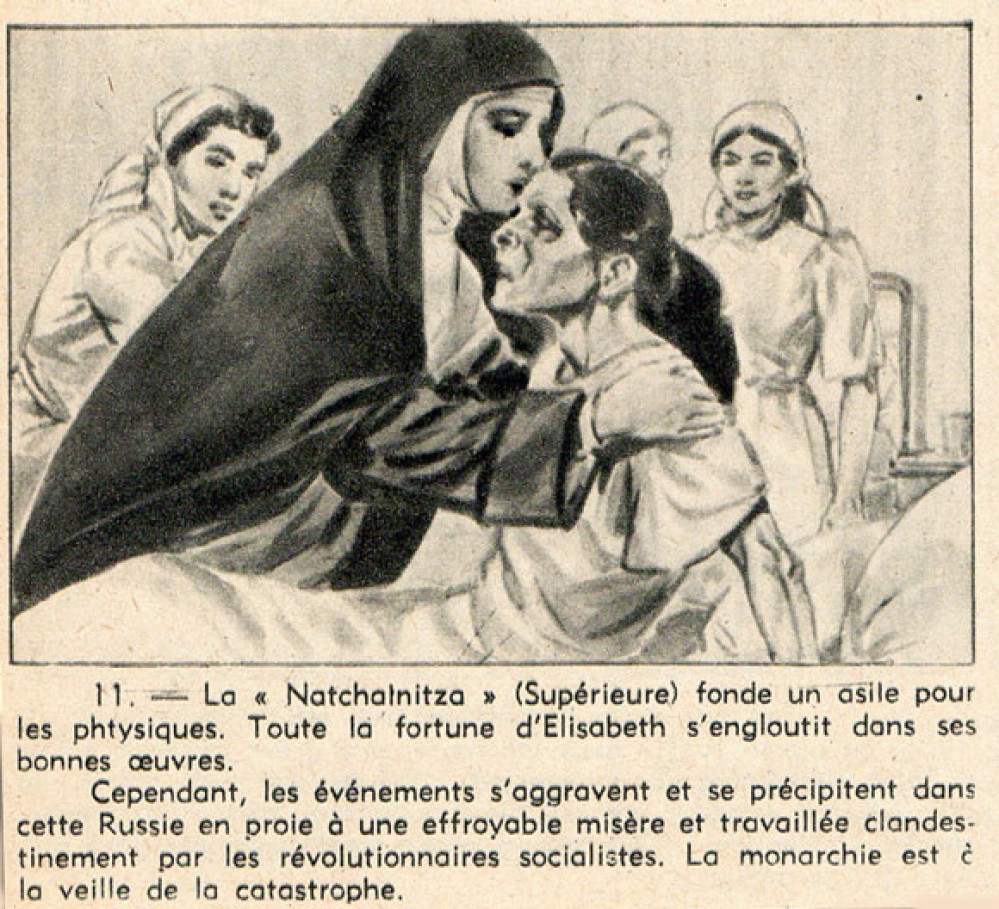
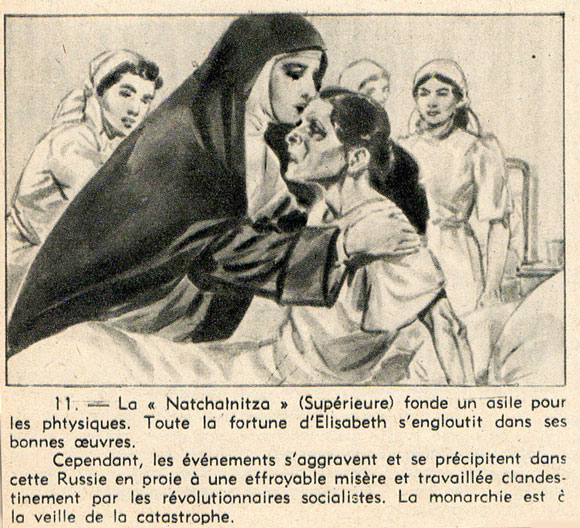
'Le Sanglant Destin d’Élisabeth Feodorovna' (1953).
Mader was a mysterious mid 20th-century illustrator, who drew comics for the Belgian women's weekly Bonnes Soirées in the mid-1950s. According to the website BD Zoom, Mader was a Spaniard.
L'Histoire Vivante
Little is known about Mader, except that he or she was active Bonnes Soirées, a the Belgian women's weekly published by Éditions Dupuis, the company that was also responsible for the weekly comic magazine Spirou. In its illustrated picture story section 'L'Histoire Vivante' ("Living History"), Bonnes Soirées presented the life stories of remarkable historical people from the recent past. Beneath the ink wash illustrations, text captions told the heroic or otherwise inspiring tales. The section was provided by the World's P. Press agency of Georges Troisfontaines, that also produced realistic and educational comic features for Spirou magazine, for instance the historical short story section 'Les Belles Histoires de l'Oncle Paul'.
Printed in Bonnes Soirées between 1953 and 1956, 'L'Histoire Vivante' mostly relied on the same production staff as the 'Oncle Paul' feature in Spirou. With Jean-Michel Charlier and Octave Joly as writers, contributing artists were the agency regulars Victor Hubinon, Gérald Forton, Pierre Dupuis, Fred Funcken, Georges Langlais, Albert Uderzo and Claude Pascal. Odd one out was the Spanish artist Mader, who provided the illustrations for four Charlier-scripted episodes, namely 'Le Sanglant Destin d'Élisabeth Feodorovna' (issue #1659, 22 November 1953), 'La Chanteuse au Camélia' (issue #1670, 7 February 1954), 'Élisabeth, Impératrice Fatale' (issue #1678, 4 April 1954) and 'Une Lépreuse, Agent Secret' (issue #1690, 27 June 1954).
During the mid-1950s, it wasn't unlikely for the World's agency to work with Spanish artists; around the same period they also assigned 'Oncle Paul' episodes to Julio Ribera, José Bielsa and Francisco Hidalgo. However, the identity of Mader has remained unknown. At the time, contact with most of the Spanish artists working for Belgian and French publishers was arranged through an agency called A.L.I., which in turn was associated with Creaciones Editoriales, a division of publisher Bruguera in Barcelona.
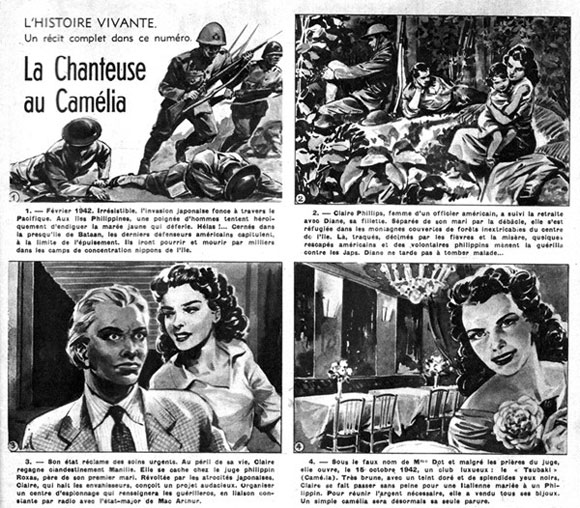
'La Chanteuse au Camélia' (1954).