

'De Smaa Grises Skovtur' ("The Little Pigs' Trip Through the Forest", 1922).
Louis Moe was a late 19th-century, early 20th-century Norwegian-Danish painter, graphic artist and children's book illustrator. His work can be classified as Romantic and Symbolist, depicting folkloric tales and legends. Moe was a mainstay in many children's magazines and books, especially the Christmas annual 'Børnenes Julegave', for which he drew many stories featuring trolls and anthropomorphic animals, particularly bears. Some are picture stories, making him a significant artist in the development of Nordic comics.
Early life
Louis Moe was born in 1857 in Arendal as the son of a dentist. His uncle, Honoratus Halling (1819-1886), was a notable magazine editor. Louis' sister, Nina Moe Leganger (1858-1941), gained fame in adulthood as a children's book writer, whose stories he would often illustrate.
Between 1873 and 1875, Moe studied at the art school of Kristiana (present-day Oslo), where the future book illustrator Theodor Kittelsen was one of his classmates and the sculptor Julius Middelthun one of his teachers. From 1876 on, Moe studied at the Academy of Fine Arts in the Danish capital of Copenhagen, and in 1882 and 1883 he was an apprentice of painter and sculptor Lauritz Tuxen. In 1900, Carl Heinrich Bloch taught Moe etching skills, while he became a trained lithographer from 1905 on thanks to Alfred Jacobsen. When Louis Moe was 20, in 1897, his father suddenly died, bringing his family in dire straits. Through help of rich friends and relatives, Moe could cobble together the money needed to complete his studies.

Illustration for Jultomten 1904, published by Svensk Läraretidnings Förlag.
From 1881 on, Louis Moe lived in Denmark, and in 1919 he was naturalized as a Danish citizen. On occasion, he traveled back to his home country, spending time at a summer farm in Kviteseid, located in the Norwegian county of Telemark, which often inspired him in his work. In 1897, he married Inger Møller, the daughter of piano producer Frederik Møller. Although Moe originally wanted to become a sculptor, he focused on making paintings and illustrations instead.
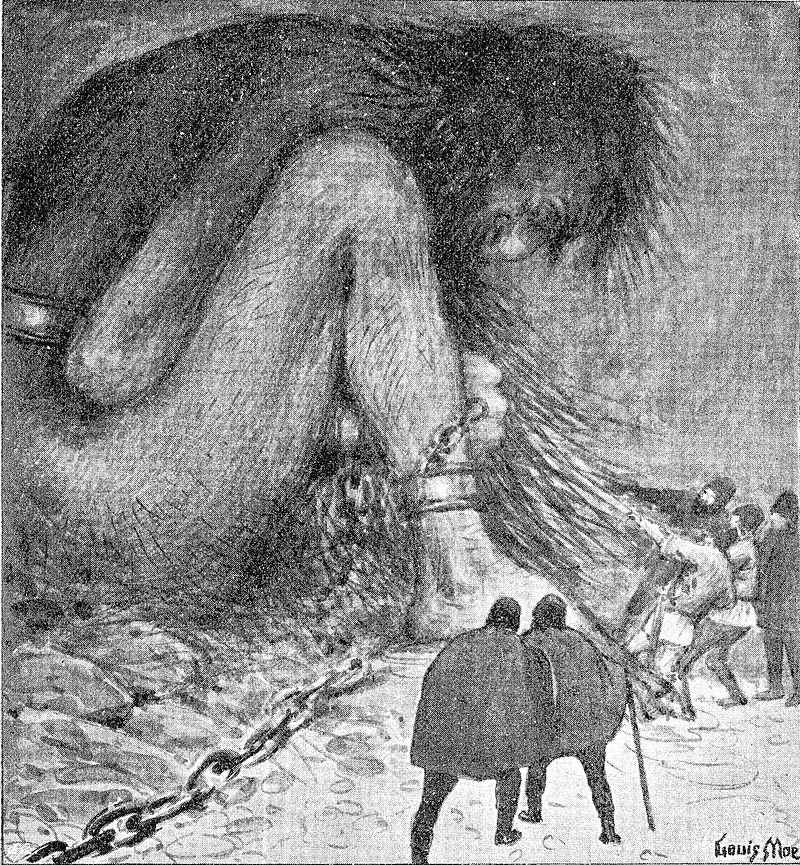
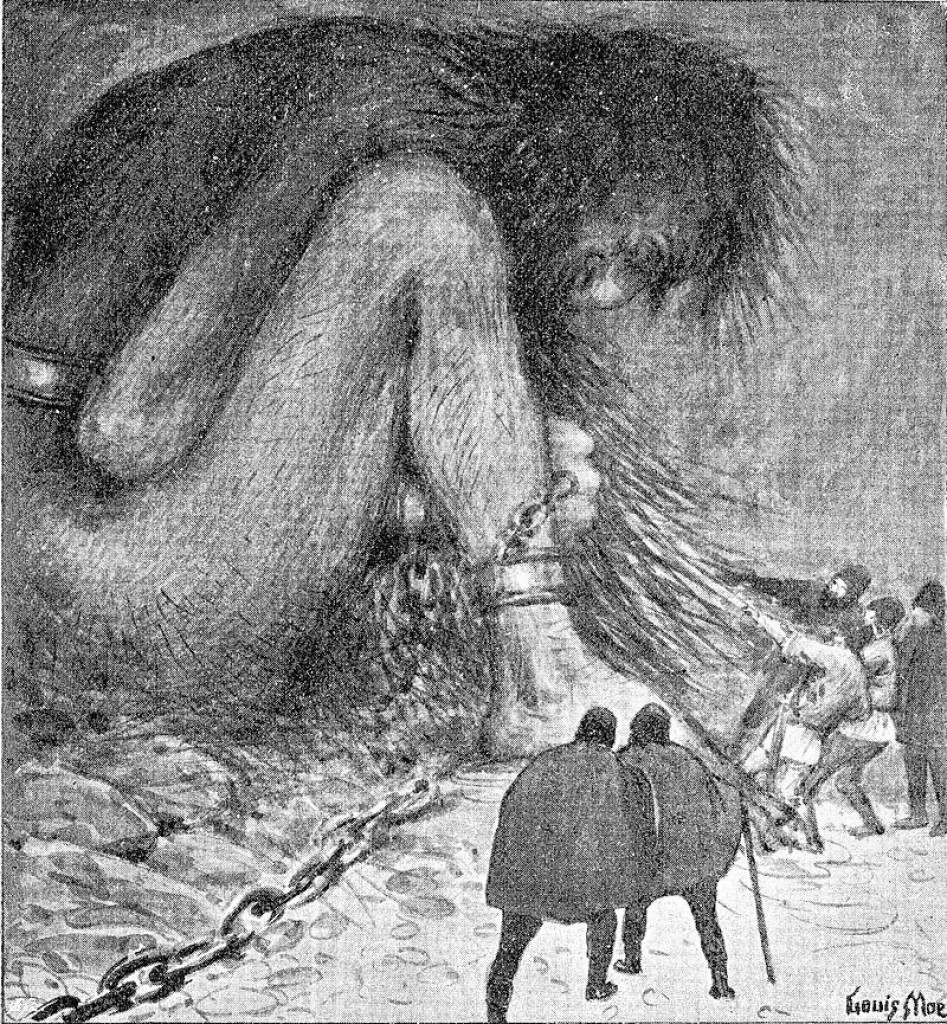
'Ragnarok'.
Illustration career
In the 1890s, Louis Moe became a notable book illustrator, livening up the pages of many romantic novels, short stories and fairy tales, as well as children's songs and nursery rhymes. Most were written by Jacob Breda Bull, Knut Hamsun, Marie Hamsun and Vilhelm Krag and fairy tale writer Carl Ewald. He also illustrated a 1900 edition of Hans Christian Andersen's fairy tales. Other illustrated stories were based on ancient Nordic epics, like the 'Edda Saga' (1890), Saxo Grammaticus' 'Danish Chronicles' (1898) and 'Ragnarok: En Billeddigtning' (1929), an illustrated account of the Norse mythologies regarding the Apocalypse. His 'Valkyrien' (1931) was an illustrated novel based on Richard Wagner's opera cyclus 'Die Walküre'.

'Trollungen fjerner katten' ("The Troll Removes the Cat", 1924).
Many of Moe's illustrations were printed in the children's magazine Magne and the weekly Norsk Ukeblad. The stories he illustrated were also translated into other languages. He was a house illustrator for the 'Børnenes Julegave' Christmas annuals (1887-1934) of printer Alfred Jacobsen, which became a holiday tradition, in direct competition with Ernst Bojesen's similar 'Børnenes Juleroser' (1884-1930).
While many of Moe's stories are frivolous tales about funny animals, he was also a master of more dark and disturbing scenes, depicting menacing giants, ugly trolls and vicious battles. In the 1910s, he underwent strong influence from the Symbolist painter Max Klinger and started making more artwork that combined eros and thanatos. Nude damsels, horny fauns, creepy monsters and Death itself started occupying his work. A typical example is the drawing 'En kentaur og en nøgen kvinde, siddende i skovbunden' ("A Centaur and a Nude Woman, Sitting on Forest Ground").

'The Treasure Digger' (1925).
Comics pioneer
The illustrations that Louis Moe made for children's books and magazines had a notable impact on Scandinavian comics. His depictions of Viking-themed stories and Nordic myths were often imitated by historical and fantasy artists. His charming portrayals of grotesque-looking trolls and animals acting like humans were likewise copied by various early 20th-century Norwegian, Danish and Swedish illustrators and comic pioneers. Olav Norheim, chief editor of Norsk Barnevald, wrote in his foreword to a chronological collection of all Norwegian Donald Duck comics that Louis Moe paved the way for the popularity of Disney comics in Norway. He pointed out that Moe had also visited the United States in his career and that his children's books were translated there. In his opinion, there is an unproven possibility that Walt Disney may have seen his work and took inspiration from it too. What is certainly true is that the Swedish children's book illustrator Gustaf Tenggren was invited to visit the Disney studios in the mid-1930s, where his romantic illustrations had a strong impact on Disney's 'Snow White and the Seven Dwarfs' (1937).

'Troldepeters Bil' ("Troldepeter's Car").
On occasion, Moe drew sequential scenes. When visualizing nursery rhymes in 'Gamle Børnerim og Lege med nye Billeder' ("Old Nursery Rhymes and Games with New Pictures", 1901), for instance, he summarized some of them in two panels on one page. The picture story 'Troldepeters Bil' ("Troldepeter's Car") is a pantomime comic in which a little troll makes a wooden cart on which he gives two adult trolls a ride, only to have the primitive vehicle fall apart when they crash down a hill. In 'Gale Katte Faar Revet Skind' ("Mad Cats Get Their Skin Torn", 1925), two cats start fighting over a mouse. As they scratch and bite each other, two girls try to make the felines stop, but only end up fighting each other while their pets daze off.

From: 'Gamle Børnerim og Lege med nye Billeder' (1901).
In the 1912 edition of the Christmas annual 'Bornenes Julegave', Moe drew the picture story 'Den Fine Hat' ("The Nice Hat") in which two anthropomorphic bears fight over a fancy top hat. The tale is presented with printed text captions underneath the images. In 'Bamsefar og Mikkel Raev' ("Father Bear and Mikkel the Fox", 1921), a sneaky fox fools a dumb bear with various shenanigans and vice versa, presented with handwritten narration next to the images. In 'De Smaa Grises Skovtur' ("The Little Pigs' Trip Through the Forest", 1922), Moe drew another text comic, starring three piglets who travel through the woods alone but are threatened by a dangerous bear.

'Bamsefar og Mikkel Raev' ("Father Bear and Mikkel the Fox", 1921).
In the text comic 'Svin er Svin' ("Pigs Are Pigs"), a pig tries to clean up his public image by dressing up in a fancy suit, only to find out that the proverb rings true. A similar picture story is 'Hønen med Pagehaaret' ("The Hen with the Bob Haircut", 1926), in which a little hen doesn't like his feathers and plucks itself clean to be more "trendy". Unfortunately, a human sees the plucked chicken and decides to cook him, leading to the moral that it's better to be happy who you are.

'Svin er Svin'.
The story 'En Little Historie om Tandpine Ved Nordpogen' ("A Little Story about Tooth Ache at the North Pole", 1908, from Börnenes Julegave) is notable for being a text comic with clearly defined panels. It follows a little walrus who has a rotten tooth, which he eventually manages to get pulled by a helpful polar bear. Bears appear to have been among Moe's favorite protagonists, as he also used this animal in another panel-based comic, 'Et Talents Historie' ("A Story About Talent"). Here a little black bear tries to get schooled at the Royal Dance Academy, but is kicked out once a little boy gets jealous that the bear gets the attention of his little girlfriend.
'Nalle och Mickel på äventyr' ("Nalle and Michael's Adventure", 1932) is another interesting prototypical comic book in the sense that all narration is presented in the form of text blocks in the center of the page, while the illustrations around it are successive panels.
Louis Moe was also a mentor to Norwegian illustrator and comic pioneer Solveig Muren Sanden.
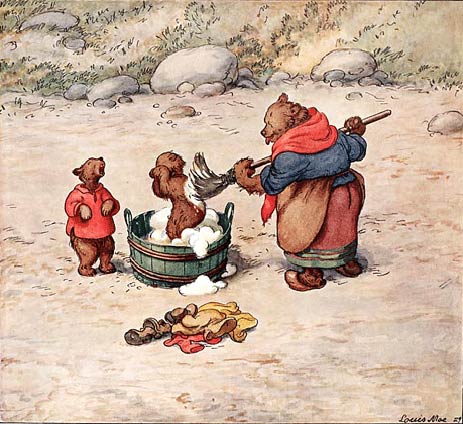
From: 'Het Feest van Koning Beer' ("The Feast of King Bear", Dutch edition, 1930).
Recognition, final years and death
In 1904 and again in 1934, Louis Moe's work was exhibited in the Museum for Decorative Arts in Oslo. In 1910, he received a golden medal from a Brussels art jury. In 1931, he was decorated as Knight of the Order of the Dannebrog.
Louis Moe passed away in 1945, at age 88. Although his work was popular during his lifetime, he has been overshadowed by the work of his former classmate Theodor Kittelsen. Several of his works are part of the collection of the National Gallery in Oslo and the Danish Museum of Art & Design in Copenhagen.

Louis Moe at his beloved Juvlandsæter (1910).