



'Matildita y Anacleto, un Matrimonio Completo' (Can Can, 8 February 1960).
Ángel Nadal was a Spanish artist with a long international career. In 1940s Spain, he began his career working for several smaller publishing houses, before becoming a staple at Bruguera. During the late 1940s and the 1950s, he contributed to their children's magazine Pulgarcito and eventually the more adult-oriented humor titles El DDT, Can Can and El Campeón. After creating typical Bruguera humor strips like 'Casildo Calasparra' (1948) and 'Pascual, Criado Leal' (1953), he satirized the life of young women and married couples in 1950s Spain through features such as 'Las Mujeres de Nadal' (1954), 'Matildita y Anacleto, un Matrimonio Completo' (1954) and 'Maripili y Gustavito, Todavía Sin Pisito' (1958). From the 1960s on, Nadal joined many other Spanish comic artists doing agency work for international publishers. Through Bardon Art, he drew the title comic of the British comic magazine Buster, as well as several other comic strips for the British publisher Fleetway, notably 'The Nutts' (1962-1976) in Valiant. Subsequently, he had a 40-year stint working with the Rolf Kauka characters for the German market, drawing 'Die 7 Schnuckel' (1972-1974), 'Fridolin' (1979-1981) and especially 'Bussi Bär' (1973-2013).
Early life and career
Ángel Nadal Quirch was born in Barcelona in 1930 as the son of a baker. As a teenager, in 1944, he began his career as an assistant of the comic artists Antonio Ayné and Emilio Boix. Shortly afterwards, he appeared with solo features in the several new comic book series and collections of the second half of the 1940s. From the start, Nadal's art styles switched from semi-realism to cartoony, although always with an elegant flair. In 1945, he drew the humor page 'El Poder del Ojo Humano' ("The Power of the Human Eye") in the landscape-format children's title Collección Princesita' of Ameller Editor. In the following year, Nadal made similar cartoons and comic strips for Ameller's humor comic 'Ediciones Pantuflas', as well as 'Colección Chispa' of Publicaciones Para Niños/Editorial Toray (1946-1947).

'Una Tarde en el Circo' (Parvulin #7, 1947).
In addition, in 1946 and 1947, Nadal drew volumes of adventure comic books by the publishing house Fantasio, including the collections 'Cuento de Hadas' (AKA 'Colleción Azul'), 'Dos Yanquis en Africa' and 'El Capitán Chupete', signing with either "A. Nadal" or "A. Quirch'. As the artist of Fantasio's two-issue series about jungle adventurer 'Tokán, El Invencible' (1946), Nadal applied a fully realistic style. In a more humorous and fairy tale tradition, he drew several installments in the collections 'Colorín' (Editorial Grafidea) and 'Parvulín' (Ameller Editor).
Jaimito
Between 1947 and 1949, Nadal also appeared in the magazine Jaimito by Editorial Valenciana, for which he created several short-lived features starring goofy characters like 'Sindulfo Sacarina' (1948), 'Repollito', the artist 'Pepe Pintamonas', the gardner 'Don Viriato, Jardinero' (1949), 'Facundo' and the nasty landowner 'Don Sombrerete'. Even more obscure seem to be 'Cayetano', 'Cleopatro', 'Don Gil', 'Lina' and 'Don Pepito', an animal lover who is constantly attacked by the objects of his affection. In 1951, Nadal also appeared in Valenciana's S.O.S. magazine with the feature 'Toby'.
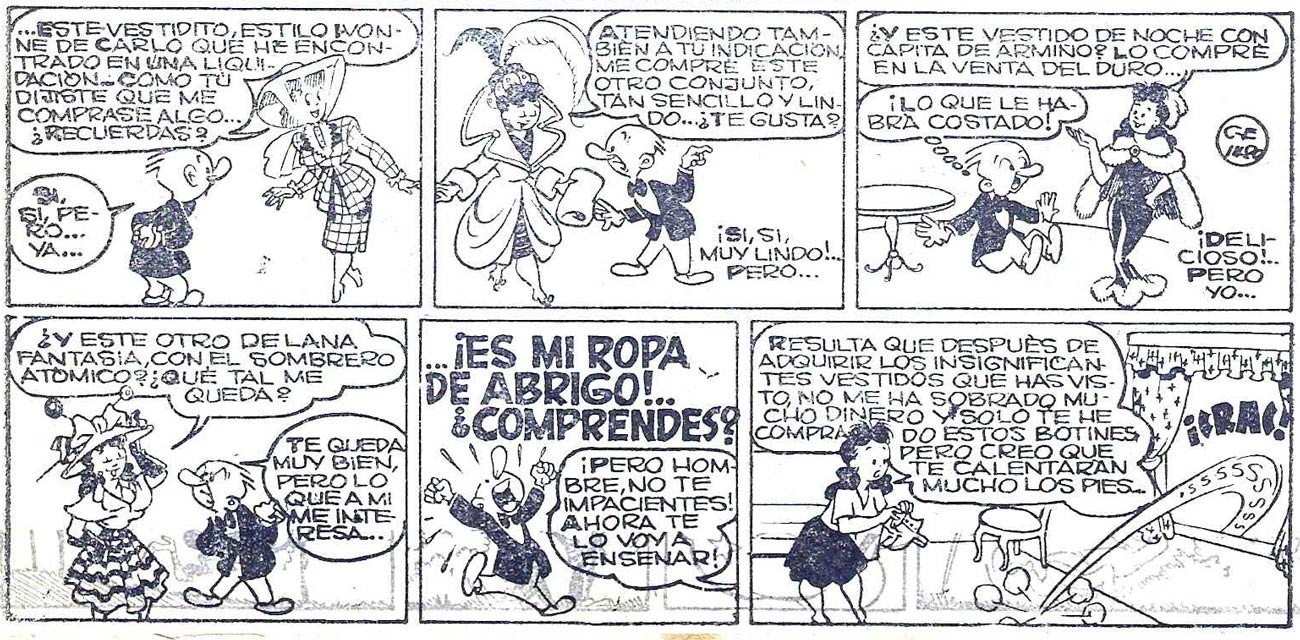
'Casildo Calasparra' (Super Pulgarcito v1#8).
Bruguera: Pulgarcito
After starting out working for several of Spain's smaller publishing imprints, Ángel Nadal eventually became a regular contributor to the country's leading publishing house, Bruguera. In 1946, he had drawn his first work for them, appearing with gag comics in A.E.I. ('Como Pocos') and the revamped Pulgarcito magazine. Between 1948 and 1960, Bruguera was Nadal's steady homebase, and he became a member of the so-called "Bruguera school", which also featured humorists like José Peñarroya, Guillermo Cifré, Carlos Conti, Manuel Vazquez, José Escobar, Raf, Martz-Schmidt, Francisco Ibañez, Roberto Segura and Blas Sanchis. Most of Nadal's Pulgarcito characters were in line with Bruguera's tradition of unlucky bourgeois men ending up in all sorts of uncomfortable situations.
One of his first and most notable creations was 'Casildo Calasparra', debuting in Pulgarcito #44 in 1948, and later also appearing Super Pulgarcito and El DDT. It is believed that the scriptwriter Rafael González participated in the creation of the early episodes. Also known as simply 'Casildo', the comic starred a submissive clerk with a large nose and three hairs, who has to endure the whims of his authoritarian and unforgiving wife Berta. Nadal's obituary by Steve Holland on the Bear Alley blog noted that this exploration of marital discomfort was not the image of family relationships that the Franco regime wanted to foster, so the censors often urged the cartoonist to tone down. In 1950, solo collections of Casildo's adventures appeared in the Bruguera collections 'Magos del Lápiz' and 'Magos de la Risa'.

'Pascual, Criado Leal' (Pulgarcito #1211).
Among Nadal's further creations for Pulgarcito were 'Sandalio Pergamín' (1948), 'Don Folio' (1951) and 'Don Cloroformo' (1951). More enduring was 'Pascual, Criado Leal' ("Pascual, Loyal Servant"), a comic about a butler and his lord, which debuted in Pulgarcito #1139 in 1953, and continued to appear for a few years on the magazine's back cover. During the 1960s, episodes were reprinted in Bruguera's Din Dan magazine. A classic character from the golden age of Bruguera, 'Pascual' was revived in 1996 by the cartoonist duo Idígoras & Pachi in the satirical magazine El Jueves as a parody of the Spanish royal family.
Satirizing family life
With his elegant line work, Nadal had a talent for drawing attractive women. This was particularly exemplified in 1951 in Bruguera's new comic magazine El DDT, which aimed at a more adult readership. First of all, the cartoonist continued his series 'Casildo Calasparra' in its pages, where the office clerk continued to be bossed around by his otherwise attractive wife Berta. In addition, Nadal further challenged the censors with his new feature 'Rosita, la Vampiresa' ("Rosita, the Vampire", 1951) and especially his vertical cartoon series 'Las Mujeres de Nadal' (1954). As El DDT was largely modeled after the Argentinean magazine Rico Tipo, "Nadal's girls" can be seen as the Spanish counterpart to the popular girls' cartoons of Guillermo Divito. But since the Spanish censors were more sensitive, Nadal's cartoons lacked the suggestive models and bikinis of their South American inspiration. Later in the 1950s, similar Nadal cartoons appeared under the masthead 'Las Chicas de Nadal' in Bruguera's Can Can magazine.

'Las Mujeres de Nadal'. Translation: "I don't know whether to sell my jewelry collection or buy a Spanish yacht..." - "(Aren't) both false?".
Relationships and family life were other recurring themes in Ángel Nadal's comics. While 'Casildo Calasparra' had a more cartoony approach, the artist explored this territory more realistically in 'Matildita y Anacleto, un Matrimonio Completo' ("Matildita and Anacleto, a Complete Marriage", 1954). A slice-of-life comic about a young couple during the economic boom, the comic proves an interesting time capsule of modern family life during the Franco regime. However, while the artwork of the feature was more realistic, the concept was more traditional. Matildita is a fashionable young woman, but can get jealous quickly, while her husband Anacleto is a tall and elegant man who resorts to little tricks to go out with his friends without his wife finding out. After its initial run in El DDT, the comic was also continued in Can Can.
For Bruguera's celebrity magazine Sissi, Nadal created a similar comic feature called 'Maripili y Gustavito, Todavía Sin Pisito' ("Maripili and Gustavito, Still Without an Apartment", 1958). In 1957, several former Bruguera artists had left the company to launch their own adult humor magazine, Tio Vivo. Two years later, Ángel Nadal briefly joined the title with his comic strip 'Marilín, Chica Moderna' (Marily, the Modern Girl", 1959). In 1959 and 1960, more risqué cartoons by Nadal appeared in Pepe Cola magazine (Editorial Mateu) and La PZ (Ediciones Rápidas), while he contributed gag cartoons to Parque, a children's supplement to the newspaper of the Solidaridad Nacional movement. In 1960-1961, the artist was back at Bruguera with cartoons in the magazine El Campeón, marking his final productions directly for the Spanish market.

'A Laugh In A Line' (Film Fun #2096, 19 March 1960).
British comics
Like many other Spanish artists of his generation, Nadal started to work for foreign publishers in the 1960s. Together with fellow Bruguera-artists Raf and Gin, he became a prominent author for the British comic magazines published by Fleetway. Working through the Bardon Art agency, Nadal started out drawing the pantomime 'A Laugh in a Line' comic strip feature in Film Fun. In May 1960, the Spanish artist spent a month at Fleetway House in London to participate in the launch of the new comic magazine Buster, for which he was a prominent artist. As Fleetway was owned by the Mirror Group that also published the Daily Mirror, an attempt was made to tie Buster to the popular strip from that newspaper, Reg Smythe's 'Andy Capp'. Wearing a similar oversize floppy cap, Buster was initially presented as Andy's son, although the connections were already dropped within a year.

'Buster's Dream-World' (Buster, 1 June 1968).
Present in Buster from its first issue, Ángel Nadal initially drew several gag features, for instance one about the sweet young girl 'Uppsy Daisy', and one about the show-off 'Big 'Ead', who always gets his come-uppance. Other early Buster strips included 'Lazy Sprockett the Tiredest Man in Tennessee' and 'Milkiway the Man from Mars'. In addition, he made cartoons for the readers' jokes section 'Make Buster Laugh'. In May 1962, Nadal took over the front page feature with title character 'Buster', originally drawn by Bill Titcombe and then Hugh McNeill. As the main artist of the character during the next twelve years, the successive features included 'Buster's Diary' (1962-1968) and 'Buster's Dreamworld' (1968-1974). The stories were written by editor Nobby Clark, who became a personal friend of Nadal.

'The Nutts' (Valiant and TV21, 29 December 1973).
Besides Buster, Ángel Nadal's artwork also appeared in other Fleetway magazines. In Knockout, for instance, he drew the misadventures of 'Professor Knockout' (later renamed to 'Professor Nutcase'), whose inventions constanly back-fire, and 'Blarney Bluffer', another arrogant, boastful character. In Valiant, he was an artist for the long-running feature 'The Nutts' (1962-1976), about a zany family, appearing with the tagline "Our Funny Family are Tough Nutts to Crack!". Additional British work by Ángel Nadal included 'Birk 'n' Ed' in Hurricane (1965), about two deadbeat Scousers (slang for people from Liverpool), and another strip for Buster, 'Ug and Tug, the Peacemakers' (1965), although both strips were short-lived. He later drew jokes for Jag and the 'Minnie's Mixer' strip for the newly launched Whizzer & Chips magazine (1969). The artist's last new strips for the British market were 'Dogsbodies Academy' in Cor!! (1970) and 'Penny Pincher' in Buster (1973-1974).
Several of Nadal's British features were also published in Spanish magazines: 'Diario de Buster' ran in La Risa, 'The Nutts' appeared as 'La Familia Chorlito' in El DDT and as 'Los Nueces in La Risa.
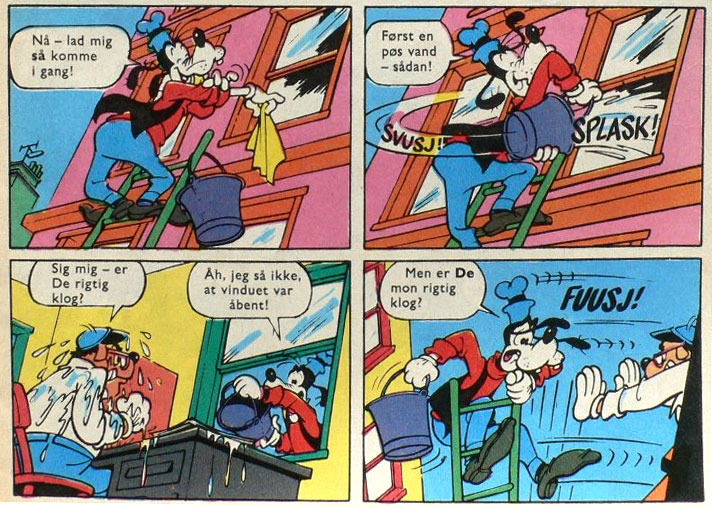
'Goofy'. Danish-language version.
Disney comics
By the early 1970s, work for British magazines dried out for the Spanish artists, forcing the agencies to turn to other markets. Through Josep Toutain's Selecciones Ilustradas agency, Ángel Nadal briefly worked on Disney comics for the Danish publisher Gutenberghus. Between 1971 and 1974, he drew several short stories and gags with 'Mickey Mouse' and 'Goofy'. In 1983 and 1984, he briefly returned to the Disney universe when drawing three stories and a gag with 'Donald Duck' and his family.

Fridolin: 'Gänsehaut und Affenhitze' (Fix und Foxi Sommer 1979).
Kauka comics
From 1972 until his retirement in 2013, Ángel Nadal's main output was for the German magazines with characters belonging to the entrepreneur Rolf Kauka. In Primo magazine, he drew stories with 'Die 7 Schnuckel' (1972-1974), starring seven little goblins who secretly live in an old oven in the attic of Pension Fröhlich. For that same magazine, he subsequently developed 'Viva La Revolution' (1974) with editor Peter Wiechmann, a short-lived humor comic centering around a battle between revolutionaries and a dictator. In 1976, the series continued for three additional short stories in Zack magazine of the Koralle Verlag, albeit under a different title, 'San Tomato'. Between 1975 and 1978, and again between 1984 and 1986, Nadal also drew stories with Kauka's signature characters 'Fix und Foxi' for the magazine of the same name. For that same title, he was also one of the main artists of 'Fridolin' (1979-1981), a bohemian cat initially drawn by Branko Karabajic. Nadal's work on the feature initiated a new drawing style for the character, which was later in the 1980s continued by other Spanish artists like Miguel Fernández Martínez and Joaquín Cañizares.

'Viva La Revolution' (Primo #19, 1974).
However, Nadal's major work for the Kauka titles was drawing the pre-school character 'Bussi Bär', an orange bear whose uprightness is illustrated by the golden heart around his neck. He is always accompanied by a blue dog called Bello. Initially developed and drawn in 1967 by Walter Neugebauer, Ángel Nadal did his first 'Bussi Bär' work for the magazine of the same name in 1973, and remained its lead artist for the next forty years. From the mid-1980s on, he dropped all his other Kauka work and focused solely on the charming bear.

'Didi und der Riesenfisch' (KNAX #2, 1974).
Knax
In the mid-1970s, Nadal also worked on some of the early issues of KNAX, the advertising comic book for Germany's saving banks, created by Peter Wiechmann. In fact, Nadal was the second artist to draw the comic after series originator Erwin Frick, and was also instrumental in giving the characters their final designs. The stories are set in a medieval-like community on an isolated island called Knax, with the characters representing an idealized image of a bourgeois society. The kids Didi and Dodo are the main heroes, who often have to take on a gang of robbers known as the "Fetzensteiner". Production was eventually expanded to a wide range of Spanish artists, affiliated with studios like Comicon and Comicup.
Final years and death
Through the Comicon agency in Barcelona, Ángel Ndal remained active for Kauka's Bussi Bär, published by Pabel-Moewig Verlag, throughout the 1980s, 1990s and 2000s. In 2008, he became the longest-serving artist for Kauka-related publications, breaking the record previous held by Branko Karabajic. Nadal retired in 2013 at the age of 83. Even though by then he had been largely forgotten in his native Spain, exhibitions of his work were held in La Massana (Andora) in late 2013 and in Cadaqués in the summer of 2014. Ángel Nadal Quirch passed away in June 2016 at the age of 85.

Cover illustration for Bussi Bär, January 1993.