

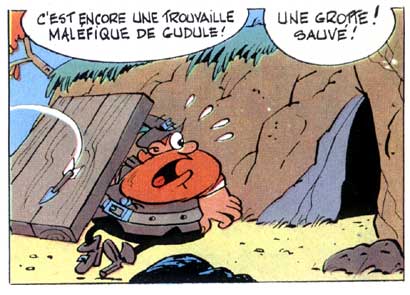
'Croquemitron'.
Noël Bissot was a Belgian artist, who made sculptures and comics. From the 1950s until his untimely death in the early 1970s, he contributed to the comic magazines Tintin and Spirou. In the latter, he was a staple in the mini books section with the medieval adventures of characters like The Baron and Juju the raven.
Early life and career
Noël Bissot was born in 1916 in the Ensival, a suburb of the Walloon city of Verviers. Throughout his life, he remained a resident of Verviers, a city in decline, that once blossomed for its textile industry. Attracted to the arts since a young age, Bissot's meeting with the local sculptor and painter Marcel Ladril convinced him to study at the Verviers School of Decorative Arts. Together with a friend, the future comic artist Raymond Macherot, he visited the comic creator Jacques Martin, who also lived in Verviers. This meeting proved instrumental for both youngsters in the decision to also try their hand at comics. But while Macherot became a full time comic creator, Bissot always did his cartooning activities on the side. During his working life, he was a milkman, going from door to door with his cart. Besides comics, he also remained active as a sculptor, specialized in busts, and regularly participating in exhibitions. His fine arts work was described as "tormented, willful and anxious".

'Coccinelle et le Petit Bison' (Tintin #11, 13 March 1957).
Early work
For the newspaper La Dernière Heure, Bissot made his debut as a cartoonist with some humorous strips. In 1956, he appeared in Tintin magazine and its Dutch-language edition Kuifje with the comic feature 'Coccinelle' (1956-1957), about a young Canadian trapper. The feature was part of the Tintin's "animated cartoon in comic strip form" section. This series of two-page stories relied heavily on slapstick humor, with each episode looking like images from a movie reel, complete with vignettes with double perforated strips in black with little white dots. Two of the seven episodes were scripted by René Goscinny. The 'Coccinelle' strips also appeared in Chez Nous Junior and Ons Volkske, respectively the comic supplements of the Belgian weeklies Chez Nous and Ons Volk, produced by publisher Le Lombard as a low-budget version of their main magazine, Tintin/Kuifje.
In 1961, Noël Bissot also appeared with a story in Bonux-Boy, a promotional comic book for washing powder, produced by Benoît Gillain.


Mini pages starring 'Youk et Yak' and 'Picrate'.
Spirou
Through the fellow Verviers artists René Hausman and Paul Deliège, Bissot eventually made the transition to Spirou magazine, as well as its Dutch-language version Robbedoes. Between 1961 and 1972, he was one of the staples of the magazine's section of fold-in mini-books, for which he created several characters. In Spirou #1201 (20 April 1961), the readers were first introduced to 'Youk et Yak', featuring two hunters from the polar regions. Until 1970, they sporadically returned with new slapstick adventures, often written by the artist's friend Paul Deliège. Another contemporary character created by Bissot was 'Picrate' (three stories in 1966, 1970, 1972), a trickster who tries to sell all sorts of faulty products at the market.

'Le Complot des Barons' (Spirou #1470, 16 June 1966).
Le Baron & Juju
However, most of Bissot's mini-book stories took place in a medieval setting, with several characters appearing in either solo or cross-over episodes. The central character was Arnulphe, Baron of Bosses, generally referred to as 'Le Baron'. While he tries to represent some authority, he is generally the butt of jokes for the other characters. When he is not at war with his nemesis Jean-Foultre de Montgibet, he tries to win over the heart of Princess Yolande, who however keeps searching for her Prince Charming. To achieve his two main goals, the Baron demands the services of the sorcerer Belphégor, who in turn is searching for the philosopher's stone. An emblematic character in most of the stories is Belphégor's crow Juju, who doesn't hesitate to tell all the other characters the truth of what is going on, but also experienced a tragic love affair with a hen.
Belphégor's nephews 'Potron et Minet' are annoying pranksters, who try their hand at alchemy, astrology and magic. Ruling the kingdom is the lazy King Machault VII, although he is mostly dominated by his tyrant wife Bruneblonde. Their nephew Prince Sarment is often expected to visit, although he mainly dreams of becoming a champion in the cup-and-ball game.


Pages from 'Le Nouveau Promethée' (Spirou #1482, 8 September 1966) and 'La Noël du Prince Sarment' (Spirou #1756, 9 December 1971).
With stylized drawings perfectly suited for the miniature format, Bissot crafted his own little universe, that dominated the Spirou mini-books for over ten years. His wide variation of characters provided for all sorts of stories, mixing poetic elements from classic fairy tales with the artist's typical mischievous humor and sharp irony. Using meta humor, Bissot's characters were fully aware that they were part of a comic story. Often, they revolted against the panel borders or their own artist, complaining about the story or the roles they have been given. In turn, the artist often fought back with a handy weapon, his eraser.
Only on occasion did Bissot appear in Spirou's regular pages, for instance with his final creation, 'Croquemitron' (1972-1973): a forester with an unstoppable hunger. Also appearing in these stories was Juju the raven. During this period, Bissot also provided illustrations for Spirou's editorial section 'Le Fureteur', written by Jean-Claude Pasquiez.

'La Matière Tendre' (Spirou #1679, 1970).
Death and legacy
A highly original creator of over 75 mini-books, Noël Bissot's body of work has continued to be praised by fellow artists and comic historians. Robbedoes editor-in-chief Karel Cavens named him "a great man in the comic world", who was "greatly underappreciated". As his comics mostly appeared in miniature format, the Begian comic historian Philippe Mouvet called him "the greatest of the smallest". To readers, however, his work was an acquired taste, and often didn't rank high in the polls. It wasn't until shortly before his death that he finally made the transition to Spirou's regular pages. How his career would have continued shall forever be unknown, as Bissot ended his own life on 8 August 1972. He was 55 years old.

First appearance of 'Croquemitron' (Spirou #1764, 3 February 1972).
The death of Noël Bissot remains one of the biggest tragedies in Spirou history. In the Facebook group Les Amis de la Bande Dessinée, the comic artist Éric Maltaite, then still a teenager, said he was a big fan of Bissot's work, and remembered how devastated his father, comic artist Will, was when he heard the news of his colleague's death. Earlier that year, in May, the Spirou team had lost another one of their artists from a heart attack at age 38, Louis Salvérius. Strangely enough, it wasn't until 14 June 1973 (issue #1835) before the magazine reported Bissot's death in a moving editorial by editor-in-chief Thierry Martens. In the meantime, for almost a year, the magazine had continued to print 'Croquemitron' gags, apparently from their stock. Weren't they informed of Bissot's death before? Or didn't they want it to become public until his final stories were printed?

Obituary for Noël Bissot, printed in Spirou #1835 (1973).
Since his output mostly consisted of mini books, Noël Bissot's work was never collected in book format by Spirou's publisher Dupuis. It wasn't until 1981 before the comic store Pepperland released a first book with 'Le Baron & Juju' stories. Between 2008 and 2014, the imprint Le Coffre à BD released a thirteen-volume series collecting Bissot's mini-book stories.
In addition to his own comics output, Noël Bissot has been the father-in-law of two well-known comic creators, as his daughter was first married to René Hausman and then to Didier Comès. Bissot's grandson is the animator, illustrator and comic artist Hugues Hausman (b. 1970).

'Le Baron et Juju'.
Noël Bissot at BDOubliees (en français)