

'Professor Pi'.
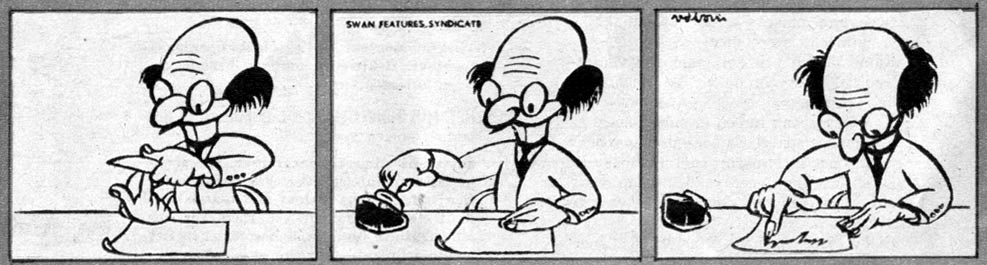
Bob van den Born was a Dutch cartoonist, best-known for his pantomime newspaper strip 'Professor Pi' (1954-1965), about a strange professor in an equally odd world. Far ahead of its time, Van den Born's strip was notable for its subtle comedy, which sometimes requires carefully studying the images to contemplate the joke. Besides running in the Amsterdam newspaper Het Parool, the feature was also distributed by Swan Features Syndicate to several international newspapers. Even though 'Professor Pi' only ran for a decade and Van den Born never made another comic again, it enjoys an enduring cult following. Outside of his comics career, Van den Born was active as a painter, illustrator and caricaturist.
Early life
Bob van den Born was born in 1927 in Amsterdam. He studied at the Rijks Normaalschool to become a drawing teacher, graduating in 1953, but eventually preferred drawing comics rather than teaching. Among his influences were Saul Steinberg, Honoré Daumier, Bruno Paul, Pieter Saenredam and Lucebert. In 1945, the Dutch government sent troops to their colony Indonesia to supress the growing resistance movement. Van den Born was one of many young Dutchmen to be drafted, though he was mostly active as a combat medic. By 1949, The Netherlands had to accept the Indonesian independence, after which Van den Born and his fellow recruits returned home.
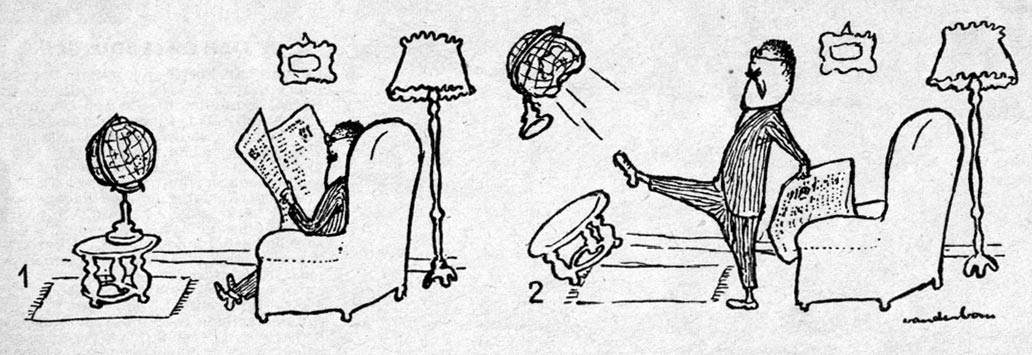
"What a world!", cartoon by Bob van den Born.
Cartooning career
Back in civilian life in 1949, Van den Born became an illustrator of news reports. In the early years after World War II, Dutch newspapers still relied heavily on drawn illustrations, before photography became a common feature. Often, photographs were difficult to obtain, so newspapers sent their illustrators to attend certain events, make portraits of people or give otherwise graphic interpretations of particular news items. As a sollicitation, Van den Born attended a Marxist meeting and sketched all participants. He then offered the drawings to the office of newspaper Het Parool and was promptly hired. For the next few years, he attended theatrical plays, parliamental meetings, court cases and other events, visualizing what he saw and heard. When a huge flood struck the Dutch province of Zeeland in 1953, he sketched the disaster area.
However, curious bystanders often looked over his shoulder while he tried to concentrate on his drawings. This irritated him, just as the large crowds at all these public events did. On top of that, the artist's very idiosyncratic view of personalities from public life and his personal graphic style did not always give the results his editors expected. This convinced him to change his profession and try cartooning instead. While some of his drawings were printed in Het Parool and the news magazine Mandril, many other cartoons were rejected. Interviewed by Peter van Brummelen for Het Parool (8 March 1991), Van den Born remembered that each time he brought 10 cartoons with him, only one might get approved. In order to make a living, he decided to create a comic strip.
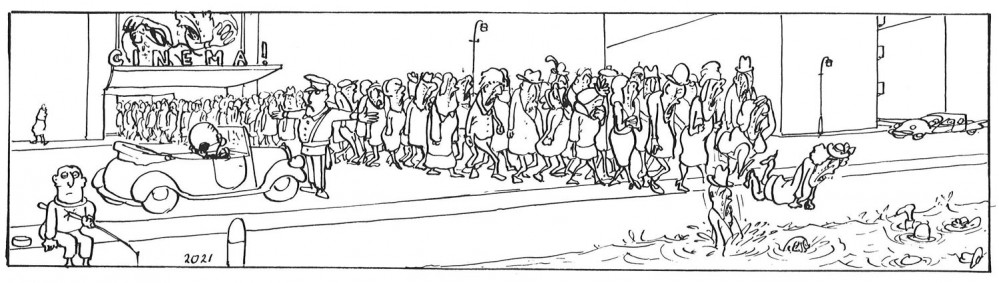
'Professor Pi'.
Professor Pi
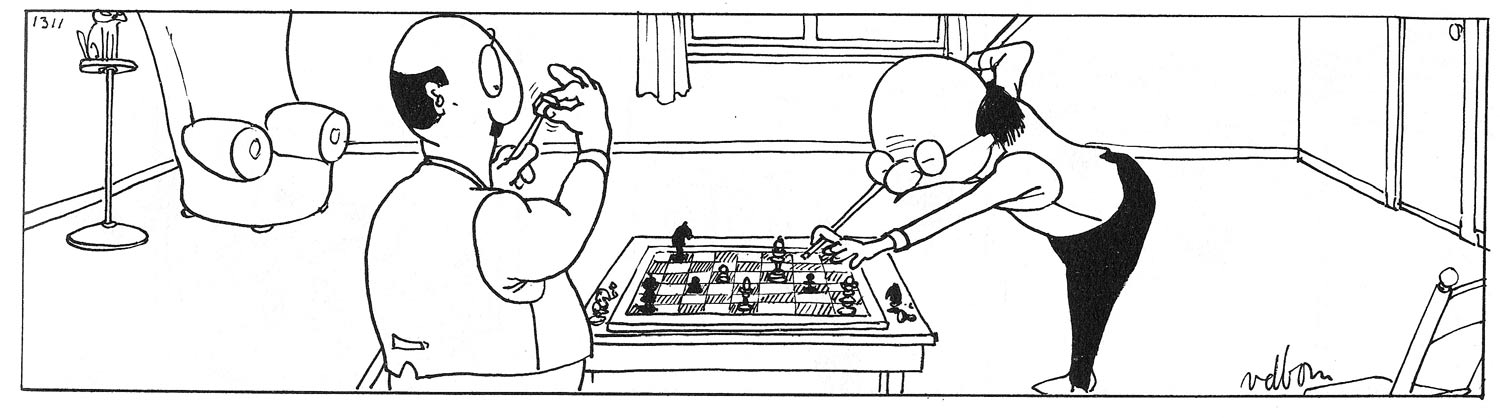
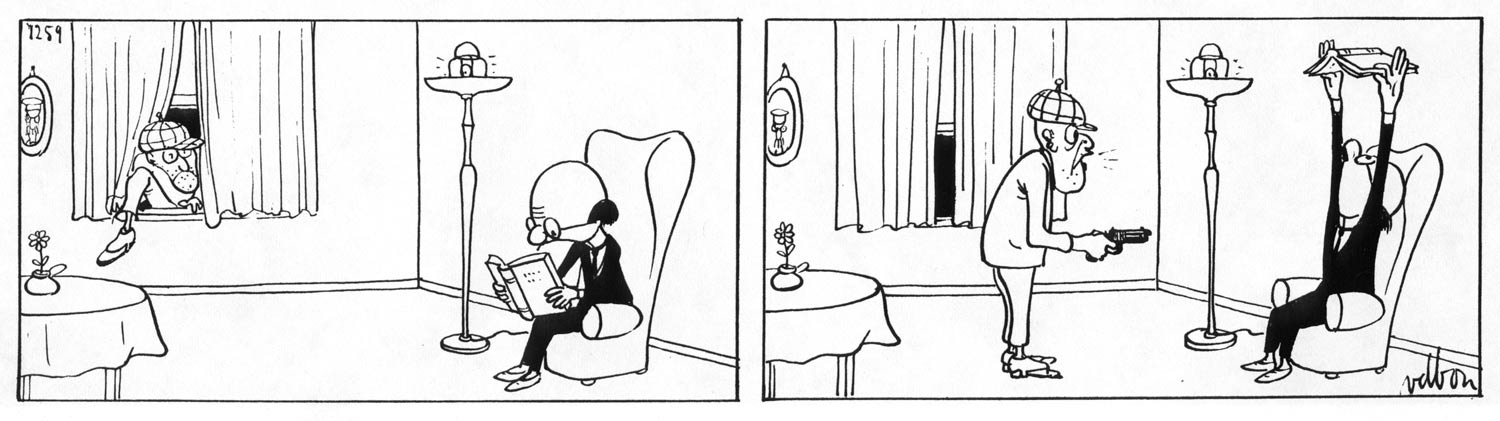
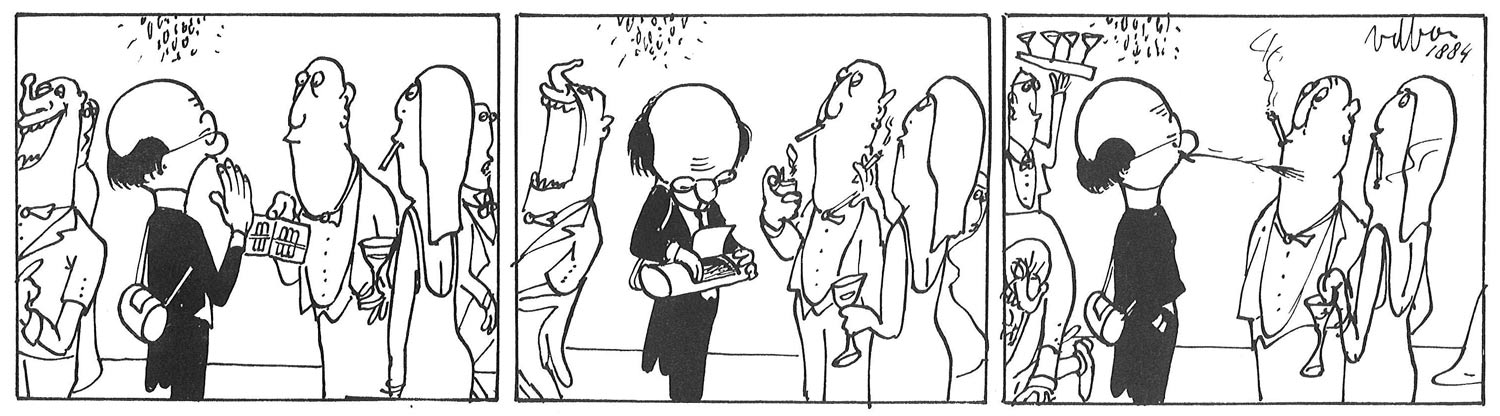
In 1954, Bob van den Born created 'Professor Pi', an absent-minded and egg-headed man who remains calm and imperturbable in every situation. Many gags poke fun at the professor's daft behavior. But likewise, many people around him act just as strange. Over the years, the titular professor grew into an ardent observer of a world increasingly absurder than himself. Van den Born took delight in thinking up visual jokes that aren't always obvious at first sight. Many of the crowded panels are full with people and animals acting bizarre, and it's not always clear whether they are part of the main gag or just extra background gags. This surrealist approach gave 'Professor Pi' its own eccentric flavor, which helped it stand out among other Dutch newspaper gag strips at the time. A comparison can be made between 'Professor Pi' and Wim van Wieringen's equally pantomime 'Simpelman' (1947-1968) strip, but this latter was far less absurd. Since the clever jokes require more meticulous observation to spot every funny detail, the comic also attracted fans among intellectuals, While 'Professor Pi' started out as a comic, it nevertheless evolved largely into a one-panel cartoon.
Originally, his home newspaper Het Parool showed no interest in 'Professor Pi', so Van den Born offered the feature to the British magazine Time & Tide instead. Only when it became a success there and found a spot in a Spanish and Chinese magazine as well, 'Professor Pi' finally got greenlighted by Het Parool. It debuted on 2 January 1955 and first ran in their weekend supplement, as a series of independent cartoons. Popular demand, including some urging of photo editor Theo Ramaker, eventually made it a daily fixture, which ran in Het Parool for almost a decade. An announcement of the daily strip appeared in the newspaper in late 1956, and the feature ran from 2 January 1957 until 9 December 1965. Decades later, between 1993 and 1998, Het Parool reprinted older episodes. Thanks to its lack of dialogue, 'Professor Pi' was easily distributable internationally and so ran with equal popularity in France, Spain, China, Italy, Switzerland, and North and South America through Swan Features Syndicate.
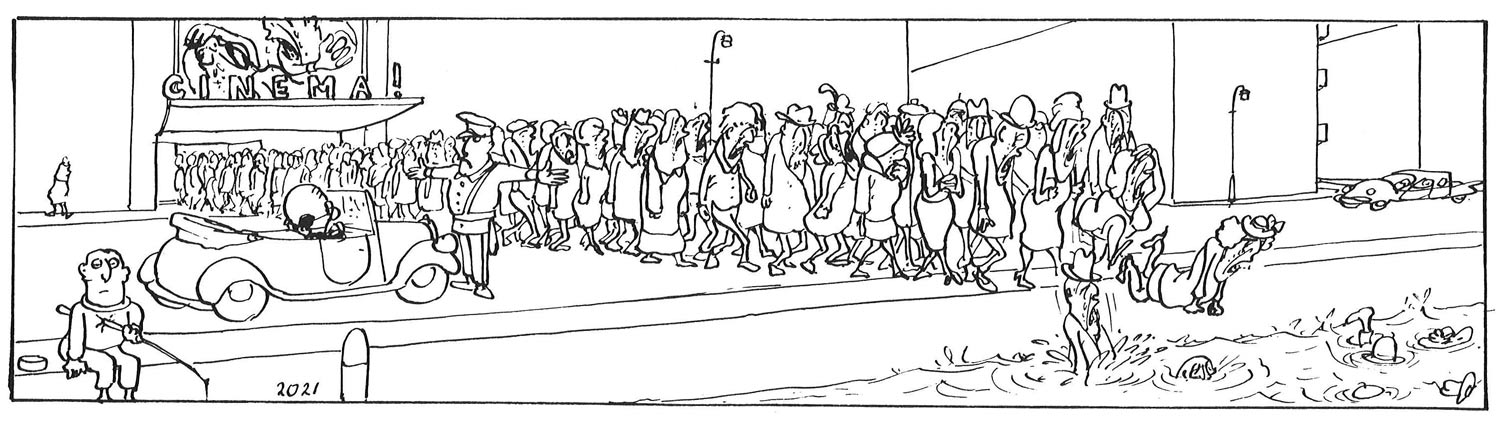
'Professor Pi'.
Despite his impressive global success, Van den Born still felt unsatisfied. Thinking up new ideas got increasingly difficult over the years. Plus: he didn't consider himself to be a genuine fan of the medium. In the previously mentioned 1991 interview with Peter van Brummelen, Van den Born confessed that he didn't like serialized comics: "I don't understand how people do this. They read three images and only 24 hours later they read the rest. By that time I've already forgotten the previous episode." He also felt that even the most beautifully illustrated comics, specifically naming Marten Toonder's 'Tom Poes' and Pieter Kuhn's 'Kapitein Rob', were too infantile for him. This also explains why Van den Born never drew longer stories and why 'Professor Pi' remained his only contribution to comic history.
In 1971, a first compilation of 'Professor Pi' comics was released as a joint production by Arcanum and Kees Kousemaker's imprint De Morsige Roerganger. Kousemaker reprinted the book in 1978 and published three more collections through his Amsterdam comic shop Lambiek in 1978 and 1979. When Kousemaker sent Hergé a copy, the 'Tintin' creator back that he liked the present, because he "had always been very interested in 'Professor Pi'."
'Professor Pi'.
Illustration career
In addition to cartooning, Bob van den Born was active as an illustrator for books and advertisements. He also made caricatures of politicians and sports celebrities in clay and paper-maché. Some have been exhibited at the Amsterdam department of Madame Tussauds. His best-known work in this wax museum was a ship featuring caricatures of Dutch politicians Piet de Jong, Marga Klompé, Hans van Mierlo, Bauke Roolvink, Norbert Schmeltzer, Joop den Uyl and Willem Witteveen. The ship worked like a carousel, spinning in circles. The piece was introduced in September 1970 and remained part of the permanent exhibition until the caricatured politicians disappeared out of public view and were replaced by others.
'Professor Pi'.
Recognition
Between 1 March and 15 April 1991, Gallery Lambiek organized a special exhibition of Bob van den Born's work, where several of his 2,929 'Professor Pi' comics were put on display. On 27 September 2008, during the Stripdagen comic festival in Houten, both Van den Born and Jaap Kramer received the Bulletje & Boonestaakschaal, an award for veterans and pioneers of the Dutch comic industry.

Collage art by Bob van den Born.
Final years and death
After 1973, Bob van den Born spent most of his time painting. From the 1990s on, he made experimental collages with the aid of a computer, and showcased them on his DeviantArt page. From 2014 on, Van den Born lived in the Rosa Spier Huis, a special retirement home for Dutch artists. He passed away on 27 November 2017 at the age of 90.
Legacy and influence
The character of Professor Pi inspired the bi-annual Professor Pi-prijs for illustrators, which in 2002 merged into the more general Amsterdam Prize for the Artst. In the Dutch city of Almere, a canal was named after 'Professor Pi', as part of the "Comics Heroes" district. Belgian math professor Dirk Huylebrouck is nicknamed "Professor Pi" and released a book under the title 'De Columns van Professor Pi' (2020).
Bob van den Born has bene named an influence on Joost Swarte.
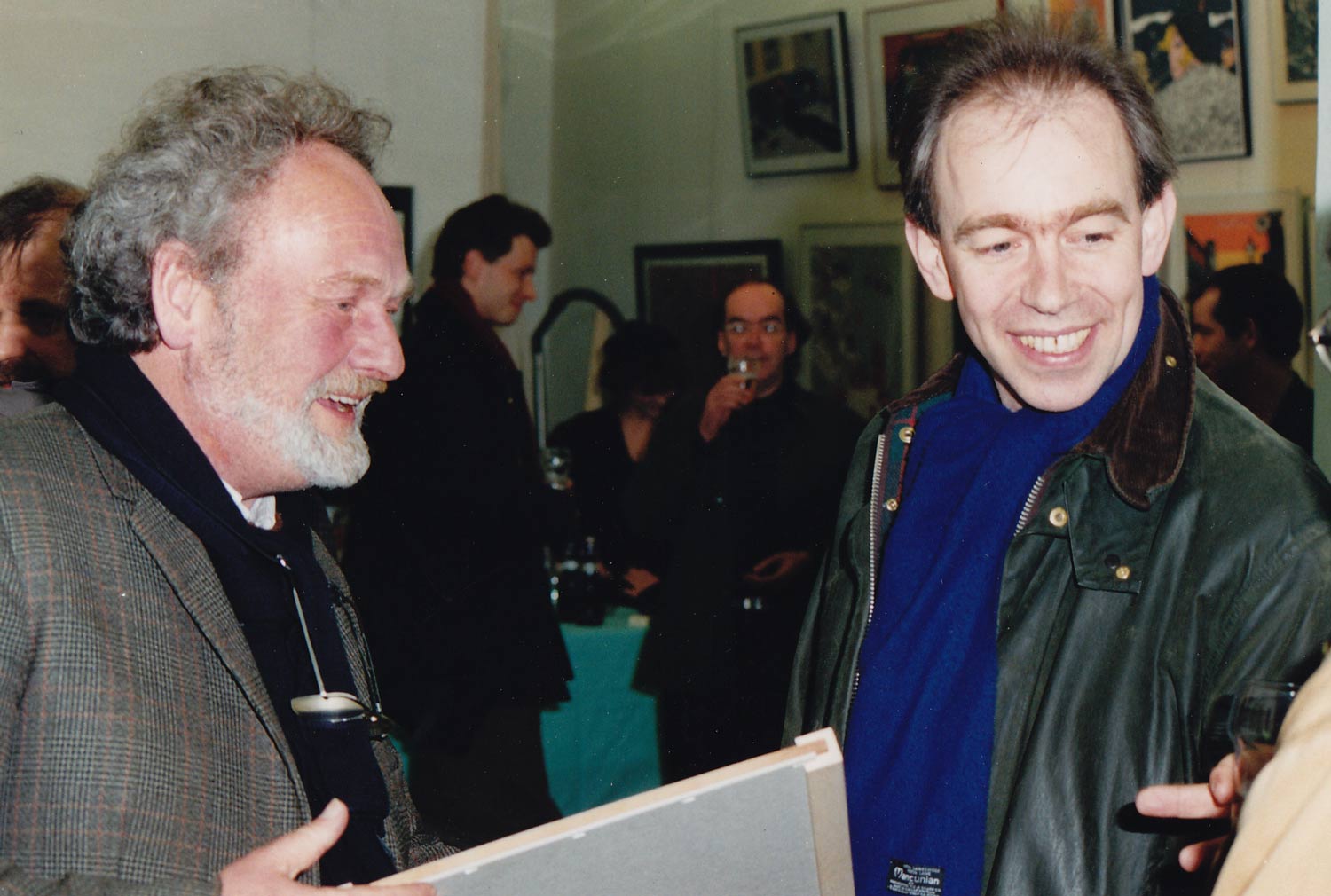
Bob van den Born (left) with Joost Swarte on the opening of his exposition at Gallery Lambiek on 1 March 1991.