

'La Cavale du Dr. Destouches'.
The twin brothers Gaëtan and Paul Brizzi are French animators, painters and illustrators. They founded their own animation studio, Brizzi Films, and created the 1985 animated feature 'Astérix et le Surprise de César’ (1985) and 'Babar: The Movie’ (1989), based on respectively Albert Uderzo's 'Astérix' and Jean de Brunhoff's 'Babar'. During the 1990s, they lent their talent and expertise to the Disney company, collaborating on various films (including 'The Firebird' sequence in 'Fantasia 2000' (1999)) and TV series, continuing well into the 21st century with work on animated films by other studios. From the mid-2010s on, the Brizzi Brothers also brought out several comic book adaptations or reinterpretations of literary classics, namely Louis-Ferdinand Céline’s 'La Cavale du Dr. Destouches' (Futuropolis, 2015), 'L'Automne à Pékin' (217), 'L'Enfer de Dante' (2023), 'Don Quichotte de la Manche' (2023) and 'Le Fantôme de l'Opéra' (2025).
Early life and career
The Brizzis were born in 1951 into an Italian family, and raised in Paris, where they studied at the École Nationale Supérieure des Arts Decoratifs. Among their graphic influences are painters Arnold Böcklin, Gustave Doré, Jean-Léon Gérôme and Gustave Moreau. In 1974, their first short 'ONE' was acclaimed by the critics. They also gained attention with their short 'Fracture', which won the César Award for Best Animated Short Film in 1977. The brothers have since cooperated on many film productions, mainly short film and commercials.
The Brizzi Brothers directed the animated feature 'Astérix et la Surprise de César' ('Asterix vs. Caesar', 1985) for Gaumont Film Company, which was the fourth movie adaptation of the comic series by René Goscinny and Albert Uderzo. The story combines the plots of two 'Astérix' albums, namely 'Astérix le Gladiateur' ('Astérix the Gladiator') and 'Astérix Legionnaire' ('Astérix the Legionary'). The catchy title song, 'Astérix est Là', was sung by Belgian pop singer Plastic Bertrand (of 'Ça Plane Pour Moi' fame). It was a rather rushed project, since the Brizzi Brothers only received a year to complete it, literally starting from nothing. While they are still pleased with the picture, they do consider the second half of the movie less well-executed, because they were running out of time. One artist who worked on 'Astérix et la Surprise de César' was Ben Van Voorn.
The Brizzi's also worked on the animated science fiction series 'Les Mondes Engloutis' ('Spartacus and the Sun Beneath the Sea', 1985-1987), created by Nina Wolmark and scripted by Dominique David.
Brizzi Films
In 1986, the Brizzi Brothers established their own animation studio, Brizzi Films. One of their earliest projects was 'Don Martin Does It Again' (1986), an animated short directed by the Brizzis in collaboration with Andy Knight, produced in Germany by Gerhard Hahn’s Deutsche Zeichentrick Erste Produktions GmbH & Co. KG. The short was based on the cartoons of Mad artist Don Martin, with direct creative consultance from Martin himself. Due to its anthology format, the scenes could also be broadcast as standalone cartoons for TV broadcasts. While they were seen on some European TV channels, they were never broadcast in the U.S. The film received first prize at the International Children’s Film Festival in Chicago.
The Brizzi's then went into co-production with the Canadian animated studio Nelvana Limited to adapt Jean De Brunhoff's classic children's book series 'Histoire de Babar'. The royal elephant starred in a 1986 holiday special, 'Babar and Father Christmas' (1987) first, which won the Gemini Award for 'Best Animated Adaptation or Series'. This paved the way for an animated TV series, 'Babar' (1989-1991), directed by Larry Jacobs, Raymond Jafelice, Laura Shepherd and Dale Schott. In this version, Babar was remodeled with a shorter trunk and simpler colors for merchandising purposes. The Old Lady became tall and slender, rather than chubby like in the original novel. Another character, Pompadour the servant, was created specifically for the series. The season finale was released as a feature film, 'Babar: The Movie'. One of the animators who worked on the 'Babar' TV series was Jeff Baud. 'Babar' became a global TV success.
The Disney years
In 1989, the Brizzis sold their studio to the Walt Disney Studios and subsequently worked as unit producers on several Disney animated films, including 'DuckTales the Movie: Treasure of the Lost Lamp' (1990) and 'A Goofy Movie' (1995). They also helped out with the animated TV series 'TaleSpin' (1990-1991) featuring Baloo, King Louie and Shere Khan from Disney's 'Jungle Book' (1967) reimagined as aviators. Another project was a 1991 Christmas special, 'Winnie the Pooh and Christmas Too'. They also directed one episode of the badly received animated TV series 'Marsupilami' (1993), based on André Franquin's comic series. Franquin's heirs and right holders later succesfully sued Disney to receive the rights for animated adaptations of the long-tailed Marsupilami back.
By the mid-1990s, the Brizzis moved to Los Angeles, California, as storyboard artists and visual developers behind Disney productions like 'The Hunchback of Notre Dame' (1996) and 'Tarzan' (1999). They were responsible for pushing the 'Hell Fire' scene in 'The Hunchback of Notre Dame' to be included in the movie, despite fear of being censored. They also directed the final sequence of the anthology film 'Fantasia 2000' (1999), a sequel to Disney's 1940 classic 'Fantasia'. The sequence in question was based on Igor Stravinsky's ballet 'L'Oiseau du Feu' ("The Firebird"), albeit in a shortened, rearranged version with a plot that has nothing to do with the original fairy tale Stravinsky based his plot on. The Disney version turned it into a simple tale of a forest spirit who is threatened by a huge firebird who destroys nature.
The Brizzi's left Disney in 2001. Their studio in France closed a year later due to the Disney Company downsizing on feature animation. Nevertheless, they did provide storyboards to the film 'Enchanted' (2007), a live-action picture about a typical Disney princess who suddenly finds herself in the real world. Her life in a fairy tale world was animated with traditional hand-drawn graphics in a parody of the typical Disney clichés.
Animated films in the 21st century
The Brizzi's helped out with '9' (2009), a feature-length adaptation of Shane Acker's animated short of the same name. Tim Burton was one of the producers. The plot is a post-apocalyptic tale about robotic dolls who fight machines after all mankind was wiped out of existence. Storyboards by the Brizzis also enriched 'Astro Boy' (2009), a CGI-animated feature based on Osamu Tezuka manga series, directed by David Bowers. The brothers also collaborated on 'The Prophet' (2014), Rogers Allers' adaptation of Kahlil Gibran's book of fables of the same name. Each fable is a separate segment in the film, animated by different artists, namely Joan C. Gratz, Mohammed Saeed Harib, Tomm Moore, Nina Paley, Bill Plympton, Joan Sfar and Michal Socha. The Brizzi's directed the segment about death. The siblings also provided storyboards for films like 'Sinbad the Sailor', 'Cloudy with a Chance of Meatballs', 'Hotel Transylvania' and 'Surf's Up', but in most cases the final movies looked nothing like their initial atmospheric drawings.
The Brizzi's final contribution to an animated film was done for 'Space Jam: A New Legacy' (2021), a sequel to 'Space Jam' (1996) starring basketball champion LeBron James and the Looney Tunes characters. At one point, the brothers would collaborate with film director Luc Besson and the Rolling Stones to create an animated adaptation of 12 hit songs by the band. The planned film, 'Ruby Tuesday', would take its inspiration from the legend of 'Faust', but eventually was scrapped when Besson and Mick Jagger had creative differences.
Early comics
In 1985, the Brizzi's made their first comic strip, to promote the animated TV series 'Transformers'. These mini comics were added as a free gift whenever somebody bought a 'Transformers' toy, as part of the 'Diaclone' series. It took another 20 years before the siblings made another comic, this time at the request of Fabrice Giger, head of publishing company Les Humanoïdes Associés. Giger asked them to create a story about legendary spy Mata Hari, 'Oeil du Jour' (2007), to be published in the magazine Métal Hurlant. Gaëtan usually focuses on the backgrounds, while Paul draws the characters. After each of them has done their part, the finished pages are streamlined a bit more to increase the readability and make it more like one person drew it. Thanks to their background in film, the brothers have a very cinematic approach towards their comics.
La Cavale de Dr. Destouches
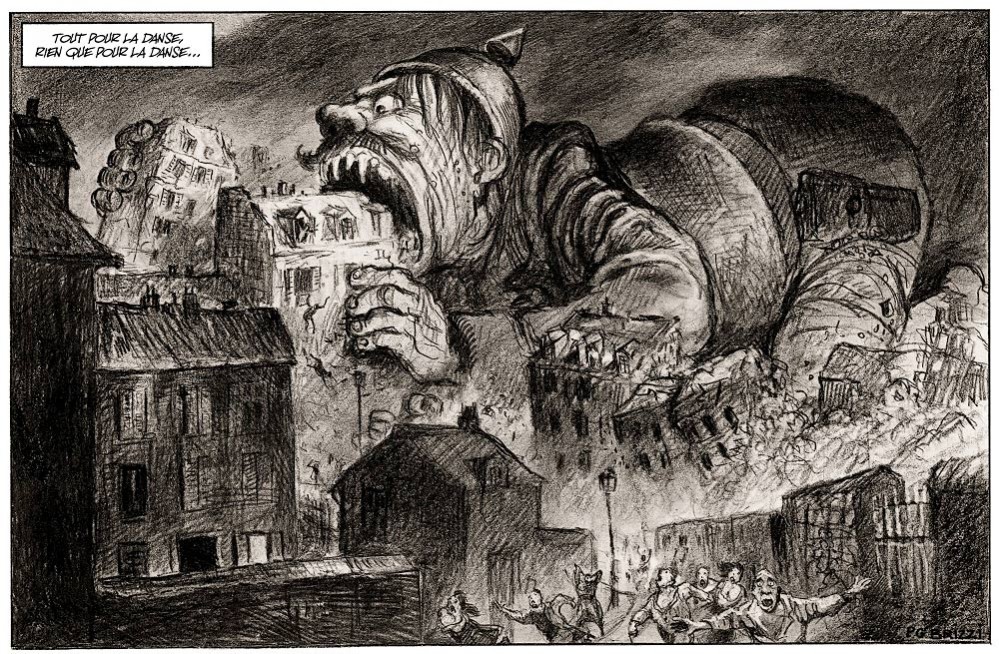
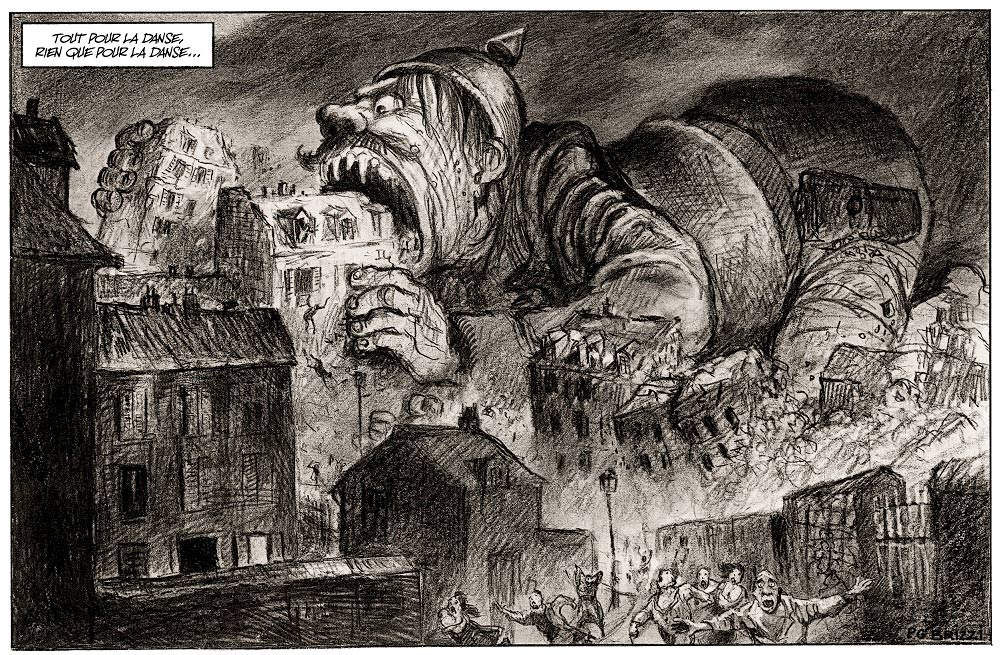
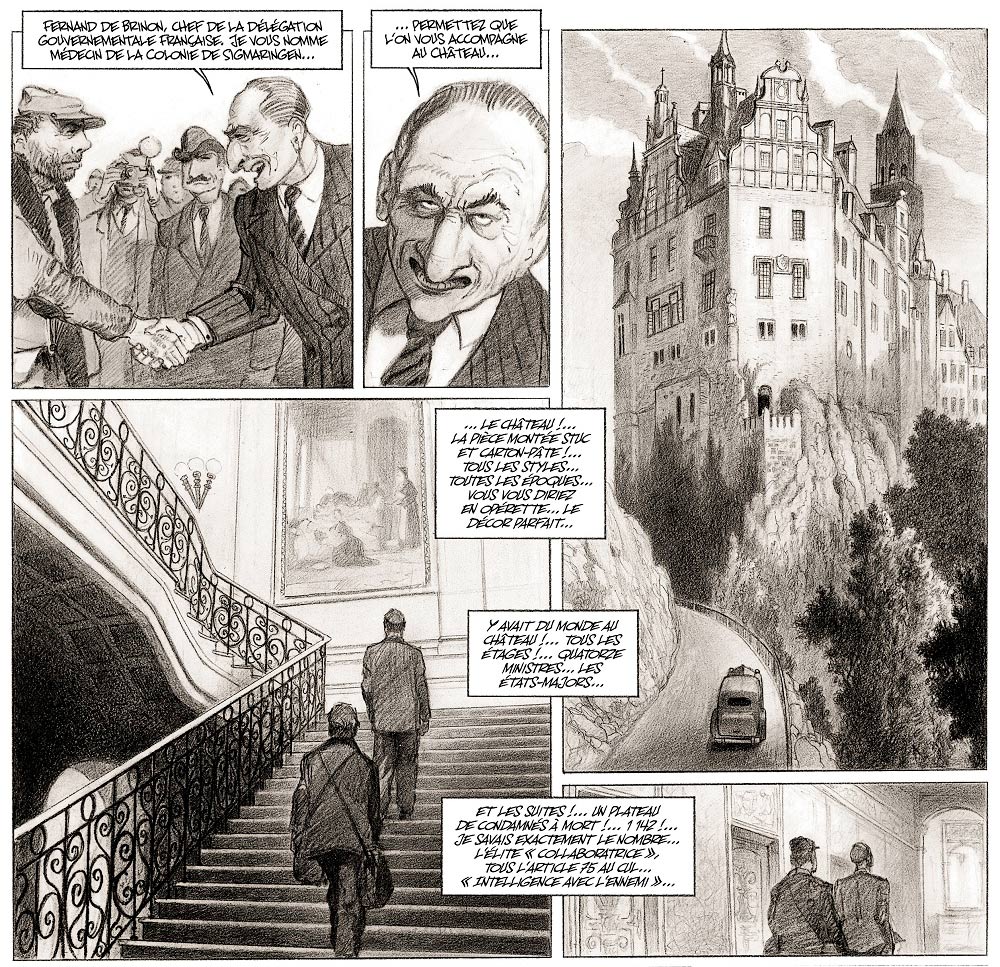
Since the 2010s, the Brizzis have also been active in comic books. Their first graphic novel was 'La Cavale du Dr. Destouches' (Futuropolis, 2015), made in collaboration with scriptwriter Christophe Malavoy. It's an adaptation of a novel trilogy by the controversial French writer Louis-Ferdinand Céline (1894-1961). Céline had gained fame with his provocative novel 'Journey to the End of the Night' in 1932, but had spent World War II openly supporting the Nazis and antisemitism. He fled through Germany with other members from the French Vichy regime near the end of the war, and spent a year and a half in prison in Denmark. He chronicled his experiences in the novels 'Castle to Castle' (1957), 'North' (1960) and 'Rigadoon' (1969), which form the basis for the comic book of the Brizzi brothers. Malavoy first wanted to adapt his script into an animated feature, but was decided to turn it into a graphic novel, since the controversy surrounding Céline would make it difficult to find sponsors for the film.
At first, the Brizzi's were uncertain, since they had never drawn a full-blown comic book before. They had illustrated a 2007 reprint of Ludovico Ariosto's 16th-century narrative poem 'L'Orlando Furioso', published by Pagliai Polistampa, which gave them some idea of how to approach a graphic adaptation. After a test page, they got the hang of it and decided to make more graphic novel adaptations of novels.
'Le Cavale du Dr. Destouches'.
L'Automne à Pékin
In 2017, the Brizzi Brothers adapted Boris Vian's novel 'L'Automne à Pékin' ('Autumn in Peking') into a graphic novel, after unsuccesfully trying to turn it into an animated feature film. The story revolves around two men, Anne and Angel, who work on a railroad in Beijing, China. Rochelle, a secretary is in love with Anne, but Angel craves for Anne, despite her having no attention for him. The book was published by Futuropolis.
Graphic novels inspired by Gustave Doré
In the early 2020s, the Brizzi Brothers adapted several literary classics once illustrated by the legendary and imaginative artist Gustave Doré. The first one was 'Les Cent Contes Drolatiques' ("Droll Tales", 2021, a series of humorus short stories by Honoré de Balzac. Two years later, they released their version of Dante Alighieri's 'The Divine Comedy', about the poet's visit to Heaven, Hell and Purgatory. The book, titled 'L'Enfer de Dante' (Daniel Maghen, 2023), features breathtaking artwork made with graphite, directly inspired by Doré's equally classic illustrations for Dante's narrative poem. While the Brizzi's admire Doré, they feel that his original drawings are too static to be transpolated directly into a comic format. Therefore, they made more use of expressive faces and dynamic action in their version. The Brizzi's adaptation also received an English-language translation by Abrams ComicArts as 'Dante's Inferno'.
In the same year as 'Dante's Inferno', the Brizzi's released another graphic novel based on a literary classic once illustrated by Doré, namely Miguel de Cervantes' 'Don Quixote'. It was released under the title 'Don Quichotte de la Manche' (Daniel Maghen, 2023). The Brizzi's wanted to adapt the story for decades. Back when they worked for the Disney studios, they tried to get it greenlighted for an animated adaptation. In their script, Quixote would be like a psychiatric patient, interviewed by a doctor. However, interviewed by Alexis Seny (Branches Culture, 10 December 2023), they explained that a Disney CEO put the project to a halt, because in his opinion "children wouldn't be able to identify themselves with an old man." Back then, the brothers felt frustrated, but in hindsight, they agreed that a comic book adaptation was not only less costly and quicker to produce, but would allow them more creative freedom. Since 'Don Quixote' is a genuine doorstop, several scenes had to be shortened. To solve this obstacle, the Brizzi's used the character of a priest, who tries to get the loony knight back home and provides summarized expositions of various scenes the authors left out.
Le Fantôme de l' Opéra
In 2025, the Brizzi's released an adaptation of Gaston Leroux' 'The Phantom of the Opera', 'Le Fantôme de l'Opéra' (Futuropolis, 2025), followed by an adaptation of Shakespeare's 'Macbeth' (Daniel Maghen, 2025).
Other projects
The Brizzi's also work closely together on Fine Arts projects which vary from oil on canvas to graphites, sculptures and watercolors, and which they have exhibited in Paris and Los Angeles. They have also illustrated reprints of Boris Vian's 'L'Écume des Jours' (2020), Edgar Allan Poe's 'Double Assassinat Dans La Rue Morgue' ("Murders in the Rue Morgue", 2023) and 'La Chute de la Maison Usher' ("The Fall of the House of Usher", 2023), all published by Futuropolis.