



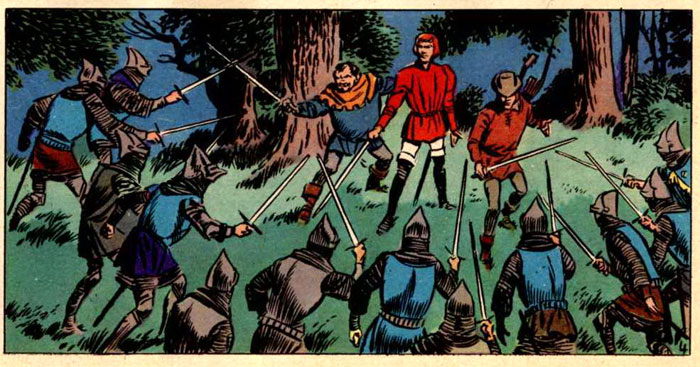
'Le Chevalier Blanc' - 'Sans Peur et Sans Reproche' (Tintin, 1954).
The Belgian artist couple Fred and Liliane Funcken were steady contributors to Tintin magazine from the 1950s through the 1980s. Specialized in historical comics, they produced a great many educational short stories on historical characters and events, and additionally several series set in all sorts of time periods. Their chivalry romic 'Le Chevalier Blanc' (1953-1973, 1987-1988) was their longest-running creation, followed by the Viking series 'Harald Le Viking' (1956-1967). They additionally launched the western series 'Jack Diamond' (1959-1960), 'Lieutenant Burton' (1962-1967) and 'Doc Silver' (1967-1969), as well as the swashbuckler comic 'Capitan' (1963-1971). The Funckens are the first known example in Belgian history of a husband and wife creating comics as equals. They were a genuine team, collaborating on both stories and artwork to the point that their individual contributions were indistinguishable. Throughout their long career, they built up a strong reputation as a reliable unit whenever realistically-drawn and well-researched historical or military artwork was required. Outside of the field of comics, Fred and Liliane Funcken were notable for illustrating the best-selling and widely translated non-fiction book series, 'L'Encyclopédie des Uniformes et de Armes de Tous les Temps' (1965-1982), documenting military weapons and uniforms throughout history.
Fred Funcken: early life
Fred Funcken was born in 1921 in Verviers, in the province of Liège. While showing great drawing talent at an early age, Fred initially dreamt of becoming a musician. He entered the Conservatory and graduated with a second prize in cello. However, his future turned out to be in drawing. He was only 12 or 13 when his first advertising strips for Lutti candy appeared in the local Verviers newspaper Le Jour. At 16, he started working as an apprentice in a lithographic printing shop, where he drew a series of 45 chromo cards with the Three Musketeers for the chocolate company L'Aiglon. Spending six months on the project without pay, his boss handed him a mere 50 Belgian francs when the work was done, after which Funcken stormed out of the print shop. He subsequently found a job with the Gordinne printery in Liège, where he worked in zincography in a team of ten artists.

First illustration by Fred Funcken in Spirou, for the serial 'Crime de Bolle Winter' (Spirou #5, 1 February 1940).
In 1939, Funcken started his professional career as an illustrator at Dupuis, publisher of the comic magazine Spirou and the illustrated weeklies Bonnes Soirées and Le Moustique. In early 1940, he illustrated several of Spirou's "Le Fureteur" editorial pages by editor Jean Doisy, as well as tales and text serials, such as 'Crime de Bolle Winter' by Arthème Dupin. When World War II broke out, Fred Funcken spent six months serving as an army cook in France. After returning to occupied Belgium, he resumed his work as an artist. As the import of U.S. comics was halted by the Nazi oppressor, Funcken was commissioned by Spirou's editor to finish the ongoing 'Brick Bradford' comic (by William Rit and Clarence Gray), improvising the rest of the cut-off story. His eight pages appeared in Spirou issues #51 of 1940 through #6 of 1941.

'Brick Bradford' by Fred Funcken for Spirou #2, January 1941.
Fred Funcken at Studio Guy
Fred Funcken's actual debut as a comic creator was in 1941, when he joined Guy Depière and his Studio Guy in the Brussels suburb Elsene. Among his first jobs there was creating content for Studio Guy's first comic magazine, Aventures Illustrées. Initally fully written and drawn by Depière himself, Funcken was among the first additional artists, allong with Valentin Dufrasne and later Marcel Moniquet. While most of the series were created and scripted by Depière, the artwork was eventually handed to the rest of the team, with each artist participating to every feature at one point or another.
At Aventures Illustrées, Funcken was tasked with drawing the western comic 'Tommy Tuller' and the space opera serial 'Akkor, le Roi dela Planètes' (1941-1942). Simultaneously, Funcken drew another western comic called 'Bob Hunter' for L'Eclair, a magazine published by ESPES. When Aventures Illustrées and L'Éclair merged into Aventures Illustrées-Bimbo, Fred Funcken received a prominent role in the title, even drawing most of its pages. While Moniquet took over 'Tommy Tuller', Funcken worked on new serials, such as the humor strip 'Bricole', 'Wolman, Détective' and 'Roberjac, Le Mousquetaire du Roy'. In Bimbo, Funcken also created 'Robin Moderne', a comic obviously modeled after Lee Falk's 'The Phantom' (1942).

'Robin Moderne' (Aventures Illustrées-Bimbo #36, 1941).
In September 1942, Fred Funcken's promising career was interrupted when the Nazi oppressors banned Bimbo because of its anglophone content. In February 1943, Funcken was sent to Nazi Germany to do forced labor, and didn't return to his home country until early 1945. A month after the Liberation of Belgium (September 1944), Bimbo magazine had returned to the market. Studio Guy resumed most of the war-time series, while the young artists Maurice Tillieux and Fernand Cheneval also joined the team. When he returned to Belgium in early 1945, Fred Funcken picked up his previous western comic 'Tommy Tuller' again, while also collaborating with Marcel Moniquet and Fernand Cheneval on the science fiction serial 'Akkor', later continued by Cheneval alone. A new post-war feature drawn by Fred Funcken was the comic about the reporter 'Big Travler'. These comics were drawn under a variety of mostly anglicized pseudonyms, such as Fred Gu, Fred Dye, W.K. Philips, Dick John's, Ranch, Mac Bones, Léo Lyon and Hector Hugo.
In June 1945, Guy Depière established another comic magazine, Jeep, for which Funcken drew 'Gogo Laroulette et Cie'. In Jeep's sister magazine for girls, Blondine (April 1946), Funcken drew 'Les Aventures Héroïques de Geneviève'. Shortly afterwards, both titles were merged into Jeep-Blondine. Some of these stories were later reprinted in albums under the Studio Guy imprint. However, the Depière titles had difficulties competing wiht the other comic magazines of post-war Belgium, such as Spirou, Tintin, Wrill, Bravo! and Story. The final issue of Jeep-Blondine appeared in February 1947, while Bimbo managed to continue until February 1949. By then, Fred Funcken had already left the team, displeased with Guy Depière's meager payment and amendments to artwork.
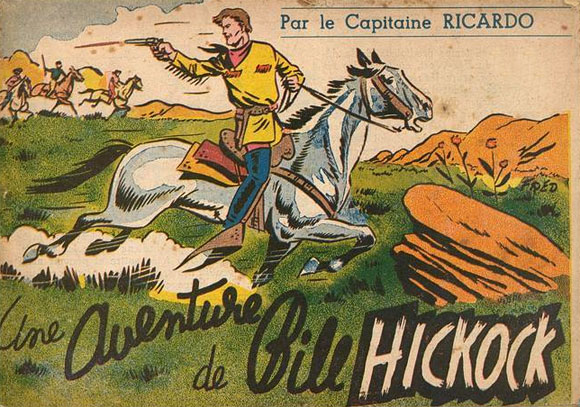
'Une Aventure de Bill Hickock'.
Fred Funcken: further solo comics
In 1947, Fred Funcken was commissioned by the publishing house Campéador to create the naval adventure comic album 'Le Cimetière des Baleines'. Shortly afterwards, he was hired by the advertising agency Havas Belgique at De Brouckère square in Brussels, as a dummy maker and commercial artist. In addition, he was a cover illustrator for several publishers. For O. Bracke & Fils, he illustrated the pulp crime novels by Gustave Van Loo, AKA "Le Capitaine Ricardo". In the meantime, he tried to continue his work as a comic artist, resulting in sporadic assignments like the unfinished 'Guy le Proscrit' (1948), made under the pen name Mary for Annette magazine. For L'Explorateur, the youth magazine of the Catholic Pro Pace movement, he adapted the Jack London novel 'White Fang' ('Croc Blanc'), Herman Melville's 'Moby Dick' and J.-H. Rosny ainé's 'La Guerre du Feu' into comic serials, as well as the adventure feature 'Frédéric Lefranc Explorateur' (1949). When the title switched to a smaller format, Funcken created the additional serials 'La Trahison de Dingaan' (1950) and 'Terres Interdites' (1951).


Cover illustrations for L'Explorateur (1951).
In the second half of the 1940s, several of the former Studio Guy artists had found a new home in the pages of Fernand Cheneval's Héroïc-Albums, a magazine modeled after American comic books with a full-length adventure story in each issue. In 1947, Fred Funcken contributed the cowboy story 'Le Tueur Noir', but after that, his contributions remained limited to reprints from Bimbo, for instance the features 'Tommy Tuller', 'Robin Moderne' and 'Big Travler'. It wasn't until 1953 before Cheneval finally managed to recruit Funcken, who first contributed the humorous adventure comic 'Yves et Cocluche' (1953), before returning to realism with the 17th-century swordslinger 'Jannic' (1953-1954) and the contemporary action series 'Clem et Shorty' (1954). In 2022, all stories by Fred Funcken for Héroïc-Albums were collected in book format by Les Editions Hibou.

'Clem & Shorty' by "Hector Hugo & Léo Lyon" from Héroïc-Albums #20, 1956 (Dutch-language edition).
While Fred Funcken had drawn an impressive amount of comics in all sorts of genres and styles during the 1940s, he was often underpaid and didn't always receive proper recognition for his work. Attempts to get his work published were often discouraging. In the 1947 interview book 'Le Duel Tintin-Spirou' by Hugues Dayez, he described how he once sent a page World's P. Presse, the agency that provided the magazines of publisher Dupuis with comics and other features. When he subsequently went to the office for a job interview and waited in the hall, he suddenly noticed the page he had submitted sticking carelessly out from under some files on the floor, with a huge shoe print on it. On top of that, no manager showed up. Instead he was confronted with Jijé, already a notable veteran in the rising Belgian comics industry. Funcken received such harsh criticism, that he had had the impression that the whole thing had been a set-up. In the 1997 interview, Funcken recalled that even Jijé's wife felt that her husband needed to calm down and blamed his temper on a stomach condition.

'Jannic' (Héroïc-Albums, 10 June 1953).
Liliane Schorils
The humiliating experience at World's P. Presse made Fred Funcken decide to drop comics altogether, and resume his day job at the Havas agency. One year later, in 1949, he was working as an artist in the decorating studio of the Grands Magasins de l'Innovation department store in Brussels. While designing displays, he met the young executive secretary Liliane Schorils. Sparks flew and a relationship and marriage followed. The couple had one daughter, Claudine. From the start, Fred and Liliane Funcken complemented each other, both personally and creatively.
Born in 1927 in Soignies, Hainaut, Liliane Schorils had the desire of becoming a lawyer, but instead landed a secretary job at L'Innovation. In addition, she was doing freelance writing jobs for the Dupuis magazines through World's P. Presse on the side. These included scripts for the educational historical comic series 'Les Belles Histoires de l'Oncle Paul' for Spirou, and many "true stories" for the women's weekly Bonnes Soirées. While Fred was more sensitive towards criticism and rejection, Liliane had a more confrontational nature and hands-on mentality. When hearing from her husband's experience with Jijé, she encouraged him to give it another try and practically dragged him back to the World's P. Presse offices. There, they met Jean-Michel Charlier, who was far more receptive of Fred's work, and gave him some 'Oncle Paul' scripts by Octave Joly as try-outs. In the period 1953-1954, ten four-page stories by the Funckens appeared in Spirou magazine, some of which were signed "Kendy". Under that same, Fred also drew romanticized biographical comics for Bonnes Soirées.

Les Belles Histoires de l'Oncle Paul - 'La Prouesse du Syracusain' (Spirou #822, 14 January 1954).
In the meantime, Fred and Liliane Funcken had also offered their services to Tintin magazine at publisher Le Lombard, where their first contributions appeared in 1952. Fred Funcken's excursion to Spirou was short-lived, since, at the time, it was an unspoken rule that a comic artist couldn't work for these two rival magazines at the same time. During the mid-1950s, Funcken continued to appear in comic magazines like Héroïc-Albums, but he eventually worked exclusively for Tintin. Liliane on the other hand continued to write for the Dupuis magazines for some additional years.
At Tintin, Fred and Liliane Funcken also began their enduring collaboration, gradually transforming into an inseparable creators team. At first, Liliane helped with scripts, then also with inking, coloring and lettering. When in 1953 Fred fell ill with the flu, Liliane decided to jump in for him and finish that week's page. Despite never having drawn a comic before, Liliane was graphically experienced enough and so the artwork matched her husband's style. Fred hated inking, because to him it was like doing the same job twice. But Liliane had a gift for precise rendering of ink by use of a brush. The first time Fred showed Tintin's art editor Evany the page Liliane had inked, he didn't tell him about her contribution, just to test whether he would notice the difference. Evany instantly noticed that the linework was notably "cleaner than otherwise." From that moment on, Fred and Liliane always worked together, handling all aspects of the creative process. Whenever they prepared a script, they both did research and brainstormed everything into a script. Fred usually made the preliminary sketches, did backgrounds and focused on faces and hands, while Liliane concentrated on drawing clothing, and then inking and coloring everything afterwards.
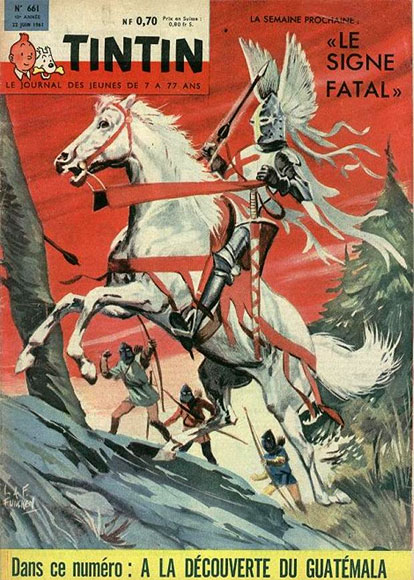
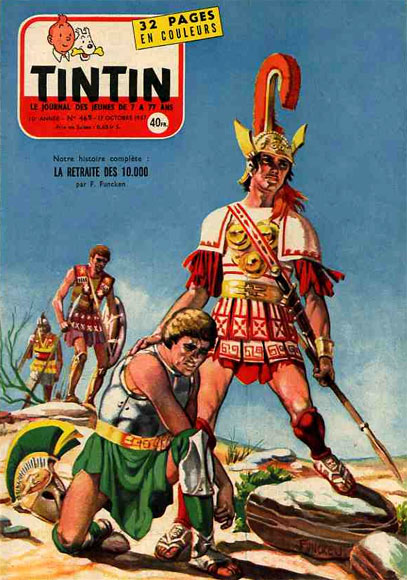
Cover illustrations for Tintin (issue #661, 22 June 1961, and #469, 17 October 1957).
Tintin magazine
In Tintin magazine, Fred Funcken initially made mostly illustrations for text serials, the first being 'La Terrible Nuit de Bill Baynes' by John Flanders, published in issue #32 of 1952. The earliest comic stories by Fred and Liliane for Tintin were mostly drawn in Hergé's characteristic "Clear Line" style. These included the humorous Boy Scouts adventure serial 'Luc et Laplume: Le Trône de Gilgit' (1952-1953) and the sports humor story 'Ça C'est Du Sport' (1952). A year later, the Funckens shifted their focus towards historical-educational comics, drawn in a more realistic, personal style that looked less like a Hergé imitation but still fit the "fine art" standard of the magazine. Hergé himself was very supportive of their work, and often provided them with documentation. Some of the Funcken's comics were romanticized biographies of real-life historical characters, like Godfrey of Bouillon, Spartacus or 19th-century archeologist Heinrich Schliemann. They were typically condensed into four-page short stories as a direct answer to Spirou's similar historical-educational series 'Les Belles Histoires de l'Oncle Paul'. During the 1950s and 1960s, the Funckens, often along with scriptwriter Yves Duval, produced over 250 of them, covering all time periods. In longer serials, they adapted historical novels and short stories, like Paul Féval's 'Henri de Lagardère' and Alexandre Dumas' 'Les Trois Mousquetaires', 'Le Comte de Monte-Cristo' and 'La Tulipe Noire' (respectively 'The Three Musketeers', 'The Count of Monte-Cristo' and 'The Black Tulip').

Luc et Laplume - 'Le Trône de Gilgit' (Tintin #37, 10 September 1952).
At Le Lombard, the Funckens gained a reputation for being reliable draftspeople. At one point, fellow artist Jacques Martin joked that the magazine might as well be renamed after them, because every time when the editors needed somebody to fill in for artists that fell ill that week, the couple were contacted. As they prepared a story, they divided the work and alternated on tasks, making it easier for them to reach their deadlines than a solo artist. Between 1955 and 1962, for instance, the Funckens contibuted over 1,600 drawings for the educational feature 'L'Histoire du Monde' ("The History of the World)" by abbot Jean Schoonjans. These richly illustrated articles were collected in three books by Le Lombard between 1958 and 1960. The Funckens were also good friends with Paul Cuvelier and helped him out with the two first pages of his medieval comic 'Flamme d'Argent' (1960-1963). Whenever Cuvelier was depressed, they also offered him comfort. In 1960, they also helped out Edgar Pierre Jacobs with the 'Blake & Mortimer' story 'Le Piège Diabolique' ('The Time Trap'), a time travel story partially set in the Middle Ages. Jacobs felt they could portray this historical era better than him. However, after penciling the pages, Jacobs provided the finished inks and then pretended having done everything on his own, straining their friendship. Nevertheless, Fred and Liliane could still produce the letter he had sent to him for help, proving their collaboration.

'Waterloo' (Tintin #24, 17 June 1953).
Le Chevalier Blanc ("The White Knight")
About a year after joining Tintin, the Funckens were offered their own series. Through art director Evany, they were handed a chivalry plot submitted by the young artist Raymond Macherot. As the editors felt Macherot was more suitable for humorous comics - he would become a staple in the magazine with the funny animal series 'Chlorophylle' - they suggested that Fred Funcken should draw it. Ironically, Funcken at the time was mostly working in a caricatural register, and now permanently switched to realism. This resulted in 'Le Chevalier Blanc' ("The White Knight", 1953-1963), which turned out to be the Funcken's longest-running series. Debuting in Tintin issue #40 of 7 October 1953, the first story was still drawn by Fred alone, with Liliane joining in with the later episodes.

Le Chevalier Blanc - 'Echec au Roi' (1960).
The main character is the noble knight Jehan de Dardemont, who returns from the Crusades to discover his father has been murdered. He decides to pick up the family tradition and become a masked crusader, dressed in white, nicknamed "the White Knight". After avenging his father's death, Jehan continues to fight injustice in service of the King, accompanied by his friends Laflèche and Taillefer.
The series ran in Tintin's Dutch-language edition under the title 'De Witte Ruiter' (and not 'De Witte Ridder' as is sometimes believed) and was also one of the earliest comics created on the European continent to be released in the United Kingdom, where it appeared under the title 'The Phantom Knight'.
After ten serial stories, the white knight put his sword aside in Tintin issue #767 (4 July 1963). Between 1984 and 1987, the Funckens returned to the character and created new, albeit shorter stories, sometimes in collaboration with scriptwriter Didier Convard. Between 1956 and 1965, Le Lombard released five albums of 'Le Chevalier Blanc'. In later years, new volumes were published by imprints like Chlorophylle (1970s) and Hélyode (1990s). In 2014, the comics heritage imprint re-released the entire series in limited editions.

Harald le Viking - 'L'Escale de la Peur' (Tintin #33, 14 August 1962).
Harald Le Viking
By request of Tintin publisher Raymond Leblanc, who wanted a series with a hero at sea, the Funckens created their next series, 'Harald Le Viking' (1956-1967). Debuting in Tintin issue #25 of 20 June 1956, the series appeared with long intermissions during a period of ten years. Until 1962, the young Viking Harald and his friend Ragnar enjoyed three long adventures. In 1966 and 1967, they returned, but in shorter tales, one them scripted by Jacques Acar. The series also ran in Dutch under the title 'Harald de Viking'. In the interview book 'Le Duel Tintin-Spirou', Liliane revealed that they weren't that fond of the series, as drawing longships quickly became boring. Again, Le Lombard collected 'Harald le Viking' in three albums, with an additional book published by Chlorophylle in 1980.
Remarkably enough, in 1965 and 1966, two serials starring a character called Harald the Viking appeared in the French magazine J2 Jeunes, scripted by George Fronval and drawn by Guy Mouminoux.

Capitan - 'Mission Spéciale' (Tintin #42, 18 October 1966).
Additional Tintin series ('Jack Diamond', 'Lieutenant Burton', 'Capitan', 'Doc Silver')
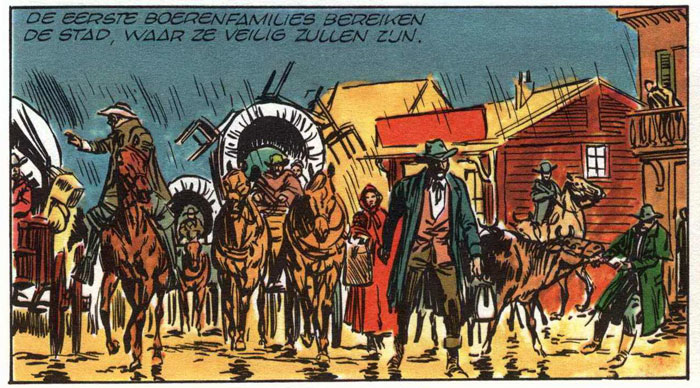
Over the years, the Funckens were assigned to several new features, which appeared in alternation with their other series. By request of editor-in-chief André Fernez, the Funckens ventured into the western genre with 'Jack Diamond' (1959-1960). Scripted by Fernez himself, the series starred a federal agent fighting crime, accompanied by his comical sidekick Bill and his dog. Three serials were published, and subsequently collected in book format.
With Yves Duval as scriptwriter, the Funckens made another western, 'Lieutenant Burton' (1962-1967), a series of short stories about a cavalry lieutenant. In 2011, these stories were collected in book format by Hibou, spread over two volumes. A series of the Funckens' own initiative was 'Capitan' (1963-1971), a swashbuckler series set in the 17th-century musketeer era. The main hero is Capitan de Castaignac, an adventurous swordsman from Gascony (Gascogne), who becomes a secret agent in the service of Cardinal Richelieu. After 1969, the episodes were scripted by Yves Duval. Seven albums were published by Lombard, and one by Bédéscope.
Doc Silver - 'La Vallée de la Peur' (Dutch-language version, 1969).
Again with writer Duval, the Funckens created their final series for Tintin during the editorship of Greg. 'Doc Silver' (1967-1969) was yet another western, but this time revolving around a travelling doctor, Gary Silver. And instead of the Wild West era, the stories were set at the turn of the 19th into the 20th century. This allowed the medic to meet historical characters like Pancho Villa and get drafted during the First World War. Le Lombard collected the series in five albums.

'Le Costume, l'Armure et les Armes au Temps de la Chevalerie' (1977).
Experts in military uniforms and weapons
In the second half of the 1960s, the comic production of the Funckens slowed down, only to come to a full stop in 1971. By then, they had embarked upon a major project by commission of the publisher Casterman. As creators of historical comics, they had collected a large amount of documentation, and had become specialists in the field of historical uniforms and weaponry. This knowledge was collected in the 18-volume illustrated collection 'L'Encyclopédie des Uniformes et de Armes de Tous les Temps' (Casterman, 1965-1982). The books were an enormous success and translated into English and German. An additional book followed a few years later, 'Les Soldats de la Révolution Française' (1988).
In the same tradition, the Funckens made the educational section 'Plus Grande Histoire du Monde' (1974-1975) for Tintin. This was basically one long illustrated timeline, where large eye-catching full-color illustrations depicting historical events and key figures were accompanied by historical dates and short descriptions underneath. Every week, a new chapter was presented. Readers who kept all their issues could cut out all the installments and hang them on their wall as one large chronological fresco.

From: 'La Plus Grande Histoire du Monde' (Tintin issue #9, 25 February 1975), depicting Benjamin Franklin, the Seven Years' War, Frederick the Great and James Cook.
Later comics
When their ambition book series had come to an end, Fred and Liliane gradually returned to the comics medium. In the pages of Tintin, they returned with 'Les Croisades des Saint-Preux' (1983-1984), a family saga set during the Crusades and co-written by Yves Duval. The stories were collected in the book 'Le Croissant et la Croix' (Le Lombard, 1985). Between 1984 and 1987, they additionally made new episodes of 'Le Chevalier Blanc'. For the newspaper La Dernière Heure, the Funckens created two historical comics about Napoleon: 'La Chute de l'Aigle' (1993), about the battle of Waterloo, and 'Le Sultan de Feu' (1994). These meticulous historical reconstructions were collected in two volumes by Mémoire d'Europe, and later in one volume by Le Lombard (2015).

Saint-Preux au Temps des Croisades - 'Honneur et Devoir' (Tintin #46, 15 November 1983).
Graphic contributions
In 1956, the Funckens illustrated the biblical book, 'L'Histoire de Jesus' (Casterman, 1956), written by Robert Bastin. In 1987-1988, the publishing company Brain Factory International released a four-volume comic book series where Franco-Belgian comic authors visualized several songs by singer Jacques Brel in comic strip form. The third volume, 'Ces Gens-Là' (1988) featured a contribution by Fred and Liliane Funcken.
Final years and death
Part of the second generation of Tintin creators - along with creators like Albert Weinberg, Raymond Reding and Edouard Aidans - the Funckens had created no less than six series for the magazine during a period of 20 years. As a result, their creations appeared irregularly, with none getting the opportunity to fully blossom, making the two authors less known among the general public compared to many of their contemporaries. Books with their heroes were spread out over several Lombard collections, with hardly any dedicated series launched, making it difficult for fans to fully embrace their creations. It wasn't until later years that publishing imprints active in the realms comics fandom and heritage, such as Chlorophylle, Bédéscope and Hibou, brought their work back to attention.
Largely retired since the 1990s, Fred Funcken passed away in 2013 in Brussels. He was 91 years old. Liliane survived him for two years, dying in 2015 at age 88.

Fred and Liliane Funcken.