

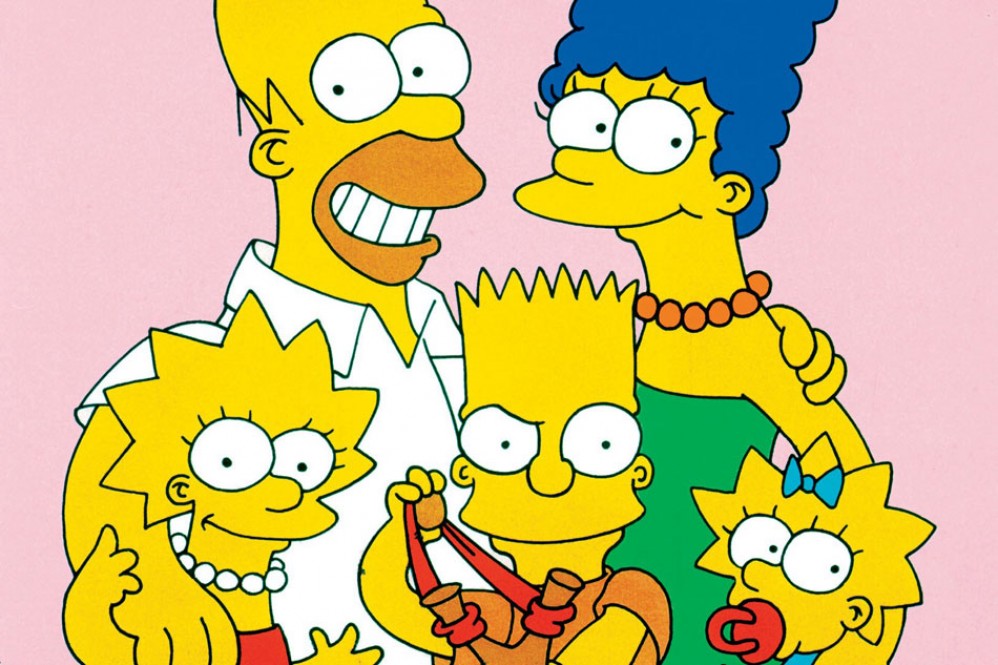
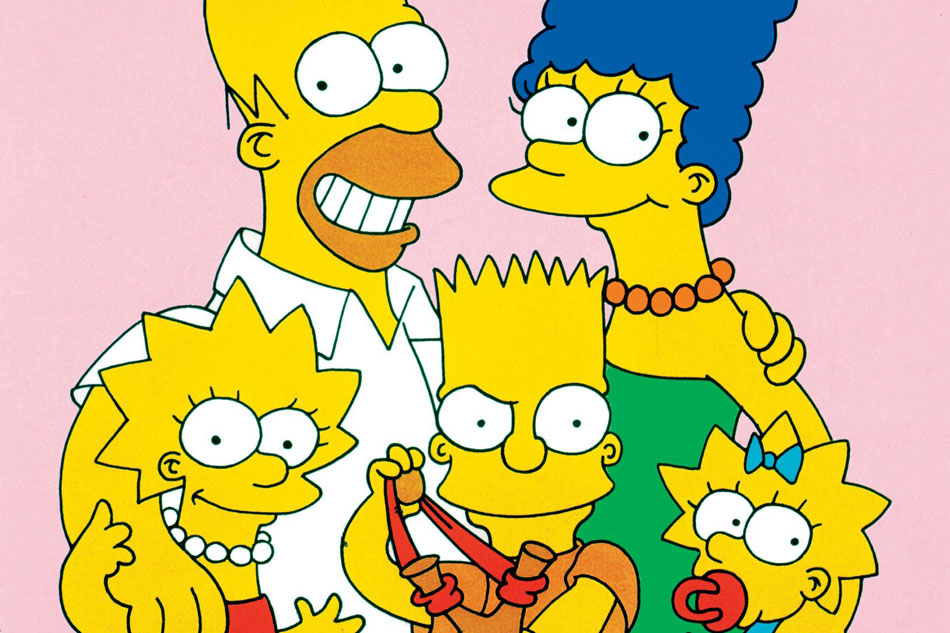
'The Simpsons'.
Matt Groening is a U.S. cartoonist and TV producer, world famous as the creator of 'The Simpsons'. He started his career with the satirical, semi-autobiographical gag comic 'Life in Hell' (1977-2012). The edgy series won him a cult following and also inspired many other alternative comic artists. In 1987, Groening went into animation, with 'The Simpsons' growing from an underground hit into a mass-merchandized global phenomenon. The yellow-skinned, dysfunctional family managed to appeal to audiences of all ages, both general viewers and intellectuals. Its all-encompassing satire of our modern-day society has received praise and countless awards. Subsequently, Groening created two other animated shows, 'Futurama' (1999-2003, 2008-2013, 2022) and 'Disenchantment' (2018-2023), which respectively satirized the science fiction and fantasy genres. His entire body of work is notable for its clever satire, edgy subversiveness, double layers, background jokes, pop culture and intellectual references, but still genuine hilarity and very relatable humanity. Groening is one of the few cartoonists whose creations have been subject to serious critical analysis and academic study. Between 1993 and 2018, he also had his own comic book publishing company, Bongo Comics, mostly devoted to adaptations of 'The Simpsons' and 'Futurama', but also offering room for a handful of other alternative comic creators. 'Disenchantment' has likewise been adapted into a graphic novel series, published by Titan Comics.
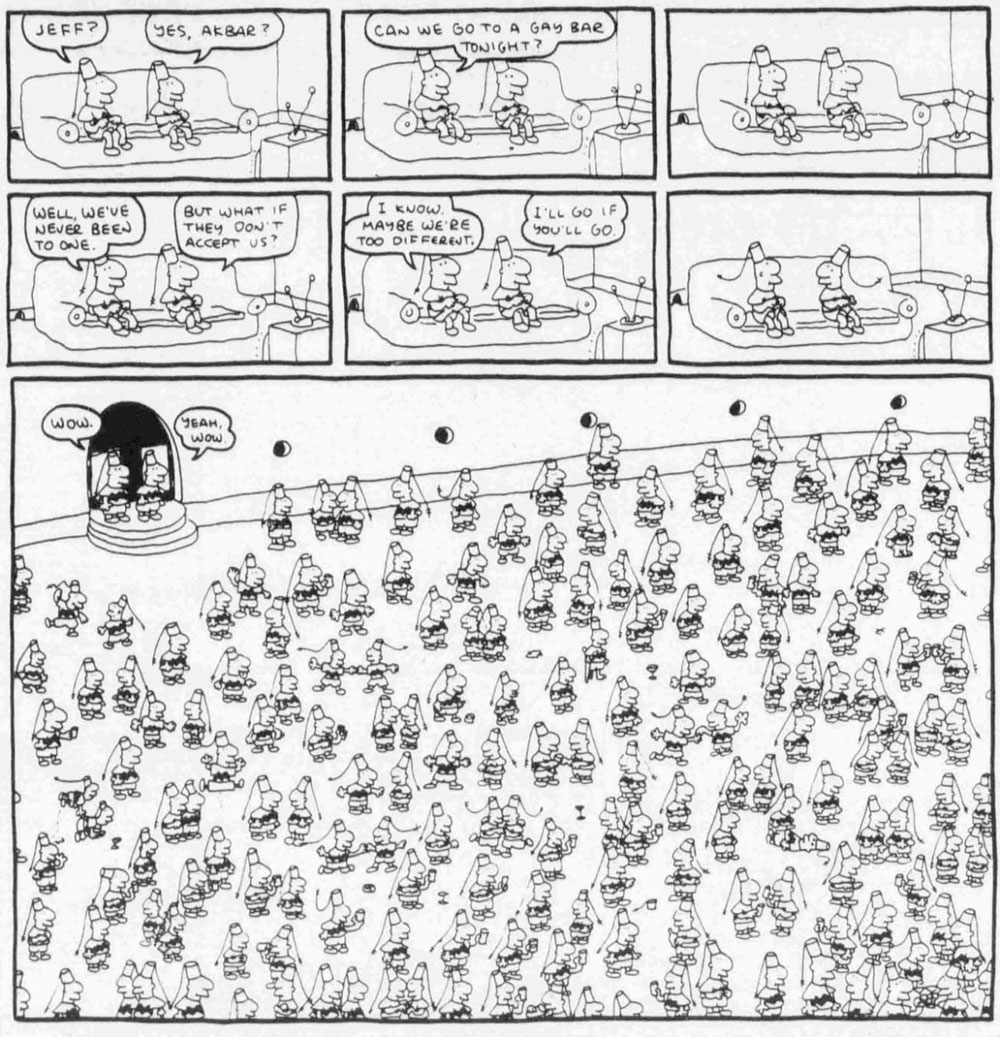
'Life In Hell', 4 July 1986.
Early life and influences
Matthew Abram Groening was born in 1954 in Portland, Oregon, the son of Homer Groening, an amateur filmmaker, writer and cartoonist. His mother, Margaret Wiggum, nicknamed "Marge", was a housewife. Matt had an older sister, Patty (1943-2013), and brother, Mark (1950), and two younger sisters, Lisa (1956) and Maggie (1958). Decades later, Groening named the main cast from 'The Simpsons' after his parents and two younger siblings. Patty, who also became a graphic artist in adulthood, inspired Marge's sister Patty. In the episode 'Prank and Greens' (2009), Bart befriends an older boy who enjoys playing pranks and whose personality was directly based on Matt's brother Mark. The only unintentional similar name is Abraham Simpson. Groening actually let his writers come up with a name for Homer's father, but by sheer coincidence it was the name of Groening's actual grandfather. The maiden name of Groening's mother was later used for the Simpsons characters Chief Clancy Wiggum and his son Ralph. Some of Homer Groening's short films, like 'Basic Brown Basic Blue' (1969) and 'The Story' (1969), were made for his children, starring themselves. In 'The Story', Matt Groening can be seen as a child.
The Groenings lived at Southwest Evergreen Terrace, which later became The Simpsons' official address, under the name "Evergreen Terrace". Other locations in Portland also inspired 'Simpsons' characters, such as Charles Montgomery Burns (Burnside Street/Montgomery Park), Ned Flanders (Flanders Street), Kearney (Kearney Street), Reverend Lovejoy (Lovejoy Street), Major Quimby (Quimby Street), Sideshow Bob Terwilliger (Terwilliger Curves) and Milhouse Van Houten (Van Houten Avenue). Lincoln High School was the model for Springfield Elementary School. Groening's first grade teacher Mrs. Hoover later inspired one of the teachers in 'The Simpsons'. In 1990, Hoover wrote Groening an affectionate letter, telling him that she vividly remembered him, particularly that he was always doodling in class and not paying attention. Groening credited her with encouraging his graphic career, since she once praised a particular drawing he made of a sail boat. As a tribute, a framed picture of a sail boat can be seen above The Simpsons' family couch in the original opening credits. Another recurring character on 'The Simpsons', Dolph Starbeam, was a nod to one of Groening's childhood friends, Dolph Timmerman. However, Groening was always quick to point out that none of the real people he borrowed names from had anything in common with their cartoon versions.

'School is Hell'. All are real-life quotes of things teachers once told Groening. He claims that the quote in the final panel, from his college teacher Mark Levensky, still haunts him today.
Groening was a geeky child. Through his father, he became familiar with radio satirists Stan Freberg, Bob & Ray and Jonathan Winters, and humorous writers like Dave Barry, Robert Benchley, Joseph Heller and Mark Twain. Groening later also expressed fondness for humorous novelists like Martin Amis, Thomas Pynchon, Terry Southern, Kurt Vonnegut, Nathanael West and P.G. Wodehouse, as well as fantasy and science fiction authors like Philip K. Dick, Robert A. Heinlein, Robert Sheckley and Theodore Sturgeon. In addition, Groening adores classic film comedians like Charlie Chaplin, Buster Keaton, Laurel & Hardy, The Marx Brothers, Jacques Tati, but also loves comedy film makers from his own era, like Woody Allen, Mel Brooks, Jackie Chan, Joel & Ethan Coen and Richard Lester. In his youth, he ranked 'Green Acres', 'Rocky & Bullwinkle', 'SCTV' and 'Monty Python's Flying Circus' among his favorite TV shows. Later in life, he also expressed enthusiasm for 'Broad City', 'The Colbert Report', 'Countdown with Keith Olbermann', 'The Daily Show', 'Fawlty Towers', 'Late Night with David Letterman', 'Mystery Science Theater 3000', Ricky Gervais' 'The Office', 'Pee-wee's Playhouse' and 'Trailer Park Boys'.
His earliest childhood influences in the field of comics were Charles M. Schulz, Ernie Bushmiller, Carl Barks, Al Capp, George Herriman (though interviewed by Richard von Busack in 1986, Groening said he liked the artwork in 'Krazy Kat' better than the comedy), Walt Kelly, E.C. Segar, John Stanley, Mad Magazine (particularly the work of Jack Davis) and Jack Kirby. Groening praised Schulz's 'Peanuts' on many occasions for its amazing humanity and philosophical, tragicomic style, calling it "one of the greatest works of the 20th century". He also named Bushmiller's 'Nancy' one of his strong favorites, since it learned him how to communicate ideas in a simple graphic style.

Visualisation of Matt Groening's teenage diary, 'Life in Hell'. It references the following albums in his record collection: Morton Subotnick's 'The Wild Bull', Frank Zappa's 'We're Only In It For The Money' , The Fugs' 'Virgin Fugs' and The Beatles' 'White Album', while also talking about his friend Richard Gehr (who gained fame in adulthood as a rock journalist) owning John Lennon's 'Two Virgins'.
As a teenager, Matt Groening became fascinated with counterculture. He read subversive cult books (like Tuli Kupferberg's '1001 Ways to Beat the Draft' and John Lennon's 'In His Own Write' and 'A Spaniard in the Works'), watched independent cinema, collected art photography books and was mezmerized by modern classical music, free jazz, psychedelic/avant garde rock, outsider music, exotica and world music. Inspired by his favorite musician, Frank Zappa, he decided to let no art forms be "too high" or "too low" for him. In the field of "high art", Groening was influenced by artists like M.C. Escher, Cameron Jamie, Mike Kelley, Kenny Scharf, Jim Shaw and Wayne White. His favorite illustrators and one-panel cartoonists were Charles Addams, John Callahan, Rowland Emmett, Ed "Big Daddy" Roth, Ronald Searle, Cal Schenkel, J. Otto Seibold, Dr. Seuss and James Thurber. He has also admired the political cartoonists and comic artists Ron Cobb, Jules Feiffer, Andrew Marlton, Ted Rall, Tom Tomorrow and Garry Trudeau.
Another teenage discovery were underground comix. Groening became a lifelong fan of Robert Crumb, Kim Deitch, Justin Green, Aline Kominsky and Robert Williams. When underground mutated into alternative comics, Groening kept following the scene. He singled out Lynda Barry as his prime influence, but also expressed admiration for Doug Allen, Peter Bagge, Charles Burns, Daniel Clowes, Lloyd Dangle, Michael Dougan, Dennis P. Eichhorn, David Greenberger, Carol Lay, Stan Mack, Joe Matt, Heather McAdams, Scott McCloud, Gary Panter, Harvey Pekar, Mimi Pond, Jeff Smith, Art Spiegelman, Chris Ware and Jim Woodring. In later mainstream newspaper comics, Groening also found artists who carried away his fancy, namely Scott Adams, Peter Blegvad, Berkeley Breathed, Kevin Fagan, Bill Griffith, Nicole Hollander, Gary Larson, Patrick McDonnell, Bill Watterson and web artist Max Cannon. He additionally praised foreign comic artists like David Boswell, Lat, Liniers, the aforementioned Ronald Searle and René Goscinny and Albert Uderzo's 'Astérix'. Famously, Groening expressed an ironic love for the "so bad they're good" Christian propaganda comics by Jack Chick.
In the field of animation, Groening's influences include Walt Disney, The Fleischer Brothers ('Betty Boop', 'Popeye'), Otto Messmer ('Felix the Cat'), Tex Avery (Looney Tunes, 'Droopy'), Chuck Jones (Looney Tunes), Terry Gilliam (Monty Python), Jay Ward ('Rocky & Bullwinkle'), John Kricfalusi ('Ren & Stimpy') and Bill Plympton. Later in his career, he also expressed admiration for Mike Judge ('Beavis & Butt-Head', 'King of the Hill'), Trey Parker & Matt Stone ('South Park'), Sylvain Chomet ('Belleville Rendez-Vous'), Nick Park ('Wallace & Gromit'), Stephen Hillenburg ('SpongeBob Squarepants'), Seth MacFarlane ('Family Guy'), Nina Paley ('Sita Sings the Blues'), Justin Roiland & Dan Harmon ('Rick & Morty'), Loren Bouchard ('Bob's Burgers') and Pendleton Ward ('Adventure Time').
From a young age, Groening loved absorbing himself into all these escapist media. In school, the bored pupil sketched in his notebooks, which regularly got him into trouble. He discovered that the angrier people got, the better his drawings were. His parents, teachers, preachers and boy scout leaders all told him that reading comics, listening to rock music, watching TV and drawing cartoons were a "waste of time". Even his own father, despite being a cartoonist, writer and filmmaker himself, discouraged Groening that he "couldn't draw", nor make a living out of it and would "never be taken seriously as a writer if he kept on cartooning." Matt Groening vowed that he would "never forget what it was like being a kid". His later comics and TV shows became a very personal expression of his sentiment. Simultaneously, he also used all the time he supposedly "wasted" as creative inspiration. Interviewed by Jamie Angell for Simpsons Illustrated (Vol. 1, Nr. 9, Summer 1993), he explained: "When you study the semiotics of 'Through the Looking Glass' or watch every episode of 'Star Trek', you've got to make it pay off, so you throw a lot of study references into whatever you do later in life." Many scenes in his work are autobiographical, while others reference specific books, cartoons, comics, TV shows, films and music, he either loves or hates. One example was the TV clown Rusty Nails, who he enjoyed watching as a child, and became the template for Krusty the Clown in 'The Simpsons'. Bart Simpsons's status as a "bad boy" was born out of his frustration that the bland 1959-1963 live-action TV sitcom adaptation of Hank Ketcham's 'Dennis the Menace' didn't live up to its promising title.
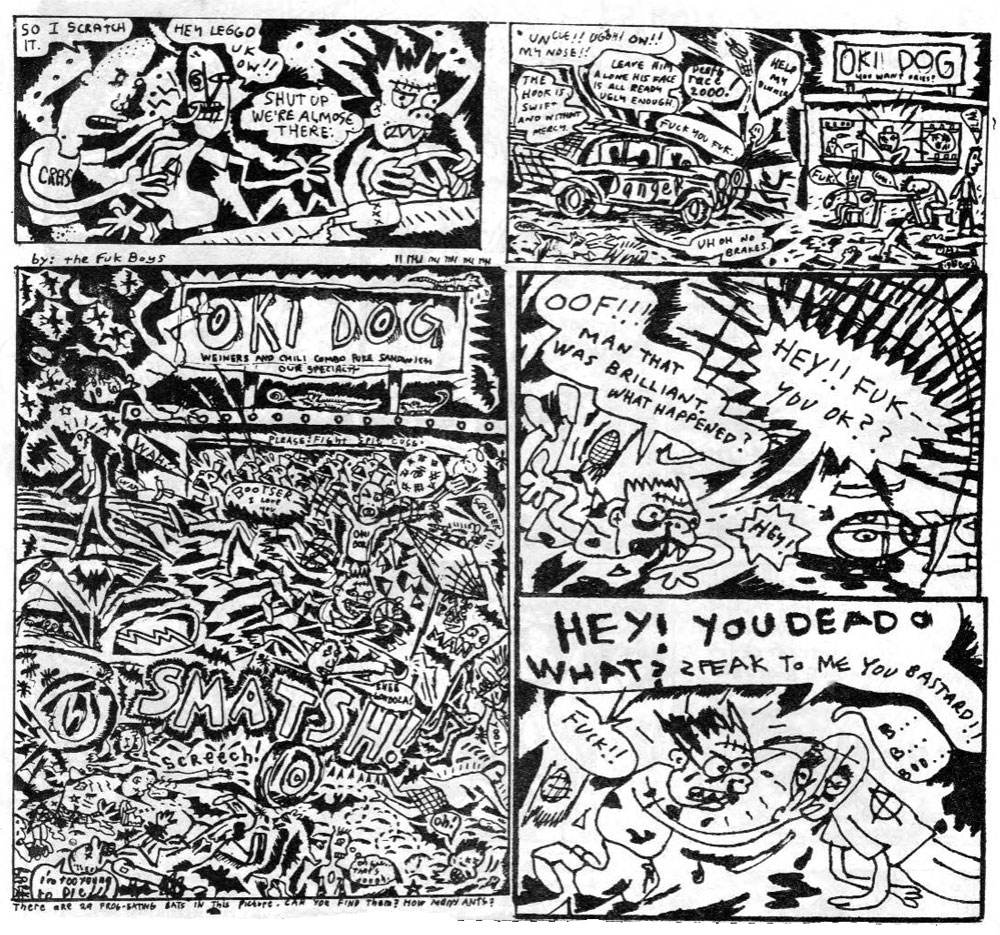
'Ocurence at Oki Dog', collaborative strip with Gary Panter, published in Flipside #33 (1982) under the pseudonym "The Fuk Boys'". Note how Groening already drew an embryonal version of Bart Simpson.
Higher education, lower expectations
Between 1972 and 1977, Groening studied philosophy and journalism at Evergreen State College in Olympia, Washington. This college was unusual since it followed an experimental educational method, with no required classes or grades. For the anti-authoritarian Groening this was exactly what he was looking for. Co-students Lynda Barry, Charles Burns and Steve Willis became lifelong friends and strong influences on his work. The friends often collaborated on cartoons and articles for the campus paper, The Cooper Point Journal, in which Groening satirized the state legislature and public figures. Groening credited Barry with proving that you don't need a virtuoso graphic style or epic adventure stories to make a great comic, but could just draw about small, personal moments. She also taught him that if you make yourself laugh, there will always be people who'll enjoy your sense of comedy. Groening was even directly responsible for launching Barry's career. Without her knowledge, he printed her earliest comic, 'Ernie Pook's Comeek' in The Cooper Point Journal, giving her more exposure. As much as he enjoyed this unconventional university, Groening reflected in the BBC documentary 'My Wasted Life' (2000): "The downside was that, once you graduate, you're basically out on your own."
In 1977, Groening moved to Los Angeles, California, since it was closer to Hollywood. His college degree didn't get him anywhere and he worked several low-paid, odd and unsatisfying jobs. He appeared as an extra in a B-movie, 'When Every Day Was the Fourth of July', as part of a lynch mob. Another time, he was autobiographer for a B-western director who was turning senile. He found a comparably better job at the record store Licorice Pizza on Sunset Boulevard, and in a photocopy center. While still badly paid, he could make copies of his comics and sell them to customers in both stores. In 1979, Groening was hired by The Los Angeles Reader, where he started out as a magazine deliverer, slowly working his way up the ladder as a typesetter, editor, paste-up artist and rock critic. While the latter profession might have seemed creatively satisfying, Groening generally didn't care much about the mainstream acts he had to discuss. He really wanted to write about musicians with a peculiar, eccentric sound, but rarely received the chance. When he had to interview musicians, he sometimes embarrassed himself. One time, he had to interview David Byrne (Talking Heads), but his cassette tape broke down, which he only noticed afterwards, with Byrne snarking: "I hope you have a good memory." Groening thereupon invented most of the interview. His column 'Sound Mix' gradually became less about music and more of a soapbox for different, more personal topics. Sometimes he just clowned around, by making up fictional bands and giving them raving reviews. Or he would satirize current trends, tell private anecdotes or summarize his favorite media. While he and a few readers got some enjoyment out of it, it didn't please Groening in the long run.
Overall, life in L.A. was highly depressing to Matt Groening. Apart from lacking enough money, he often heard gun shots and police helicopters outside of his apartment. Yet in the ironically nicknamed "city of angels", he also met more kindred creative souls who shared the same struggles. One of them was graphic artist Gary Panter, with whom he made a few crossover comics, like 'Ocurence at Oki Dog', published in the punk magazine Flipside (issue #33, 1982). The title character of Panter's comic strip 'Jimbo' later inspired Bart Simpson's hairdo. During the late 1970s, Groening was part of the artistic collective The Art Boys, which had people like Robert Williams, Mark Mothersbaugh (from the band Devo), The Pizz, Gary Panter, Mike Kelley and Neon Park as its members. He also befriended other comic artists who were still unknown, like Carol Lay and Byron Werner.
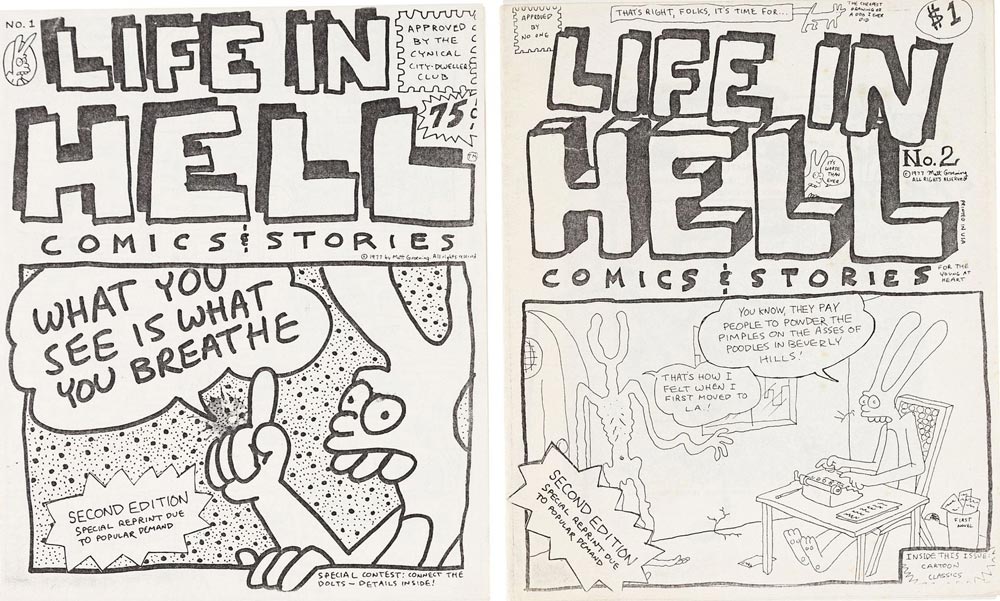
Self-published 'Life in Hell' zines by Matt Groening, 1977.
Life in Hell
In 1977, Groening started making a series of cartoons for his friends, which he xeroxed in the photocopy center where he worked. It eventually developed into a comic strip, 'Life in Hell', first appearing in print in the local art magazine Wet (September 1978). Thematically, Groening was directly inspired by a chapter in Walter Kaufmann's 1958 book 'A Critique of Religion & Philosophy', titled 'How To Go To Hell'. Later he explained that the title 'Life in Hell' referenced his struggling, frustrating life in Los Angeles. In some 1980 interviews, Groening also said it reflected life under the Ronald Reagan administration.
'Life in Hell' has five recurring characters, all drawn in Groening's trademark style, with bug eyes and large overbites. The main anti-heroes are a rabbit family, since they were the only animals Groening could draw recognizably. Binky is the disgruntled father. Originally, Groening made him a sarcastic wiseguy, but this attitude didn't endear him with readers. He then recharacterized Binky as a pitiful victim of life's struggles, increasing his appeal. Binky is married to Sheba, his long-suffering wife, and has an illegitimate son called Bongo. Since readers had trouble telling Binky and Bongo apart, Groening eventually drew Bongo with only one ear to distinguish him from his dad. A troublemaker, Bongo is disobedient and often gets punished by his parents and teachers for asking deep, critical questions about life. In school, he is bullied and put in detention, which looks a lot like a torture cellar. But Bongo also has a softer, more innocent side. He simply says what's on his mind. In several gags he lies awake at night, worrying about fears that are either disturbingly relatable, or laughably naïve. Interviewed by Joe Morgenstern (L.A. Times, 29 April 1990), Groening said: "I vowed never to forget (...) how scary it is to be a kid. (...) I think there's a lot of unnecessary misery in education. I certainly felt it. Just the idea of punishing a kid for drawing stacks of cartoons, of ripping them up and throwing them away." More than one observer has noted that Binky, Sheba and Bongo were embryonic versions of Homer, Marge and Bart Simpson.
The only recurring human characters in 'Life in Hell' were Akbar and Jeff, two identical-looking men with fezzes and striped shirts. Their distinctive look was a bastardization of Charles M. Schulz' Charlie Brown from 'Peanuts'. Interviewed by Alan Paul (Flux, 30 September 1995), Groening said: "Akbar and Jeff are either brothers or lovers - whatever offends you most, that's what they are." However, in other interviews, the cartoonist revealed that he had deliberately created them to counter his girlfriend's criticism that all of his commentary on relationships was drawn from his own male perspective. Since Akbar and Jeff look the same and share the same sex, he could provide more general observations. Nevertheless, just like any couple, Akbar and Jeff sometimes can't stand one another.

'Life in Hell' (5 March 1987).
Life in Hell: style
'Life in Hell' has a minimalistic art style. Groening took a lot of cartooning tips from Jack Hamm's drawing guides and by mimicking the simple artwork and instant readability of Ernie Bushmiller's 'Nancy'. Many 'Life in Hell' gags rely heavily on verbal comedy, featuring huge chunks of text, with only a few drawings here and there. But what the comic lacked in graphic skills, it made up for in content. The series offers sharp and satirical digs at modern society: school, work, relationships, politics, religion, parenting and childhood are all lampooned.
While some episodes reference then-current events and trends, most of the comedy remains timeless. 'Life in Hell' philosophizes about life, but also pays attention to smaller, touchingly melancholic moments. Interviewed by Gary Groth for The Comics Journal (issue #141, April 1991), Groening reflected: "When I got the opportunity to draw my comic, I wanted to do what was on my mind, the stuff that keeps me worried: love, work, sex, death - the basics. I was always amazed that so many cartoons either dealt with political ideas in a very heavy- handed way, or concentrated on the trivial inconsequentialities of life, while the hellishness of most people's jobs and love lives and fear of death remain unexplored."
'Life in Hell' has a strong autobiographical undercurrent. Early in Groening's career, Bongo reflected his childhood memories, while Binky expressed his adult frustrations. Binky and Sheba, alongside Akbar and Jeff, presented his view on relationships. Once Groening got married, the tone of the comic shifted towards gags about (raising) children. As the years passed, Groening also used 'Life in Hell' more for personal commentary, often depicting himself and his sons Will and Abe as rabbit characters. He would adapt pages from his own childhood diaries into comics pages. In other episodes, he summarized "lies my teachers told me" and "lies my older siblings told me". Other gags reflected on anecdotes from his adult life and media career. During the 1990s, he drew several gags about the unintentionally funny and touching conversations, questions and remarks of his sons Will and Abe, enough to fill an entire book: 'Will and Abe's Guide to the Universe' (HarperCollins, 2007). In one episode, for instance, he asks them what happens after death. The oldest son, Will, takes the question seriously, while the youngest, Abe, eventually decides: "I'm tired of this talking! I want to play! I'm alive NOW!!".

'The Road to Manhood' (13 February 1986).
The modern-day reader of 'Life in Hell' will notice the origins of Groening's typical humorous style, later made famous in 'The Simpsons', 'Futurama' and 'Disenchantment'. They range from analytical satire in comic strip form to fake advertisements, magazine covers or instructional guides. A typical example would be 'Struggling Artist Magazine', with headlines like 'how to act mysterious' and '3 out of 10 artists might not possibly be the geniuses they think they are: could your friends be among them?". Compared with his later TV shows, 'Life in Hell' has always been the most direct reflection of Groening's personal views. In an editorial published in Simpsons Comics issue #21 (June 1996), he reflected: "I love doing the comic strip, because it has none of the headaches that come with a large-scale collaboration, and I hate doing the comic strip, because it's so lonely up there in my little loft all by myself." Groening started out as a genuine underground cartoonist, drawing his characters with visible genitals, and using swear words. Since most magazines were not willing to print this, he cleaned up his style.
Nevertheless, Groening still dared to take up edgy, left-wing opinions, mocking the corporate world, the school system, rock industry, MTV, religion, the U.S. flag salute and the administrations of presidents Ronald Reagan, George Bush Sr. and Jr. In many gags, Bongo is asked to recite the U.S. flag salute, but makes up his own funny lines. After the Gulf War (1991), Groening drew Akbar and Jeff wearing gas masks, cheering "We won! We won!" in front of a colossal graveyard. When Richard Nixon died in 1994, Groening drew a comic in which Bongo says: "I never realized he was such a great statesman", whereupon Binky instantly lists all of Nixon's scandals, corruptions and vices, leaving the boy with only one comment: "When you are dead, I'll say nasty things about you."

Life in Hell - 'The Case for the Existence of God' (1987).
In another episode (5 March 1987), Bongo prays before bedtime, asking God to make "tomorrow a nice day", only to miss his bus the next day, being bullied, receive a bad grade and return home to an angry father. That evening, he recites the same prayer in a seemingly endless and pointless cycle. The little rabbit also investigates "the existence of God" in another 1987 gag, listing all the fun stuff that "prove" it (water balloons, James Brown, ice cream) and all the horrible things that "disprove" it (bees, Saturday morning cartoons, Republicans). When he no longer can think of anything good, he panicks: "Uh-oh." In the two-parter episode 'The Road to Manhood' and 'The Road to Womanhood' (13 and 20 February 1986), Groening chronologically satirized all the key moments in a lifetime that add to one's masculinity or feminity. While most are witty ("first realisation that girls might not be the enemy", "first time you put Barbie on top of Ken"), others are more thought-provoking ("first sexually transmitted disease", "first abortion").
By the turn of the 1980s into the 1990s, 'Life in Hell' no longer reflected Groening's earlier years of bitter struggle and irritation. Now a millionaire thanks to 'The Simpsons', he had far less to complain about. To reflect his new outlook, in 2006 he changed the title of his comic to 'Life Is Swell'.
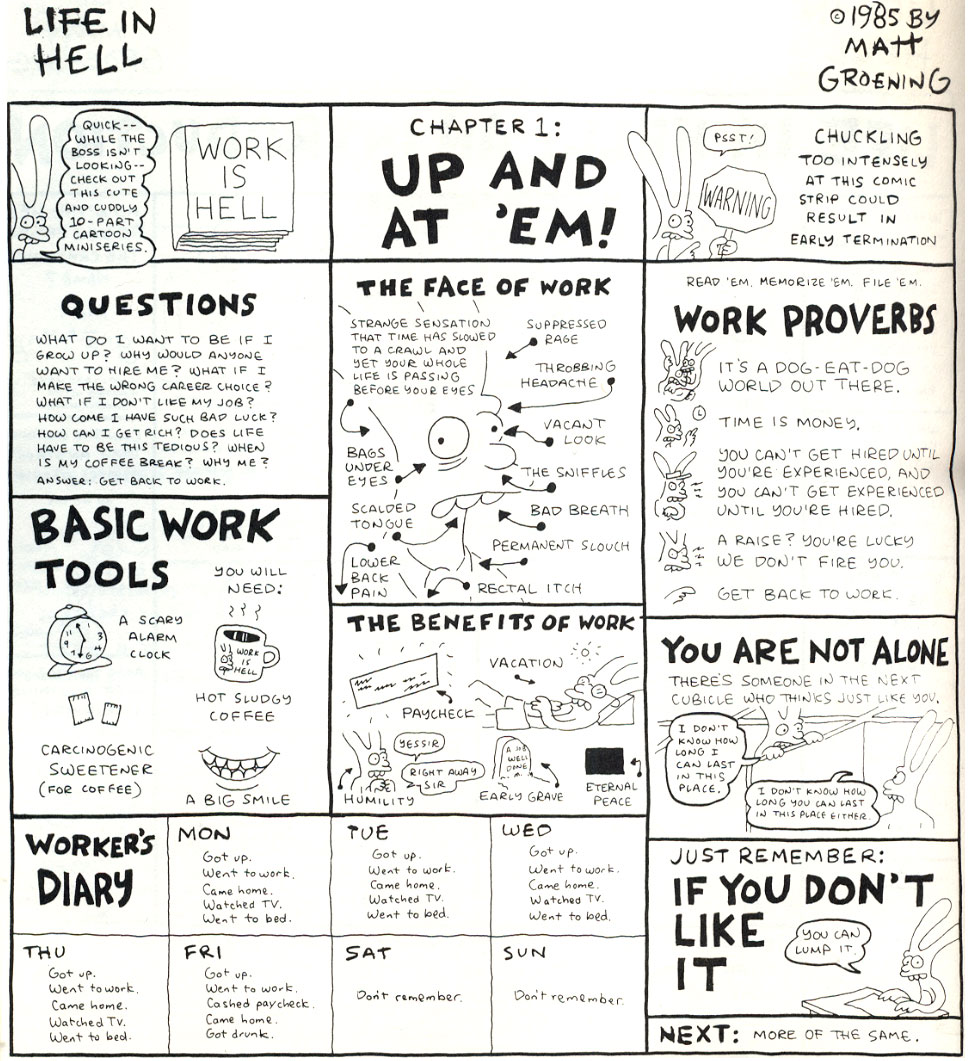
'Work Is Hell', 1985.
Life in Hell: success
On 25 April 1980, The Los Angeles Reader allowed Groening to publish 'Life in Hell' in their pages too, where it reached a wider audience. Soon it also ran in other alternative publications, including The Oregonian and, from 1986 on, The San Francisco Examiner. He also met his future first wife at The Los Angeles Reader - Deborah Caplan - who worked there as an advertisement saleswoman and by 1984 became their sales manager. In 1985, the couple established their own syndicate, Acme Features, distributing 'Life in Hell' to other magazines and, through a sub-department, Life in Hell Cartoon Co., organizing a merchandising line of T-shirts, greeting cards, calendars and mugs. In the mid-1980s, Groening also drew exclusive 'Life in Hell'-themed advertisements for Apple Computers, starring Akbar and Jeff who, in his own words, "would endorse anything, as opposed to my rabbit characters." Groening and Steve Vance were also the co-producers of Paper Moon Graphics, a successful line of humorous greeting cards. Acme additionally syndicated features by two other alternative cartoonists, Lynda Barry and John Callahan. 'Life in Hell' was noticed by Art Spiegelman who contacted Groening and helped him get his books published by Pantheon Books.
Groening's comics were collected in the books: 'Love is Hell' (Pantheon, 1986), 'Work is Hell' (Pantheon, 1986), 'School is Hell' (Pantheon, 1987), 'Childhood is Hell' (Pantheon, 1988), 'Greetings From Hell' (1989), 'Akbar and Jeff's Guide to Life' (Pantheon, 1989), 'The Big Book of Hell' (Pantheon, 1990), 'With Love From Hell' (HarperPerennial, 1991), 'How to Go to Hell' (Perennial, 1991), 'The Road to Hell' (Perennial, 1992), 'Binky's Guide to Love' (Perennial, 1994) and 'The Huge Book of Hell' (Penguin Books, 1997). The shape and characteristic lay-out of the covers were deliberately designed to look like LP sleeves, so they could be placed in the record store where Groening used to work. His main inspiration was the album cover of Frank Zappa's 'Hot Rats', designed by Cal Schenkel.

Ad with Matt Groening for a 'Life in Hell' T-shirt.
In 1986, one of the writers in The Los Angeles Reader was fired and Groening wrote a protest letter. On 23 April 1986, he was fired too, only learning about it when he read that day's edition of the paper and noticed 'Life in Hell' had been replaced with another comic. Luckily, Groening found another homebase for his comic when he joined the L.A. Weekly. And a year later, when 'The Simpsons' first aired and became a hit, general interest for 'Life in Hell' rose. Episodes of the strip were translated into French ('La Vie en Enfer'), German ('Leben in der Hölle'), Spanish ('La Vida Es Un Infierno'), Portuguese ('Vida No Inferno'), Italian ('Vita All' Inferno'), Danish ('Livet i Helvede'), Swedish ('Livet i Helvetet') and Finnish ('Eläma on Helvettïä'). One quote from a 'Life in Hell' gag, humorously attributed to Friedrich Nietzsche ("Love is like a snowmobile racing across the tundra, until it suddenly tips over, pinning you underneath. At night, the ice weasels come.") often appears online, with some actually believing it was an authentic citation by Nietzsche. Yet although 'Life in Hell' benefited from 'The Simpsons' name recognition, it never reached the same mainstream fame. Groening said that he has often encountered self-declared "biggest fans", who claim to love "everything he ever created", but turn out to be completely unaware of 'Life in Hell'.
Interviewed by Erik H. Bergman (TV Host, 16 December 1989), Groening swore: "I'll never give up the comic strip! It's my foundation." But by the turn of the 2000s into the 2010s, he was preoccupied with two TV series, 'The Simpsons' and 'Futurama', while the market for alternative comics had shrunk considerably. Even Groening couldn't escape this evolution and so, on 16 June 2012, the final episode of 'Life in Hell' appeared in print. Twenty-two cartoonists drew a special farewell tribute, namely Sergio Aragonés, Alison Bechdel, Ruben Bolling, Jim Borgman, Jeffrey Brown, Ivan Brunetti, Jordan Crane, Tom Gammill, Sammy Harkham, Peter Kuper, Carol Lay, Bobby London, Patrick McDonnell, Tony Millionaire, Jerry Scott, Robert Sikoryak, Jen Sorensen, Art Spiegelman, James Sturm and Tom Tomorrow. Another homage came from Ted Rall, who praised 'Life in Hell' on his personal blog, claiming that its success motivated many mainstream magazines and newspapers to publish more alternative cartoonists. Rall also included 'Life in Hell' on a list on his blog with his "Top Ten Comics of All Time" (22 May 2011), citing "particularly the 1980s era that opened the field to new artistic approaches."
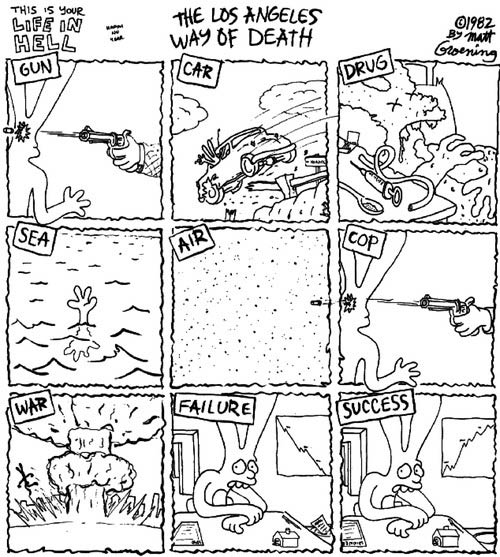
'Life In Hell', 'The Los Angeles Way Of Death', 1982. This gag motivated Hollywood producer James L. Brooks to give Matt Groening a TV contract. Brooks still keeps the original page on a wall of his office, even though the ink is "fading out".
The Simpsons (Tracey Ullman Show era, 1987-1989)
In 1983, Hollywood director and producer James L. Brooks received an original 'Life in Hell' page from his production designer Polly Platt, titled 'The Los Angeles Way of Death'. Brooks felt the comic was very funny, particularly the poignant last two panels, depicting "failure" but also "success" as morbid fates for people in L.A. In 1985, he contacted Groening for a meeting at Paramount Studios. As bad luck would have it, Groening's car was broken, so he went to the studio on foot, where he wasn't allowed on the lot, precisely because he didn't have a car. Two years later, Brooks invited Groening to a new appointment, this time going as planned, where they discussed adapting 'Life in Hell' into a series of animated intermezzos in the sketch show 'The Tracey Ullman Show' (1987-1990) on the brand new TV channel FOX. This was the offer Groening had been waiting for. However, he soon learned FOX would own the rights to his comic. Already anxious, given the existence of so many bad TV versions of popular comics, he came up with a different concept about a dysfunctional human family: 'The Simpsons'.

Early character designs for the Simpsons family.
All episodes were to be built around 10-year old Bart Simpson, whose name was a throwback to the buck-toothed teen protagonist in a novel Groening wrote in high school, 'I Was A Teenage Malcontent' (later retitled 'Mean Kids'). Like the anagram in his name hints, Bart is a mischievous brat, constantly punished by his parents and teachers. His spiky haircut is based on Jimbo, the signature character of Groening's colleague Gary Panter. In this early era, Bart's parents, Homer and Marge, and his younger sisters, Lisa and Maggie, were still less three-dimensional side characters. As Homer's voice actor Dan Castellaneta was already a fan of 'Life in Hell', he was thrilled to join in. In the Internet Age, some speculation has risen that Homer was designed after either Oscar Jacobsson's comic character Adamson or Angie, the father in Ralph Bakshi's animated feature 'Heavy Traffic' (1974). In reality, Groening credited David Boswell's 'Reid Fleming, World's Toughest Milkman' as a direct inspiration. The running gag where Homer strangles Bart was inspired by Rudolph Dirks' 'The Katzenjammer Kids', while Maggie Simpson's dress was based on Swee'Pea in E.C. Segar's 'Popeye'. Color designer Gyorgi Peluce came up with the idea to give the characters in the show a yellow skin. At first, Groening felt it looked weird, but he soon realized this striking funky color would help his cartoon stand out, especially among people zapping by, "thinking something was wrong with their TV set."

Production cell set-up for a segment for 'The Tracey Ullman Show'.
FOX accepted 'The Simpsons' and on 19 April 1987 they debuted during 'The Tracey Ullman Show', albeit purely as 15-second long shorts before and after each commercial break. Apart from this setback, FOX had hired the cheapest animation studio available, Klasky-Csupo, who simply traced Groening's rough sketches for production, instead of modifying the artwork. It gave the cartoons a very crude look, while the writers had to rely on low-brow comedy. In this early incarnation, many viewers were either fascinated, or put off by it. When the BBC broadcast 'The Tracey Ullman Show' in the UK, they even edited out the cartoons segments. However, Groening knew that, thanks to the fast-paced nature of animation, one could still get a good set-up and punchline across in 15 seconds. He was also confident that children would watch his show, holding up Jay Ward's 'Rocky & Bullwinkle' (1959-1964) as a prime example of a low-budget cartoon that still attracted viewers, thanks to its funny and sophisticated writing. Groening also felt encouraged by the popularity of the live-action children's TV program 'Pee-wee's Playhouse' (1986-1990), since it proved that even an eccentric TV show could achieve high ratings. Slowly but surely, 'The Simpsons' received a loyal following, allowing budgets to rise and animation to improve under guidance of director David Silverman.

Animation cell.
The Simpsons (prime time TV series) (1989- )
By 1989, FOX wanted a 20-minute 'Simpsons' Christmas special, but Groening, James L. Brooks and co-executive producer and co-writer Sam Simon insisted on a full-blown series, broadcast in prime time. If the special was successful, they could at least follow it up with more episodes. At first, FOX was reluctant, since prime time animated sitcoms hadn't been a hit since Hanna-Barbera's 'The Flintstones' (1960-1966). But they eventually greenlighted it, with the special 'Simpsons Roasting On An Open Fire', scripted by Mimi Pond, indeed drawing huge ratings. With a longer runtime at their disposal, Groening, Brooks and Simon fleshed out the personalities of their main cast and expanded their universe. Homer became an ignorant slob who hates his job. He is too stupid to understand how and why society mistreats him, so he seeks escapism in eating, boozing, sleeping and watching TV. Marge is comically homely, bland and worrisome. She suffocates under the pressure of being a housewife, stuck with a useless husband and demanding offspring. Bart, Lisa and Maggie all feel misunderstood and neglected in their own way. Bart is a rebel who just wants attention and respect from his peers. Lisa is an intellectual who sometimes feels as if she's the only smart, cultivated and sane person. In reference to jazz as "America's only artform", she plays saxophone. And Maggie is ignored since she can't talk yet. Groening once described The Simpsons as "a family who both love and want to strangle each other." Their all-to human foibles, struggles and frustrations are relatable and built up a strong emotional bond with viewers.
Right from the start, 'The Simpsons' were promoted as a "family sitcom". In reality, they were actually a subversion. Since the 1950s, most live-action sitcoms on US television had featured painstakingly "normal" families, presented as an ideal viewers should live up to. The plots were bland, simplistic and formulaic, often accompanied by laugh tracks. The Simpsons, by contrast, didn't rely on canned laughter. Homer, Marge, Bart, Lisa and Maggie are a dysfunctional family who don't live in a safe, homely neighborhood, but a depraved, polluted town named Springfield. The mayor and local police force are corrupt, the local reverend is a smug hypocrite and the town's more successful business is a nuclear power plant, where Homer works. Run by the evil billionaire Mr. Burns, all employees are underpaid and constantly face radio-active threats. Bart and Lisa go to an underfunded elementary school, where demotivated teachers bore pupils out of their minds and children bully each other. Seniors are stashed away in isolated retirement homes. Local TV shows are superficial, and everybody who runs a business rips off their customers with shoddy products and services, from bars to supermarkets. Almost all characters have flaws and vices. They get drunk, smoke, swear, get violent or express other questionable behavior.
In this field, 'The Simpsons' was also incomparable with most animated cartoons at the time. It was obviously not a children's show and didn't use typical cartoon tropes, like wacky body exaggerations or physically impossible gags. Decades earlier, Hanna-Barbera's 'The Flintstones' (1960-1966) and 'Wait 'Til Your Father Gets Home' (1972-1974) had been successful with adult viewers too, but the tone was still very family friendly. From the late 1960s on, various underground animated cartoons had existed and, since 1972, Ralph Bakshi directed subversive animated films, strictly intended for adults. But these were all created outside of the mainstream, while 'The Simpsons' was the first prime time animated show to be uncompromisingly adult in tone.
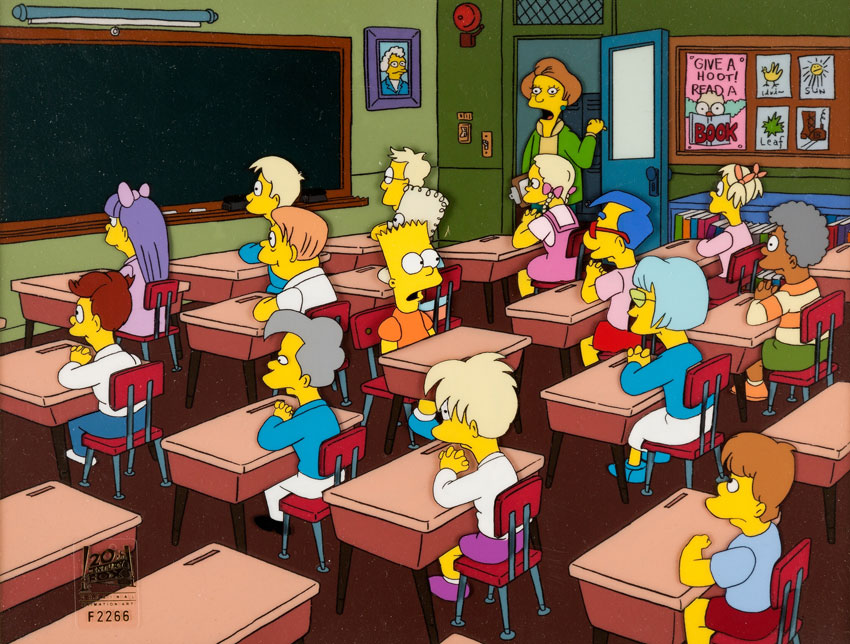
Cell from the Simpsons episode 'Treehouse of Horror V' (1994).
The Simpsons: success
After becoming a full-blown TV series, ratings of 'The Simpsons' kept rising, eventually surpassing the successful TV sitcom 'The Cosby Show'. The yellow-skinned family spawned a veritable tidal wave of merchandising products, including T-shirts, bed sheets, books, toys, clothing, mugs, alarm clocks, video games, musical singles and records. In 1991, two music videos were released, 'Do The Bartman' and 'Deep, Deep Trouble', to promote the album 'The Simpsons Singin' the Blues'. In 2007, a feature-length film followed: 'The Simpsons Movie'. Some critics have held this cash cow exploitation against the show's creators, who nevertheless have often poked fun at it themselves, both in the show itself and in their products. One T-shirt had the tagline: "We're just the product of a society that lost its good manners."
Although the TV broadcast rights of 'The Simpsons' are owned by the FOX network, Groening stipulated in his contract that every piece of merchandising has to sport his signature, much like Walt Disney did. This clause allows him to maintain a strong association with the franchise, to avoid being regarded as disposable. Groening has also been the owner of the show's publishing rights, giving him creative control and independence in this field. Book releases like 'Bart Simpson's Guide to Life' (1990) and the collectable trading cards based on the show's countless characters (co-supervised with Mili Smythe) could therefore be given a playfulness and edginess in line with the show's overall tone. Groening also rejected certain proposals. He, for instance, refused a real-life "Duff" beer brand and Las Vegas slot machines with 'Simpsons' characters.


Simpsons trading cards.
'The Simpsons' have become such a lucrative juggernaut that they spawned equally infinite and odd bootleg products, of which Groening is an enthusiastic collector. Among them are Mexican figurines with strange proportions and a Russian coloring book in which none of the characters resemble. Bart Simpson has also been illegally depicted as Nelson Mandela, Bob Marley and a member of hiphop group N.W.A.. Interviewed for The Roanoke Times (28 July 1990), Groening quipped: "Rampant copyright infringement is the sincerest form of flattery." Though in another interview (with Paul Andrews, The Seattle Times, 19 August 1990), he said that he was less thrilled when he saw Bart Simpson graffiti on the side of his own house.
The Simpsons: controversy
Since its debut, children and youngsters have adored the anti-authoritarian streak of break-out character Bart Simpson. Bart's cool personality often shifts between being a disruptive class clown and a downright juvenile delinquent. Naturally, many moral guardians considered him a bad role model, with some U.S. schools (like Lutz Elementary School in Balville Township, Ohio) banning his T-shirts, especially the ones that read: "Underachiever, and proud of it, man!". In the early seasons of 'The Simpsons', many people sent angry letters to the animation studio, complaining that the show was "unsuitable for children". Others were outraged over its frequent mockery of family ethics, morals, religion, school, capitalism, patriotism and nuclear energy. Interviewed by People (1 October 1990), First Lady Barbara Bush named 'The Simpsons' "the dumbest thing she ever saw." And during a Republican Party meeting (27 January 1992), even President George Bush Sr. declared that "the American Family (...) needs to be a lot more like the Waltons and a lot less like the Simpsons." The negative comparison with 'The Waltons', a hardworking, devout TV family living through the Great Depression, led to Bart Simpson responding in that week's next episode: "Hey, we're just like The Waltons: we pray for an end to the recession too".

Artwork for the "Underachiever" T-shirt.
Groening embraced all the outrage: "I consider the fact that 'The Simpsons' irritate so many people, the highest compliment." Since the program appears to be a simple animated cartoon for family audiences on the surface, certain risky scenes often catch viewers off guard. Groening, Brooks and Simon actually presented 'The Simpsons' to FOX's executives as a "show for adults." This allowed them to get away with more subversive content, satire and intellectual references. Brooks stipulated that the censors couldn't interfere with the show's content, except for "critical notes."
The Simpsons: sophistication and acclaim
Gradually, 'The Simpsons' gained more respectability. While the program depicts modern-day society in a grim light, it simultaneously also celebrates life's fun and absurdity. On a straightforward level, many plots are funny and unpredictable, and the dialogues feature many witty quotes. Several episodes also serve as metaphors and allegories of historical events and political-social issues that divide people to this day. They satirize politics, education, psychology, business, religion, media, nuclear power and the United States in general. At the same time, it also allows room for different interpretations and analyses. Interviewed in the documentary 'America's First Family' (2000), Groening said: "If there's any kind of overall message we have with 'The Simpsons' it's (...) your leaders don't always have your best interests in mind, your teachers, your religious leaders, your political leaders, your spiritual leaders... they may be flawed."
In general, 'The Simpsons' is a thorough satirical mirror of our modern-day society, comparable to the heydays of Al Capp's comic 'Li'l Abner' and Mad Magazine. The series captures the spirit of the late 20th century, early 21st century, much like Hieronymus Bosch did for the Middle Ages, Pieter Bruegel the Elder for the 16th century, William Hogarth for the 18th, Charles Dickens for the late 19th century and Robert Crumb for the late 20th century, early 21st century. The hundreds of memorable side characters each have their own distinctive personality and archetypical, satirical role. The comic book store owner, named simply Comic Book Guy, is a spot-on parody of every obsessive and self-important pop culture geek, so much so that viewers have frequently asked Groening whether he happened to be based on their local comics salesman. Groening's standard reply was that "Comic Book Guy is just EVERY comic book store owner in the US". The Simpsons' three-dimensional universe also features its own animated cartoon section ('Itchy and Scratchy', a pastiche of cartoon violence) and comic book characters (the superhero spoof 'Radioactive Man'). All these recurring characters can be written into any potential plot, allowing great versatility in narratives. Thanks to the creative limitlessness of animation, the show has allowed narratives and location changes a live-action TV show budget could never afford.

Still from 'E-I-E-I Annoyed Grunt'. Examples of background gags. The advertised films are either spoofs of genres ('Facepuncher IV'), Hollywood adaptations of TV shows ('That '70s Movie'), mash-ups between two titles ('My Dinner With Jar Jar' mixes 'My Dinner With Andre' with Star Wars character Jar Jar Binks) or puns ('Mars Needs Towels' refers to 'Mars Needs Women', 'Shakespeare In Heat' to 'Shakespeare In Love' and 'Das Booty Call' to 'Das Boot'.)
For the sophisticated viewer, many scenes allude to, parody or satirize well-known art, literature, films, TV shows, music, science, advertisements, video games, cartoons and comics. Particularly their parodies of famous film scenes have been imitated by several other animated TV shows since. A special case are The Simpsons' annual Halloween specials, the 'Treehouse of Horror' episodes, which gave the creators leeway to specific parodies of horror media and plots that are less rooted in plausible reality. Much like composer Carl Stalling did with 'Looney Tunes' cartoons, the soundtrack in 'The Simpsons' occasionally nods to well-known popular melodies, arranged by their first house composer Alf Clausen and his successor, Bleeding Fingers Music. Being referenced in 'The Simpsons' has become the equivalent of being satirized in Mad Magazine, appearing on the cover of Time, receiving a star on the Hollywood Walk of Fame, becoming a Spitting Image puppet or a wax statue at Madame Tussauds: a sign that you really made it. Groening has fully admitted that even he doesn't always get every reference made in the show, but it all fits within his general principle that one doesn't always have to dumb everything down to the lowest common denominator in order to appeal to mainstream audiences.
Beyond the main visual and verbal comedy, 'The Simpsons' has also featured a lot of background comedy, ranging from funny inscriptions, magazine headlines to secret messages. Some can only be spotted if one freeze-frames a scene. A notable example was the "End Apartheid Now!" poster in Lisa's room in several early 1990s episodes. Through this multi-layered concept, 'The Simpsons' has great rewatchability and appeal to viewers of all ages and within very diverse societal brackets. Together with 'Looney Tunes', it's often named the one animated series even people who normally dislike the medium enjoy. Over the decades, it gained some surprising celebrity fans, including novelist Salman Rushdie, scientist Stephen Hawking, comedian Ricky Gervais, film director Stanley Kubrick and musicians Frank Zappa, Moby and Michael Jackson.

Still from 'Deep Space Homer'.
The Simpsons: guest voices
Just like Hanna-Barbera's 'The Flintstones' in the 1960s and Jim Henson's 'The Muppets' in the late 1970s and early 1980s, 'The Simpsons' also attracted viewers by featuring media celebrities in guest roles. They either play themselves or a character. Among them have been Hollywood stars, TV actors, comedians, pop, rock and hip hop musicians, as well as famous people from the worlds of sports, art, literature, business and science. Some very remarkable, including actors Elizabeth Taylor, Kirk Douglas, Dustin Hoffman, Meryl Streep, musicians Paul McCartney, George Harrison, Ringo Starr, Little Richard, Johnny Cash and Michael Jackson, scientist Stephen Hawking, astronaut "Buzz" Aldrin and even the otherwise reclusive cult author Thomas Pynchon.
Some guest voices have been fellow cartoonists and animators, including Hugh Hefner (the episode 'Krusty Gets Kancelled', 1993), Mike Judge ('Bart Star', 1997), Stan Lee ('I Am Furious (Yellow)', 2002, 'Married to the Blob', 2014, 'Caper Chase', 2017), Art Spiegelman, Alan Moore, Daniel Clowes ('Husbands and Knives', 2007), Gary Larson ('Once Upon a Time in Springfield', 2010), Nick Park ('Angry Dad: The Movie', 2011), Neil Gaiman ('The Book Job', 2011), Seth MacFarlane ('Dangers on a Train', 2013), Pendleton Ward ('Monty Burns' Fleeing Circus', 2016), Seth Green ('The Cad and the Hat', 2017) and Alison Bechdel, Roz Chast, Dan Harmon and Marjane Satrapi ('Springfield Splendor', 2017). It landed 'The Simpsons' a place in the Guinness Book of Records as the TV show with the most guest stars in history.
The Simpsons: guest animators
Several artists have also guest-animated the shows' opening credits, including Banksy ('MoneyBart', 2010), John Kricfalusi ('Bart Stops To Smell the Roosevelts' 2012, 'Treehouse of Horror XXVI', 2015), Bill Plympton ('Beware My Cheating Bart', 2012, 'Black Eyed, Please', 2013, 'Married to the Blob', 2014, 'Lisa the Veterinarian', 2016, '22 for 30', 2017, '3 Scenes Plus A Tag From Marriage', 2018, 'Manger Things', 2021, and 'One Angry Lisa', 2022), Seth Green ('The Fabulous Baker Boy', 2013, 'The Cad and the Hat', 2017, 'The Wayz We Were', 2021, 'The Many Saints of Springfield', 2023), Sylvain Chomet ('Diggs', 2014), Michael Socha ('What to Expect When Bart's Expecting', 2014, 'The Incredible Lightness of Being a Baby', 2020), Don Hertzfeldt ('Clown in the Dumps', 2014), Paul Robertson, Ivan Dixon & Jeremy Dower ('My Fare Lady', 2015), Dan Harmon and Justin Roiland ('Mathlete's Feat', 2015), Steve Cutts ('Teenage Mutant Milk-Caused Hurdles', 2016), Disney animator Eric Goldberg ('Fland Canyon', 2016), Pendleton Ward ('Monty Burns' Fleeing Circus', 2016), Bernard Derriman ('My Way or the Highway to Heaven', 2018), Janine Widget & Katrin von Niederhäusern ('Burger Kings', 'Portrait of a Lackey on Fire', 2021, 'Habeas Tortoise', 2022, 'It's a Blunderful Life', 2023), Jacob's Food Diaries ('From Beer to Praternity', 2022) and Stan Kelly (pseudonym of Ward Sutton) ('Treehouse of Horror XXXV', 2025).
The opening credits of 'Poorhouse Rock' (2022) were designed by fan artist SpikerMonster. For the segment 'Death Tome' in the Halloween episode 'Treehouse of Horror XXXIII' (2022), the manga 'Death Note' by Takeshi Obata was parodied by having the original crew of the 'Death Note' anime adaptation provide the animation. The opening credits of 'Treehouse of Horror XXXV' (2024) were animated by Jorge R. Gutierrez.
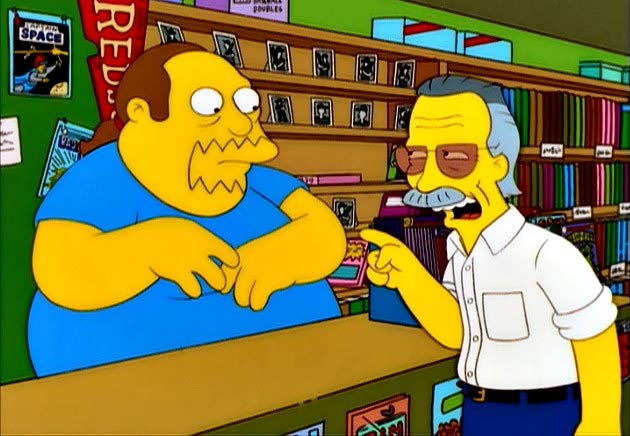
Comic Book Guy and a cameo of Stan Lee, from the episode 'I Am Furious (Yellow)', 28 April 2002.
The Simpsons: longevity
Through the variety of their cast, plot possibilities and contributors, 'The Simpsons' managed to keep surprising viewers, explaining the show's longevity. Already the most successful animated TV sitcom since Hanna-Barbera's 'The Flintstones' (1960-1966), they eventually broke the modern stone-age family's record as longest-running prime time animated TV series. 'The Simpsons' (1989- ) is also the longest-running U.S. prime time TV show since 'Gunsmoke' (1955-1975). It has been on the air for over 35 uninterrupted years, making the family some of the most recognizable TV characters on the planet. Unavoidably, it also led to repeated comments from longtime fans that the once counterculture show has become such a mainstream merchandising mammoth that it lost much of its edge and hilarity. Since the mid-1990s, other adult animated shows like Mike Judge's 'Beavis & Butt-Head', Everett Peck's 'Duckman', Trey Parker & Matt Stone's 'South Park' and Seth MacFarlane's 'Family Guy' upped the ante in terms of subversive satire and pitch black comedy. Though with more than 800 episodes on its track record, it's to be expected that some 'Simpsons' episodes may be better than others. And, from time to time, the show's creators did manage to take up subversive positions again. During the 2008, 2012 and 2016 U.S. presidential elections, various standalone 'Simpsons' shorts satirized the event with very contemporary jokes. And during the first presidential administration of Donald Trump (2017-2021), they went for the unprecedented approach of directly attacking a sitting president in a series of shorts released every few months.
Another byproduct of the show's ongoing success is that some viewers claim the show can "predict the future". Some throwaway jokes later became reality, while others are remarkably similar to events that would happen years later. In all soberness, these are all mere witty coincidences, with the rest just being examples of how history always repeats itself.
The Simpsons: contributors
Comic artists who once worked in 'The Simpsons' animation department have been Istvan Fellner (layout, character designer), Mike Fontanelli (animation, layout), Tom Gammill (producer, scripts), Liz Climo (storyboard revisionist and clean-up artist), David Schwartz (storyboards) and Cliff Voorhees (backgrounds and lay-outs for three episodes). Groening himself doesn't draw or animate for the series, joking that his graphic skills are so limited that "I wouldn't be hired by my own studio". He also only wrote one 'Simpsons' episode completely on his own, 'Colonel Homer' (1993), and co-wrote three others: 'Some Enchanted Evening' (1990), 'The Telltale Head' (1990) and '22 Short Films About Springfield ' (1996). This has sometimes led to the gross oversimplification that Groening has no input at all in the series. In reality, he is creative advisor, supervising all the scripts, judging or vetoing ideas and reminding the staff if they have already done a certain plot or joke before. He designed several of the series' core characters. Many jokes and references still bear his creative fingerprints, nodding to personal pet peeves or autobiographical elements. He has also been "special guest voice" in four episodes: 'My Big Fat Geek Wedding' (2004), 'Homer the Whopper' (2009), 'Holidays of Future Passed' (2011) and 'Treehouse of Horror XXXVI' (2025).
The Curiosity Company
In 1997, Groening established his own production company, The Curiosity Company (sometimes known as the "ULULU Company"), which produced two of his own animated TV series, 'Futurama' and 'Disenchantment', alongside the film 'Olive, The Other Reindeer' (1999), based on J. Otto Seibold's children's book of the same name. With 'Futurama' and 'Disenchantment', he had more direct creative involvement in the scriptwriting process and character design. He would do the initial character design, with more skilled artists streamlining, then giving it back to him, so he could alter the elements too different from his trademark style.

'Futurama'.
Futurama
On 28 March 1999, Groening launched the animated TV show 'Futurama'. Its style of satire and comedy was similar to 'The Simpsons', but stories were set in the 31st century. The show stars Fry, a 20th-century simpleton, who was accidentally cryogenically frozen only to awake a thousand years later. He starts a new life at a distant relative's delivery company, led by mad scientist Professor Farnsworth. Fry's co-workers are the antisocial robot Bender, clumsy Amy, bureaucratic Hermes, crab-like creature Dr. Zoidberg and one-eyed mutant Leela. The show spoofs science fiction, both the naïve utopia featuring flying cars, wacky aliens and cool spaceships, as well as more grim, disturbing dystopia. Plots frequently reference and parody famous novels, films and TV shows, from the most obvious ('The Jetsons', 'Star Trek', 'Star Wars') to the more intellectual (novels by Robert A. Heinlein, Arthur C. Clarke, Harry Harrison and Isaac Asimov). Much like 'The Simpsons', the show also nods to historical events and science, with a stronger emphasis on astronomy, computer technology, math, quantum physics and space exploration. Contrary to 'The Simpsons', 'Futurama' didn't focus on a family audience and features a full-adult cast. This allows the comedy to be more mature and risqué. The sci-fi element also gives the creators the chance to delve into wilder narratives, not bound by plausible reality.

'Futurama' character sketches by Matt Groening.
'Futurama' satirized human society with jokes about suicide booths, discrimination against "robosexuality" and the vanity of celebrities, whose heads are kept in special jars. Some real-life celebrities actually lent their voices to appear as head-in-jars on the show, like hip hop band The Beastie Boys, scientist Stephen Hawking, astronaut "Buzz" Aldrin, 'Dungeons & Dragons' creator Gary Gygax, politician Al Gore, actors Lucy Liu, Mark Hamill and almost the complete cast of the original 1960s 'Star Trek' TV series. Fellow cartoonists also turned up in front of the microphone, such as Sergio Aragonés and Groening himself in the 2010 episode 'Lrrreconcilable Ndndifferences'. Groening co-wrote three 'Futurama' episodes: 'Space Pilot 3000' (1999), 'Rebirth' (2010) and 'In-A-Gadda-Da-Leela' (2010). Aldin Baroza and Ted Stearn were storyboard artists on the series, while Dave Cooper made conceptual background designs. Several writers and voice actors behind 'Futurama' later also helped out with the 2020s reboot of the satirical puppet show 'Spitting Image', by Roger Law.
However, despite excellent reviews, 'Futurama' never matched the mainstream popularity of 'The Simpsons'. In 2003, the show was canceled. Thanks to a strong cult following and DVD sales, it was revived in 2008, but met its end again in 2013. In 2014, the Simpsons episode 'Simpsorama' was a crossover with 'Futurama'. In 2023, 'Futurama' made another comeback, this time on Hulu.
In 2000, 'Futurama' was launched as a bi-monthly comic book series by Bongo Comics. It ran until February 2017 (issue #82), after which all new stories were exclusively presented on a special app, titled 'Futurama'. Contributing writers and artists have been Ian Boothby, Pam Cooke, John Delaney, Mike Kazaleh, Tom King, James Lloyd, Phyllis Novin, Andrew Pepoy, Eric Rogers, Steve Steere, Jr. and Patric M. Verrone.
Disenchantment
On 17 August 2018, Matt Groening launched a new animated TV series, 'Disenchantment', streamed on Netflix. Set in the Middle Ages, albeit an imaginary version with several modern-day anachronisms, the show satirizes the world of fantasy literature. The main character is Princess Bean, a buck-toothed teenager who suffers from alcoholism. She is often seen in the company of her dim-witted elf, Elfo, and her personal demon Luci. Groening based the concept on a comic strip he used to draw in high school, titled 'Tales of the Enchanted Forest', which had talking animals and a leprechaun. Contrary to 'The Simpsons' and 'Futurama', 'Disenchantment' had a continuous storyline, ending each episode on a cliffhanger. Groening praised Netflix for giving his team more creative freedom than possible on regular TV networks, including portrayals of nudity, excessive violence and quite blasphemous comedy, with a light bulb-shaped God and satirical depiction of Heaven and Hell. Aldin Baroza was a storyboard artist. The show received mixed reviews, with some critics argueing it lacked enough political-social satire, while others felt it could have easily been integrated in 'Futurama' in terms of premise. After five seasons, 'Disenchantment' came to an end on 1 September 2023.
In 2022, 2023 and 2024, three graphic novels based on 'Disenchantment' were released by Titan Comics under the title: 'Disenchantment. Untold Tales'. According to Groening, they were mostly intended to adapt some unused storylines from the TV series. The scripts and artwork were provided by Karen Bates, Jacob Chabot, Terry Delegeane, Tim Flores, Jason Ho, Nathan Kane, Tim Kummerow, Alfredo Mercodo, Robert Stanley, Christopher Ungar and Ruth Waytz.
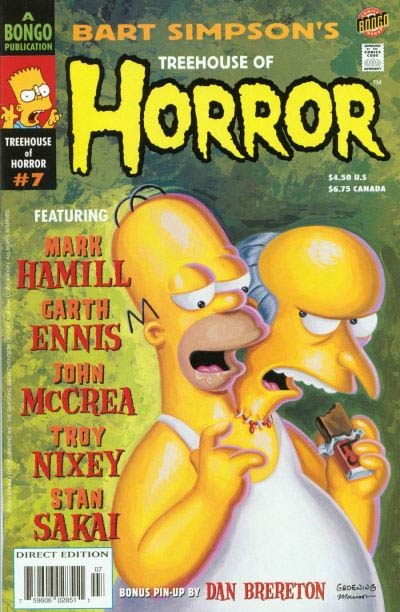
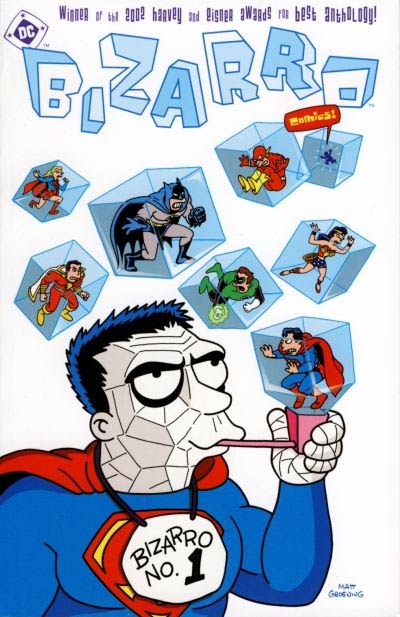
'Bart Simpson's Treehouse Of Horror issue #7', 2001, and 'Bizarro issue #1', August 2001.
Bongo Comics
Starting 4 April 1991, the first comics based on 'The Simpsons' were presented in nine issues of the quarterly magazine Simpsons Illustrated (1991-1993), distributed by Welsh Publishing. Simpsons Illustrated featured humorous columns, articles, ads and comics starring or related to characters, locations and concepts from the show. Produced by Matt Groening, Bill Morrison, Steve & Cindy Vance, with Katy Dobbs as editorial director, the magazine also presented the latest news about upcoming episodes, along with interviews. The only non-Simpsons comic was 'Arnold' by Craig Bartlett, Groening's brother-in-law, who in 1996 developed this series into the children's animated TV show 'Hey Arnold!' (1996-2004). In 1993, an additional one-shot comic book was launched, 'Simpsons Comics and Stories', as testing ground for a potential monthly comic book. When the gamble turned out to be a hit, Groening, Morrison and the Vances established their own publishing company, Bongo Comics, named after the bunny infant from 'Life in Hell'. Its offices were based in Santa Monica, California. On 29 November 1993, they launched a bi-monthly comic book series, 'Simpsons Comics' (1993-2018), which lasted 245 issues.
Each story in 'Simpsons Comics' started off with an attention-grabbing but misleading opening panel, usually a sensational out-of-context scene that turned out to be just an optical illusion, dream sequence or something far more innocent. Each issue usually contained two 'Simpsons' stories. The opening tale was typically a long narrative, focusing on the Simpsons family. The back-up story was shorter and centered on one of the show's many (side) characters. This could be a day in the life of, for instance, bar hopper Barney or supermarket owner Apu. Some stories were more fantasy-oriented, casting characters in an unusual new context. In the show, for instance, Bart Simpson has a juvenile fantasy that he is a superhero: Bartman. In the comics, 'Bartman' is portrayed as an actual masked crimefighter. Other stories are comic book spin-offs based on fictional media franchises in 'The Simpsons' TV series, like superhero Radioactive Man, girls' doll brand Malibu Stacy, Hollywood action star McBain, TV clown Krusty and the cat-and-mouse cartoon Itchy & Scratchy. The Bongo Comics writers and artists depicted these non-existant spin-off comics complete with random serial numbers and sometimes the look of the 20th-century era they were supposedly first published. This could range from a 1930s funny animal comic featuring early prototypes of Itchy & Scratchy, to a 1950s style 'Radioactive Man' story that is actually a thinly disguised anti-Communist propaganda tale.
All 'Simpsons Comics' stories were based on original scripts, although the comics followed the same continuity as the TV series. However, some stories used minor characters or throwaway gags from the TV episodes to develop them further. For instance, in the TV episode 'Three Men and A Comic Book' (1991), the bus driver Otto Mann shows Bart a self-made postapocalyptic comic book featuring himself as 'Busman'. In Simpsons Comics issue #4 (May 1994), a full-blown 'Busman' story was realized, drawn by Bill Morrison. Other comics were leftover ideas for proposed TV episodes or spin-offs that were never realized. One example was Groening's idea for an animated series based on Homer Simpson's childhood, 'Li'l Homer', which in 2012 had its own one-shot comic book.

'...Inside Bongo Comics', from Simpsons Comics #50. Pencils by Phil Ortiz.
Contrary to the show, 'Simpsons Comics' were targeted more towards children, although the TV series' edginess' and contemporary satire wasn't completely watered down either. Springfield's nuclear power plant remained a toxic place. Characters like Barney, Krusty, Mrs. Krabappel and Patty & Selma were still portrayed as alcoholics or chain smokers. Gruesome violence, like in the 'Itchy & Scratchy' comics or Halloween-themed Treehouse of Horror stories, were still present. Bart remained a bad boy, while he and Lisa were sceptical about what adult authority figures tell them. Each issue also features fake advertisements in the style of Mad Magazine, satirizing marketing scams through the use of recurring 'Simpsons' characters. Some stories, like Simpsons Comics #172 (script by Mike W. Barr, artwork by John Costanza, 2010) which lampoons the Christian fundamentalist obsession with keeping Christmas "Christian", are still pointy political-social-religious satire. And though the Bongo Comics' creators kept their pop culture parodies on a level what young readers might recognize, they still included more cultivated references too.
Some comic stories are spoofs of popular genres, like romance comics ('Patty & Selma's Ill-Fated Romance: My Sister, My Homewrecker', issue #2, January 1994), manga ('Mr. Sparkle: Destroy All Manga', issue #45, October 1999) and the 'Classics Illustrated' comic adaptations of literary classics (issue #127). Very specific series are lampooned too, like Carl Barks' 'Uncle Scrooge' (issue #102, January 2005), Jack Chick's tracts ('Reverend Lovejoy's Hellfire Comics: Citizen Shame!', issue #23, August 1996), EC Comics' 'Tales from the Crypt' (Bart Simpsons's Treehouse of Horror #11, September 2005), Will Eisner & Jerry Iger's 'Sheena, Queen of the Jungle' ('Edna, Queen of the Congo', issue #8, January 1995), Bob Montana's Archie Comics ('Everything's Bartchie!', issue #183, 'Springfield's Typical Teen-Ager Homie', issue #122), Osamu Tezuka's 'Astro Boy' ('Bartmanga! Featuring Robartman', Simpsons Super Spectacular issue #16, December 2012) and Mad Magazine (issue #203, June 2013). In 'The Simpsons Comics Internationale!' (issue #131, June 2007), three international comic genres were spoofed, namely manga, Franco-Belgian bande dessinée (with specific spoofs of Hergé's 'Tintin' and Peyo's 'The Smurfs') and Mexican comics. Some of these comic strip parodies could be quite obscure if one isn't a full-blown geek. Certain covers parodied famous Marvel and DC comic book stories and one gag comic, 'Dartin' Around', from issue #17 (February 1996), was a spoof of Jack Davis' 1970s advertising comic for the basketball brand Spalding.

'Clip Clip Hooray!', special meta-humor story for Simpsons Comics #100. Artwork by Phil Ortiz & others.
Over the years, several Simpsons-related one-shot specials or spin-off comic book series were launched by Bongo Comics, often centering around one of the show's made-up franchises, such as 'Bartman' (1993-1995), 'Itchy & Scratchy Comics (1993-1994), 'Krusty Comics' (1995) and 'Radioactive Man' (1993-1994, 2000-2004), among other titles. Around Halloween, Bongo released an annual 'Treehouse of Horror' anthology. While most titles published by Bongo Comics centered around Matt Groening's characters, the company also printed comics by other creators, like Bill Morrison's science fiction strip 'Roswell, Little Green Man' (six issues, 1996-1997) and Stephanie Gladden's 'Hopster's Tracks' (two issues, 1998-2000), as well as twelve issues of 'Sergio Aragonés Funnies' (2011-2014) with humor by the veteran Mad artist and 'Mylo Xyloto' (2012), a seven-issue comic book series created by British rock band Coldplay and filmmaker Mark Osborne, drawn by Alejandro Fuentes. Between 2011 and 2018, Bongo Comics additionally distributed the comic books with Stephen Hillenburg's 'SpongeBob Squarepants', published by United Plankton Pictures.
Groening and his staff hadn't forgotten older audiences. In 1995, they established the Zongo Comics imprint, featuring more adult-oriented work by the alternative cartoonists Gary Panter ('Jimbo', 7 issues) and Mary Fleener ('Fleener', 3 issues), intended for mature readers. However, after only 10 issues, Zongo was already disbanded due to lack of strong sales. 'Simpsons Comics' on the other hand went from bi-monthly to monthly releases by 2000. In all countries where 'The Simpsons' aired on TV, local translations were released, some in magazine format, others in comic book form. On 22 November 2000, Bongo Comics also started publishing comics based on Groening's other show, 'Futurama Comics', featuring much of the same writers and artists. In 2002 and 2005, two special crossover comics were released, 'The Simpsons Futurama Crossover Crisis', scripted by Ian Boothby and drawn by James Lloyd, bringing the cast of both shows together. In 2014, an actual crossover TV episode, 'Simpsorama', was broadcast.

Double cover for Simpsons Comics #200. Artwork by Bill Morrison, Mike Rote and Nathan Kane.
Initially, Bongo co-founders Steve Vance and Bill Morrison were the company's lead writers, artists and editors. In their wake, a great many artists and writers were involved in the titles with Matt Groening characters. The list of additional scriptwriters alone contains the names of Jon Aibel, Neil Alsip, Jamie Angell, Michael Aushenker, Corey Barba, Mike W. Barr, James Bates, Glenn Berger, Tracy Berna, Elma Blackburn, Chris Bonham, Dan Brereton, Ian Brill, Ted Brock, Jeffrey Brown, Erik Burnham, Michael Caleo, Jim Cashman, Dan Castellaneta, Scott Cunningham, Max Davison, David DeGrand, Terry Delegeane, Abby Denson, Tony DiGerolamo, Paul Dini & Misty Lee, Chuck Dixon, Tom Dougherty, Larry Doyle, Gerry Duggan, Barry Dutter, Sarah Dyer, Glenn Fabry, Adam Fein, Jackie Filgo, Jeff Filgo, Brent Fletcher, Christopher Forgues, Dan Fybel, Alice Gammill, Henry Gammill, Frank Gibson, Scott Gimple, George Gladir, Gary Glasberg, Evan Gore, Andrew Gottlieb, Robert L. Graff, Todd J. Greenwald, Clay Griffith, Susan Griffith, Jason Grode, Nathan Hamill, Rob Hammersley, Tim Hensley, Sam Ho, W.E. Holliday, Justin Hook, Shane Houghton, Brian Houlihan, James Huang, Gavin Jennings, Clint Johnson, Ben Jones, Nathan Kane, Arie Kaplan, Earl Kress, Paul Kupperberg, Deb Lacusta, Jim Lincoln, Michael Lisbe, Steve Luchsinger, Tim Maile & Doug Tuber, Jesse Leon McCann & Amanda McCann, Pat McGreal, Harry McLaughlin, Kayre Morrison, Michael Nobori, Andrew Osborne, Tom Peyer, Douggy Pledger, Domenic Polcino, Frank Polcino, Brian Posehn, David Razowksy, Nathan Reger, Eric Rogers, Jeff Rosenthal, Bill Rubenstein, Michael Saikin, Christine Seghers, David Seidman, Chris Simmons, David Slack, Sherri L. Smith, Jan & Julie Strnad, Dan Studney, Joseph Torres, Bryan Uhlenbrock, Jim Valentino, Sib Ventress, Seran Williams, Chris Yambar and John Zakour.
Artists who have worked for Bongo Comics have been John Adam, Edwin E. Aguilar, Marcos Asprec, Igor Baranko, Hilary Barta, Karen Bates, Jeannette Bose, Sharon Bridgeman, George Broderick, Shaun Cashman, Chris Clements, Pam Cooke, Jeannine Crowell, John Delaney, Francis Dinglasan, Art Ebuen, Mark Ervin, Luis Escobar, Marilyn Frandsen, Bill Galvan, Tom Gammill, Michael T. Gilbert, Stephanie Gladden, Tim Harkin, Carl Harmon, Chris Harmon, Matt Hebb, Jason Ho, Brian Iles, Jen Kamerman, Tom King, Nathan Kane, Mike Kazaleh, Batton Lash, Abel Laxamana, Carol Lay, Kim Le, Rex Lindsey, James Lloyd, Istvan Majoros, Nina Matsumoto, Barbara McAdams, Linda Medley, Mike Milo, Jeanette Moreno, Carlos Mota, Eric Moxcey, Kimberley Narsete, Kevin M. Newman, Joey Nilges, Phil Ortiz, Andrew Pepoy, Julius Preite, Dexter Reed, Rick Reese, Ryan Rivette, Jeremy Robinson, Christian Roman, Mike Rote, Sondra R. Roy, Aaron Rozenfeld, Horacio Sandoval, Alberto Santiago, Cary Schramm, Scott Shaw!, David Silverman, Jennifer Sindon, Bob Smith, Mili Smythe, Robert Stanley, Steve Steere, Gerald Steffen, Will Sweeney, Mary Trainor, Erick Tran, Art Villanueva and Mike Worley.
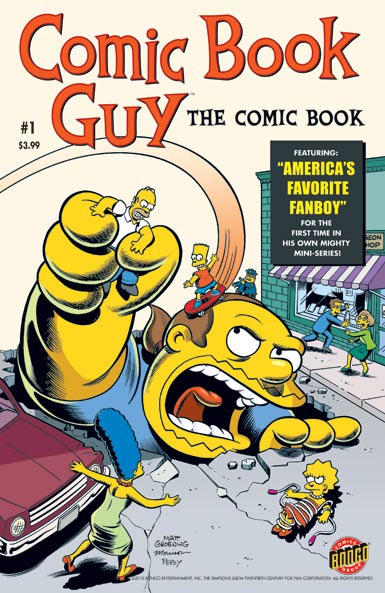
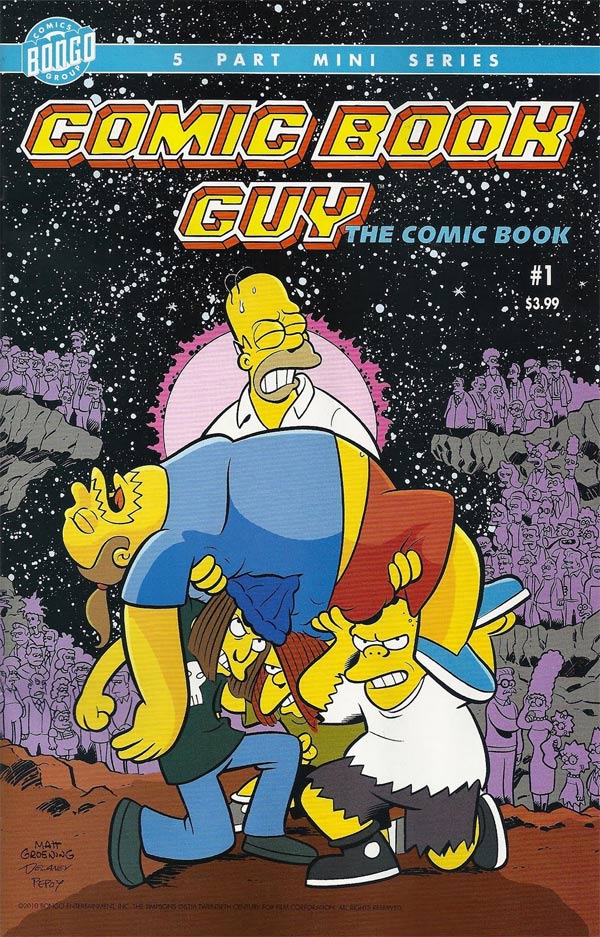
Two 'Comic Book Guy' covers. The one of the left (artwork by Bill Morrison) references the classic cover of the first 'Fantastic Four' story by Jack Kirby. The one on the right (artwork by John Delaney) parodies the cover 'Death of Supergirl' (Crisis on Infinite Earths issue #7, October 1985) by George Pérez.
Some Bongo titles had guest contributions by veterans in the comic industry, like Lalo Alcaraz, Mike Allred, Sergio Aragonés (who drew the gag series 'Maggie's Crib' starring baby Maggie), Peter Bagge, Kyle Baker, Corey Barba, Tim Bavington, Tom Beland, Ian Boothby, Jeff Brennan, Dan Brereton, Jeffrey Brown, Zander Cannon, Jacob Chabot, Howard Chaykin, Gene Colan, John Costanza, Jordan Crane, Geof Darrow, Dan DeCarlo, Mike DeCarlo, Evan Dorkin, Becky Dreistadt, Garth Ennis, Glenn Fabry, Chris Forgues, Ramona Fradon, Stan Goldberg, Oscar González Loyo, Pia Guerra, Gene Ha, Sammy Harkham, Tim Harkin, Tim Hensley, Gilbert Hernandez, Francisco Herrera, Tom Hodges, Chris Houghton, Kevin Huizenga, Ray Johnson, Kelley Jones, Carolyn Kelly, John Kerschbaum, Peter Kuper, Rich Koslowski, Rex Lindsey, Jim Mahfood, Kelvin Mao, Jim Massara, Ted May, John McCrea, Pete McDonnell, John Jackson Miller, Gary Spencer Millidge, Doug Moench, Terry Moore, Scott Morse, Steve Niles, Troy Nixey, Phil Noto, Heather Nufher, Jerry Ordway, Eric Powell, Dean Rankine, Steve Ringgenberg, James Robinson, Tone Rodriguez, Stan Sakai, Horacio Sandoval, Mark Schultz, Gail Simone, Jeff Smith, Dan Spiegle, Neal Sternecky, Ty Templeton, Doug Tennapel, Jill Thompson, Matt Thurber, Bobby Timony, Carlos Valenti, Jon Vermilyea, Patrick Verrone, Rob Walton, Len Wein, Shannon Wheeler, Dave Windett, Jim Woodring, Marv Wolfman and Bernie Wrightson. 'Bart Simpsons's Treehouse of Horror' #11 (September 2005) presented a spoof of a 1950s EC Comics horror book with actual contributions by EC veterans John Severin, Angelo Torres and Al Wiliamson. Other stories in this horror-themed annual series were written by non-comic authors, like actors Mark Hamill, Thomas Lennon, Patton Oswalt and Lona Williams, and musicians like Lemmy of Motörhead fame ('Simpsons' Treehouse of Horror', #16, September 2010), Jane Wiedlin of The Go-Go's ('Simpsons' Treehouse of Horror #17, September 2011) and Alice Cooper, Gene Simmons (Kiss), Rob Zombie and Pat Boone ('Bart Simpson's Treehouse of Horror' #10, September 2004).
Much like Stan Lee credited all the artists, writers, inkers, letterers and colorists in each new Marvel Comics release with colorful descriptions, Bongo did the same in its titles. The panel of each story names all the contributors in a byline, with Groening being given witty nicknames like "ringmaster", "switched at birth" or "the amazing 'don't have a cow, man", instead of the plain dull "creative consultant". In the early Bongo Comics titles, Groening still took the time to provide an editorial column for each new issue of 'Simpsons Comics', in which he told readers anecdotes about his childhood or revealed inspirations for certain characters. He sparked the creativity of aspiring young talents by giving them advice and tips on cartooning. One time, he printed a full-blown list of 250 people he considered creative influences, inspired by a similar list inside the sleeve of Frank Zappa's debut album 'Freak Out!'. When 'Simpsons' actors Doris Grau (voice of Lunchlady Doris) and later Phil Hartman (voice of Troy McClure) passed away, Groening wrote a personal obituary for them. By the year 2000, Groening discontinued his column.
In 2000, Bongo Comics' 'Simpsons Comics' received the Eisner Award for "Best Title for a Younger Audience". In October 2018, Bongo Comics ceased all of its publications.

'The Simpsons' newspaper strip.
'Simpsons' newspaper comics
The step from 'Simpsons' comic books to a newspaper strip seemed almost self-evident, but still took a few years before it came about. On 9 January 1999, 'The Simpsons' debuted in a Saturday newspaper supplement, albeit not in the USA but in the British newspaper The Times of London. Originally, TV screenwriters were assigned to the feature, even though they had little experience scripting a comic. Bill Morrison brought more writers from 'Simpsons Comics' on board, namely Neil Alsip, Barry Dutter, Evan Gore, Robert L. Graff, Jan, Jesse Leon McCann, Dave McKean, David Razowsky, Jeff Rosenthal and Gail Simone. The artists were Norman Auble, Igor Baranko, Barington, Jeanette Bose, John Costanza, Francis Dinglasen, Stephanie Gladden, Oscar González Loyo, Jason Ho, James Huang, Kim Le, James Lloyd, Istvan Majoros, Jim Massara, Joey Nilges, Phil Ortiz, Julius Preite, Allen Roberts, Mike Rose, Gerald Steffen and Peggy Yamamoto. Apart from comics, Morrison and his ever-rotating team of creators also used the newspaper space to parody horoscopes, games, puzzles and film posters. The only time they had to censor something was when the hillbilly character Cletus asks a foreign dignitary if he could "swap his wife", which editors of The Times felt "went too far". During its run, Morrison only drew one ‘Simpsons' newspaper episode, to pay homage to the final episode of Charles M. Schulz' 'Peanuts' in 2000.
After this well-received British start, the American comics syndicate Universal Press began distributing 'The Simpsons' as a Sunday comic. Between 5 September 1999 and 27 August 2000, it appeared in about 50 U.S. papers, though some only bought the rights to take it off the market from their competitors and didn't actually run it. This wasn't the only setback Groening and Morrison experienced in their home country. The 19 December 1999 'Itchy & Scratchy' comic 'It's A Wonderful Slice' had been printed without any trouble in the UK, but caused controversy when published in US papers, since this gruesome violent imagery coincided with the holiday season. The Chicago Sun-Times and Seattle Times instantly canceled 'The Simpsons' comic, while The Detroit Free Press put it on a hiatus. Later, four or five other papers, including The Los Angeles Times, also dropped the feature.

'The Simpsons' newspaper strip: "Nickames" (1999). Artwork by Phil Ortiz.
Despite 'The Simpsons' popularity, the Sunday comics met with a lot of criticism. Rival newspaper cartoonists felt their own comics were being pushed aside to make room for this commercial "TV-based comic". Morrison pointed out that the 'Simpsons' newspaper comic also had to fight for their own spot in the papers. Another criticism from fans was that it lacked the edge of the TV show and was too dialogue-heavy. Most of their writers and artists were used to a comic book layout and often tried to cram too much dialogue and background gags in a 12-to-15-panel comic. Even after finding a better balance, they were creatively limited by the format. Since newspaper comics aim for family-friendly comedy, 'The Simpsons' comic had to submit to these restrictions too. In 'The Simpsons' TV episode 'Behind the Laughter' (2001), even the creators themselves poked fun at its appalling quality, with Marge mentioning that Homer writes the Sunday comic strip himself and Bart winking sarcastically: "So you know it's great", whereupon Homer strangles him in anger.
Right from the start, Groening and Morrison stated that they wanted their strip to remain true to the spirit of the show. Since it obviously became impossible to secure this standard, the comic was already cancelled in 2001, but reprints remained in circulation. Internationally, like in the United Kingdom, Italy and the Czech Republic, the newspaper comic version of the yellow family was far better appreciated. In 2004, HarperCollins announced a book collection of the strip under the title 'The Simpsons Comic Strip Cavalcade', but it was never released.
Media appearances
Groening has voiced characters in animated films such as J. Otto Seibold's 'Olive, the Other Reindeer' (1999) (produced by Groening's Curiosity Company) and Bill Plympton's 'Hair High' (2004). He also appeared in several documentaries, including ones about about Frank Zappa ('Peefeeyatko', 1992, 'Late Night Special', 1993, 'Classic Albums: 'Freak Out!', 2021), Captain Beefheart ('The Artist Formerly Known As Captain Beefheart',1997), Chuck Jones ('The Magical World of Chuck Jones', 1992 and 'Chuck Jones: Extremes and In-Betweens', 2000), John Cage ('Revenge of the Dead Indians', 1993), Charles M. Schulz ('Good Grief, Charlie Brown', 2000), The Beatles ('The Beatles Revolution', 2000), Daniel Johnston ('The Devil and Daniel Johnston', 2005), Ed "Big Daddy" Roth ('Tales of the Rat Fink', 2006), Wayne White ('Beauty is Embarrassing', 2012), David Boswell ('I Thought I Told You To Shut Up!', 2015), Nick Park ('A Grand Night In: The Story of Aardman', 2015), The Residents ('A Theory of Obscurity', 2015) and Steel Pulse ('Dreadtown'). He occasionally played in the amateur rock band The Rockbottom Remainders. In issue #352 (December 1996) and #409 (September 2001) of Mad Magazine, Groening was featured in their column 'Celebrity Snaps', where he was photographed holding an issue of Mad.
Graphic contributions
Groening designed the album cover of 'Crazy Backwards Alphabet' (1987) by Crazy Backwards Alphabet, a musical side project by Henry Kaiser, John French (Captain Beefheart), Michael Maksymenko and Andy West (The Dixie Dregs). He also illustrated the cover of 'Country Music in the World of Islam' (1990), an album by Eugene Chadbourne, Elliott Sharp and the Sun City Girls. He did the same for the comedy record '(If U Want Free Speech) Go To Russia' (1990) by Harry Shearer (the voice of Mr. Burns, Smithers, Skinner and several other Simpsons characters). Groening additionally illustrated Frank Zappa's posthumous live record, 'Frank Zappa Plays the Music of Frank Zappa: A Memorial Tribute' (1996). He was also one of many cartoonists who contributed a graphic homage to The Ramones' compilation CD/comic book 'Weird Tales From The Ramones' (2005).
Written contributions
Groening wrote the foreword to Monte Beauchamp's book about Robert Crumb, 'The Life and Times of R. Crumb' (St. Martin's Press, 1996), the 1956-1958 volume of the posthumous compilation books of Charles M. Schulz' 'Peanuts' series and Sergio Aragonés' compilation book 'Mad's Greatest Artists: Sergio Aragonés: Five Decades of his Finest Works' (2010). He did the same for reprints of Chuck Jones' autobiography 'Chuck Amuck' (Farrar, Straus and Giroux, 1994), Lat's 'Kampung Boy' and a 2022 translation of Liniers' 'Macanudo'. When the Hammer Museum and Museum of Contemporary Art in L.A. held the exhibition 'Masters of American Comics' (Hammer Museum, 2005) and published a catalog with work by the respective artists, Groening wrote an essay about Gary Panter. In 2014, Groening penned the foreword to Richard Gehr's compilation book 'I Only Read It For The Cartoons: The New Yorker's Most Brilliantly Twisted Artists' (New Harvest).
Groening included a full chapter to 'Midlife Confidential: The True Story of the Rockbottom Remainders' (Viking Press, 1994), updated almost a decade later under the new book title 'Hard Listening' (Coliloquy, LLC, 2013). He provided liner note contributions to Yma Sumac's 'The Ultimate Collection' (2000), the science fiction-themed soundtrack compilation album 'Brain In A Box: The Science Fiction Collection' (2000) and Frank Zappa's 'The Hot Rats Sessions' (2019).
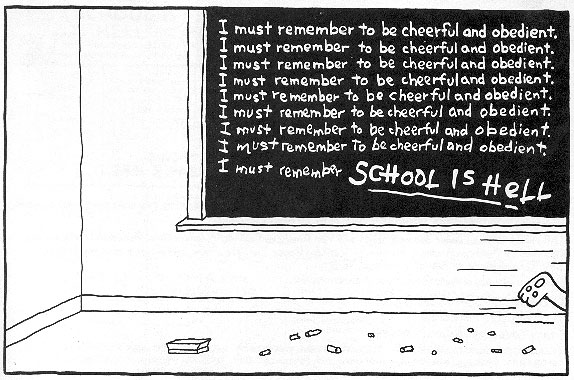
'School Is Hell'.
Recognition
'The Simpsons' has won 34 Emmy Awards over the years, and 'Futurama' six. Groening won an Inkpot Award (1988) and a Reuben Award (2002) for 'Life in Hell'. In 2000, 'The Simpsons' received a star on the Hollywood Walk of Fame, and Groening got his own star in 2012. He received the Winsor McCay Award (2010) and in 2016 he was inducted in the Eisner Hall of Fame. In 2025, the 'Simpsons' creator received a Honorary Crystal at the Animation Festival of Annecy.
Legacy and influence
Matt Groening can in many ways be considered the Walt Disney of our age. 'The Simpsons' have become the most popular, recognizable and mass-merchandized characters since Mickey and Donald. However, contrary to Disney, Groening has preferred to operate from the underground. The cult success of 'Life in Hell' - doubled when 'The Simpsons' became a hit - inspired more media to ran work by other alternative comic artists. Groening's own comic book imprints, Bongo and Zongo Comics, offered opportunities for several comic creators. By frequently namedropping or referencing artists he admires, either in interviews or in episodes of his TV shows, Groening has increased their fame and fanbase. He has been frequently invited to participate in all kinds of lectures, festivals and documentaries, and asked to write forewords, curate musical or cinematic events or provide DJ sets on the radio. In a similar manner, 'Futurama' and 'Disenchantment' popularized science fiction and fantasy among new audiences. Without exaggeration, Groening can be named one of the forces who increased mainstream attention for alternative culture. Though in 2025, he jokingly referred to himself as "an underground cartoonist who sold out."
'The Simpsons' alone has had a remarkable impact on modern-day culture. Bart Simpson has become an eponym for a proverbial "bad boy" and Homer Simpson an all-to recognizable representation of the average, clueless and fallible (American) working class male. Many characters are often compared with real-life people in society, such as pathetic alcoholics (Barney Gumble), bland Christians (Ned Flanders), frustrated teachers (Mrs. Krabappel), cold-hearted, aging businessmen (Mr. Burns), Indian store owners (Apu) and pop culture-obsessed geeks (Comic Book Guy). In terms of language, the series popularized the exclamation "D'oh!" (originally lifted from 'Laurel & Hardy' actor James Finlayson) whenever somebody realizes he's done something stupid. The newspaper headline "Old Man Yells At Cloud" featuring the character Granpa, from the episode 'The Old Man and the Key' (2002), has become a popular meme, referring to cranky people who always complain. Several Homer sequences and images have inspired popular social media memes, for instance a gag from 'Homer Loves Flanders' where Homer slowly walks backwards to hide in a bush (in its original context a parody of 'Terminator 2'). The Simpsons' annual Halloween specials ('Treehouse of Horror') effectively popularized this holiday in many countries that traditionally didn't celebrate it. The show also inspired the bands Fall Out Boy, Okilly Dokilly and the Belgian group Malibu Stacy and the songs 'Good Lobna' (Frank Zappa), 'Ralph Wiggum' (The Bloodhound Gang), 'Let's Save Tony Orlando's House' (Yo La Tengo) and 'Everything's Coming Up Milhouse' (Allie Goertz).

'Life in Hell' episode featuring Matt Groening himself.
Matt Groening and his work have received admiration from veteran cartoonists like Sergio Aragonés, Joseph Barbera, Robert Crumb, Terry Gilliam, Chuck Jones, Kamagurka, Willy Linthout, Ever Meulen and Richard Sala. Numerous cartoonists and comic artists have mentioned Groening as a strong influence on their work. In the United States, he inspired Matt Furie, Stephen Hillenburg, Seth MacFarlane, Nina Paley, Ted Rall, Dana Simpson, Andy Singer and Tom Tomorrow. In Europe, he influenced Pieter De Poortere, Steve Michiels and Zep. The Englishman Ryan Humphrey started 'Bartkira', a community art project where hundreds of artists from all over the world collaborate to recreate all six volumes of Katsuhiro Otomo's manga series 'Akira', replacing all the characters with the cast of The Simpsons'. In Africa, Matt Groening has followers among Pitshou Mampa, and in Latin America Francisco Munguia is a fan.
'The Simpsons' had a huge impact on TV animation, proving that the genre could allow sophisticated quality entertainment and find an adult audience as well. It paved the way for many other animated TV series for adults, including Mike Judge's 'Beavis & Butt-head' (first series in 1992-1997) and 'King of the Hill' (1997-2009, 2025- ), Al Jean and Mike Reiss' 'The Critic' (1994-1995), Everett Peck's 'Duckman' (1994-1997), Glenn Eichler and Susie Lewis Lynn's 'Daria' (1997-2002), Trey Parker and Matt Stone's 'South Park' (1997- ), Eddie Murphy, Larry Wilmore and Steve Tompkins' 'The PJs' (1999-2001), Seth MacFarlane's 'Family Guy' (1999- ) and 'American Dad!' (2005- ), Aubrey Ankrum, Rhode Montijo and Kenn Navarro's 'Happy Tree Friends' (1999), Matthew Carlson's 'God, the Devil and Bob' (2000), Mike Reiss' 'Queer Duck' (2000-2004), Christopher McCulloch's 'The Venture Brothers' (2004-2018), Dave Jeser and Matt Silverstein's 'Drawn Together' (2004-2007), Seth Green and Matthew Senreich's 'Robot Chicken' (2005), Loren Bouchard's 'Bob's Burgers' (2011), Justin Roiland and Dan Harmon's 'Rick and Morty' (2013) and Raphael Bob-Waksberg's 'BoJack Horseman' (2014-2020).
At the same time, 'The Simpsons' has also made more eccentric and sophisticated children's TV shows possible, such as John Kricfalusi''s 'Ren & Stimpy' (1991-1995), Tom Ruegger's 'Animaniacs' (1993-1998), Bruce Timm and Paul Dini's 'Freakazoid' (1995-1997), Joe Murray's 'Rocko's Modern Life' (1993-1996) and 'Camp Lazlo' (2005-2008), Genndy Tartakovsky's 'Dexter's Laboratory' (1996-2003) and 'Samurai Jack' (2001-2004) (2017), Craig McCracken's 'The Powerpuff Girls' (1998-2005), Stephen Hillenburg's 'SpongeBob Squarepants' (1999- ), Butch Harman's 'The Fairly Oddparents' (2001-2017) and Pendleton Ward's 'Adventure Time' (2010-2018). Groening's work has also influenced U.S. TV comedy. Since the 1990s, more TV sitcoms have abandoned laugh tracks and low-brow, non-offensive comedy in favor of more clever, edgy writing. Several TV makers have credited 'The Simpsons' with inspiring them to do this. The show also provided a climate where U.S. TV satire could be more audacious and pointed, without the fear of alienating mass audiences.
The impact of 'The Simpsons' has been such that in 1999 Bart Simpson became the only fictional character to make Time Magazine's list of the "100 Most Influential People of the 20th Century". As Matt Groening said, interviewed by Carina Chocano for Salon (30 January 2001): "My success has gone beyond my wildest dreams and worst nightmares."

Promotional Matt Groening portrait (artwork by unknown artist) to advertise his TV show 'Disenchantment' (2018). Behind him on the shelf, we can spot various (works by) authors Groening loves: Charles Dickens, Thomas Pynchon, Gary Panter, Jack Vance's 'Tales Of Dying Earth', Terry Pratchett, Walt Kelly's 'Pogo', Carl Barks' Uncle Scrooge' (a few shelves below, also 'Donald Duck'), Justin Green's 'Binky Brown', 'Evelyn Waugh's The Loved One', John Lennon's 'In His Own Write', P.G. Wodehouse, 'Fascism: A Warning', John Stanley's 'Little Lulu', Andrew Sarris, a Frank Zappa record, Gene Wolfe, A.B. Guthrie, Jr.'s 'The Big Sky', Gershon Legman's 'Rationale of the Dirty Joke' and 'No Laughing Matter', Dave Barry, J.D. Salinger, Tuli Kupferberg's '1001 Ways To Beat The Draft', R. Crumb, Sinclair Lewis' 'It Can't Happen Here', Lynda Barry's 'Cruddy', Ernie Bushmiller's 'Nancy and Sluggo' and Henry A. Shute.