

Stan Lee, as portrayed on the cover of Marvel Age #41 (August 1986).
Stan Lee was a US comic writer, editor and publisher, and to many, the face of Marvel Comics. Starting with the predecessors of the company in the 1940s and 1950s, he was an editor and writer for both Timely Comics and the Atlas comic book line. Building on the talents of Jack Kirby, Steve Ditko and other creators, he helped catapult Marvel Comics into the "Silver Age of American Comic Books" with the launch of a new generation of superheroes, with equal attention paid to thrills and action as to psychology and character development. During the 1960s, a wave of iconic characters came into being under Lee's editorship, subsequently 'The Fantastic Four' (1961), 'The Incredible Spider-Man' (1962), 'The Mighty Thor' (1962), 'The Incredible Hulk' (1962), 'The X-Men' (1963), 'Iron Man' (1963), 'The Avengers' (1963), 'Sgt. Fury and His Howling Commandos' (1963), 'Doctor Strange' (1963), 'Daredevil' (1964), 'Hawkeye' (1964) and 'The Silver Surfer' (1966). This new approach to the ailing superhero trope rebooted general interest in the genre, and also appealed to more mature readers. Contemporary societal problems like prejudice, drug abuse and death were woven into the plots, while characters battled with their conscience and self-doubt, as they experienced the rapid social changes of the 1960s and beyond. As an editor, and later publisher, Lee built up a strong bond with Marvel's fans through his editorial columns, the so-called "Soapboxes". Larded with his signature hyperbolic verbiage, editor Stan Lee addressed readers directly and made public the names of scriptwriters, artists, inkers and colorists, the "bullpen" people who generally remained anonymous. Through his frequent media appearances, Lee himself became a recognizable spokesperson for Marvel Comics, in the 1980s making the move to Hollywood to warm up the movie industry for the company's characters. Comparable to Walt Disney, the name and face of Stan Lee became recognizable to a broad segment of the general public.
However, Lee has also been the subject of an ongoing polarizing controversy among modern audiences attempting to establish a fact-based, objective evaluation of the extent and nature of Lee's actual accomplishments in the creation of Marvel's classic characters. To his fans and the general audience, he is the visionary who crafted the "Marvel Universe" which keeps the entire comic book line together; to his critics, Lee is a tireless a self-promotor who exaggerated his own role in the creative process, while simultaneously downplaying the contributions and innovations of others. Working according to the Marvel Method, Lee often only discussed a basic story concept with his artists, letting them independently write and draw the full issue, after which he stepped back into the process to write the dialogues (but still received full scriptwriter credit). While the question of Lee's exact role in the development of the comics he is credited for creating remains fuel for heated debate among select members of the Marvel Comics fanbase, a sizable segment of the general world population credits Stan Lee's special type of humorous hype, featuring tireless (self)promotion of the Marvel brand to the children, teens and young adults of the 1960s, using absurd acronyms ("FOOM"), superhero slogans ("Your Friendly Neighborhood Spider-Man") fan-base branding ("Make Mine Marvel"), colorful catchphrases ("It's Clobberin' Time!") for single-handedly transforming Marvel from a soon-to-close-up-forever failed comics division of a New York City publishing company into the successful multinational multimedia global conglomerate it is today, nestled deep into the power structures and ancillary merchandising of the Disney empire. But as the years progressed from the 1960s wave of "Silver Age" Marvel titles, Stan Lee became more remote from the day-to-day of Marvel comics production, and by the time Marvel characters began making their way to the silver screen, his role in the movies were largely limited to the short Hitchcock-like cameos in which he appeared.
Early years and influences
Stanley Martin Lieber was born in 1922 in Manhattan, New York, into a Romanian-Jewish family. Both his parents, Iancu Urn Liber and Celia Solomon, were Romanian refugees who had arrived in New York City in the early 20th century. There, Iancu took on the anglicized name Jacob Aaron Lieber and went to work as a dress cutter in Manhattan's Garment District. By the time the couple met, Celia was working as an accountant at the Woolworth's department store. After their marriage in 1920, they had two sons; nine years after Stanley came Larry Lieber, who later became a notable comic writer and artist for Marvel in his own right.
As their father was largely out of work during the Depression years, the boys were brought up in poverty. As Stan would later describe in his memoirs, he loved to explore the city on his bicycle, which gave him a great sense of freedom. He was also an avid reader, enjoying newspaper comics like Rudolph Dirks' 'The Katzenjammer Kids', Walter Berndt's 'Smitty', Percy Crosby's 'Skippy', Chester Gould's 'Dick Tracy' and Sidney Smith's 'The Gumps', as well as popular novels, for instance the work of H.G. Wells, Arthur Conan Doyle, Mark Twain and Edgar Rice Burroughs. A favorite was the swashbuckler adventures of 'The Scarlet Pumpernickel' by Baroness Orczy. As he grew older, Lee also discovered Edgar Allan Poe, Charles Dickens, Edmond Rostand, Émile Zola and William Shakespeare. The early Modern English and poetical phrasing from both Shakespeare and the King James Bible shaped his future writing. Another influence on Lee's style was the evocative and rhythmic use of language on pre-war radio serials, for instance, ones starring Edgar Bergen and W.C. Fields.
While Stan Lieber was attending high school at DeWitt Clinton in the Bronx, he became determined to become a writer. At age 15, he participated in a competition by The New York Herald Tribune, in which young writers were encouraged to write a short essay about a current event. As Lee later often recollected, he managed to win the contest three times in a row, prompting editors of the paper to ask him if he would let others have a chance and instead focus on making a professional career out of writing. Looking into this matter, Josephine Riesman - author of the 2021 posthumous biography 'True Believer: The Rise and Fall of Stan Lee' - discovered that Lee did indeed participate, but only reached seventh place in the first week and was then among 99 other honorable mentions in the next two weeks. An early example of Lee's talent for mythmaking, both creatively and autobiographically. According to Lee, he had several odd jobs as a teenager and excelled in all of them, including sandwich delivery boy, paid actor in the theater and writer of obituaries and press releases for the National Tuberculosis Center.
Following the alleged advice of the newspaper editors, in 1939 he found a job at the Federal Theater Project. Organized by the Works Progress Administration, this federally funded arts program enabled US theaters to produce plays, even at the height of the Great Depression. There, Lee helped write and edit theatrical drafts, but the program was quickly shut down before much was produced.


U.S.A. Comics #1 and All Winners Comics #1, the first comic book containing stories scripted by Stan Lee (1941).
Timely Comics
Through connections of his uncle Robbie Solomon, the 17-year-old Stanley Lieber first entered the comic industry. Solomon worked for a New York publishing company, Timely Publications, based in the McGraw-Hill Building at 330 West 42nd Street. Managed by Solomon's brother-in-law Martin Goodman (1908-1992), the company had been flooding the market through pulp magazines with true-crime, romance and risqué content. By 1939, they were also entering the brand new comic book market, which had been pioneered by companies such as Centaur Comics, M.L.J. Publications (the future Archie Comics) and the two predecessors of DC Comics (All-American Publications and Detective Comics Inc.). Launching the imprint Timely Comics, Goodman's first release was Marvel Comics #1, cover-dated October 1939. It debuted the earliest superheroes of what later became Marvel Comics. In the next couple of years, several additional titles were launched, initially filled by writers and artists from outside "comic book packagers" like Lloyd Jacquet's Funnies Incorporated and the Harry "A" Chesler Shop. Within a couple of months, Goodman began assembling an in-house production department, spearheaded by editor Joe Simon and art director Jack Kirby. Urged by his uncle, the teenage Stanley Lieber applied for a job opening in this new division.
Hired in 1939, Lieber initially got a job as an office boy, keeping artists' supplies in check. He sharpened their pencils, filled their inkwells and bought them food during lunch breaks. His most rewarding task during those early days was proofreading comic pages. However, the ambitious teenage office clerk constantly bugged Joe Simon to let him write something until the editor finally gave in. His earliest efforts were text stories that were used as fillers in the comic books. Since he still had the ambition to become a successful novelist, Stanley Lieber decided to keep his legal name in reserve for his future, as yet unwritten, "Great American Novel" and invented a pseudonym he could sign as for his less prestigious low-brow comic book work: Stan Lee. (Ironically, it was the name Stanley Martin Lieber that was shunted aside and abandoned and the lowly pseudonym Stan Lee that won prestige, honor, and eventually, legal status, as Lieber permanently changed his legal name to "Stan Lee" in 1971.)
However, during those early years, he also tried out other pen names, such as S.T. Anley and Neel Nats. In the third issue of Captain America Comics (May 1941), his first text story, 'Captain America Foils the Traitor's Revenge' appeared in print. The episode was notable because for the first time Captain America spins his shield through the air to disarm a villain in a boomerang-like fashion. Several additional text stories followed, often with heroes foiling plans by the Axis powers, until Lee saw his first comic stories printed. Unlike other writers from this "Golden Age of American Comic Books", practically all of Lee's stories have been identified because he was one of the first to always sign his work with one of his pseudonyms. On his Timely-Atlas-Comics blog, the comic book historian Dr. Michael J. Vassallo has made the most comprehensive overview.
The first-ever published comic story written by Lee appeared in U.S.A. Comics #1 (cover date August 1941, published 15 May), and was drawn by Charles Wojtkoski. One of several weird superheroes from Lee's early output, the character was Jack Frost, the anthropomorphized spirit of winter. Three more stories with the characters appeared, of which the writer credit is unknown, but artists included Frank Giacoia and Carmine Infantino. Around the same time, he wrote a story with the existing superhero 'Black Marvel' for All Winners Comics #1 (art by Al Avison and Al Gabriele), and co-created the backup feature 'Headline Hunter, Foreign Correspondent' for Captain America Comics #5 through #13 (August 1941-April 1942) with Harry Fisk and then Warren Kremer as the artist. Among the other early characters co-created by Lee were 'The Destroyer' in Mystic Comics issues #6 through #9 (1941, art by Jack Binder, Chad Grothkopf and Al Avison), the first incarnation of 'The Witness' in Mystic Comics #7 (December 1941, by an unknown artist, Vassalo says Michael Suchorsky), and 'Father Time' in Captain America Comics #6 through #12 (art by Al Avison and Jack Alderman).
By the end of 1941, the powerful team of Jack Kirby and Joe Simon was fired by Timely over a salary dispute. Following their departure from the company, 19-year-old Lee was promoted to editor, soon upgraded to the role of chief editor. With the number of Timely comic books rising up to ten, he continued to write his regular features and create new ones. New characters he worked on during this period include 'The Whizzer' in All Winners Comics #2 and #3 (art by Paul Reinman), 'Rockman, Underground Secret Agent' in USA Comics #3 (art by Charles Nicholas), 'Hurricane' in Captain America Comics #11 (art by Charles Wojtkoski) and 'The Challenger' in Mystic Comics #8 and #9 (art by Mike Sekowsky). One of Lee's more offbeat creations was 'The Imp', a cartoony character speaking in rhyme, drawn by Chad Grothkopf (with the assistance of Al Jaffee) in Captain America Comics #12 through #16 (1942). In addition, Lee was writing book-length stories for Young Allies Comics, starring the patriotic kids' gang created by Joe Simon and Jack Kirby shortly before leaving the company. In 1942, he also began supplying gags and jokes to Timely's newly launched, but short-lived, humor magazines, such as Joker, Stag and Comedy. Shortly afterwards, Marvel also launched a line of humor comic books, for which Lee began writing as well, featuring characters like 'Widjit Witch' (Comedy Comics), 'Little Lester' (Krazy Komiks) and 'Dinky' (Terrytoons).

Stan Lee in the military, drawing a poster.
Military service
On 9 November 1942, Lee's blitz career was interrupted when he enlisted in the U.S. Army to serve his country. At Fort Monmouth in New Jersey, he was trained in the Signal Corps, a division of the army dealing with communication and infrastructure. Realizing he was a scriptwriter, his officers relocated him to the Training Film Division in Astoria, Queens. There, he was on a team of eight artists, filmmakers and writers working on military propaganda media and army instruction films. In interviews, Lee also mentioned he had a short stint as a cartoonist, illustrating training manuals and designing posters. Among his fellow recruits in this specific division were the cartoonist Charles Addams, children's book author Dr. Seuss and film director Frank Capra. During the remainder of the war, Lee was stationed in several places, all in the USA, such as Duke University in North Carolina and Indiana's Fort Benjamin Harrison.
At Timely, Lee's role as editor was temporarily taken over by Vincent Fago. From wherever he was stationed, Lee kept in touch with the company's creative and administrative proceedings by mail, and "Pvt. Stan Lee" remained credited as "consulting editor". Over the course of 1943, he also resumed writing scripts, but dropped the superheroes and instead contributed to Timely's new funny animal titles. For his friend Jim Mooney, he wrote several scripts for the feature 'The Ginch and E. Claude Pennygrabber' (1943-1945), which appeared in the licensed Terrytoons comic book with characters from Paul Terry's animation studio. For issue #15 of Krazy Komiks (June 1944), he wrote the war propaganda comic story 'Super Soldier', credited to P.F.C. Stan Lee and possibly drawn by Kin Platt or David Gantz.

'Super Soldier' from Krazy Komiks #15 (June 1944), written by "P.F.C. Stan Lee".
From Timely to Atlas
Discharged from his military service on 29 September 1945, Lee picked up his old job at Timely Comics, which had in the meantime relocated from the McGraw Hill Building to the Empire State Building. However, much more had changed at the company during his absence. The war years had made people weary of masked superheroes fighting Nazis, so the company changed direction. While Timely Comics maintained a handful of superhero titles until the late 1940s, their new focus became funny animal and teen comic books. Inspired by direct competitors such as MLJ Publications (Archie Comics) and Dell Comics (Disney/Warner Bros. comics), Timely launched dozens of similar titles from the mid- to late 1940s. Some were loosely inspired, other blatant copies.
Back in the saddle in 1945, Lee was appointed editor and art director for all of those comic books, while he was also put in charge of a team of subeditors and a "bullpen" of in-house writers and artists. Among the art staff were pencilers Ken Bald, Dave Berg, Frank Carin, Vince Fago, Ernest Hart, Al Jaffee, Dennis Neville, Kin Platt, Mike Sekowsky, Morris Weiss, Ed Winiarski and Moe Worthman, as well as production artists (inkers, letterers) Mario Acquaviva, David Gantz, Gary Keller, Bill King and George Klein. On occasion, Lee also did some editing duties for Timely's magazine division, contributing to titles like Film Album and Focus. During this period, he also took his first steps in the promotion of comics as a medium with the release of the 1947 booklet 'Secrets Behind The Comics', which for the first time gave readers a glimpse behind the scenes of a comic book publisher, although his narrative was not entirely historically accurate regarding the origin stories behind some of the Timely creations. Behind the scenes at the actual comic book office, things were less than idyllic. According to legend, Lee had built such a big stock of stories, that publisher Martin Goodman let him fire the entire staff.
In October 1951, Timely Comics ventured into self-distribution and, for the occasion, switched to using the Atlas Comics imprint. There, the practice of copying the competition continued. For example, to compete with EC Comics, Atlas published horror and mystery comics. Since Lev Gleason's 'Crime Does Not Pay' was a bestseller, Atlas also jumped on the crime comic bandwagon. In 1954-1955, the company made an ill-fated attempt to relaunch their old superhero successes from the past ('Sub-Mariner', 'The Human Torch', 'Captain America'), but none succeeded. During the 1940s and 1950s, Timely/Atlas launched hundreds of series in every imaginable genre. It wasn't until 1948 that Lee returned to writing comic scripts himself, starting with book-length stories for the short-lived crime title 'Complete Mystery' (1948-1949), with art by Gene Colan, Syd Shores and Carl Burgos. In the same vein, he wrote for Timely's true history title 'Ideal - The World's Greatest Stories' (1948).
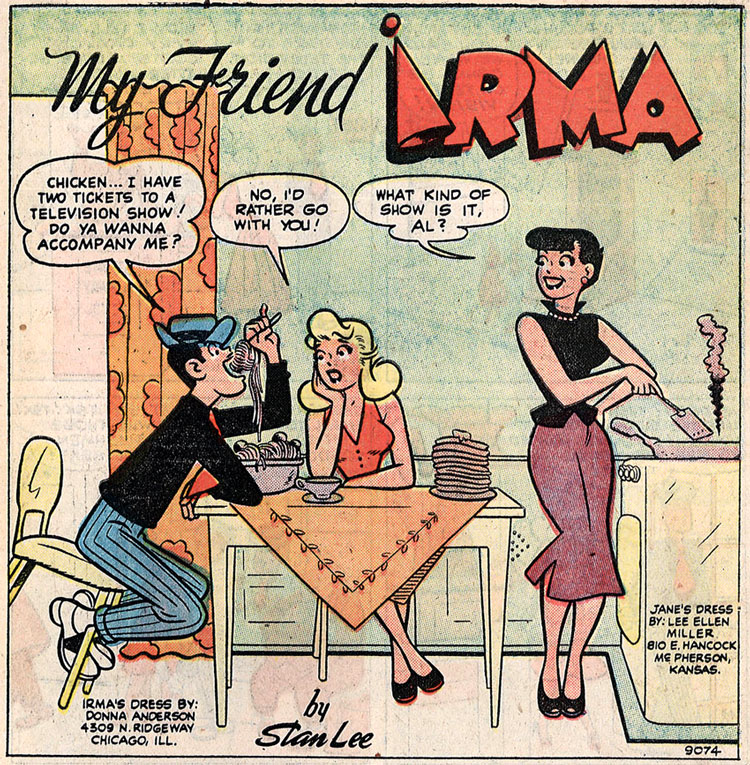
'My Friend Irma'. Artwork by Dan DeCarlo.
Teen humor series
As a scriptwriter, Lee's most prominent work during the pre-Atlas period was for the teen humor titles. His longest tenure was on 'Millie the Model', a series originally created in 1945 by Ruth Atkinson. Lee took over from issue #18 (April 1949) and was credited as writer until #129 (July 1965), first working with artist Dan DeCarlo and then with Stan Goldberg. The title proved perfectly suitable for Lee's trademark snappy banter and wisecracks, especially in the dialogue between Millie and her friendly nemesis Chili Storm. In addition, Lee also wrote the spin-off 'A Date With Millie', including a first series with Dan DeCarlo (1955-1956) and a second one with artwork by Al Hartley (1959-1960). The spin-off series was then continued as, subsequently, 'Life With Millie' (1960-1962) and 'Modeling with Millie' (1963-1967), both with artwork by Stan Goldberg.
Another long-running collaboration of the "Stan & Dan" team-up was forty issues of 'My Friend Irma' (1951-1955), based on the CBS radio sitcom about dumb but good-natured blonde Irma Peterson. In 1952 the series was also adapted for television. When publisher Martin Goodman didn't continue the license, the 'My Friend Irma' comic book was replaced by the almost identical 'My Girl Pearl' (1955-1961), of which 11 issues appeared irregularly written by Lee and drawn by Dan DeCarlo and then Stan Goldberg.
In between, Lee had scriptwriting duties on a whole range of additional "girly humor" titles, for instance taking over 'Rusty Comics' from issue #20 (1949), a clone of Chic Young's 'Blondie' strip. During his two-issue run, the artwork was provided by future Mad stalwarts Al Jaffee and Harvey Kurtzman. With his artist friend Kenneth Bald, he made three issues of 'Mitzi's Romances' (1949), and he also contributed to 'Hedy Devine', AKA 'Hedy of Hollywood' (1949-1952), with Ed Winiarski as the main artist. In 1949 and again in 1951-1952, he wrote the 'Nellie the Nurse' comic book, drawn by Howie Post. A final collaboration between Lee and Dan DeCarlo was 'Sherry the Showgirl' (1956-1957), of which Al Hartley eventually took over the artwork. With the latter, Lee also created short-lived romance titles like 'Meet Miss Bliss' (1955), 'Della Vision, the Television Queen' (1955) and 'Patty Powers' (1955-1956). Between 1958 and 1965, Lee and Hartley also collaborated on many issues of 'Patsy Walker', turning the series' theme from high-school humor to the romantic adventures of a young career girl. In the 1970s, Patsy Walker notably made the leap from the teen humor titles to the superhero line, when writer Steve Englehart gave her the Hellcat identity in 'The Avengers' issue #144.


Millie the Model #18 and Melvin the Monster #1.
Further humor titles
While teen humor titles with adolescent girls seemed to be Lee's specialty for a long time, he also worked on comic books starring younger kids. In 1949, the first such titles he worked on were 'Little Lenny' (1949, art by Vic Dowd), 'Awful Oscar' (1949, art by Hal Lockwood), 'Frankie Fuddle' (1949, art by Leon Winik) and 'Little Lizzie' (1949-1950, art by Al Jaffee and Kin Platt), the latter a blatant rip-off of Ernie Bushmiller's newspaper comic 'Nancy'. In the mid-1950s, more creations followed. Copying the concept of Hank Ketcham's daily 'Dennis the Menace' cartoon series, Lee and artist Joe Maneely created 'Melvin the Monster' (1956-1957), although it was renamed to 'Dexter the Demon' in the seventh and final issue. Lee also had stints in Timely's funny animal books with stories about 'Wonder Duck' (1949-1950) with artist Ed Winiarski. In 1957, Atlas Comics made a final attempt at funny animal books, but both the Stan-scripted 'Marvin Mouse' (art by Bill Everett) and 'Dippy Duck' (art by Joe Maneely) disappeared after only one issue.
Besides girls, Lee also did some scriptwriting work for issues of teen humor titles with boy characters. Both 'Georgie Comics' (1952) and 'Homer Hooper' (1953), drawn by Hy Rosen, were obvious copies of Bob Montana's 'Archie Comics' series by competitor MLJ Publications. Similar copies were the 22 issues of the 'Homer the Happy Ghost' comic book (1955-1958), another collaboration between Lee and Dan DeCarlo, which were a bit too strongly inspired by the 'Casper the Friendly Ghost' series of Harvey Comics. Some titles directly tied in with existing comedy material. In 1955, Lee and artist Morris Weiss created five issues of 'The Adventures of Pinky Lee', a comic book based on the children's TV comedian of the same name.
Mad copies
In 1954, when EC Comics gained increased success with Harvey Kurtzman's burlesque parody/humor comic book 'Mad', Atlas joined in and launched no less than three similar titles: 'Crazy' (1953-1954), 'Wild' (1954) and 'Riot' (1954-1956). While Lee was credited as editor, he only did some sporadic scriptwriting contributions to 'Crazy' and 'Riot'. In 1955, he was more actively involved in the launch of another Mad clone, the three-issue Snafu. As Mad was now appearing as a magazine instead of a comic book, Snafu also took this format and featured mostly illustrated articles with parody, satire and silliness. With Lee writing many of the articles, contributing illustrators were Joe Maneely, John Severin, Bill Everett, Russ Heath, Howie Post and Marie Severin. The magazine's title was based on military slang from the World War II period, sarcastically meaning "Situation Normal: All Fucked Up". Standing out among the other Mad copycats from this period, Snafu had its own visual style and tone and own contents page, a letters page, fake ads, a shopping section and advice column. The magazine mascot was Irving Forbush, who reappeared as a superhero in the 1967-1969 satirical comic book Not Brand Echh, and continued to be referenced as an in-joke in Marvel's later line of superhero comics.

For My Own Romance #24 (September 1952), Stan Lee took inspiration from his own 1947 courtship and marriage to Joan Boocock. Art by Al Hartley.
Atlas genre books
During the Atlas period (1951-1957), Martin Goodman continued to publish the ongoing teen humor titles, while attempting a reboot of the superhero line and the launch of humor magazines and new kids' comic books. However, this period in Marvel's existence is characterized by the focus on genre-based anthology titles with mostly stand-alone stories instead of recurring characters. Although this trend had started in the second half of the 1940s, it fully came to blossom during the 1950s. Just like their competitors, Atlas flooded the market with comic book series in the genres crime (23 titles), war (32 titles), romance (42 titles), western (45 titles) and horror/fantasy (24 titles). A notable exception was the five-issue chivalry series 'Black Knight' (1956), created by Lee and artist Joe Maneely.
While Lee was presented as editor-in-chief of the entire line, the other Atlas staff writers/editors included Hank Chapman, Paul S. Newman, Don Rico and Carl Wessler. Among the titles that Lee completely oversaw were 'Suspense', 'Battlefield' and 'My Own Romance', in which he first introduced the tradition of a letters page. As a writer, his contributions were more sporadic than in the teen humor titles. During the 1950s, he scripted only a handful of stories for titles in the genres of romance ('True Secrets', 'Girl Confessions', 'Actual Confessions', 'Lovers', 'My Own Romance'), crime ('Justice Comics') and ('War Adventures', 'Battle', 'Combat'). His largest output, over 200 stories, was for the western titles, which included 'Black Rider', 'The Gunhawk', 'Wild Western', 'Cowboy Action', 'Two-Gun Kid', 'Frontier Western' and 'Kid Colt Outlaw'.
Consisting of both staff and freelance contributors, the Atlas art team included veterans from the Timely period, such as Bill Everett and Carl Burgos, as well as a host of new ones. Among them were future Marvel Comics stalwarts like Steve Ditko, Don Heck, Gil Kane and John Romita Sr. Other Atlas artists included Ross Andru, Dick Ayers, Matt Baker, Dave Berg, Gene Colan, Reed Crandall, Mort Drucker, Al Hartley, Russ Heath, Fred Kida, Bob McCarthy, Joe Orlando, Jay Scott Pike, Bob Powell, Paul Reinman, Hy Rosen, Werner Roth, John Severin, Syd Shores, Joe Sinnott, Angelo Torres, Alex Toth, George Tuska, Doug Wildey and Al Williamson. However, the Atlas line's lead artist was the multi-talented and highly productive Joe Maneely, who was able to shift quickly between every genre.
The Atlas implosion
Contrary to other comic book publishers, Atlas continued to expand during most of the 1950s. After 1954, their titles had managed to survive the institution of the "Comics Code", an industry-created tool for self-censorship following the release of Dr. Fredric Wertham's book 'Seduction of the Innocent' and the ensuing Senate hearings on the dangerous effects of reading comics for youngsters. However, by 1957-1958, tragedy did strike for the Atlas line on more than one front. First, their distribution network fell through. In the previous year, Atlas had dropped self-distribution and signed up with the American News Company, but only a couple of months later, this company turned out to be nearly insolvant and eventually closed its doors, dragging with them several of their business partners. In an act of desperation, Atlas publisher Martin Goodman joined the distributor Independent News, a business owned by Timely's main competitor National Periodical Publications (DC Comics). Not willing to give the competition a free ride to the newsstands, DC boss Harry Donenfeld insisted that in return for their distribution services, Atlas drastically had to reduce its comic book line from 85 to 16 monthly titles. By October 1957, the Atlas brand emblem was dropped altogether.
Just like eight years earlier, Lee had to fire his entire staff, and rely on reprints and his inventory of previously unpublished scripts to fill new Atlas comics. Whenever new material had to be created, Lee provided the script, or at least a basic instruction for the artist - a way of working that predated the future "Marvel Method" of comic book production. Besides ongoing teen titles like 'Millie the Model' and 'Patsy Walker', Lee for instance wrote so-called "character features" for the western titles, such as 'Two-Gun Kid', 'Kid Colt Outlaw' and 'Wyatt Earp'. In 1958, another blow came, when Lee's friend and major collaborator Joe Maneely died in a train accident, leaving the comic book line without one of its firm pillars.

Stan Lee (with cigar) and Joe Maneely, portrayed by Joe Maneely for the 'Mrs. Lyons' Cubs' press kit (1958).
Escape to newspaper comics
In the post-Atlas period, it was uncertain whether the comic book line would survive. For Lee, this was an opportunity to explore other fields. To him, comic books were still considered just an interlude, and he still had the desire to once write the "Great American novel", a literary masterpiece on par with European and Asian examples. That never happened, but he did try his hand at other media. On a freelance basis, he had been a ghostwriter for radio and television, and occasionally also wrote copy for advertising agencies and newspapers. In terms of comics, he tried his hand at newspaper strips. Earlier in the 1950s, he had already done some ghostwriting chores for Chad Grothkopf on the 'Howdy Doody' newspaper strip at United Feature Syndicate, and with Dan DeCarlo, he had taken over the short-lived 'My Friend Irma' newspaper strip from Jack Seidel at the Los Angeles Mirror Syndicate (2 June-23 August 1952).

Part of the 'Willie Lumpkin' Sunday page of 29 May 1960. Art by Dan DeCarlo.
But now with his employer in dire straits, Lee teamed up with the New York-based agent Toni Mendez to sell his newspaper feature ideas to syndicates. His first attempt was a soap opera concept called 'Clay Murdock, V.P.', with art by Vince Colletta. However, no syndicate was interested, so Lee moved on to the next project. Later, Lee and Colletta tried another romance strip, 'For The Love Of Linda', but also to no avail. Appearing between 10 February and 27 December 1958, Lee's first feature that was picked up was the Cub Scouts strip 'Mrs. Lyons' Cubs', drawn at first by Joe Maneely and then by Al Hartley, and syndicated as a daily and Sunday comic by the Chicago Sun-Times Syndicate. When the strip ended, Lee and Mendez shopped around with other ideas, including an illustrated advice column for men called 'Stag Line' and a strip called 'Li'l Repute', about a sexy woman, with artwork by Russ Heath. All remained unpublished.
By request of the Publishers Syndicate, Lee developed the gag-a-day comic 'Barney's Beat', about a New York City cop. Although the syndicate appeared to be satisfied with the idea, they feared newspaper readers in small towns would care less about it than people in big cities. So instead of a police officer, Lee was requested to turn the main character into a mailman with the ludicrous name 'Willie Lumpkin'. Drawn by Dan DeCarlo, the strip was sold to over fify papers, running between 7 December 1959 and 6 May 1961. On 28 May 1960, the feature also received a Sunday page. Still, this watered-down version of Lee's initial idea never caught on. Two years later, Lee and Jack Kirby reused Willie Lumpkin as a comic-relief character in 'The Fantastic Four'.

'You Don't Say!' with a photo of John F. Kennedy.
Caption craze
Other ideas that Lee pitched were a coloring book and books with funny captions paired with otherwise serious images. His proposal for 'Art Script', a book with snappy captions accompanying famous works of fine art, went nowhere. To overcome the difficulties of finding a publisher, Lee set up a one-man imprint called Madison Publishing and turned to self-publishing. In 1961, he released 'Golfers Anonymous: The Perfect Book for the Imperfect Golfer (and Aren't We All?)' and 'Blushing Blurbs: A Ribald Reader for the Bon Vivant', respectively combining pictures of golfers and pretty girls with his funny captions. Later, at Marvel Comics, he released two issues of 'You Don't Say!' (1963), a magazine adding satirical dialogue to news photographs. Even though these efforts were no success, Lee returned to the concept on several occasions in later years, starting with the three-volume 'Monster Madness' series (Marvel, 1972-1973), which used stills from classic monster films. In 1977, Lee created a short-lived newspaper feature called 'Says Who!' for the Register and Tribune Syndicate, using photos of politicians with added captions. Even in old age, he couldn't let go of the idea: in 2008, he produced 'Election Daze', a book published by Filsinger Publishing, with similarly funny lines by politicians.
The return of the superhero
In the meantime, Lee tried to keep the comic book line of what used to be Atlas Comics afloat. When the story inventory dried out, production was slowly restarted. In the post-Maneely period, he found new pillars in Steve Ditko and Don Heck. However, the return of Jack Kirby to the company gave the actual new creative spark. His recent experiences as creator of 'Challengers of the Unknown' at DC Comics (1957) and the 'Sky Masters' newspaper strip (1958) led to a new focus on science fiction and fantasy in the Stan Lee-edited books. A couple of years later, Kirby's talent for crafting new worlds with emblematic characters proved a goldmine for Marvel's new superhero line. But before that, in the so-called "pre-hero" years (1958-1961), the company spearpoint remained the genre-based anthology titles. In this period, several of the remaining Atlas teen, war, crime and romance titles were phased out. New series were launched, such as 'Strange Tales', 'Tales of Suspense', 'Tales of Astonish' and 'Amazing Fantasy'. Initially, these contained stand-alone stories with monsters and other beings terrorizing mankind. Later, they became the breeding ground for some of the world's most iconic superheroes. When these characters were deemed commercially viable, they were given their own titles.
In the second half of the 1950s, the superhero genre had seen a revival at DC Comics with updated versions of 1940s characters like 'The Flash' and 'Green Lantern', heralding in the so-called "Silver Age of Comic Books" (1956-1970). Also, DC's newly launched team-up title 'Justice League of America' (1960) by Gardner Fox had popularized the idea of a "shared universe". While the original war-time superheroes were patriotic vigilantes, the Silver Age heroes were often ordinary humans gaining superpowers under bizarre sci-fi events, or mutants who had to deal with the way they were born. In 1961, Martin Goodman's company rebranded itself to Marvel Comics and stepped into the Space Age.
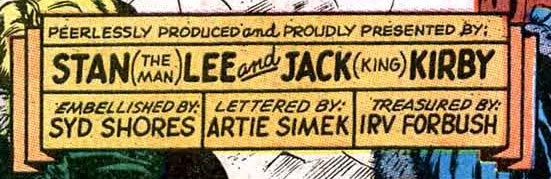
Typical tongue-in-cheek Marvel credit byline from 'Captain America' #101.
Marvel Method
During this period, Stan Lee's team applied the "Marvel Method" way of working for comic book production. Unlike other companies, Marvel's artists didn't work with full scripts when drawing their stories. In general, production started with the editor, Lee, discussing a general plot outline with the artist. This could vary from one-line comments such as "make the next one about Dr. Doom" to Lee acting out what he wanted characters to do and say in his office. From these basic ideas, the pencil artist then fully plotted, directed and crafted the story, while creating additional characters and a basic dialogue. After that, the inkers and colorists were set to work, while the editor wrote the final dialogue. To this day, this has led to heated debate over the actual creators of these groundbreaking worlds and stories. In general, the dialogue writer received the full scriptwriting credit, so it was generally assumed that he was the initial creator. Since no notes or documents exist of the initial plot talks between artist and editor, the only information to go from are contradicting interview statements and studies of the original artwork. In Marvel's corporate branding, Lee has been pushed forward as the mastermind behind the entire superhero line, but nowadays this claim is largely contested. Whatever stamp Stan Lee has put on Marvel's success and the appreciation of comics in general, his contributions must be seen as collaborative efforts, and the current Marvel Universe could not have existed without the visionary input from Jack Kirby and Steve Ditko, nor without the work of other early Marvel artists like Don Heck, Wallace Wood, Gene Colan, Gil Kane and John Romita.
During the "Silver Age of Comic Books", notable members of "The Mighty Marvel Bullpen" were the pencilers Neal Adams, Dick Ayers, Sal Buscema, John Buscema, Gene Colan, Johnny Craig, Steve Ditko, Bill Everett, Stan Goldberg, Al Hartley, Don Heck, Gil Kane, Jack Kirby, Larry Lieber, John Romita, Marie Severin, Jim Steranko, Herb Trimpe, George Tuska and Wallace Wood, as well as the inkers Dan Adkins, Vince Colletta, Sam Grainger, George Klein, Tony Mortellaro, Tom Palmer, John Severin, Syd Shores, Joe Sinnort, John Tartaglione and John Verpoorten. Additional editors/writers included Arnold Drake, Gary Friedrich, Archie Goodwin, Dennis O'Neil and Roy Thomas. Among the further staff were the colorists Sharon Cohen and Paul Reinman, letterers Sol Brodsky, Morrie Kuramoto, Sam Rosen, Artie Simek and Jean Simek Izzo, and the office workers Suzan Lane, Stu Schwartzberg, Flo Steinberg and Jean Thomas. The inker-letterer team of Sol Brodsky and Artie Simek was notably responsible for designing the Spider-Man logo.
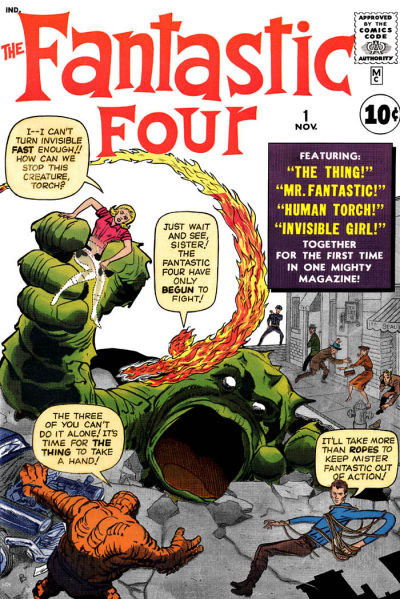
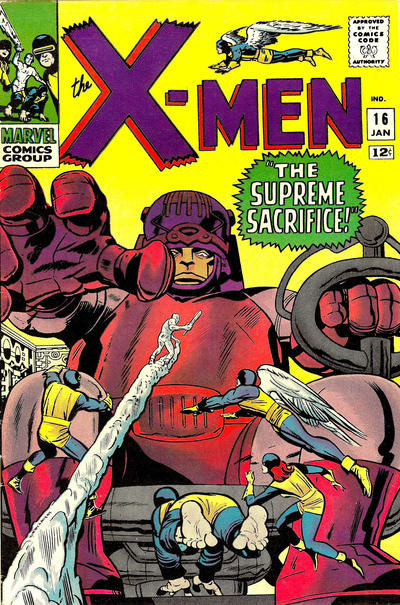
'The Fantastic Four' issue #1 (November 1961) and 'The X-Men' issue #16 (January 1966), artwork by Jack Kirby.
The Fantastic Four
The first Kirby-Lee co-creation for Marvel's new superhero line was 'The Fantastic Four', a direct response to DC's 'Justice League', in which several characters from their superhero series were brought together as a team. Cover-dated November 1961, the first issue of 'The Fantastic Four' presented a team of four superheroes. The team leader is Reed Richards, AKA Mr. Fantastic, who is able to stretch his body to incredible lengths. The other members are Ben Grimm (The Thing), a powerful monster made of rock, Sue Storm (Invisible Woman), who can generate force fields and make herself invisible, and the teenage Johnny Storm (Human Torch), who can fly and create fire. Within this quartet, only the Human Torch was a revamped version of an earlier Timely superhero; the other three were brand new creations.
At the time, The Fantastic Four were notable for their innovations. Unlike other superheroes, the team has no secret identities. Sue and Johnny Storm are siblings, while Reed and Sue are a married couple, creating family dynamics within the group. In later years, team members were given their own spin-off series. What attracted young readers the most was how the cast of the Fantastic Four struggled with angst. The language of the comic wasn't stylized, but peppered with slang.
The supervillains Dr. Doom (1962), Galactus (1966) and other various side characters introduced in 'The Fantastic Four' also appeared in other Marvel series. One of the comic's most notable secondary character introductions was the Silver Surfer, an alien humanoid who surfs through space. This Jack Kirby creation first appeared in Fantastic Four #48 (1966), and had its first of many solo series between 1968 and 1970, drawn by John Buscema.
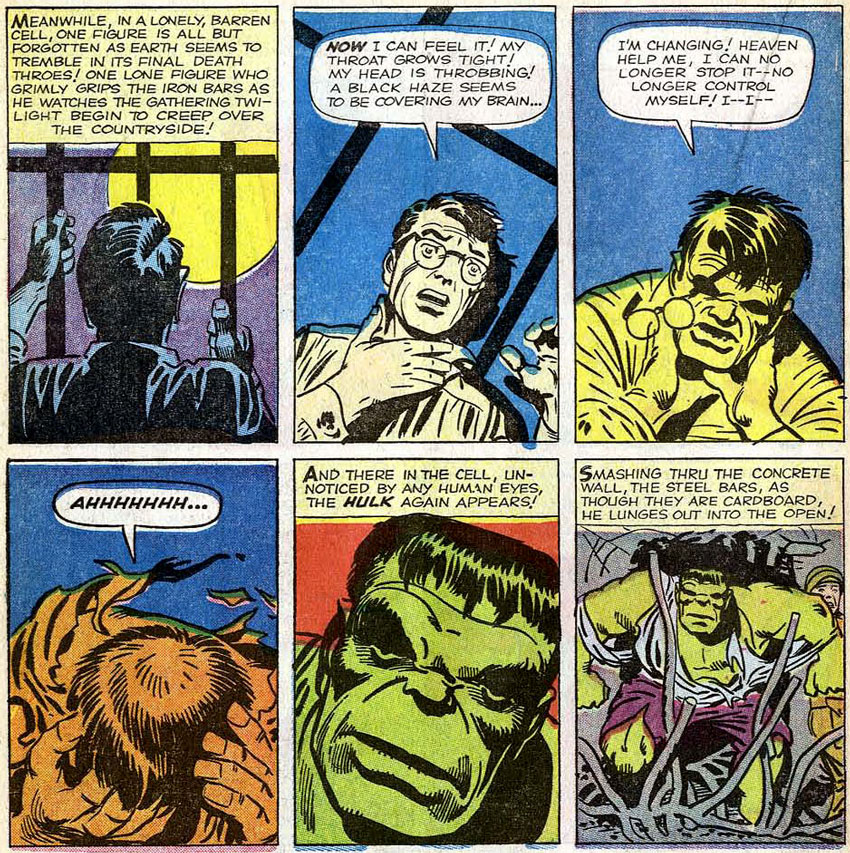
Bruce Banner turns into the Incredible Hulk (Incredible Hulk #2, July 1962, artwork by Jack Kirby).
The Incredible Hulk
With a cover date of May 1962, Lee and Jack Kirby introduced one of Marvel's most iconic characters in the first issue of 'The Incredible Hulk'. Slightly based on Robert Louis Stevenson's 'Dr. Jekyll and Mr. Hyde' novel, its main character is the physicist Bruce Banner, who is accidentally exposed to gamma radiation. As a result, he turns into a giant green monster with immense power when agitated, which was a superpower he initially has no control over. The Hulk struck a nerve with many people who could relate to his anger problems and inability to properly express himself. Jack "King" Kirby, together with co-plotter Stan Lee and several inkers, produced the first five issues of the original 1962-1963 six-issue mini-series, with the sixth issue penciled by Steve Ditko. After that Lee and Steve Ditko continued the character's adventures as a regular feature in 'Tales to Astonish'. Later 1960s artists of the 'Hulk' stories were Gil Kane, Bill Everett, John Buscema and Marie Severin. After issue #101, 'Tales to Astonish' was rebranded as 'The Incredible Hulk', which continued its numbering with issue #102. By then, Gary Friedrich was credited as writer, with Marie Severin still on art duties.
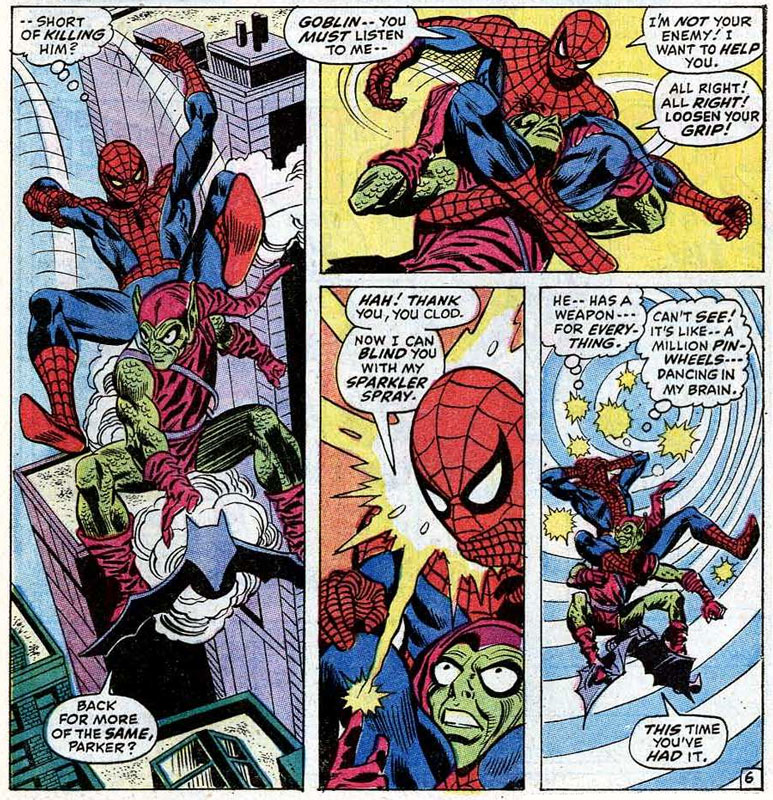
Emotions and doubts in Amazing Spider-Man #97: 'Green Goblin Reborn!' (May 1971, art by Gil Kane).
The Amazing Spider-Man
While 'The Fantastic Four' and 'The Incredible Hulk' debuted directly in their own solo comic books, other new superhero characters were first introduced in the remaining anthology titles. In the final issue of 'Amazing Fantasy' (#15, August 1962), 'The Amazing Spider-Man' made his debut. Originally, Jack Kirby was intended to draw the character, but Lee was more eager to let Steve Ditko do the job. Although Kirby had already made some initial designs and pages, Ditko quickly made the character his own. He designed the trademark costume with its well-known web shooters. The character's back story was also changed from the original Kirby-Lee concept. Instead of being an orphaned boy who finds a magic ring that gives him superpowers, Peter Parker was conceived as a high school student who gets bitten by a radioactive spider. This set-up provided more material to work with. Parker was an average kid, who had to deal with his newly acquired powers and its obligations, inspiring the phrase "with great powers come great responsibilities". In the very first story, Peter's uncle Ben is killed, an act that Spider-Man could have prevented. The teenager's feelings of guilt remains a driving force throughout all of his further adventures. While fighting a host of colorful villains at night, Peter Parker has to keep his secret identity hidden from his aunt May, and continue his everyday school life. This soap opera approach made 'Spider-Man' another relatable character for the Marvel readership. 'The Amazing Spider-Man' was an instant hit and got its own monthly title in March 1963.
X-Men
In September 1963, Lee and Jack Kirby further delved into the burden of superpowers with the creation of the 'X-Men', a group of teenage mutants who are trained to deal with their special abilities in Professor Xavier's special school. In interviews, Lee said he made them mutants to avoid having to think up an actual origin story. The original team consisted of Cyclops, Marvel Girl, Beast, Angel, and Iceman, who found their nemesis in Magneto and his Brotherhood of Evil Mutants. Various 'X-Men' stories work around the theme of prejudice and notably have characters from different races, cultures, religions and sexes. By issue #20 (1966), the original Lee-Kirby team for the book were replaced by writer Roy Thomas and artist Werner Roth.
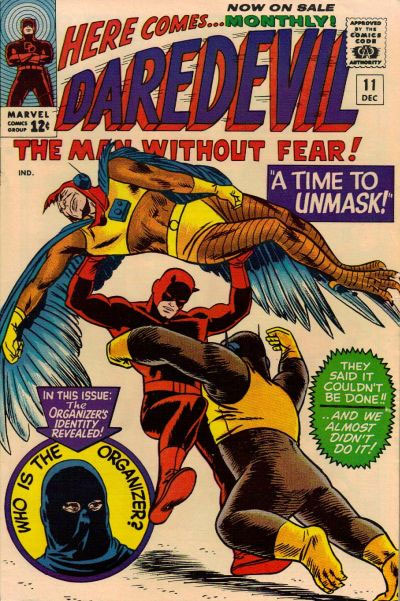
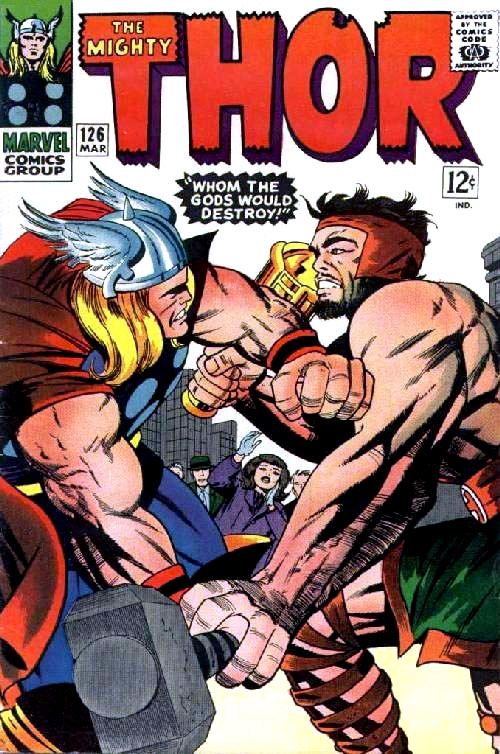
'Daredevil', issue #11 (December 1965, artwork by Bob Powell) and 'The Mighty Thor' issue #126 (March 1966, artwork by Jack Kirby).
The Avengers
Throughout the 1960s, Marvel Comics introduced many other enduring superheroes. 'The Mighty Thor' debuted in 'Journey into Mystery' issue #83 (August 1962), in a story plotted by Jack Kirby and Stan Lee and scripted by Larry Lieber. Based on the Norse mythological god but updated to modern times, the character was initially a fairly straightforward superhero in stories written and drawn by other Marvel staffers, but received more character depth and a mythological in Jack Kirby's back-up feature 'Tales of Asgard'. Lee and Kirby's next co-creation, 'Iron Man', told the story of Tony Stark, a rather unlikable billionaire, playboy and engineer who was forced to wear an armor suit with technological gadgets due to a shrapnel near his heart. The character debuted in 'Tales of Suspense' #39 (March 1963), with Kirby providing the character design and the cover illustrations until 1965, and Don Heck penciling the stories. The July 1963 issue of 'Strange Tales' (#110) introduced the Steve Ditko creation 'Doctor Strange', a brilliant but vain surgeon who dabbles in black magic. The feature's mystic themes and frequent psychedelic imagery particularly appealed to hippie readers. With Marvel veteran Bill Everett, Lee created the 'Daredevil' series (April 1964), about a man who is blinded by radioactivity but develops a radar sense. It wasn't until the 1980s before the character's popularity increased under the pen of Frank Miller, who fleshed out his background.
While most of Marvel's new creations were superheroes, Lee, Jack Kirby and Dick Ayers also created a series more grounded in reality. 'Sgt. Fury and his Howling Commandos' (1963-1981) featured sergeant Nick Fury, officer of a special military unit during World War II. The series was notable for its multicultural cast, including the Jewish private Isadore Cohen, Italian-American Dino Manelli, British Percival Pinkerton and African-American Gabriel Jones. In 'Strange Tales' #135 (August 1965), the character was transformed into a leading agent of the fictional espionage agency S.H.I.E.L.D., through which he has made frequent appearances in other Marvel superhero titles.
From September 1963 on, several of these new creations by Lee, Jack Kirby and Steve Ditko teamed up to form the all-star superhero team 'The Avengers'. Marvel's Golden Age superstar 'Captain America' was also added to the line-up. Another regular character in the series was 'Hawkeye', a co-creation of Lee and Don Heck. The master archer originally appeared as a remorseful antagonist in the science fiction series 'Tales of Suspense' (1964), and was later recruited as a helpful member of the Avengers.
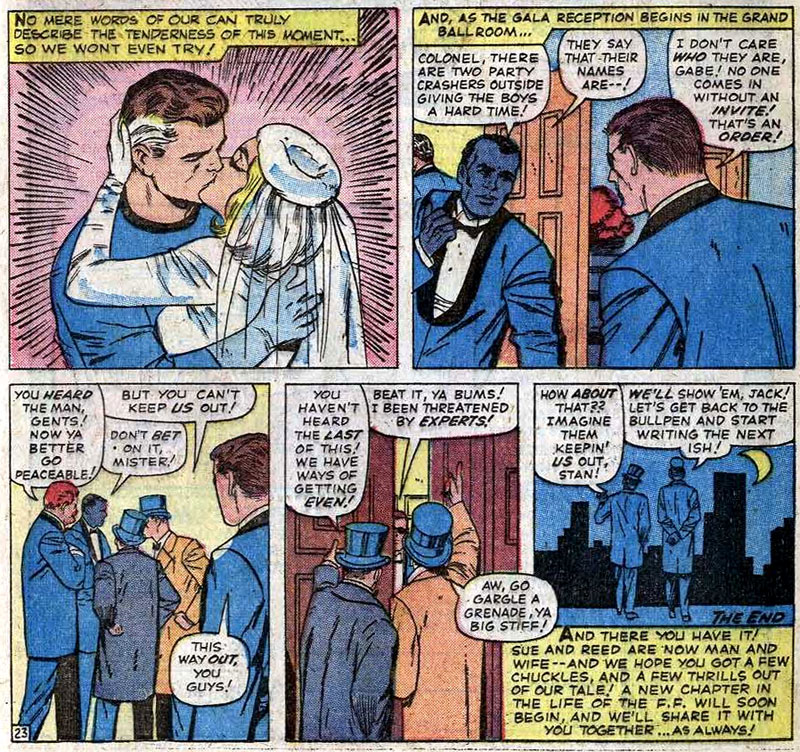
Stan Lee had several cameos in Marvel's stories. The example here features him with Jack Kirby in 'Fantastic Four' Annual #3 (October 1963).
Style
With this innovative wave of new superheroes, Lee and his team elevated the genre from the basic "good vs. evil" battles in safe, family-friendly universes into more challenging narratives set in modern worlds. They endowed the super-human characters with human failings and emotions readers could identify with. The geeky teenager Peter Parker (Spider-Man) is often bullied and full of recognizable self-doubt, even questioning why he - of all people - should be saving mankind. The Thing and The Hulk also regard their superpowers more as a curse than a blessing, as it left them with a monstrous appearance that repulses fellow members of society. An otherwise unlikeable character, Tony Stark, was forced to wear armor due to a shrapnel stuck near his heart and become Iron Man. And even though the Marvel protagonists are heroic, they still have recognizable vices. Because of their family dynamics, the Fantastic Four constantly argue with each other. Bruce Banner's own temper problems make him transform into the Hulk. Likewise, villains like Dr. Doom ('The Fantastic Four') and the Green Goblin ('Spider-Man') are more tragic than vicious antagonists. They have personal problems that explain their motivations and provoke pity. Lee also deliberately avoided using sidekicks, something that had already become a cliché in other superhero comics.
As supervising editor, Lee presented Marvel as one big family and all their characters as part of a "shared universe". All of Marvel's characters are able to interact with each other, making countless crossovers possible, even with the company's teen humor character Patsy Walker and Lee's own newspaper comic mailman Willie Lumpkin. This concept was borrowed from Gardner Fox, who had pioneered the idea at DC Comics.
Another important aspect of the Marvel books were their specific use of language, filled with irony, sarcasm and meta-humor. As dialogue writer, Lee had characters speak in colloquial language, festioned with slang phrases. The way Marvel characters spoke fitted their personalities, often with snappy expressions, like The Thing's catchphrase "It's clobbering time!". Earlier superhero comics had more stilted, bland dialogues that felt increasingly corny and old-fashioned among post-war readers. Lee gave both the narration and dialogues a hip, fluid and more direct style that has often been imitated since. When crediting artists at the start or end of each story, Lee had fun inventing honorary nicknames for each contributor. His own nickname, "Stan the Man", was quickly adopted by fans.
Realism and racial diversity
Thematically, Marvel's series felt authentic because they addressed real-life issues. Lee and his team didn't shy away from condemning racism and drug abuse. They went ahead in discussing these taboo topics, defying the authority of the official censor commission the Comics Code. The Black Panther (co-created with Jack Kirby, 1966), The Falcon, (co-created with Gene Colan, 1969) and Luke Cage (created by Archie Goodwin and John Romita Sr., 1972) were the first African-American super-heroes in mainstream comics. One particular 1971 'Spider-Man' story arc in issues #96-98 dealt with Peter Parker's best friend coping with his drug addiction. The Comics Code Authority heavily objected to the depiction of this taboo subject in a children's medium. However, after publication, the story drew so much praise that it became clear the times had changed. Within a few years, the Comics Code loosened its grip, allowing more creative freedom for U.S. comic publishers. One of the groundbreaking stories that otherwise wouldn't have been published was the 'Spider-Man' episode 'The Night Gwen Stacy Died' (1973), written by Gerry Conway and drawn by Gil Kane, John Romita Sr. and Tony Mortellaro, which shocked audiences by having a major character in the franchise permanently die off. With their complex, contemporary tales and stunning artwork, the Marvel comic books managed to reach a wide demographic. As the first generation of comic book readers had grown up, adults weren't ashamed to admit that they enjoyed the Marvel superheroes.

An ad appearing in 'Nick Fury, Agent of S.H.I.E.L.D.' #2 (1968) offers Marvel Super-Hero T-Shirts for The Fantastic Four, Iron Man, The Mighty Thor, The Amazing Spider-Man, The Avengers, The Incredible Hulk and a "brand new!" Captain Marvel, for $1.60 plus 25 cents postage and handling ($17.55, or 15 euro at today's exchange rate), as well as a limited supply of Marvel Thing or Hulk Sweat Shirts for $3.15 plus 25 cents postage and handling to the US ($32.50/€27.75, plus an additional 20 cents - $2 or 1.70 euro - for shipping to Canada and Europe) sold directly to the public though the Marvel offices on Madison Avenue, New York City. An example of Marvel marketing merchandise worldwide, targeting not only small children, but the young adults (note that they offer three "adult" sizes, but only two "youth" ones), a new market that Stan Lee and Martin Goodman recognized and sought out. The bottom half of the page offers the Marvel reader an opportunity to get a membership kit for the Merry Marvel Marching Society New Membership kit for only 1 dollar ($9.50/ 8 euro, only check or money order accepted, no cash): a pin, an official recording of the MMMS song, eight super-hero stickers, a nutty notepad, a Marvel mini-book, a Marvel pencil, a MMMS certificate and a “munificent membership card.” Quite the deal for just a buck (‘Nuff said")!
"Stan the Man"
To strengthen the bond with the readers, Lee directly addressed them in his chatty editorials. Using his trademark snappy banter, the editor became almost a character on his own, often referred to as "Stan the Man". In 1964, he founded a Marvel fan club called the Merry Marvel Marching Society (MMMS). For only a dollar, fans received membership and assorted goodies. Starting in 1965, Lee kept readers up-to-date on the latest news and coming attractions through the monthly 'Bullpen Bulletins'. On the reader's mail page, he had his own column called 'Stan's Soapbox' (December 1965-January 1982), through which he addressed his "rollickin' readers" as if he was a personal friend. Even though this column mostly increased his personal fame, Lee's editorial approach also introduced the readers to the names of production staff who otherwise would have remained anonymous. Besides the writer and artist, the Marvel books also credited inkers, letterers and colorists. In his columns, Lee wrote about the individual artists, making them household names among fans. In addition, Lee coined catchphrases that remain fondly remembered by longtime readers, such as "Excelsior!", "Face front!" and his traditional closing sentence, "'Nuff said". By being open to input from his readers and keeping them informed, Stan Lee masterfully established brand loyalty through a dedicated fanbase who were led to believe that Marvel was the hottest thing on the planet.
By the mid-1960s, Lee had firmly cemented himself as the face of Marvel Comics, riding on the wave of the new comics fandom subculture. News media began reporting more frequently about Marvel and comics in general, with Lee becoming one of the industry's leading spokesmen. Besides in print media and on radio and television, Lee became a popular speaker at college campuses around the USA. By 1968, Marvel was even advertising and selling autographed photos of Lee, something previously unheard of in the field of comic books. Starting in the 1970s, all the Marvel titles began bearing the "Stan Lee Presents" header on the title pages, which was more a marketing decision than an indication that Lee was directly involved in their production.

Advertisement for a Stan Lee performance in London (1975).
From editor to publisher
In 1968, Marvel's parent company, Martin Goodman's Magazine Management Company, was acquired by the Cadence Industries conglomerate, and continued as one of its subsidiaries. Four years later, Goodman retired, after which his son Chip was appointed President of Magazine Management and Lee became publisher of Marvel Comics. In September 1972, Lee's role as editor at the Marvel bullpen was taken over by Roy Thomas, who had been with the company since 1965 as a writer and assistant editor. John Romita was appointed art director. Subsequent editors-in-chief of the Marvel Comics line have been Len Wein (1974-1975), Marv Wolfman (1975-1976), Gerry Conway (1976), Archie Goodwin (1976-1977), Jim Shooter (1978-1987), Tom DeFalco (1987-1994), Bob Harras (1995-2000), Joe Quesada (2000-2010), Axel Alonso (2011-2017) and C. B. Cebulski (2017- ). When Chip Goodman's contract was not renewed, Lee was also appointed publisher of the magazine division, resulting in some ill-fated attempts of launching new magazines like Celebrity, Nostalgia Illustrated, Film International and Pizzazz, which all couldn't find a receptive audience.
By the time Lee became publisher of the comics division, the Comics Code Authority had loosened its grip, allowing for more initiatives in the horror and fantasy genres. Marvel quickly responded with the comic books 'The Tomb of Dracula' (1972-1979) and 'Werewolf by Night' (1972-1977), followed by the black-and-white horror magazines Vampire Tales (1973-1975) and Monsters Unleashed (1973-1975), as well as Unknown Worlds of Science Fiction (1975). New versions of earlier superheroes, like 'Ghost Rider' (1973-1983) and 'The Man-Thing' (1974-1975), were introduced, while even more tormented characters were created with a longer durability, such as 'The Punisher' (in 'The Amazing Spider-Man' #129, February 1974) and 'Wolverine' (in 'The Incredible Hulk' #180, October 1974). A more satirical addition to the Marvel Universe was Steve Gerber and Val Mayerik's anthropomorphic 'Howard the Duck'. To attract readers from different ethnicities, Marvel launched the Asian American hero 'Master of Kung Fu' (1974-1983) and the Native American 'Red Wolf' (1972-1973). Characters like 'Night Nurse' (1972-1973) and 'Shanna the She-Devil' (1972-1973) were created in an attempt to attract a female audience, but were short-lived as they never found their audience.. Fan service came with the launch of FOOM ("Friends of Ol' Marvel"), Marvel's own periodical with exclusive features and interviews.
In addition, new markets were explored. When Lee was still editor, Marvel had already launched a successful comic book series based on Robert E. Howard's sword-and-sorcery novel hero 'Conan the Barbarian' (1970-1993). Later, in 1972, Marvel Comics launched its separate Marvel UK imprint for the British readership. In a partnership with publisher/editor Denis Kitchen, Marvel even dabbled in the field of underground comix with the three-issue 'Comix Book' (1974). More commercial opportunities were found in licensed properties and joint ventures. In 1975, Marvel even teamed up with its competitor DC Comics to release the one-shot 'MGM's Marvelous Wizard of Oz' as a joint venture, adapting the 1939 movie 'Wizard of Oz'. Later in the decade, Marvel released comic book versions of the movies '2001: A Space Odyssey' (1976), and launched series based on the 'Godzilla' (1977-1979) and 'Star Wars' (1977-1986) franchises. More playful were the two comic books produced in collaboration with the rock band Kiss (in the 'Marvel Comics Super Special' series, 1977-1978) and the team-up between Spider-Man and the comedy crew of 'Saturday Night Live' (Marvel Team-Up #74, 1978). By the end of the 1970s, Marvel launched its first comic book series that tied in with toy lines, such as 'Micronauts' (1979-1984), 'Shogun Warriors' (1979-1980) and 'Rom: Spaceknight' (1979-1986). This tradition was continued in the 1980s with developing the character backgrounds and comic stories for the Hasbro franchises 'G.I. Joe: A Real American Hero' (1982-1994) and 'Transformers' (1984-1991). By then, Lee had already focused all of his attention to more ambitious plans.
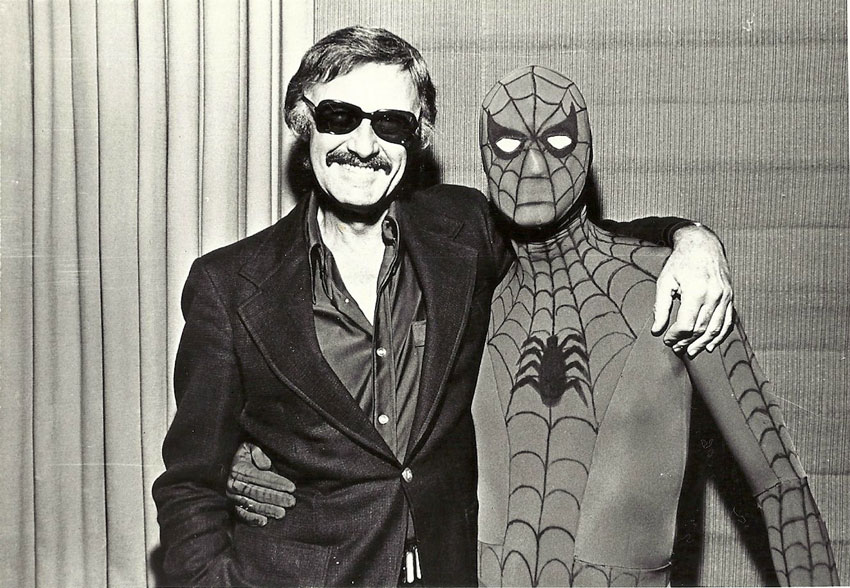
Stan Lee with Danny Seagren, the first actor to portray Spider-Man in the children's series 'The Electric Company' (1974).
Move to Hollywood
Since the 1960s, Lee had been involved in media adaptations of the Marvel superheroes. In 1966, the line was adapted for television for the first time in the 65-episode animated TV show 'The Marvel Super Heroes'. Produced by Grantray-Lawrence Animation, each episode consisted of three seven-minute segments highlighting a different Marvel character, with artwork lifted directly from the comic books. Between 1967 and 1970, 'Spider-Man' reached a wider audience through its first animated TV series (1967-1970), of which the theme song, "Spider-Man, Spider-Man, does whatever a spider can" (composed by the aptly-named Paul Francis Webster and Bob Harris) is still well-known today. During the 1970s, live-action TV shows with Spider-Man also followed. An early hit was the TV series 'The Incredible Hulk' (1978-1982), starring Lou Ferrigno. It introduced Banner's familiar warning: "Don't make me angry. You wouldn't like me when I get angry", which was later added to the comics as well.
Stan Lee had the dream of making it big in Hollywood. In 1980, he moved from the East Coast to Los Angeles to become creative director of Marvel Productions, a new division set up to generate and sell TV content with the Marvel properties. During the early 1980s, this effort resulted in the new animated TV shows 'Spider-Man and His Amazing Friends' (1981-1983) and 'The Incredible Hulk' (1982), for which Lee himself performed as the narrator. During the 1980s, the Marvel Productions leg was also responsible for popular children's TV cartoon series like 'Transformers', 'Muppet Babies', 'G.I. Joe: A Real American Hero' and 'My Little Pony 'n Friends', as well as their movie spin-offs. During this period, Lee's role as Marvel's publisher became more ceremonial, as he was mostly occupied with pitching and promoting the franchise's media adaptations. However, although he had become somewhat of a legend within the realm of comic book fandom, Stan Lee didn't have the same effect on Hollywood moguls. It would take until the 21st century before Marvel superhero movies really took flight, and the "Marvel Cinematic Universe" became a cultural phenomenon.

'Spider-Man' newspaper strip of 1 December 1977, art by John Romita.
New comic projects
On occasion, Lee returned to producing comics himself, most notably newspaper strips. Between 11 October 1976 and 4 September 1977, he worked with artist Frank Springer on the syndicated comic 'The Virtue of Vera Valiant', a soap opera satire for the Los Angeles Times Syndicate. More success came with the newspaper comic adaptations of his Marvel co-creations. On 30 October 1978, the Register and Tribute Syndicate began distributing a 'The Incredible Hulk' newspaper comic. Drawn by Stan's brother Larry Lieber, it was modeled after the concept of the 'Hulk' TV series with Lou Ferrigno. In the strip's early run, Lee wrote the narratives, but quickly left this job to his brother as well. Running until 2 September 1982, other artists and writers involved with 'The Incredible Hulk' were Rich Buckler and Alan Kupperberg. More enduring was his tenure on the newspaper strip based on 'The Amazing Spider-Man', which was launched as both a daily and Sunday comic by the same syndicate. Written in a soap opera style with Lee's trademark snappy humor, the strip had its own continuity, separate from the comic books. Running between 3 January 1977 and 23 March 2019, Lee was credited as writer throughout its run, although many ghost writers from the Marvel staff have contributed. Starting in 2000, Roy Thomas did most of the plotting and scriptwriting. Throughout the years, the feature's lead artists were John Romita Sr. (1977-1981), Fred Kida (1981-1986), Larry Lieber (1986-2018) and Alex Saviuk (2018-2019).


'Silver Surfer: Parable' and 'Ravage 2099' #1.
In the second half of the 1970s, Lee was talking with producer Lee Kramer about a possible 'Silver Surfer' movie. To boost the film's marketing, Lee and Jack Kirby teamed up one more time to produce the graphic novel 'The Silver Surfer: The Ultimate Cosmic Experience', published in 1978 by Simon & Schuster. However, the planned movie never went into production, and Kirby never worked with Lee again. For Marvel's Epic imprint, Lee wrote the critically acclaimed two-part limited series 'Silver Surfer: Parable' (1988-1989) for the French artist Moebius, in which the Surfer was presented as a modern-day Jesus Christ. During the 1980s, Lee was also involved as co-writer on 'Silver Surfer' one-shot graphic novel projects with John Byrne (a 1982 story in Epic Illustrated), John Buscema ('Silver Surfer: Judgment Day', 1988) and Keith Pollard ('Silver Surfer: The Enslavers', 1990).
In the early 1990s, another comic book project came to fruition, based on a Lee concept of a futuristic garbageman with superpowers. Marvel's editor-in-chief Tom DeFalco saw it as the perfect opportunity to reunite Lee with his former co-worker Steve Ditko. While Ditko was initially interested, creative differences quickly ended the planned collaboration. Instead, Paul Ryan was brought in as artist and, following the Marvel Method, co-writer. Between 1992 and 1995, 'Ravage 2099' ran for 33 issues, with several writers and artists involved after both Lee and Ryan quit after issue #7.
A remarkable later print project from this period was 'Just Imagine Stan Lee Creating the DC Universe' (2000-2004), containing five comic books and a book compilation published by Marvel's main competitor, DC Comics. Intended as a joke, the project had Lee reinvent DC's greatest heroes in collaboration with artists like Jim Lee, Dave Gibbons, Gary Frank, John Cassaday and Joe Kubert. In 2010, Lee co-plotted one final 8-page 'Fantastic Four' story, in which the team celebrates the Jewish holiday of Hanukkah with The Thing. Published in the 'Marvel Holiday Magazine 2010', the story was drawn and scripted by Nick Dragotta.


'Origins of Marvel Comics' (1974) and 'How to Draw Comics the Marvel Way' (1978).
Conflicts and controversy
Like many prominent media personalities, Stan Lee was not free from controversy and criticism. Even today, he has staunch supporters and haters. Since his name was attached to so many iconic Marvel series, he was arguably the most famous comic creator of the company. His visibility increased through his numerous media appearances and the fact that he outlived many of his former co-workers. However, Lee's gift for self-promotion has sometimes overshadowed his merits. Critics have contested how much creative input he actually had in the series that built his fame and reputation, sentiments that were largely fuelled by the fall-outs Lee had with his two primary co-workers, Steve Ditko and Jack Kirby. Over the years, several of his former co-workers have been critical about him in the media.
A large part of the debate can be traced back to the Marvel Method way of working. Based on oral plot outline discussions, the artists crafted the comic stories, after which Lee added the dialogue. However, Lee still received full scriptwriting credit, including an additional writers fee. In interviews, Lee praised Kirby and Ditko for their drawing skills, but failed to acknowledge their merits as writers. This was also exemplified in the compilation books of classic Marvel stories that Simon & Schuster compiled during the 1970s: 'Origins of Marvel Comics' (1974), 'Son of Origins of Marvel Comics' (1975), 'Bring on the Bad Guys' (1976) and 'The Superhero Women' (1977). In the accompanying texts, Lee wrote about how the characters were created, presenting himself as the instigator and limiting Kirby and Ditko's roles to those of artists only. This minimization of other's contributions also happened with the instruction book 'How to Draw Comics the Marvel Way' (1978), Lee made with artist John Buscema: Jack Kirby's art was omnipresent, but the artist was hardly mentioned.
In interviews, Lee painted more romanticized versions of the origins of the Marvel Comics line. One of them was the anecdote that when the Atlas line went down in the early 1960s, Lee was about to quit comics for good. But then his wife convinced him to try one final story, more in line with his personal taste. Since he had nothing to lose, he created the Fantastic Four. In reality, the entire concept of the Marvel superhero line was most likely suggested by Jack Kirby, and its conception a collaboration at best. In 1966, Lee's 1940s associate Joe Simon was the first to spoof Lee in a comic story. When Simon's attempts to secure the copyright to Captain America failed, he created a comic story about the injustices of the comic industry for Sick magazine issue #48. It featured a pompous editor named Sam Me, who was a parasite on the talent of artists called Dripko and Plotsky.

'The New Age of Comics', Joe Simon's comic story spoofing Stan Lee in Sick #48 (1966).
In 1966, Steve Ditko was the first to leave Marvel Comics, reportedly out of creative and political differences with Lee. Jack Kirby followed in 1970, only to return to the company a couple of years later for a short while. In later years, Kirby was especially very vocal in his criticism of Lee, such as his scornful 1990 interview with The Comics Journal. In 1972, he introduced the vain, toupee-wearing entrepreneur Funky Flashman in his 'Mister Miracle' series at DC Comics, an obvious stab at his former editor. Flashman's obedient assistant was named "Houseroy", referring to Marvel's subeditor Roy Thomas. Although more media-shy than Jack Kirby, Steve Ditko also expressed his displeasure in his later essays, outing himself as co-creator of Spider-Man. In 1977, Wallace Wood wrote in his Woodwork Gazette newsletter that Stan Lee only came up with two surefire ideas: "Why not let the artists WRITE the stories as well as draw them?" and "Always sign your name on top - BIG!".
In the summer of 1980, The Comics Journal printed a letter by 'Howard the Duck' creator Steve Gerber, which said that Lee "was responsible for a massive infusion of creativity into the industry twenty years ago," but also that he "under the protective umbrella of Marvel company policy, had robbed Jack Kirby, Steve Ditko, and others of the credit due them as creators for those same twenty years." It was the first time that Lee was openly criticized in front of the general public, but not the last.

In 'Mister Miracle' #6, Jack Kirby based the characters of Funky Flashman and Houseroy on Stan Lee and Roy Thomas (1972).
However, not all of his former co-workers shared negative experiences. Neal Adams, John Romita and Roy Thomas have all said that they enjoyed working with Lee, as did his legendary secretary and fan liaison Flo Steinberg. He has been described as an easy-going person with a personable approach, also in a corporate environment. He had a quick wit, and was a clever salesman, which were traits that made Lee so suitable for his countless media appearances. However, Lee was also a notable mythmaker, not only for his characters, but also for himself. One critic said that the only character that Stan Lee actually created was Stan Lee himself. Whenever confronted with criticism during interviews, he usually brushed it off with a joke, or pretended he had absolutely no idea where that criticism came from. To maintain his public persona, he didn't want to be associated with failure, and didn't shy away from dissing Marvel's own commercial duds. Even though he had hyped up the 1986 'Howard the Duck' movie during a publicity tour, he quickly denigrated the movie in public when it flopped.
Within the industry itself, Lee was also entangled in some heated debates. In 1970, Lee and DC's Carmine Infantino founded the Academy of Comic Book Arts (ACBA), an honorary society of professionals dedicated to celebrate the comic book craft, with Lee instated as its first President. However, by the time Neal Adams became President, the group publicly battled both Marvel and DC; the ACBA was turned into an advocacy organization for creators' rights, which included demands for royalties and the returning of original artwork. In 1974, Stan Lee's former bosses Martin and Chip Goodman founded a new publishing initiative called Seaboard Periodicals, with a new Atlas line as comics arm. To fill their books, they tried to hire away Marvel's top talent with higher page rates and creator ownership. Among the artists who joined Seaboard was Larry Lieber, who was dissatisfied with his brother for not giving him any work. In a desperate attempt to keep his freelancers on board, Lee urged them to work for Marvel exclusively, while comparing the Goodmans to Adolf Hitler. Even though the Seaboard project folded after only one year, Lee and Martin Goodman remained on bad terms throughout the rest of their lives.
Nevertheless, all the criticism aside, Lee did give his co-workers more exposure among fans than other editors did at the time. Even though he only credited them for their artistic value, Jack Kirby and Steve Ditko became household names to the general public. Much like Walt Disney, Lee's controversial status as the "man who built a cultural empire" can also be blamed on marketing strategies. As a staffer on the Marvel payroll, Lee didn't actually have any ownership over the characters he is credited for. But since he was the one name and face general audiences would recognize, Marvel has continued to use him to advertise their franchises and latest releases. To this day, the fierce discussions about Lee's deeds and misdeeds can hold their own against the epic battles from the comics that inspired them.

Stan Lee as mailman Willie Lumpkin in the 2005 'Fantastic Four' film.
Later Marvel years
In November 1986, parent company Cadence sold off its Marvel division to the film and distribution house New World Pictures, which became Lee's new employer. Still, few of the planned movie projects saw the light, and if they did, they were often limited to the direct-to-video market. However, this period marked the first of Lee's on-screen cameo appearances in movie productions. His debut was as an extra in the 1989 TV movie 'The Trial of the Incredible Hulk', where he can be seen among the jury members. In that same year, he appeared as himself on the 'Muppet Babies', followed in 1990 by a small role as himself in the comedic thriller film 'The Ambulance' by Larry Cohen.
In October 1996, Lee was well in his seventies when he stepped down from his official role as Marvel's publisher. His contract with the company was terminated after a reorganization in the summer of 1998. In November of that year, he signed a new deal, which reinstated him as a figurehead for the company. In 2000, the first cinematic adaptation of 'X-Men' by 20th Century Fox was a big hit, and initiated an entire line of new Marvel movies. This prompted Lee in 2002 to sue the company, as they had promised him 10% of the profits of any future movie and TV project with the characters he had co-created, but had failed to do so. On 28 April 2005, a 10 million dollar financial settlement was reached, and Lee remained visible as an icon of Marvel Comics. From the 2008 'Iron Man' film until the posthumously released 'Avengers: Endgame' (2019), Lee appeared in each movie of the "Marvel Cinematic Universe" in a cameo role. On 31 August 2009, Marvel was sold to the Walt Disney Company.
Stan Lee Media
Following the end of his full-time association with Marvel Comics, Lee spent the 21st century venturing into a variety of ill-fated businesses, all of which ended badly. In 1998, he associated himself with the entrepreneur Peter Paul, a conman and convicted felon, in the founding of Stan Lee Media (SLM), an entertainment company that would ride the wave of the dot-com boom. The set-up was ambitious, as Lee would develop a new range of characters and concepts launched through the Internet. After the initial online Flash cartoons, the so-called "webisodes", these creations were up for licensing and bigger media deals. The first launched concept was the cyberspace saga 'The 7th Portal'. This was followed by 'The Accuser', about a disabled lawyer who could turn his wheelchair into a robotic battle suit, 'The Drifter', about a futuristic vigilante traveling back in time to battle an evil corporation, and a partnership with the boy band Backstreet Boys, who were turned into the earth-defending 'Cyber Crusaders'. A comic book of 'The Backstreet Project' was created by Lee and lead vocalist Nick Carter with artwork by Ruben Martinez, and was available for purchase at the group's 2000-2001 concerts.
The company was fully built on Lee's persona, and the SLM website also presented cartoons about a mischievous copy of Stan called 'Stan's Evil Clone', and invited visitors to join a fan club called SCUZZLE. However, the ambitions and costs were way higher than the revenue that came in, and few of the planned licensing deals came through, so the adventure was quickly over. After the burst of the dot-com bubble in late 2000, the company was in dire straits, and by December, the extensive 165-people staff were laid off. In the aftermath, Peter Paul and his business partner Stephen Gordon were accused of fraud, as they had tried to inflate the price of the company's stocks through a variety of methods. By then, Peter Paul had already fled to Brazil, but was eventually picked up by Interpol. Lee was investigated by the Department of Justice, but cleared of any wrongdoing. To Lee, the SLM affair remained a stain on his reputation, and something he didn't wish to talk about anymore. In 2009, Peter Paul was eventually sentenced to ten years in prison for stock manipulation, but was paroled in December 2014.
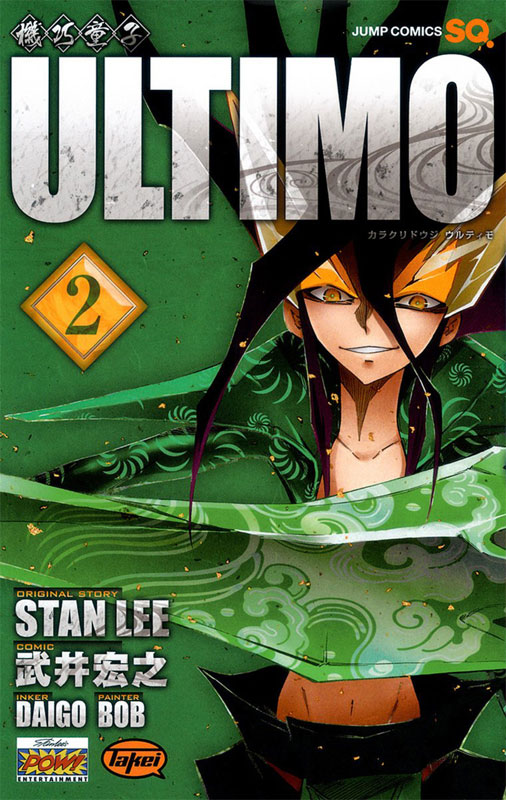
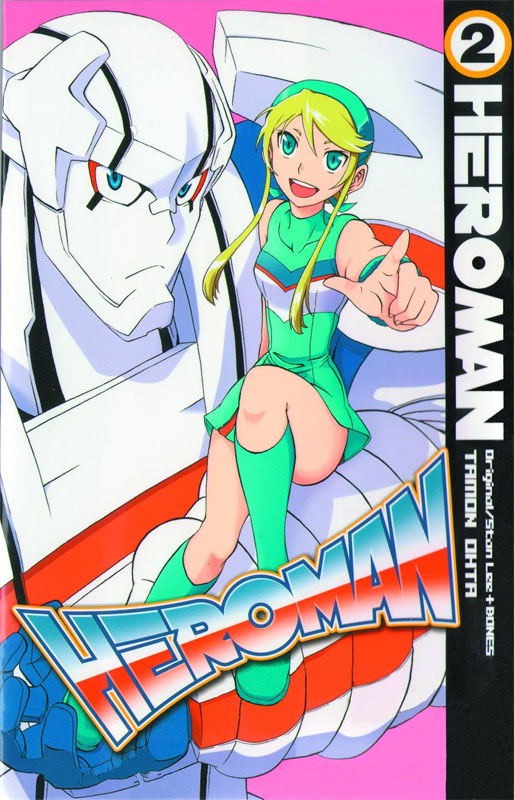
'Ultimo' and 'Heroman'.
POW! Entertainment
Out of the ashes of Stan Lee Media came a new company, founded in 2001 by Lee with former SLM COO Gill Champion and the lawyer Arthur Lieberman: POW! Entertainment. Again, it was intended as a vehicle for marketing new creative concepts by Lee, but again, its existence was also shrouded by controversy and criminal investigations. Over the years, POW! has been accused of ripping off investors, lying to shareholders, entering the stock market through an illegitimate merger and committing bankruptcy fraud, among other things. In the meantime, Lee was seemingly unaware of the misconducts, and was working on new ideas to be developed for film, print, online games, animations or as cross-media projects. One of the first projects that saw the light was 'Stripperella' (2003-2004), an adult animated TV series for Spike TV, featuring a stripper with a secret superhero identity, voiced by Pamela Anderson. In 2004, Deep Cut Productions released a single issue 'Stripperella' comic book, drawn by Anthony Winn. Further new Lee superheroes appeared in either TV films or direct-to-video releases, such as 'Lightspeed' (2006), 'Mosaic' (2007) and 'The Condor' (2007). Projects like the children's book 'Stan Lee's Superhero Christmas' (HarperCollins, 2004), a subscription-based online comics portal called 'Stan Lee's Sunday Comics' (2004) and the online animation platform 'Stan Lee's POW! Mobile Channel' (2006) were not successful. In addition, Lee hosted the reality TV show 'Who Wants to Be a Superhero?' (2006-2007) and the documentary series 'Stan Lee's Superhumans' (2010-2013). In 2012, Lee's own YouTube channel was launched, first known as Stan Lee's World of Heroes and then as MarvelousTV, which hosted shows like 'Bad Days' and 'Stan's Rants'.
At POW!, Lee also worked on new comic projects, which saw the light through partnerships. First, he tried his hand at manga for the Japanese market, creating 'Ultimo the Mechanical Boy' ('Karakuridôji Ultimo', 2008-2010) with artist Hiroyuki Takei for Shueisha and Viz Media. This was followed by the manga/anime series 'HEROMAN' (2009-2012), created by Lee with the Japanese animation studio Bones. Published by Square Enix, the books were illustrated by Tamon Ohta. Teaming up with Boom! Studios, the POW! team launched a new superhero line supervised by comic writer Mark Waid, featuring the new Lee creations 'Soldier Zero', 'Starborn' and 'The Traveler'. Published in the 2010-2011 period, writers involved were Dan Abnett, Paul Connell, Andy Lanning, Chris Roberson and Mark Waid, with artwork provided by Sergio Ariño, Ramón F. Bachs, Chad Hardin, Javier Pina, Khary Randolph and Matteo Scalera.


Stripperella #1 and Stan Lee's Mighty 7 #1.
Long in the making was 'Stan Lee's Mighty 7', a planned new superhero media franchise. In the series, Lee himself mentors two groups of aliens into a superhero team while he uses them to write comic books. Despite many announcements for films, TV series and a comic book line, only few saw the light. Of a planned six-issue mini-series at Archie Comics, only three issues were released in 2012. Besides Lee, the scriptwriters were Tony Blake and Paul Jackson, the art was provided by Alex Saviuk and Bob Smith. In 2014, one 66-minute film installment named 'Stan Lee's Mighty 7: Beginnings' was released on DVD and Blu-ray. In association with Graphic India, Lee co-developed the 2013 superhero franchise 'Chakra: The Invincible' for the Indian market, spawning an animated film, comic books, games and toys. Another attempt at a new franchise was 'The Zodiac Legacy' (2015-2016), released as illustrated novels by Disney Press and a Papercutz graphic novel, all made with co-writer Stuart Moore and artist Andie Tong. In 2016, Lee's digital graphic novel 'Stan Lee's God Woke' appeared, based on a 1972 poem by his hand. Comic book writer Fabian Nicieza created visualizations to match the text, with artwork by his brother Mariano Nicieza and others.
'Stan Lee's Lucky Man' (2016-2018) was a live-action British superhero crime drama series in cooperation with Carnival Films, which ran for three seasons. In 2017 and 2018, The Real Stan Lee Site hosted the webcomic 'Work Force', about a group of superhero employees, with several appearances of Stan Lee himself. One of the artists for the series was Ryusuke Hamamoto. Stan Lee was also a prominent character on the 2016 webseries 'Stan Lee's Cosmic Crusaders', developed by Genius Brands. One of the final projects Lee worked on was the developing 'Superhero Kindergarten' (2021), an animated TV series in collaboration with Arnold Schwarzenegger and Andy Heyward. But despite the multitude of POW! launches, none really stuck, and most quickly folded.

'Stan Lee's Work Force' (2018).
Recognition
Lee won an Inkpot Award (1974), the Saturn Life Career Award (2002) and was, along with the late Jack Kirby, named a Disney Legend in 2017. In 1994, he was inducted into the Eisner Award Hall of Fame and a year later in the Jack Kirby Hall of Fame. The comics veteran received the National Medal of Arts in 2008 and, three years later, his own star on the Hollywood Walk of Fame. In 2007, as an ultimate tribute, Marvel made an action figure modeled after him. Several cities in the USA have honored Lee with special celebrative days. In 2016, Los Angeles County and the Californian city of Long Beach declared 28 October "Stan Lee Day", while New York picked 7 October for the celebration.
As he grew older, new fans embraced Lee as a kind of "cool grandpa" figure. Besides the Hitchcockian cameos in Marvel films, he also had appearances in other media. In Matt Groening's animated sitcom 'The Simpsons', he voiced himself in the episodes 'I Am Furious (Yellow)', (2002), 'Married to the Blob' (2014) and 'Caper Chase' (2017).
Stan Lee could rank many celebrities among his fans. Film directors Federico Fellini and Alain Resnais told him in person how much they adored his accomplishments. Resnais even wrote a screenplay with Lee called 'The Inmates/The Monster Maker', but the film never materialized. Lee did play the narrator in Resnais' film 'L'An 01' (1973), an adaptation of the eponymous comic book by Gébé. In the 1980s, Lee heard that President Ronald Reagan was a fan of Spider-Man, so he sent him a signed page from the comic strip, joking that Reagan "could hang it next to the Declaration of Independence." Another U.S. president with a passion for the character was Barack Obama who later featured in an official one-shot story, 'Spidey Meets the President' (2009), written by Zeb Wells and drawn by Todd Nauck and Frank D'Armata. On 19 December 2012, Obama was also photographed by White House photographer Pete Souza pretending to be caught up in Spider-Man's webs while playing with a young boy dressed in Spider-Man costume. The Hulk too had become such a pop culture icon that U.S. wrestler Terry Gene Bollea adapted it as part of his stage name, "Hulk Hogan". In popular speech, the term "hulk" has become a synonym for a dumb, muscular type.

Stan Lee drawn by Neal Adams, accompanying an open letter published on Bleedingcool.com with regard to Stan Lee's situation in 2018.
Final years and death
The final years of Lee's life were shrouded in conflict and tragedy. In the hope of finding new fame and fortune, he surrounded himself with shady people, resulting in ill-fated enterprises like Stan Lee Media and POW! Entertainment. In the Stan Lee Media aftermath, Peter Paul and his associates filed a flood of lawsuits against POW!, Marvel and Lee, claiming rightful ownership over Lee's name, likeness and slogans, as well as all the characters he ever created. In 2009, the longtime Kirby-Lee feud flared up again when the Jack Kirby estate sued Marvel over rights to the characters that Jack Kirby had co-created for the company, and which by then were appearing in blockbuster movies. In 2014, the matter was settled out of court, with the Kirbys receiving financial compensation and a co-creator credit for Jack Kirby on future releases.
Until old age, Lee continued to attend comic conventions and other media events. After the death of his wife Joan in 2017, he largely disappeared from the public eye. His final years were filled with declining health and painful personal issues, as again he was surrounded by people who appeared to be after his money. In 2018, reports about "elderly abuse for financial gain" gained momentum as several people in Lee's entourage were accused. His business manager Keya Morgan had isolated the comics veteran from his trusted friends and associates, including his personal assistant Max Anderson, and forced him to attend signing sessions at events, even though Lee was clearly in bad health. Also caught up in the rumors was Lee's daughter JC, who had been accused before of abusing her parents, both mentally and physically. Another "vulture" surrounding the Lee camp was the businessman Jerardo Olivarez, who, according to the complaints, had Lee's power of attorney, fired Lee's personal banker and changed Lee's will, while transferring millions from his accounts. Investigative articles by Max Ebner were posted on the Daily Beast and Gary Baum wrote about the affair for The Hollywood Reporter, after which JC Lee and Keya Morgan responded with a video of Lee denying many of the accusations, particularly regarding his own daughter. The comics veteran claimed that he did sign some legal declarations, but couldn't properly read what it actually stated, since he suffered from macular degeneration. Lee and Morgan also targeted Jerardo Olivarez, suing him for a far-fetched scheme of drawing Lee's blood and supposedly mixing it with ink to make stamps for the promotion of 'Black Panther' comics. Amidst all the media frenzy, several of Lee's former co-workers and friends posted online cries for help, and issued calls for the parasites around him to be removed.
Shortly afterwards, Lee sued POW! Entertainment for manufacturing a fraudulent property agreement, a statement which he claimed to have no memory of afterwards. It was believed that the lawsuit was again an initiative of Keya Morgan instead of Stan. Around this time, it seemed that Morgan was monitoring Lee's e-mail and controlling his social media accounts. In August 2018, a restraining order was issued against Morgan to stay away from Lee, his daughter, and his associates for three years. In an interview with the Daily Beast, conducted by Max Ebner on 8 October 2018, Lee once again denied any problems with his daughter, but did admit putting trust in many people who betrayed him. A month later, Stan Lee passed away in the Cedars-Sinai Medical Center in Los Angeles, California. He was 95 years old.

Stan Lee tribute drawing by Terry and Rachel Dodson (2018).
Secondary literature
Over the years, several books and documentaries have been made about Stan Lee, some following the Marvel corporate branding, others more investigative or skeptical in their evaluation. In 2002, Simon & Schuster released Lee's autobiography, 'Excelsior!: The Amazing Life of Stan Lee', written in collaboration with celebrity biographer George Mair. This book was adapted into the 2013 graphic novel 'Amazing Fantastic Incredible: A Marvelous Memoir', written by Peter David and drawn by Colleen Doran. In 2023, Lee's life was again captured into the graphic novel format in Tom Scioli's 'I Am Stan: A Graphic Biography of the Legendary Stan Lee', published by Ten Speed Graphic. 2010 saw the release of 'With Great Power: The Stan Lee Story', a documentary by Nikki Frakes, Terry Dougas and Will Hess, featuring interviews with colleagues and rare archival footage. In 2023, the streaming service Disney+ released another documentary, directed by David Gelb, called simply 'Stan Lee'.
For those interested in Lee's life and career, highly recommended are Jordan Raphael and Tom Spurgeon's 'Stan Lee and the Rise and Fall of the American Comic Book' (Chicago Review Press, 2003), Jeff McLaughlin's 'Stan Lee: Conversations' (University Press of Mississippi, 2007), Danny Fingeroth's 'A Marvelous Life: The Amazing Story of Stan Lee' (St. Martin's Press, 2019), Josephine Riesman's 'True Believer: the Rise and Fall of Stan Lee' (Random House, 2022) and Bob Batchelor's 'Stan Lee: A Life' (Bloomsbury Academic, 2025). As a response to Stan Lee's own 1974 book 'Origins of Marvel Comics', Chaz Gower gave a far more critical look on the legendary creator in the independently released book 'Stan Lee Lied: Your Handy Guide to Every Lie in The Origins of Marvel Comics' (2024). In 2025, Roy Thomas compiled an art and essay book about his former boss, titled 'The Stan Lee Story' (Taschen, 2025).

Stan Lee caricature by Drew Friedman.for the book 'Heroes Of The Comics: Portraits Of The Pioneering Legends Of Comic Books' (Fantagraphics, 2014).