

'Bakamé'.
Jeroen Janssen is a Belgian comic artist and graphic journalist, with a particular interest in humanitarian and sociological topics, both inspired by Central Africa and his home country Belgium. He won critical acclaim with 'Muzungu, Sluipend Gif in Rwanda' (1997), a semi-autobiographical account about his life in Rwanda until the 1994 genocide forced him and his family to flee. Together with scriptwriter Pieter van Oudheusden, he continued to make several graphic novels, of which the trilogy about the Rwandese folkloric trickster Bakamé (2003, 2007, 2010) became the best-known. Specialized in graphic journalism, urban sketching and observational art, many of Janssen's comics are a mix between a travel report and sketch books. Intimate and socially engaged, his work has also notably explored the country of Ecuador ('Guaranda', 2015) and the Belgian town of Doel, which was threatened with demolition. Over the years, Jeroen Janssen has made graphic stories and reports for media outlets like Revue XXI, Mo*, Apache and Tchak. Proudly carrying the nickname "Belgium's slowest journalist", Jeroen Janssen is part of a subculture called slow journalism, a media movement focused on quality, depth, and context over speed and real-time breaking news.
Early life
Jeroen Janssen was born in 1963 in the city of Ghent. Two years later, his sister Marieke was born, who later became known for her spontaneous and uninhibited paintings. As a child, he already enjoyed handicraft and drawing, secretly filling his school notebooks with sketches while other students were doing their exercises, marking the origin of his preference for using a ballpoint pen when drawing. At the time, he drew everything from memory, including the caricatures of his teachers and fellow students. Later, he developed a keen talent for observational art. At high school, he discovered the French alternative comic magazine (À Suivre), which made him realize there was more to comics than just plain humor and adventure.
Between 1981 and 1985, Janssen studied free graphics at the Sint-Lucas School of Arts in Ghent. In an interview with Dirk Draulans in the October 2018 issue of Stripgids, Janssen said he learned the finer points of etching and lithography, but felt particularly at ease at sketching in live model drawing classes. His teachers learned him to look differently to the world. However, his interest in comics was discouraged, as his the medium was considered too low-brow. Among his graphic influences are Edmond Baudoin, Cosey, Johan De Moor, Loustal, José Muñoz, Joe Sacco, Carlos Sampayo, Jean-Philippe Stassen, Jacques Tardi and Chris Ware. After graduation, Janssen continued to draw, but initially tried his hand at several odd jobs, from working with psychiatric patients to being a chauffeur, gardener, publicity man in a fodder company and eventually mailman.
Life in Rwanda (1990-1994)
In September 1990, Janssen and his first wife Myriam moved to Nyundo, Rwanda, where he worked as a teacher in the local art school, and the couple had a son and daughter. In this African country, Janssen was overwhelmed with the local culture and splendor of nature. It inspired him to make many sketches, which evolved into his first comics, though at the time he didn't publish anything yet. At the Nyundo art school, Janssen encouraged and inspired his young students to take inspiration from their direct environment. With several of them, he has kept in touch later in life.
When their daughter was two months old, Rwanda succumbed into civil war. On 6 April 1994, unknown assailants shot down the presidential plane, killing Rwandese President Juvénal Habyarimana and Burundese President Cyprien Ntayamira inside. Centuries-old tensions between the Hutu and Tutsi population were heated by extremist propaganda, each blaming the other side. Between 500,000 and 1 million people were murdered in one of the worst genocides in history. As foreigners, the Janssen family wasn't safe from violence. During their final night in the country, they hid below the sink of their home, as it was the only place where they would be safe from bullets. The next morning they fled to the neighboring country of Congo and took the first plane to Belgium.
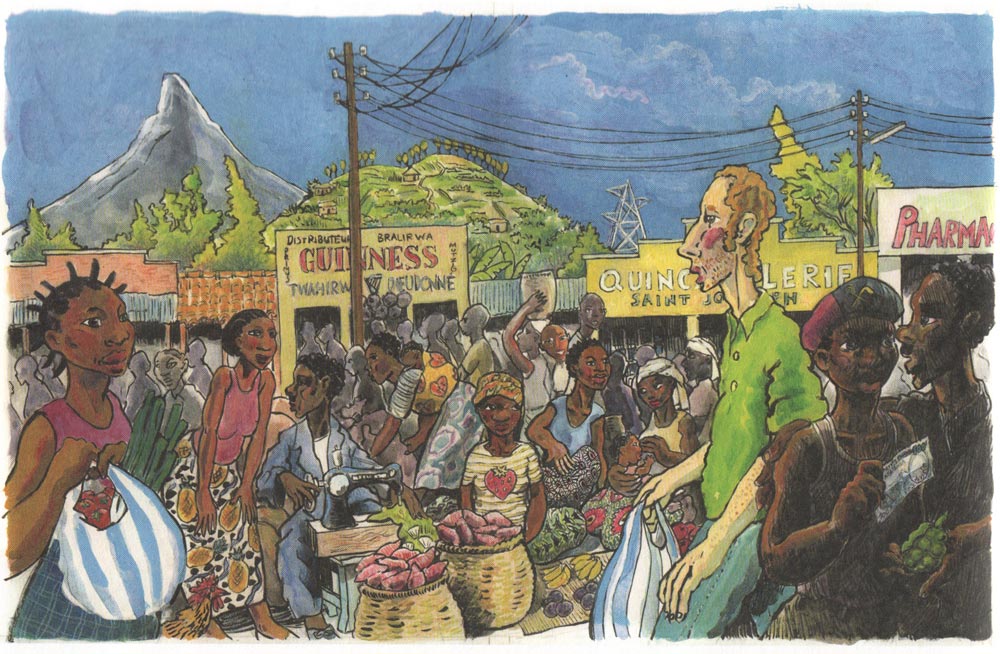
Cover illustration for 'Muzungu'.
Muzungu and other early comics
Back in Belgium, after escaping the genocidal atrocities in Rwanda, Janssen found work as a job coach and assistant-restorer with the firm Vandenborre-Lauwers. Eventually, he became a part-time administrative assistant with the library of Evergem. He has also been active as a volunteer for the Red Cross and Oxfam Fair Trade shops. Still, he couldn't forget his traumatic experience. Luckily, he had been able to take his artwork with him and decided to turn it into a graphic novel, which was published in 1997 by the small Belgian imprint Wonderland Half Vier Productions. In his socially conscious comic book 'Muzungu - Sluipend Gif' (Wonderland, 1997), Janssen captured his experiences as a "muzungu" (Swahili for "white man") in Rwanda. The first chapter was drawn in 1993-1994, when he was still living in the country, and dealt with the gap between rich land owners and poor farmers. The second chapter discussed the horrors he witnessed during the genocide, and was made after his return to Belgium. Janssen used a fictional protagonist and narrative, but otherwise many events in the book were autobiographical.
'Muzungu' met with critical acclaim and won the VSB Award at the 1998 Stripdagen Haarlem comic festival in The Netherlands. This increased his notability and led to publications of shorter comics in alternative magazines, starting with Beeldstorm, for which he drew socially engaged strips about the mayor of the fictional town of Zwammergem (1997-2000). Later came contributions to Incognito, Gr'nn, Ink, Kerozene, XXI, Parcifal, Orsai and Zone 5300, by then often in collaboration with scriptwriter Pieter van Oudheusden.

'Klaarlichte Nacht'.
Bakamé and other collaborations with Pieter van Oudheusden
When Janssen traveled to the Dutch city of Haarlem to pick up his VSB Award, he was introduced to jury member Pieter van Oudheusden, a novelist and translator who occasionally wrote comic scripts. The two hit it off and decided to collaborate, with short stories published in Incognito, Zone 5300 and Ink. Their first book publication was the poetic 'Een Nachtegaal In De Stad' (Wonderland, 2000), which followed four people on a hot summer night in a provincial city. Their chance meetings will change their lives forever. Janssen and Van Oudheusden's next joint effort was 'Klaarlichte Nacht' (Wonderland, 2001), a collection of four erotic short stories. A luxury edition of the book came with an original linocut, cut and printed by Janssen.
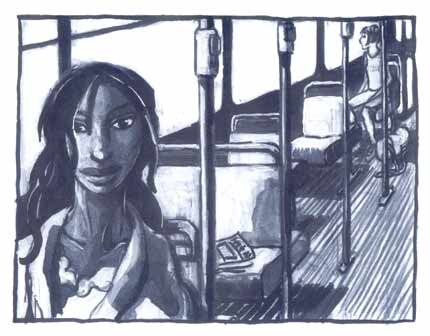
'Een Nachtegaal in de Stad'.
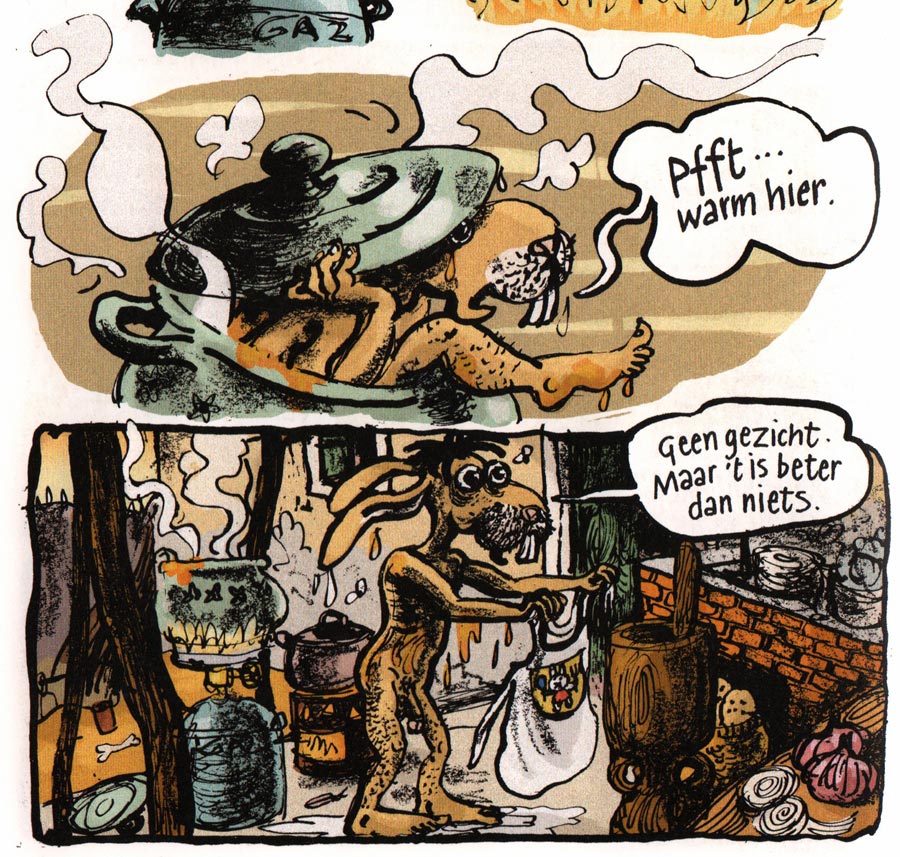
The Janssen-Van Oudheusden duo won most acclaim with their trilogy about the African folklore character Bakamé. When teaching in Rwanda, Janssen had heard stories about this cunning hare from his pupils. Bakamé is a trickster character comparable to similar animal tales in other continents. He inspired Joel Chandler Harris' 'Br'er Rabbit' in the United States (later made into a popular Disney character too). Van Oudheusden and Janssen also saw similarities with the Flemish medieval poem about Reynard the Fox. The authors took several pre-existing stories about Bakamé and molded them in the graphic novel 'Bakamé' (2003), where the sly rodent torments the mayor of the real-life Rwandan village of Buruseri. This book was picked up by the publishing house Oogachtend, which from then on became Janssen's main homebase.
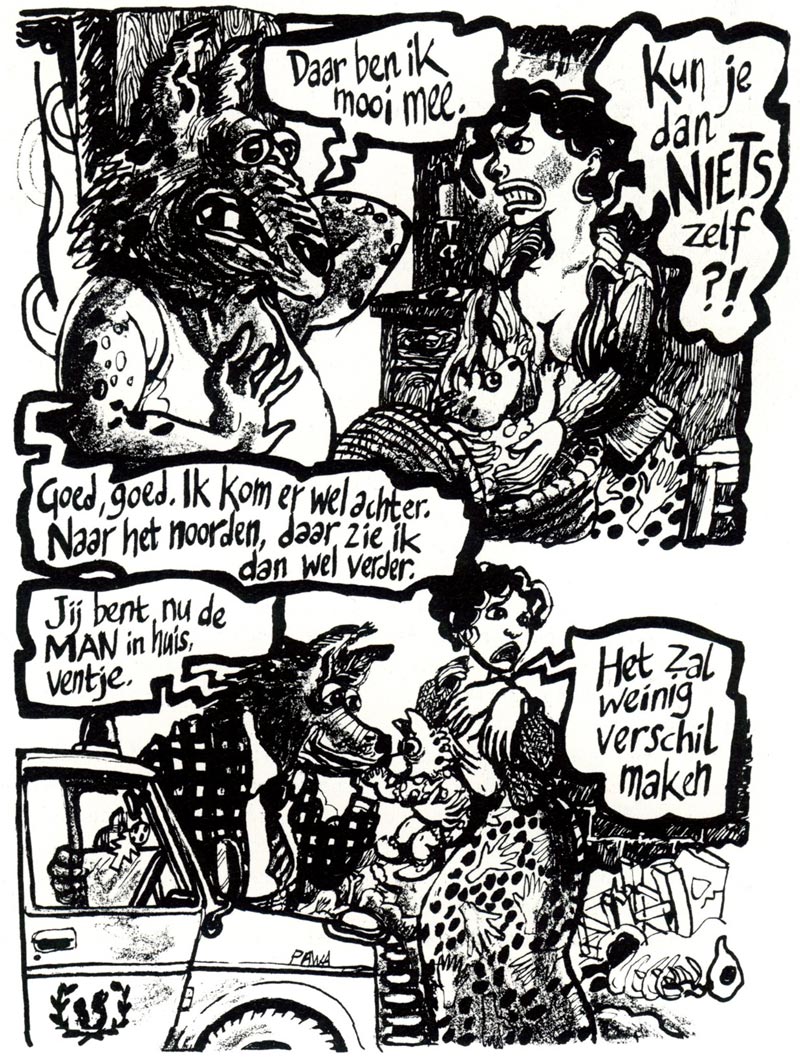
'De Grote Toveraar'.
In 2007, Janssen made his first return to Rwanda in 13 years. He revisited his old friends, pupils and locals and made photographs and drawings which found their way into his next graphic novel 'De Grote Toveraar: De Kruisweg van Mpyisi' (Oogachtend, 2007), a partial sequel to 'Bakamé'. Co-written by Van Oudheusden, the story centers around Mpyisi, a hyena struck by bad luck. Bakamé has stolen his car motor and put it inside an aeroplane which carried the national football team. When the plane crashes, the entire country is angry with Mpsiyi. The only way to get out of this mess is visiting Bwana Kero, a legendary magician who might be able to help him.
In 2010, voluminous 'De Wraak van Bakamé' was published, which not only compiled 'Bakamé' and 'De Grote Toveraar', but also added a new Bakamé story, originally serialized in Stripgids and Ink. 'De Wraak van Bakamé' was also translated into French. It was never the authors' intention to turn Bakamé into a trilogy and most of the stories are one-shots with no real continuity. But in the end, the three available tales are often dubbed the "Bakamé trilogy" in the press, because Bakamé is a central character. Sadly enough, in 2013 the fruitful collaboration with Pieter van Oudheusden came to an end when the writer passed away from a brain tumor.
Their final, unfinished project was a biographical flashback to the life of 19th-century Austrian composer Franz Schubert, though with occasional creative and anachronistic liberties. It wasn't completed until 2020, when the Dutch publishing house Sherpa released it as 'Posthumus', which came with bonus sketch material by Jeroen Janssen in the back of the book.

From: 'Posthumus'.
Africa-related projects with Hilde Baele
In the early 2010s, Janssen teamed up with Hilde Baele, a Belgian journalist and illustrator working in several African countries on educational and humanitarian projects. Together, Janssen and Baele set out to work on 'L'Histoire d'un Truc Bizarre', an educational book to stimulate condom use among Rwandan youth. The project unfortunately was rejected because the Ministry of National Education in Rwanda and the U.S. financers took offense about certain details, including a small stain on the boy's pants and the fact that the kid's buttocks were slightly exposed in one drawing. They also objected to a scene where a store owner dozes off and the fact that the child protagonists were supposedly a Hutu and a Tutsi, "clearly recognizable by their clothing", even though Janssen just drew two kids without any other intentions. In the end, Baele illustrated the book herself in a less provocative style, but Janssen and Baele did collaborate on two other picture stories. One of them was an educational children's booklet on health communication, 'Ese Teta Ntiyumvira?', which was distributed on a massive scale throughout Rwanda.

Part of Jeroen Janssen and Hile Baele's story of the Rwandese Jérôme Sebasoni, who joined the expedition of Che Guevara in Africa. Published in English on Drawing the Times.
In 2020, Hilde Baele and Janssen released the graphic novel 'Mijn Kameraad Che Guevara' (Oogachtend, 2020), based on 12 years worth of research about the seven-month stay in 1965 of Cuban revolutionary leader Ché Guevara in the Democratic Republic of Congo. Baele and Janssen traveled all the way to Congo and Cuba, talking with people who had met or knew Guevara. Central in the story was the testimony Jérôme Sebasoni, who was Guevara's original guide in Africa. Baele's journalistic report was illustrated with sketches by Janssen. Early installments of their report were prepublished in Mo* Magazine, issue #43 of the comic news magazine Stripgids (fall 2015) and on the Drawing the Times platform. Ten years later, Janssen and Baele revisited the raw and authentic life story of Rwandese gardener Jérôme Sebasoni for the graphic novel 'Kameraad Jeronomo' (Oogachtend, 2025), illustrated by Didier Kassaï, an artist from the Central African Republic.

'Abadaringi'.
Guaranda and Abadaringi
In 2014, Janssen returned to Rwanda, where he made a special graphic report first published in two issues of Humo magazine (April 2014). Much of his research inspired his next two graphic novels, 'Guaranda' (Oogachtend, 2015) and 'Abadaringi' (Oogachtend, 2016). Both were travel reports inspired by Joe Sacco's graphic novels about his voyages to Bosnia and Palestina. Compared with Sacco, Janssen's graphic novels are more observatory in nature, focusing on the local people instead of his personal impressions. To produce the books, he received financial support from the Flemish Literature Fund and the Pascal Decroos Fund. 'Guaranda' reflected Janssen's voyage to Guaranda, Ecuador, where he was by commission of the city council of the Belgian town of Evergem, of which Guaranda is a sister city. 'Abadaringi' revisited the artist's life as a teacher in Nyundo, Rwanda. He talked with former pupils about the impact the 1994 genocide had on their lives. Some still lived in Rwanda, others had moved to Europe and the USA. Some people were notably tarnished by the events and a minor few took a strong dislike of Janssen. Many of his travel report comics have appeared in magazines like Knack and De Morgen, and on the news websites Apache.be and Mo*.
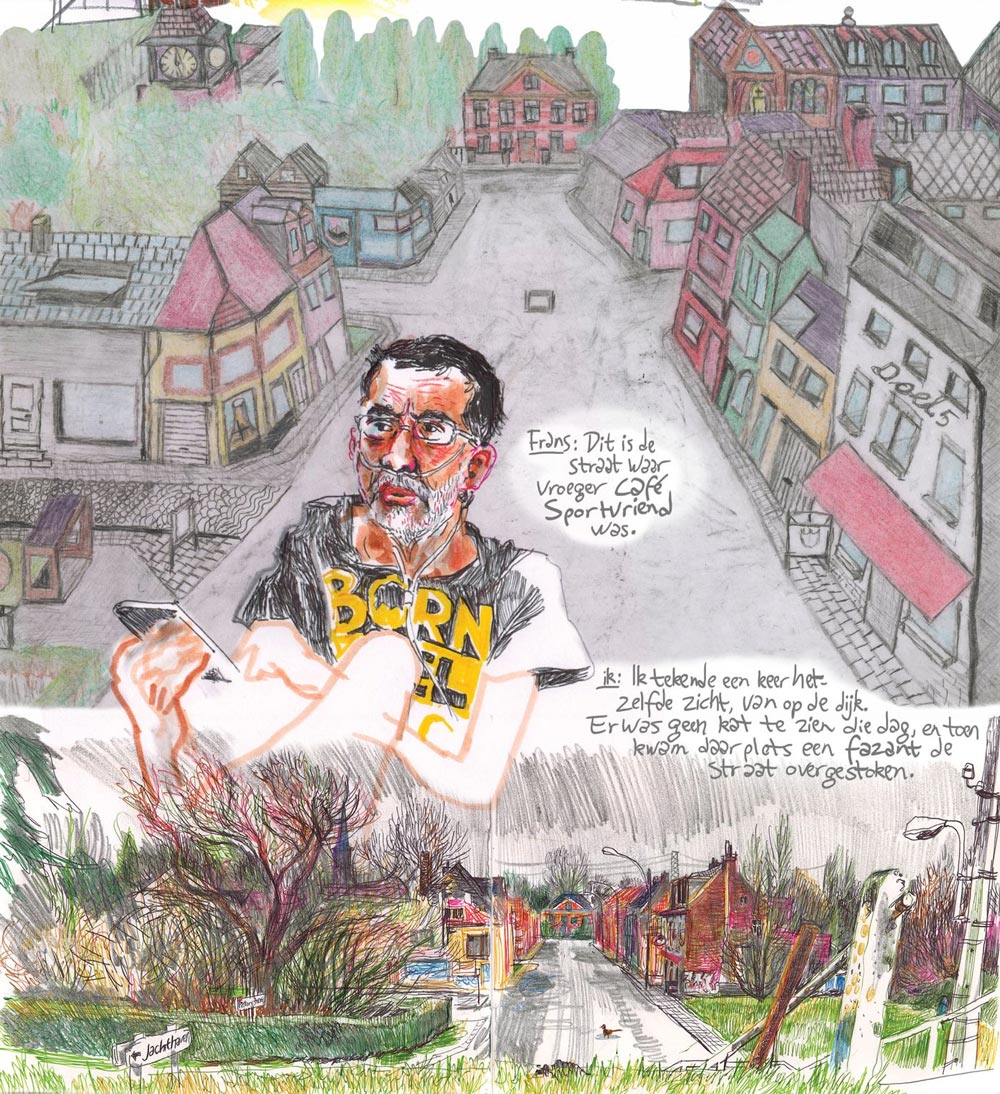
Scene from a comics report about Doel, published on Apache.be on 20 July 2018.
Comics about Belgian towns
Besides Africa, Janssen has also shown his social engagement more regionally through his graphic reports about Doel, a Belgian village threatened with demolition for over half a century. In the 1960s, the Antwerp city council had plans to expand their port and dispossess the citizens of Doel, leading to a lot of protest and political turmoil. Many people expressed solidarity with Doel. Guido van Meir's novel 'Terug naar Oosterdonk' was inspired by it and adapted into a 1997 TV series by Frank van Passel. Documentary maker Manu Riche made the 2015 film 'Oratorium zonder Doel'. Over the decades, many people left the village, which effectively became a ghost town and a haven for squatters. Only in 2018, it was decided to save Doel as it is.
Janssen's interest in Doel happened by coincidence. In 2010, he offered his services to the Parisian magazine XXI, which ran a lengthy comics report in each quarterly issue. While Janssen initially offered his stories about Rwanda, the editor instead requested a report about a Belgian subject, inspiring Janssen to visit Doel for a first time. As a former refugee himself, Janssen could relate to the villagers, and often visited the town to make sketches of the people and the surroundings. To keep the atmosphere intact, he didn't redraw anything afterwards. After scanning his sketches back home, he composed them into a graphic narrative. After his first graphic report in the French magazine XXI, Janssen eventually released the graphic novel 'Doel' (Oogachtend, 2013), a reflection of his conversations with local people. Sketches, some in black-and-white, others in color, were alternated with comics and written conversations. 'Doel' won praise by Flemish novelist and columnist Jeroen Olyslaegers and sold out in a few months. In 2018, Janssen created a new book about the topic, 'Er Wonen Nog Mensen - Tekenen Van Leven In Doel' (Oogachtend, 2018). He was inspired by the juridical decision to make Doel a living area again, which oddly enough had the opposite effect. The same people who had fought to stay in the village for years suddenly moved out one by one, a paradox that formed the core of Janssen's book.
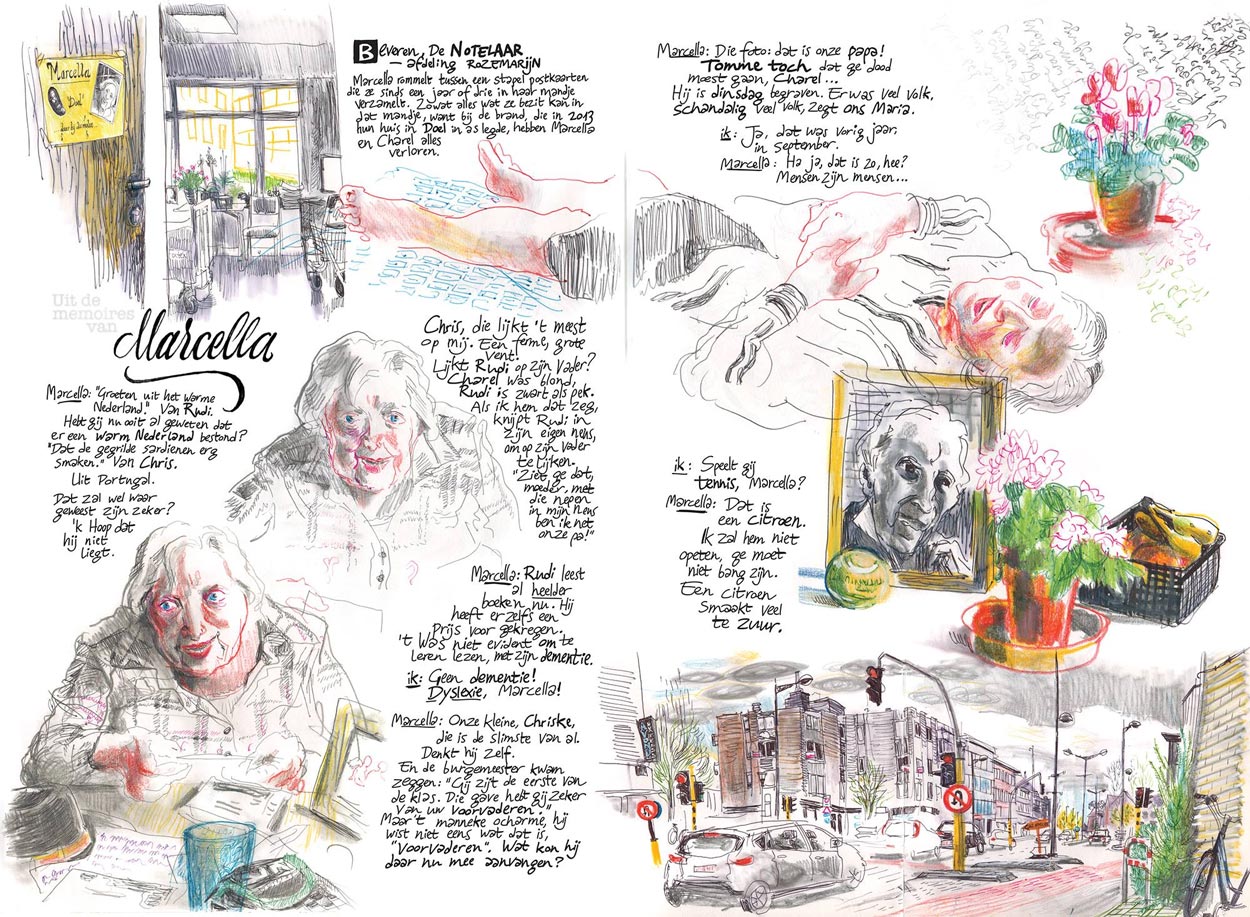
Graphic journalism for the Spring 2017 issue of Stripgids.
In the 2020s, Janssen teamed up with the Belgian-Iranese writer and sociologist Arezoo Morado. In their book 'Landloos als de Wind' (Oogachtend, 2023), the authors sketched a portrait of Ledeberg, a sub-municipality on the fringes of the city of Ghent. With subtle and almost poetic observations, the two portrayed the allotment gardens with their rickety sheds, overgrowing blackberries and nettles, as well as the nearby railway and motorway. For his book 'Halfweg - Tussen Reizen en Thuiskomen' (Oogachtend, 2026) and his co-writer Pablo Janssen used a more philosophical approach to his observational art. In the promotional text, Janssen was desribed as an artist who constantly balances between traveling and coming home. Exploring the question what people consider a home, the book came with an exhibition in Expo Leuven in April/May 2026.
Other projects
In 2004, Jeroen Janssen illustrated 'Imigani' (2004), a self-published collection of Rwandan proverbs, calligraphed by his partner Els Schneiders. In 2019, Janssen revisited the subject for the collection 'Guca Imigani', risographed by Wasco and published by Black Olive Press. Janssen has also provided the coloring of 'Hippo & Zeno', a comic strip by Klaas Verplancke. Since moving back to Ghent, Janssen has played in the orchestra 'De Ledebirds', a social-artistic project.

'Halfweg' (2026).
Graphic contributions
Contributions by Janssen have appeared in Dutch anthology projects like 'Sprookjes in Strookjes' (2006) and 'Strips in Stereo - Bootleg' (2006), both initiated by Margreet de Heer, as well as 'Loslopend Wild' (Oogachtend, 2009), showcasing a new generation of Flemish comic creators. For the 2010 anthology 'Mooi Is Dat!', Janssen made a one-page graphic interpretation of the novel 'Knielen op een bed violen' by Jan Siebelink.
Janssen was one of several artists to make a comic strip for the artbook 'Building Bridges in Europe’ (2012), published by the European Association of National Builders' Merchants Associations and Manufacturers (UFEMAT). In 2024, Jeroen Janssen and Arezoo Moradi participated in the international exposition and graphic novel project 'Het Onvoorstelbare Verbeeld' (Scratch Books, 2024), telling stories from the Nazi concentration camps Neuengamme (Germany), the Dossinkazerne (Belgium) and Camp Westerbork (The Netherlands). The other participating artists were Guido van Driel, Erik de Graaf, Melanie Kranenburg, Sterric, Jennifer Daniel, B. Carrot, Wide Vercnocke, Milan Hulsing and Tobi Dahmen.
Recognition
Several books by Jeroen Janssen have won awards. His career really took off after his debut 'Muzungu' won the 1998 VSB Award at the Stripdagen Haarlem. Later, 'Guaranda' (2015) and 'Abadaringi' (2016) each received the Prix de l'Écriture at the Festival of Clermont-Ferrand. Nicknamed "Belgium's Slowest Journalist", in 2018 Janssen received both the Bronzen Adhemar and Prix Atomium, two prestigious Belgian comics prizes. On 11 July 2011, Pieter De Poortere designed a comics mural in the Rue Euler, Paris, featuring characters created by Janssen, Judith Vanistendael, Olivier Schrauwen, Randall Casaer and Brecht Evens, to promote Flemish comis. This was the first of its kind in France.
Jeroen Janssen has been named an influence by Ben Gijsemans.
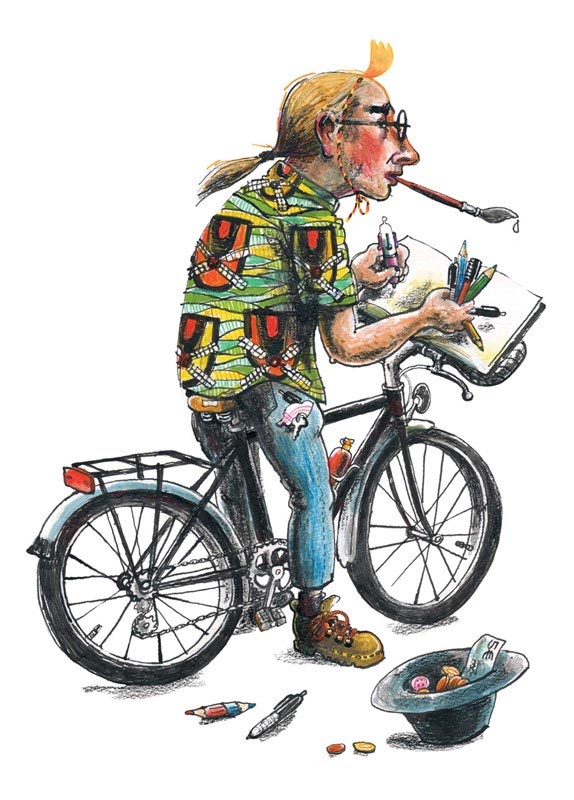
Self-portrait.