

'Tekko Taks en de Zoon van het Hemelse Rijk'.
Henk Kabos was a Dutch comic artist and art director for animated films, who spent large parts of his career working for the studios of Marten Toonder and Joop Geesink. At Geesink's Dollywood, he served as art director on several successful puppet film productions, including the first five years of the 'Loeki de Leeuw' shorts (1972-1977), which appeared as bumpers during commercial breaks on Dutch television. As a comic creator, Kabos is best remembered for his humorous newspaper adventure strip 'Tekko Taks' (1946-1956), about an anthropomorphic dachshund. Co-created with James Ringrose, this funny animal comic was not only a success in the Netherlands, but also translated into English, German, Finnish and Turkish. Further comics by Henk Kabos included advertising strips for Kabouter gin, Pitex insect powder, Faam peppermint and Planta margerine, as well as the 'Barendje Big' comic for the women's weekly Eva (1964).
Early life and career
Hendrik Jacob Theodorus Kabos was born in 1912 in Amsterdam, where until 1935 he received his artistic education at the local Arts and Crafts School ("Kunstnijverheidsschool"). Spending the first years of his career as a visual artist, he painted murals for a photographer in Amersfoort and the children's hospital in Utrecht, and also produced stained-glass windows for a church in Hilversum. In addition, Kabos worked as an illustrator for the children's magazines De Kleine Wij and Doe Mee!, and for the illustrated monthly Astra.
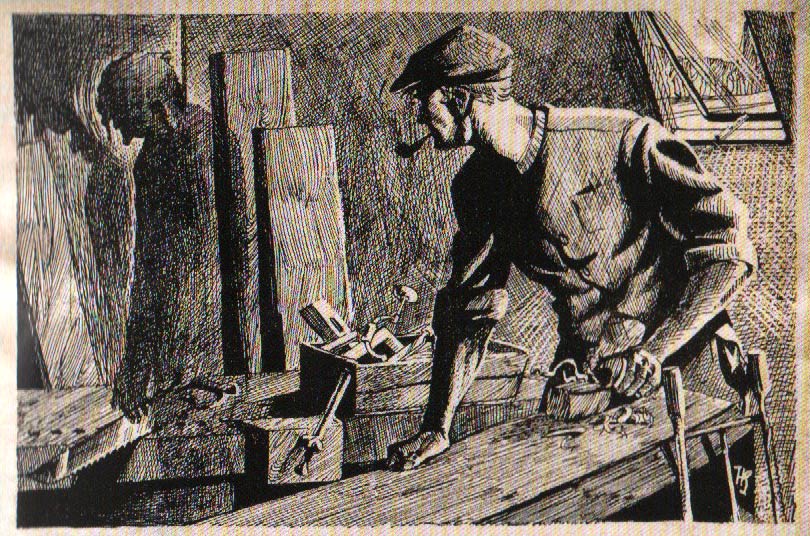
Illustration by Henk Kabos for Astra.
Geesink-Toonder Studio's
After working for about a year as a drawing teacher at a private school, in early 1942 Henk Kabos found employment with Joop Geesink's animation studio in Amsterdam. Shortly afterwards, Geesink's firm joined forces with Marten Toonder's studio, resulting in the founding of "Geesink Toonder Teekenfilm-Productie". Initially, Kabos specialized in animation, collaborating on projects like Geesink's film by commission of the Dutch Railways ('Pierus in de Contramine') and the animated film 'Das Geheimnis der Grotte', based on Toonder's first 'Tom Poes' story 'Tom Poes Ontdekt Het Geheim der Blauwe Aarde'. Once a week, Henk Kabos and his colleague Cees van de Weert trained the studio's less experienced artists in human anatomy and the construction of cartoon characters. When Toonder and Geesink parted ways after about one year, Kabos initially stayed with the Toonder Studios.
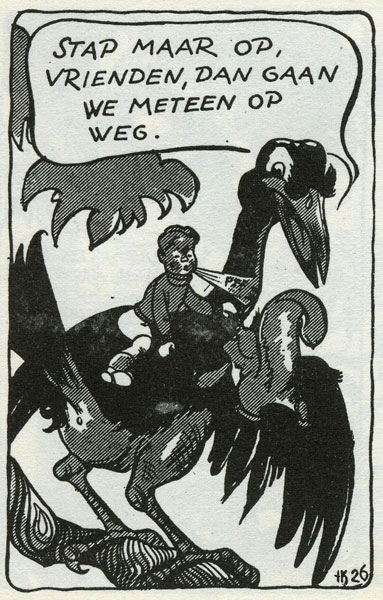
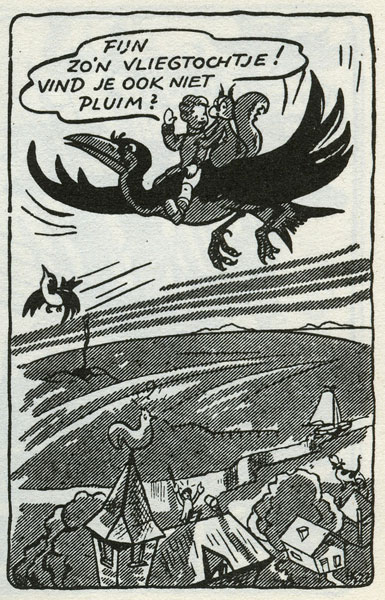
'Pukkie's Avonturen' (Kabouterboekje, 1943).
Work for Marten Toonder
During World War II, Henk Kabos and Marten Toonder, along with other studio co-workers got involved with Dick van Veen and Jo Pellicaan's illegal printing company D.A.V.I.D. and its magazine Metro. They operated from a so-called "second division" of the Toonder Studios in the Amsterdam Spuistraat, where D.A.V.I.D. printed illegal papers like Vrij Nederland, Het Parool and Trouw, as well as booklets for the publishing company De Bezige Bij. Kabos designed the printer's logo and provided illustrations for several of their publications, often under the pseudonym Karel Woud. A notable publication with illustrations by Kabos was the booklet 'Keukenkrabbels' (1945) by Marten Toonder's brother Jan Gerhard, followed after the Liberation by 'Geef Ons Heden Ons Dagelijks Brood' (De Suijckermoolen, 1946). Both books gave a visual and written expression of the despair and anger during the war years, particularly the Hunger Winter (late 1944-early 1945), when the northern half of The Netherlands was still under Nazi occupation and endured severe famine.
During the occupation, the Toonder Studios produced the advertising comic 'Het Recept van Pinneke Proost' (1943) for the gin brand Kabouter. Toonder wrote the story, while H.G. Kresse developed the characters, Cees van de Weert did the lay-outs and Frans van Lamsweerde produced the finished art. Kabos designed the ornamental first letters of each text block. The book was printed, but never distributed. It wasn't until 1995 when limited collector's edition was released by John Wigmans. Still in 1943, Kabos also drew some booklets in the 'Kabouterboekjes' collection of the Bijenkorf department store, for instance 'Pukkies Avontuur' (number #6), 'Reinaard de Vos' (#7) and 'Aladdin en de Wonderlamp' (#13). For the latter, Kabos also provided the text.
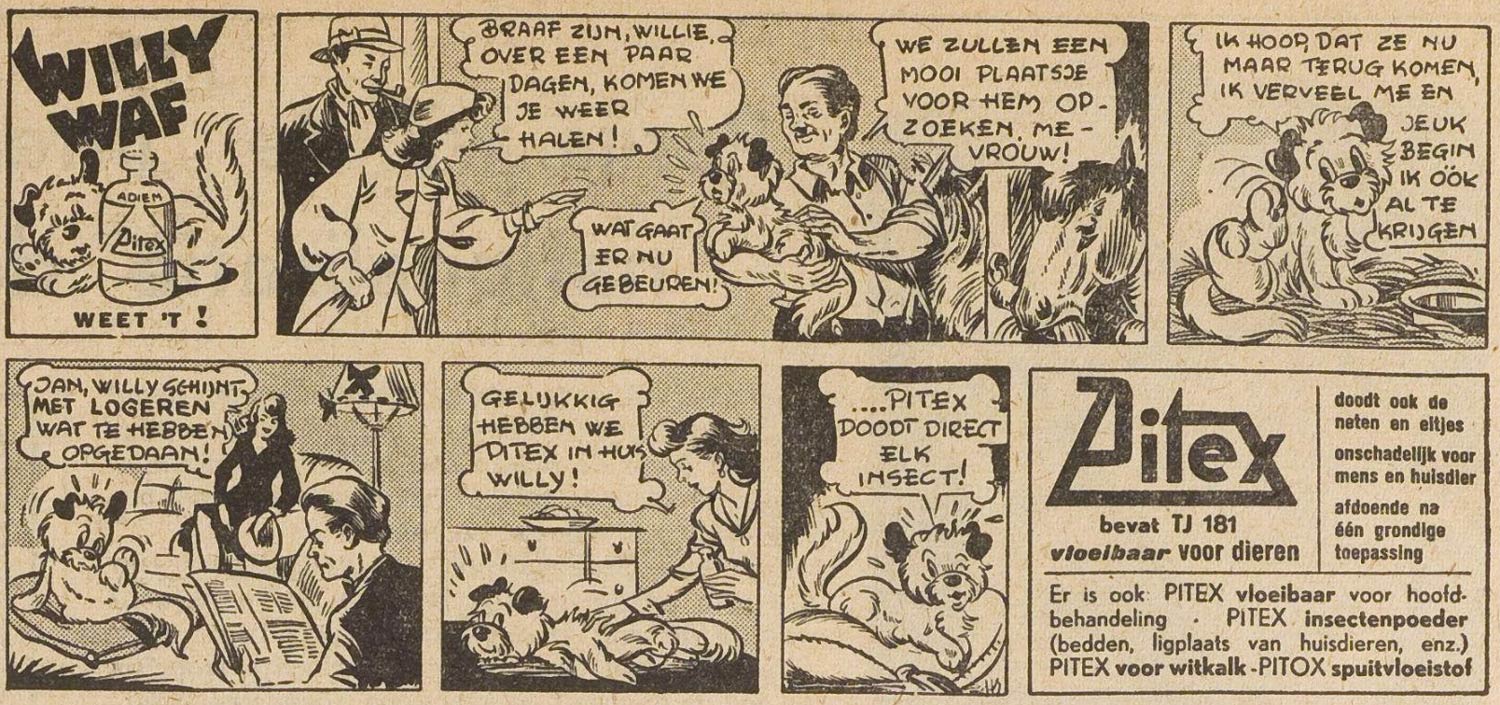
'Willy Waf' (Het Vrije Volk, 12 August 1947).
Joining the studio's comic strip department, Kabos also drew Toonder's daily 'Tom Poes' comic strip for De Telegraaf for four months (most likely the 1944 story 'De Superfilm-onderneming'), and presumably also participated in the artwork of the 1949 story 'Horror de Ademloze', which ran in De Nieuwe Rotterdamse Courant and De Volkskrant. In 1947, Kabos drew a series of advertising comic strips for Pitex insect powder, starring the dog 'Willy Waf'. These strips appeared at least in the newspapers Het Vrije Volk, De Waarheid, Nieuwe Apeldoornsche Courant and Nieuwsblad van het Noorden. In the second half of the 1940s, Kabos also served as lead animator and director on the Toonder Studio's first post-war animation projects, most notably the 'Tom Poes' shorts by commission of Philips, 'The Haunted Castle' (1948), 'The Magic Music' (1948) and 'Dreamland' (1949).
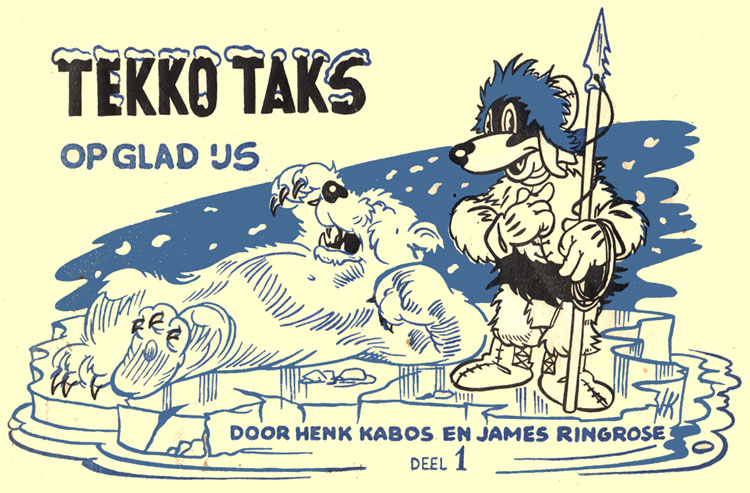
Cover illustration for 'Tekko Taks' booklet 'Op Glad IJs'.
Tekko Taks
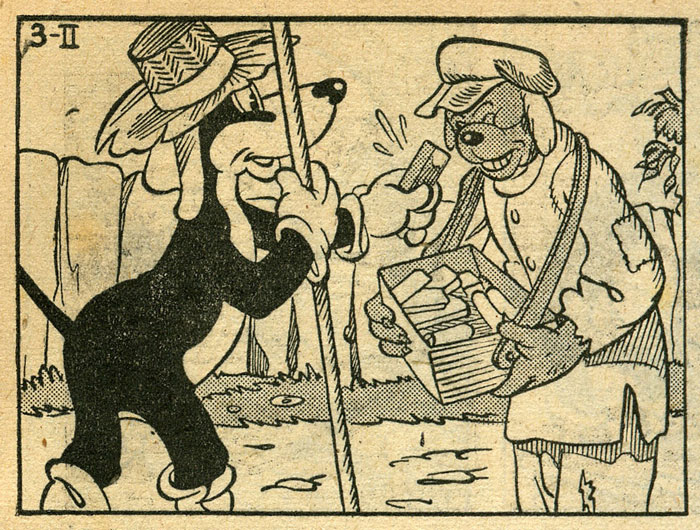
After World War II, the Toonder Studio's expanded their comic strip productions, with several of the studio workers developing their own series available for syndication in the many launched and relaunched Dutch newspapers. Together with his colleague James Ringrose, Henk Kabos created his signature series, 'Tekko Taks' (1946-1952). Between 11 January 1946 and 6 February 1947, the first three stories appeared in the newspaper De Nieuwe Nederlander. After a short break, the comic continued in Trouw on 5 November 1947 ran for another 28 stories in this paper. Like many Dutch newspaper comics around that time, it was a funny animal series published in text comics format, with the narration and dialogue printed underneath the images. Tekko is a black dachshund who is quite homebound. He loves his house and garden and it's only out of necessity that he is forced to go on adventure. Set in an anthropomorphic animal world, the plots often take him to exotic locations. Because both creators spent their days working on Toonder's animation projects, Kabos and Ringrose plotted their stories after working hours, during evenings filled with Dutch gin (according to a 1970 interview with Kabos, published in comics news magazine Stripschrift). Kabos then did the pencil work, while Ringrose took care of the inking duties and the final texts.
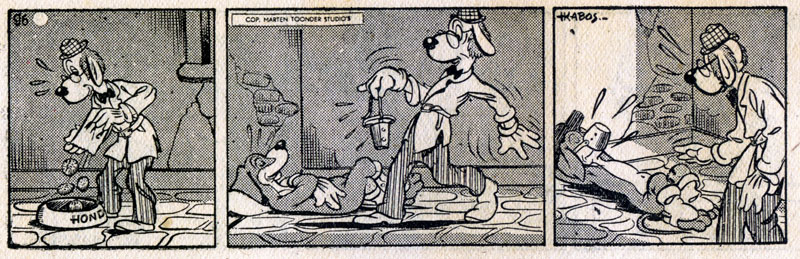
'Tekko Taks'.
Even though in 1949 Kabos returned to Joop Geesink's studio, he continued to produce the 'Tekko Taks' strip for the Toonder Studios. However, initially his new workload forced him to let Ben van Voorn fill in on the artwork of three stories in the 1949-1950 period. The strip ran exclusively in Trouw until 18 April 1956. By then, the strip was distributed by Swan Feature Syndicate, the company of Toonder's former business partner Anton de Zwaan. After the final episode, Swan Features continued to distribute reprints of 'Tekko Taks' to the Frisian local papers Friese Koerier and Leeuwarder Courant, and even to Amigoe di Curaçao, a newspaper from the Dutch-speaking Carribean island of Curaçao. In Flanders, Belgium, Tekko's adventures could be enjoyed in 't Kapoentje, the youth supplement of the newspaper Het Volk. The comic was also published in Ireland, Germany, Finland and Turkey.
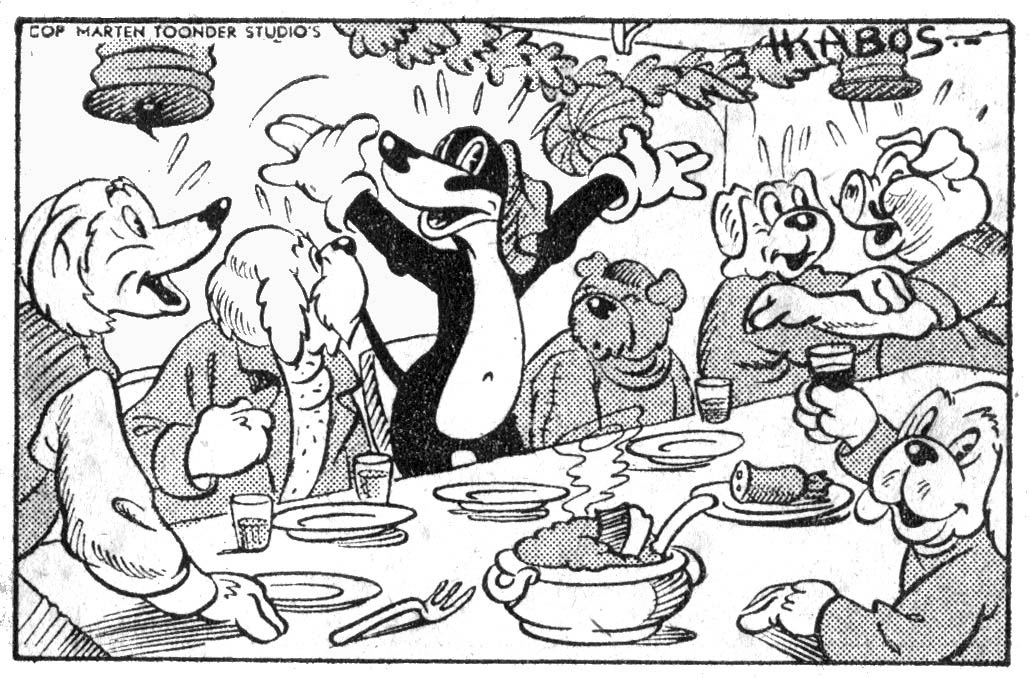
'Tekko Taks'.
In an interview in issue #14 of comic news magazine Stripschrift, Henk Kabos said that he terminated the series in 1952 after a total of 31 stories, and that no new material was made after that date. Knowing that new stories appeared in Trouw until 1956, Kabos was probably mistaking. However, it is known that another artist, Frits Kloezeman, has drawn the comic for about a year, so he is possibly the author of the final three stories in 1955-1956. Perhaps Kabos' run on the strip lasted until 1954, although it is also possible that James Ringrose made a few episodes on his own.
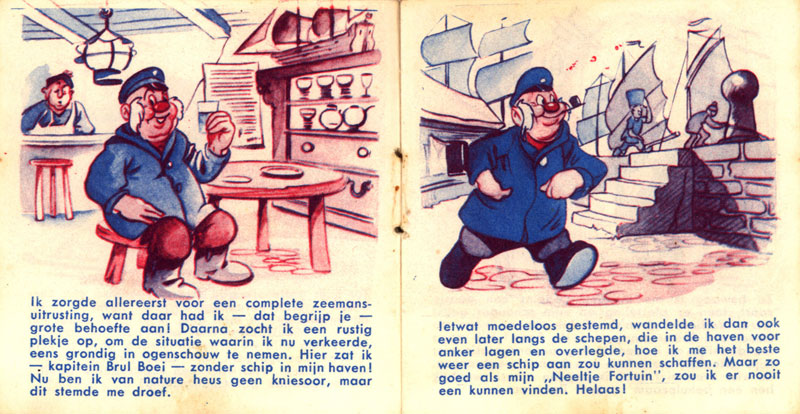
'Kapitein Brul Boei'.
Later comics
Other creations by Henk Kabos, possibly through the Geesink studio's, were two series of 24 picture books for the peppermint brand Faam from Breda, the first starring 'Generaal Trip' (1948) and other with 'Kapitein Brul Boei' (1949). For the margerine factory Planta, Kabos drew the landscape-format picture booklets with 'Pukkie Planta' (1953). His final comics work was 'Barendje Big' (1964), another funny animal co-production with James Ringrose, made under the joint pen name "Rincká" for the women's weekly Eva of the Nederlandsche Rotogravure. Replacing Jean Dulieu's 'Paulus de Boskabouter', the 'Barendje Big' comic was serialized in 26 episodes between 1 February 1964 and 25 July 1964. After that, Kabos dedicated all his time to his work in animation at Joop Geesink's Dollywood.

'Barendje Big' (Eva, 8 February 1964).
Dollywood Studios
Working for Joop Geesink's Dollywood Studios from 1949 on, Henk Kabos was eventually promoted to art director. In this role, he worked on critically praised and award-winning puppet film productions like 'Philips' Lamplight Band' (1957), 'Light Concert in the Zoo' (1963) and films starring 'Dutchy' for the Dutch Dairy Firm in The Hague. After the 1971 bankruptcy of Dollywood, Kabos continued to work on Joop Geesink's further 1970s projects. Together with animator Cor Icke, he was also responsible for the 'Loeki de Leeuw' stop-motion animated films, starring the orange lion character created by Geesink. The 'Loeki de Leeuw' shorts were used as bumpers before and during commercial breaks on the Dutch public TV channels. First broadcast in 1972, they were an iconic mainstay of Dutch television until 2004. Apart from the Netherlands, the 'Loeki' shorts were also shown in France, the United Kingdom, Austria, Italy, Japan and the United States throughout the decades.
Final years and death
During his career, Henk Kabos additionally illustrated children's books, and made costume designs for the Dutch National Ballet. After having worked on about 1,500 'Loeki' shorts, Henk Kabos retired from Joop Geesink's studio in December 1977. He died in July 1984 at the age of 71.

On 23 December 1977, Loeki the Lion was portrayed with his "godfather" Henk Kabos in newspaper De Telegraaf, on the occasion of the artist's retirement.