
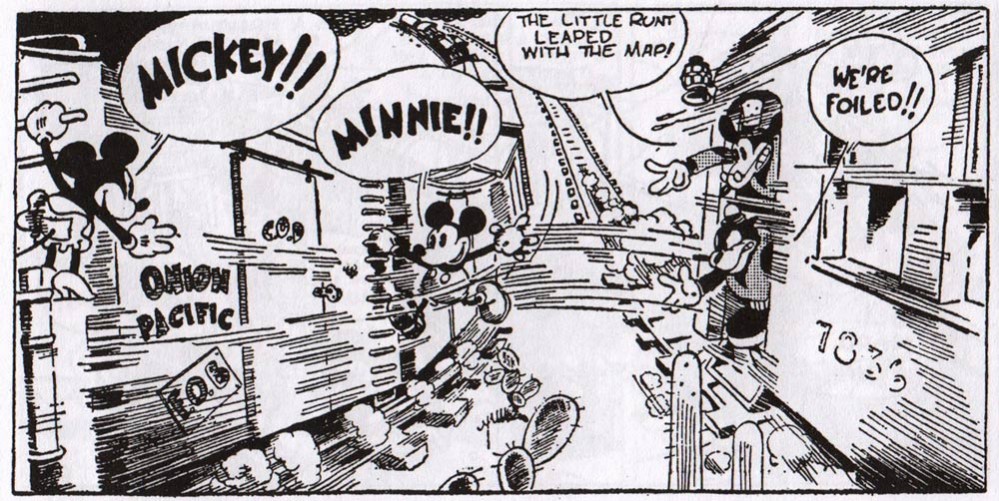
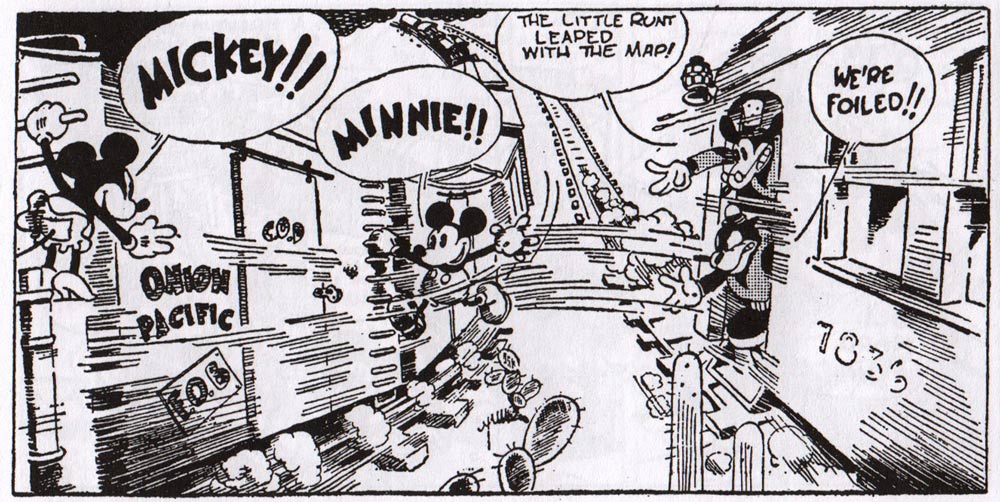
'Mickey Mouse', 1930. © Disney.
Jack King was an American animated film director, best remembered for his extensive work for the Walt Disney Studios. Between 1929 and 1933 and again from 1936 to 1948, he worked on various shorts for the studio, several starring Mickey Mouse and later predominantly featuring Donald Duck. King also contributed to the 'Silly Symphonies' series and some of Disney's animated features. Between 1933 and 1936, King briefly worked for Warner Brothers' animation department. In comics, his career was brief: for a few weeks in 1930, King did some filler work on the 'Mickey Mouse' newspaper comic.
Early life and career
James Patton King was born in 1895 in Birmingham, Alabama. In 1917, he started his career at Raoul Barré's studio, after which he joined William Randolph Hearst's International Film Service (1916-1918), and subsequently the Bray Studios. At Bray, he worked on animated adaptations of the newspaper comic strips 'Judge Rummy' and 'Silk Hat Harry's Divorce Suit' by Tad Dorgan. Among his Bray colleagues were Raoul Barré, Wallace Carlson, Shamus Culhane, Clyde Geronimi, Milt Gross, Burt Gillett, David Hand, Frank Moser, Grim Natwick and Pat Sullivan. In the mid-1920s, King also worked for Bill Nolan's animation studio, contributing to cartoons based on George Herriman's 'Krazy Kat'.
Disney animation (1929-1933)
Between 1929 and 1933, King had his first tenure working for the Walt Disney Studios. He was animator on various 'Mickey Mouse' cartoons, of which 'Mickey's Orphans' (1931), 'Mickey's Nightmare' (1932), 'The Mad Doctor' (1933) and 'Mickey's Gala Premier' (1933) are the best-known. King was also closely involved with several 'Silly Symphonies' installments, such as 'Flowers and Trees' (1932) - one of the first color cartoons in history - and 'The Three Little Pigs' (1933). By 1932, Disney had requested his animators to start using rough pencil sketches for the test recordings, instead of the clean, finished drawings they originally used to provide. However, King continued to work the way he had always done, using coins to draw Mickey's head and torso. Afterwards, he let his assistant Roy Williams add rough sketch lines around the drawings to satisfy his boss. When Disney became aware of King's method, the two had an argument, and on 17 May 1933, King left the studio for the first time.
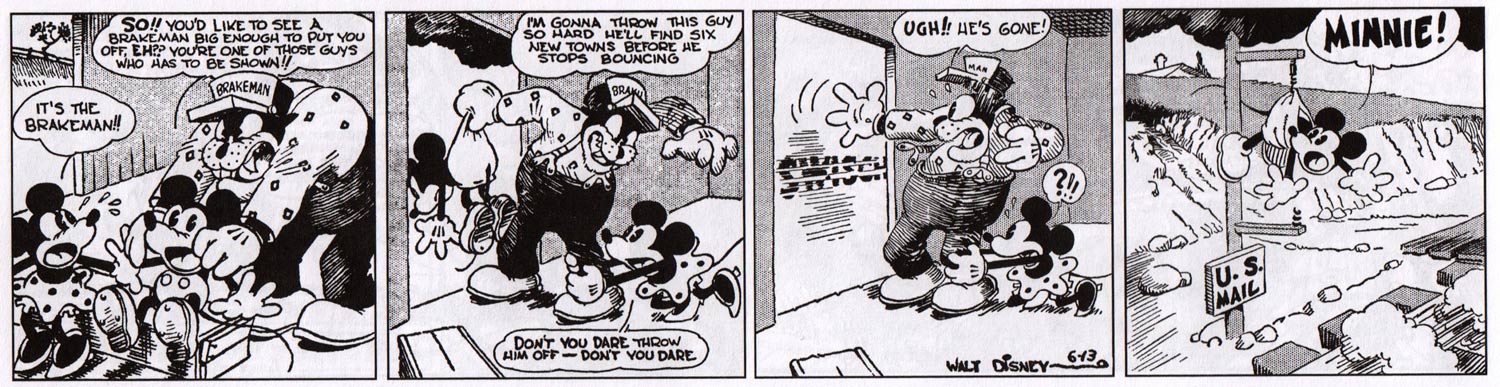
'Mickey Mouse', 1930. © Disney
Mickey Mouse newspaper comic
While chiefly known as an animator, King briefly contributed to Disney's comic strip department too. In early 1930, Walt Disney had launched a 'Mickey Mouse' newspaper comic, which he scripted himself, with Ub Iwerks providing artwork. However the labor and pressure of a daily comic caused a lot of problems during the first six months for the two studio founders. Iwerks left the series after only a month. His replacement Win Smith continued the series for three months until getting into an argument with Disney and also leaving the studio. During the chaotic period that followed, King was one of several Disney animators who temporarily drew or inked the 'Mickey Mouse' comic, among the other contributors were Earl Duvall, Hardie Gramatky and Roy Nelson. King drew 'Mickey Mouse' between 9 and 21 June 1930, until Floyd Gottfredson became the definitive 'Mickey Mouse' scriptwriter and artist.
According to Devon Baxter on the website cartoonresearch.com, King drew his characters with vertical pie-cut eyes and hobnails on Mickey's shoes. Reportedly, Disney disliked this hobnails, but many other Disney artists started imitating it. At a certain point, the studio gave their staff a special briefing to avoid drawing or inking hobnails on Mickey's shoes.

From: 'A Cartoonist's Nightmare' (1935).
Warner Brothers (1933-1936)
After his departure from Disney in 1933, King was hired by Warner Brothers' brand new animation studio, where he stayed for three years. Originally he was an animator, but when one of the directors, Earl Duvall, got into a drunken argument with Warners' producer Leon Schlesinger and subsequently fired, King was appointed as his successor. Most of the cartoons directed by King revolved around the now-forgotten characters 'Buddy and Beans'. One memorable short is 'A Cartoonist's Nightmare' (1935), in which Beans is an overworked animator who has a bad dream where his cartoon creations terrify him. The cartoon is notable for its scary but imaginative imagery and metafictional, self-reflexive commentary on the animation profession.
At Warners, King also directed four 'Porky Pig' cartoons, namely 'Fish Tales' (1936), 'Shanghaied Shipmates' (1936), 'Porky's Pet' (1936) and 'Porky's Moving Day' (1936). While King did oversee the rise of Porky as Warner's first enduring cartoon star, the studio was still far behind Walt Disney in popularity. His successors Friz Freleng, Tex Avery, Bob Clampett, Chuck Jones and Frank Tashlin eventually revolutionized Warners with more zany characters like Daffy Duck (1937) and Bugs Bunny (1940), but King had already left by that point. Still, King provided the studio with valuable technical skills and tips from his experience at Disney, which modernized Warners' animation department enough to eventually become Disney's true competitor from the 1940s on.
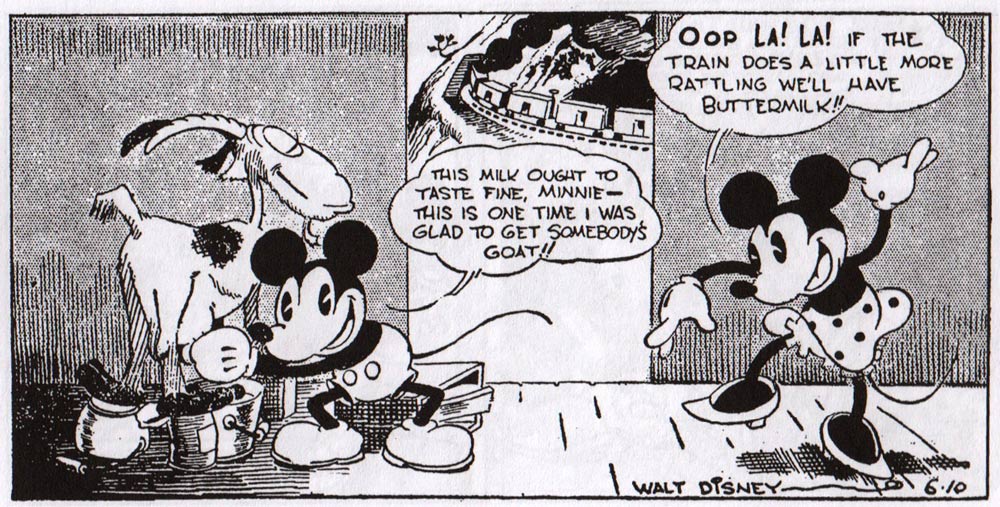
'Mickey Mouse', 1930.© Disney
Disney animation (1936-1948)
In 1936, King returned to the Walt Disney animation studio, where he moved up the ladder as a director. This role attracted him not just for more creative control, but also because Disney was one of the few studios at the time that could afford producing cartoons in color. King's first short was 'Modern Inventions' (1937), a Donald Duck cartoon co-scripted by Carl Barks. King directed 50 cartoons starring the short-tempered duck, with many narratives, gags and new side characters thought up by Barks. In 'Donald's Nephews' (1938), for instance, Huey, Dewey and Louie made their on-screen debut, after being introduced in Al Taliaferro's 'Donald Duck' newspaper comic a few months earlier. The lazy and gluttonous cousin Gus Goose was introduced in 'Donald's Cousin Gus' (1939), and Donald's girlfriend Daisy made her first appearance in 'Mr. Duck Steps Out' (1940). With 'The Autograph Hound' (1939), King directed one "celebrity caricature" cartoon, in which Donald visits Hollywood to get autographs of famous movie stars like Greta Garbo, Mickey Rooney, Sonja Henie, The Ritz Brothers and Shirley Temple. After Barks left the animation studio in 1942, Roy Williams became the prime scriptwriter of the 'Donal Duck' cartoons.
The 1940 short 'Window Cleaners', starring Donald Duck and Pluto, introduced an annoying bumblebee, who would later be named Spike. He reappeared in a few cartoons featuring Mickey Mouse or Pluto, but is best remembered as a recurring opponent for Donald in Jack Hannah's 'Inferior Decorator' (1948), 'Honey Harvester' (1949), 'Slide, Donald, Slide' (1949), 'Bee at the Beach' (1950), 'Bee on Guard' (1951) and 'Let's Stick Together' (1952).

From: 'Mr. Duck Steps Out' (1940).
During World War II, King directed the propaganda cartoons 'Donald Gets Drafted' (1942), 'The Vanishing Private' (1943), 'The Spirit of '43' (1943) and 'Commando Duck' (1944). 'The Spirit of '43' was a sequel to 'The New Spirit' (1942), directed by Wilfred Jackson and Ben Sharpsteen. In both cartoons, Donald learns the value of paying income tax to support the U.S. war effort. However, 'The Spirit of '43' proved a more memorable cartoon, since it featured a more dramatic opening narrative, where Donald argues back and forth with a stereotypical Scottish duck who advices him to save his money, and a hustler duck in direct alliance with the Nazis who wants him to spend it. The Scottish duck is a prototype of the character that Carl Barks would eventually develop into Uncle Scrooge. According to reports of the time, both of the 'Spirit' cartoons succeeded in convincing a large part of the U.S. population to indeed pay their income taxes "to save for victory". 'Commando Duck' is a more contested war-time propaganda cartoon by King, in which Donald combats stereotypically portrayed Japanese soldiers.
King's 'Donald Duck and the Gorilla' (1944), another one with collaboration of Barks, shares a similar plot element with the Carl Barks short comic 'The Rabbit's Foot' (1943), in which Donald and the nephews are also confronted with a menacing gorilla. King's 'Sleepy Time Donald' (1946) was adapted into a comic strip version by Jack Hannah. The opening credits of 'Donald's Dilemma' (1947), also directed by King, marked the first appearance of Donald Duck's theme song ("Who's got the sweetest deposition? One guess, guess, who?"), composed by Oliver Wallace. At the time, only a few cartoon stars had their own theme song, for instance The Fleischer Brothers' Betty Boop and Popeye and Paul Terry's 'Mighty Mouse'. While the Disney studios produced many 'Donald Duck' cartoons, some of their animators developed a hatred for the tantrum-throwing duck, and especially his quacking voice. This might explain why in some King-directed cartoons, like 'Donald's Dilemma' (1947) and 'Donald's Dream Voice' (1948), Donald temporarily speaks in a normal voice, while in 'Donald's Double Trouble' (1946), he meets a lookalike with a smooth voice who goes on a date with Daisy, while a jealous Donald looks on in horror, while having fewer dialogue than usual.
King was also a character animator on the Disney short 'The Wind in the Willows' (1949) and directed some animated sequences in the feature films 'Pinocchio' (1940), 'Dumbo' (1940), 'Saludos Amigos' (1942) and 'Make Mine Music' (1946). Just like the cartoons of fellow director Jack Kinney, King's cartoons are notable for occasional darker comedy than typical Disney cartoons and often end with a chase scene.

Promotional poster for the King-directed short 'Autograph Hound', artist unknown .© Disney. Behind the policeman we recognize (from left to right): Sonja Henie, Katharine Hepburn, Martha Stewart, Greta Garbo and Shirley Temple.
Recognition
Four Donald Duck cartoons by Jack King were nominated for an Academy Award for 'Best Animated Short', namely 'Good Scouts' (1938), 'Truant Officer Donald' (1941), 'Donald's Crime' (1945) and 'Tea for Two Hundred' (1948), but they all lost.
Final years, death, legacy and influence
In the second half of the 1940s, King retired from the Disney Studios, with Jack Hannah succeeding him as the main 'Donald Duck' director. The specific date or reason for his departure remains open for debate. Some believe it was his own initiative, while it is also plausible that he was one of the casualties of the lay-offs following the 1946 strikes. Even though he was only in his fifties at the time, not much is known about King's further life. In 1958, Jack King passed away in Los Angeles, one month before his 63rd birthday. The cause of death has also remained unknown.
In 1971, King's 'Donald's Dilemma' (1947) was an inspiration to the animated intermezzo 'Dental Hygiene Dilemma' in Frank Zappa's cult movie '200 Motels'. This animated short, based on designs by Cal Schenkel and directed by Charles Swenson, not only has a similar title and similar visual ideas (like the huge talking mouth in the sky), but also features a grotesque cameo of Donald Duck. Obviously without permission of the Walt Disney Company.
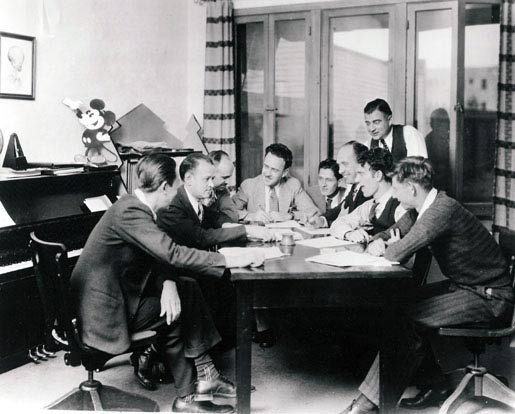
From left to right: Walt Disney, Carl Stalling, Ben Sharpsteen, Ub Iwerks, Les Clark, Burt Gillett, Johnny Cannon, Wilfred Jackson, and (standing) Jack King.