

'Van Nul Tot Nu'.
Co Loerakker is a Dutch illustrator and comic artist for books and magazines, most notably the children's titles published by Oberon/VNU, such as Bobo, Donald Duck and Eppo/Wordt Vervolgd. Mixing realistic depictions of animals and backgrounds with comical caricaturizations of humans, Loerakker became known for his nature drawings, large overview pictures and nostalgia to the classic Dutch village and countryside life. As a comic artist, his best-known work was the educational series 'Van Nul tot Nu' (1982-1987, 1994), made in collaboration with scriptwriter Thom Roep. The five-volume series provided a chronological overview of the history of the Netherlands, aimed at a juvenile audience. In the decades since its release, 'Van Nul to Nu' has been regularly used as a teaching tool in Dutch-language primary schools.
Early life and career
Co Loerakker was born in 1949 in Haarlem, into a family with nine children. Enjoying a happy childhood, Co and his siblings all enjoyed drawing, even creating their own cut-out houses and little people, that filled the entire room. As a child, his father often took him into the dunes, which trained his perceptive eye for specific plants and bird. Captivated, the boy skipped general children's literature and read his father's entire collection of books about nature. Even though he had been drawing avidly since his early childhood, he had no ambition to go to art school. He spent one afternoon at the Amsterdam Rietveld Academy, but didn't feel at ease between all the bearded, artistically-focused students that walked around there. Instead, he enrolled at the Vrije Universiteit Amsterdam, where he studied Geography. However, his passion for drawing people, animals, houses and Dutch landscapes eventually urged him to drop out of his studies and become a freelance artist in 1974. Feeling lost in the Dutch capital, he quickly returned to his birth town of Haarlem, settling in the city center. In terms of comics, he was inspired by the artwork of Marten Toonder's 'Tom Poes' and Albert Uderzo's 'Astérix'.


Book covers for 'De Grote Vivat' (1975) and 'Mijn Oom Theodoor' (1978).
Book illustrator
After some first drawings published in local papers and student magazines, Loerakker's first official assignments as a professional artist was illustrating the children's book 'De Grote Vivat' (Het Spectrum, 1975) by Mies Bouhuys. This poetically written book told the story of the prehistoric man Vivat, who lives long enough to experience the consequences of air pollution and mechanization firsthand. Loerakker's illustrations for the book even earned him the 1976 Henriette Roland Holst Prize for Dutch literature. In 1975, he also made the illustrations for Children's Book Week gift, 'Ogen op Steeltjes', by Jan Wartena. During these early years of his career, Loerakker quickly became known for his lively depictions of animals, illustrating informative books for the publishers Het Spectrum and J.H. Gottmer. However, the artist wanted to avoid being typecast as an animal artist, and explored several other genres. Inspired by Pieter Bruegel the Elder, he enjoyed making crowded pictures with lots of things to see, but also tried out fairy tale-like artwork, for instance illustrating a segment in the storybook 'De Kleine Heks' (Het Spectrum, 1978). For publisher Gottmer, Loerakker also illustrated several books by children's book writer Toon Kortooms, starting with the book 'Mijn Oom Theodoor' (1978), and then followed by 'Hallo, Tegenvoeter!' (1981) and the single-volume collection of the 'Dokter Angelino' series (1983).

Early work by Co Loerakker for Bobo, a spread about the weather (Bobo #7, 1977).
Bobo
In the mid-1970s, Loerakker became a prominent illustrator for the children's magazines of the VNU group and its comics division Oberon. During this period, he provided artwork and stories for the preschool children's magazine Bobo and illustrated a great many nature and picture books. In February 1977, he debuted in Bobo's magazine's pages with a series of illustrated spreads about the weather and the seasons. They were an early showcase of Loerakker's talent for nostalgic depictions of the Dutch countryside and village scenes. In 1978, his weather series was collected in book format by Van Holkema & Warendorf under the title 'Van Regen en Zonneschijn'. The artist's best-known work for Bobo was writing and illustrating the stories about the everyday life of Michiel van Gisteren and his peculiar family. After their publication in Bobo, the illustrated stories were collected in the books 'De Klup van Gisteren' (1979), 'Wij Zijn van Gisteren' (1980) and 'De Dag van Gisteren' (1981).

'De Klup van Gisteren' (Bobo #16, 1979).
Donald Duck
In 1975, Loerakker made his first illustrations for the Dutch Disney magazine Donald Duck. Of the many text stories he illustrated in the period 1975-1999, Allard Schröder's series 'Het Dagboek van een Kat' ("The Diary of a Cat", 1988-1992) stood out. In 1977, Loerakker had his own section in this weekly, called 'Elf Lage Landjes en een Heleboel Water'. Fully written and illustrated by him, sometimes with comic panels, the feature presented the eleven provinces of the Netherlands in a comical way. In 1981, Oberon collected the series in book format. From 1994 until his retirement in the early 2010s, Loerakker wrote and illustrated Donald Duck magazine's animal section 'Natuurtalenten'. The feature continued in the tradition of Theo Schildkamp's earlier animal paintings for the magazine, with each installment highlighting another animal species.
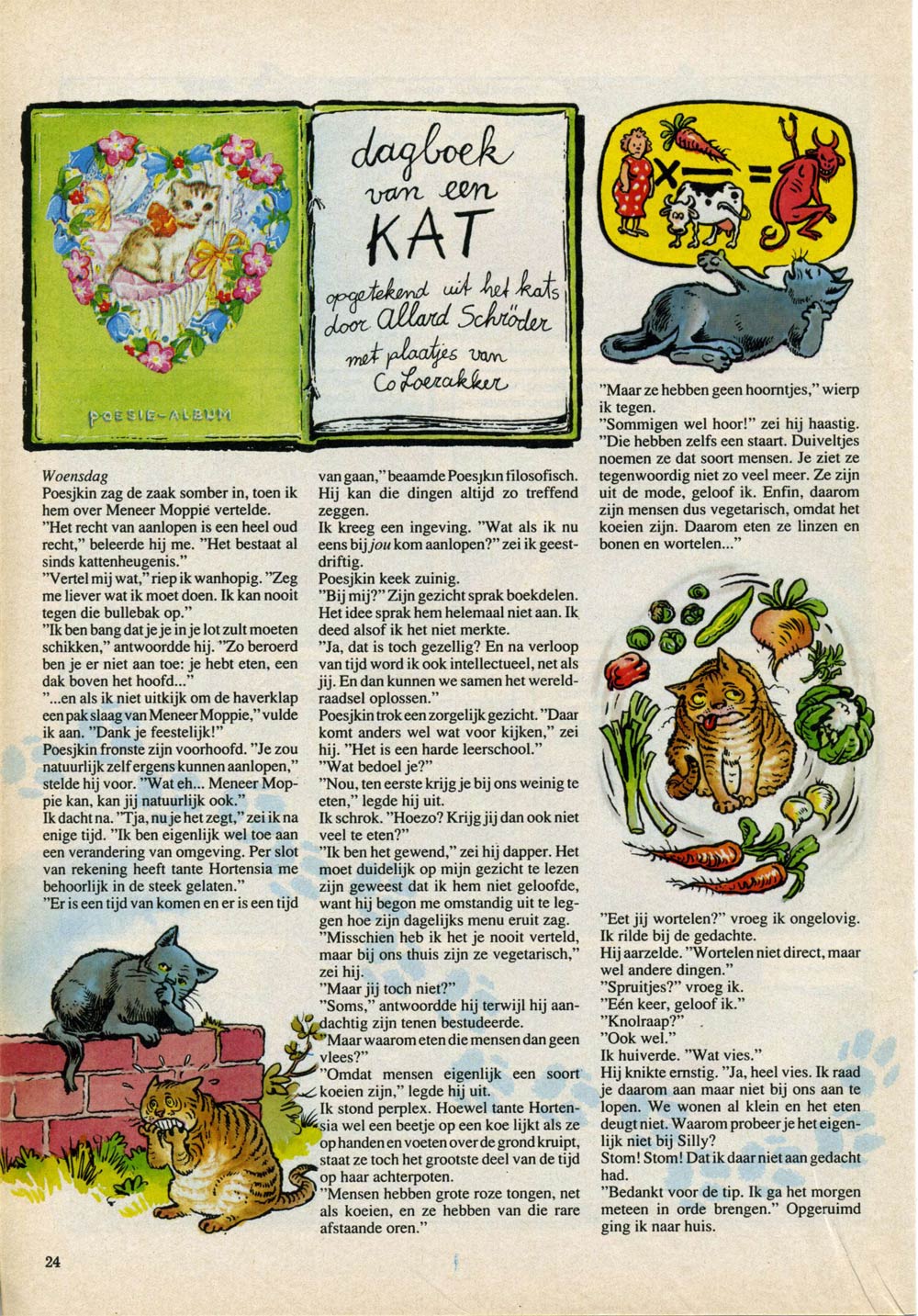
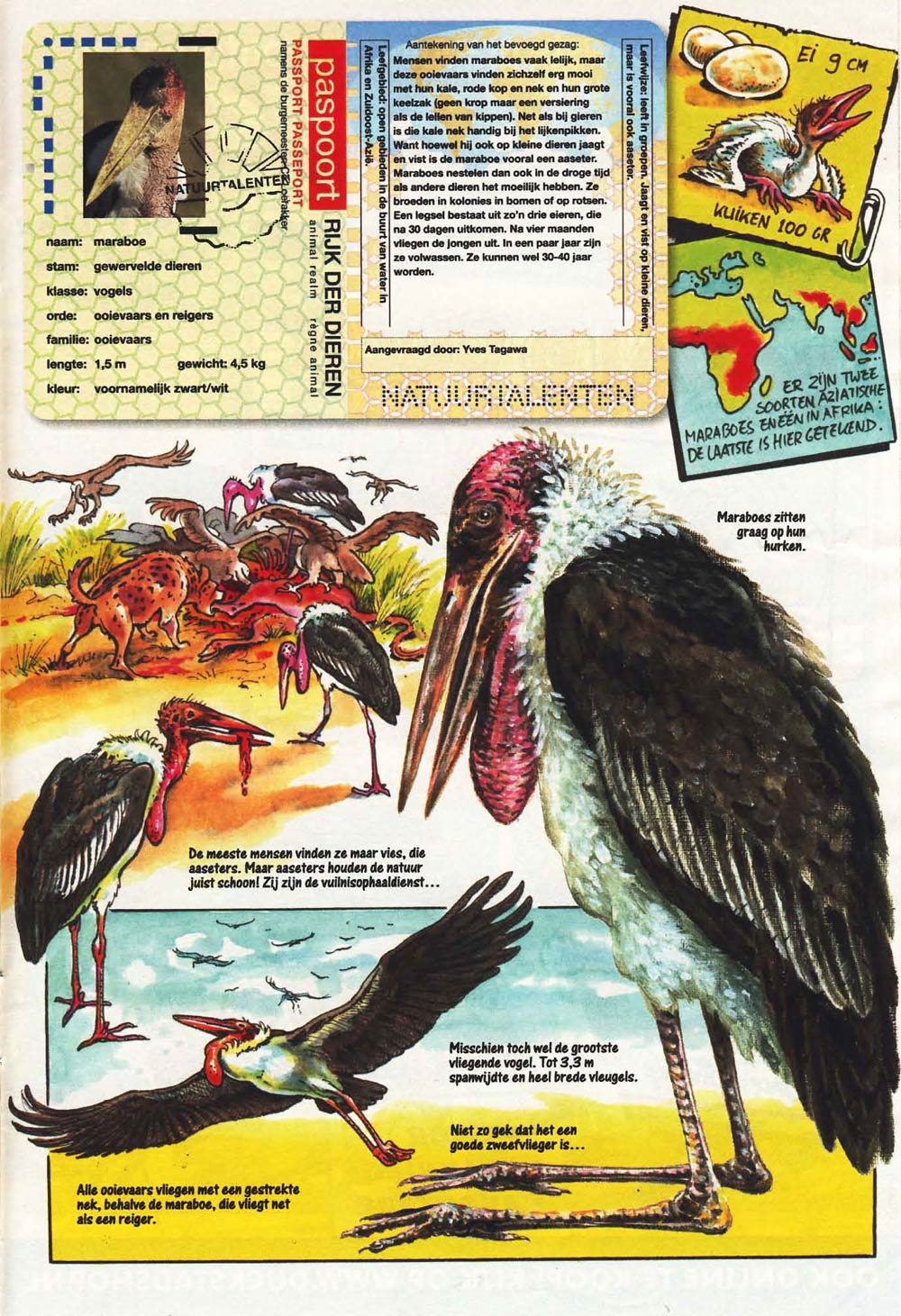
Illustrations for 'Dagboek van een Kat' (Donald Duck #32, 10 August 1990) and 'Natuurtalenten' (Donald Duck #22, 5 June 2010).
Van Nul tot Nu
Following 'Elf Lage Landjes', Donald Duck editor (and future editor-in-chief) Thom Roep felt that Loerakker would be the perfect artist to create a comic series about the history of the Netherlands for Donald Duck's target audience. Oddly enough, nobody in the Netherlands had ever created such a project before. There were a few historic predecessors, such as Jacob van Lennep and Pieter van Loon's illustrated picture story 'Tafereelen uit de Geschiedenis des Vaderlands, tot Nut van Groot en Klein' (1854). Between 1904 and 1906, Jan Feith made an illustrated history of the Netherlands using silhouettes, while Bertus Aafjes and Piet Worm created 'De Vrolijke Vaderlandse Geschiedenis' (1948), a humorous look at national history. But all were basically text comics focusing on a few key events.
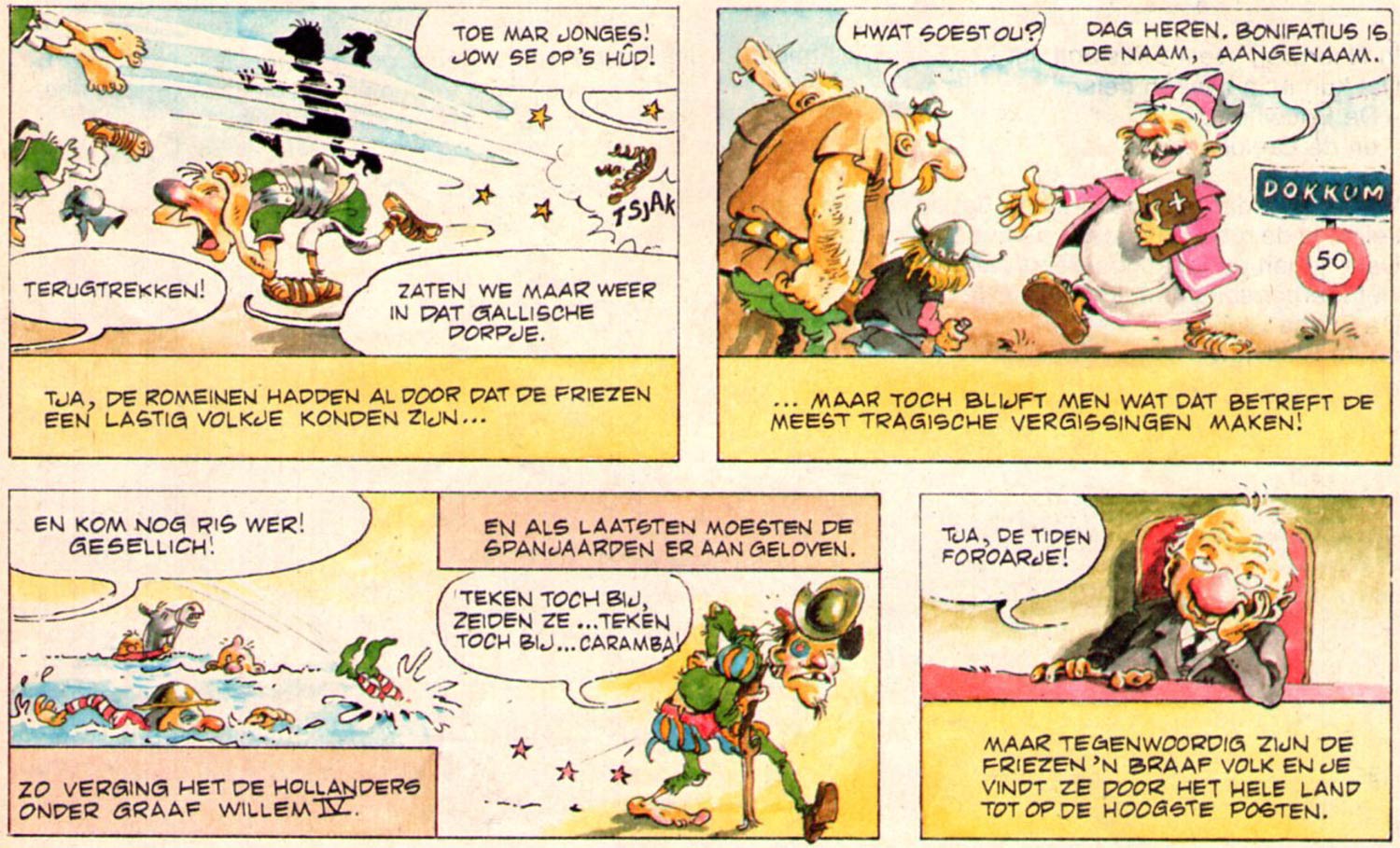
'Elf Lage Landjes' installment about Frisia (Donald Duck #48, 27 November 1979).Precursor to 'Van Nul Tot Nu'.
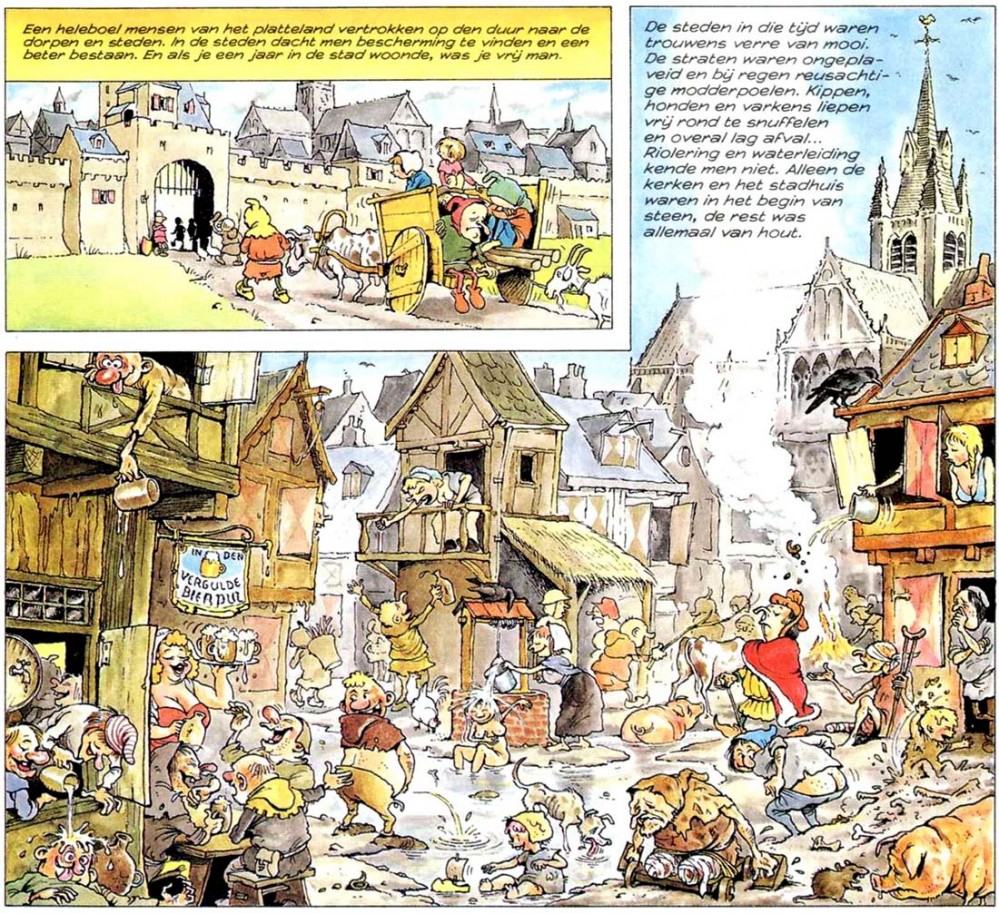
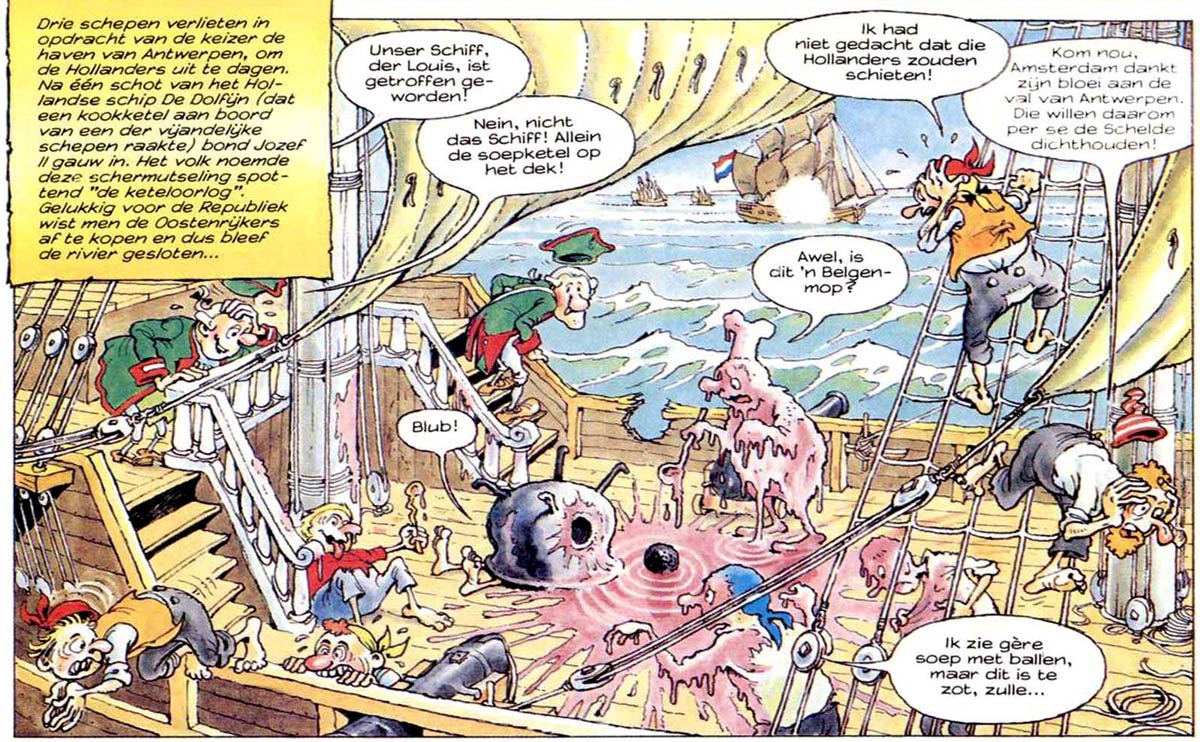
As a result, Roep and Loerakker had to look at other countries' comics to find a study-worthy example. The book 'L'Aventure des Belges' ('België in Beeld' in the Dutch translation, 1979) by Georges H. Dumont and Louis Haché told the history of Belgium in comic strip format, but Roep felt this effort was well-intended yet too dry in its writing and too static in terms of drawings. To appeal to young readers, their comic strip would need to be a lot more dynamic and offer room for some humor. Contrary to 'L'Aventure des Belges' - which was a text comic - Roep and Loerakker decided to make their series a balloon comic. Initially, chief editor Cees de Groot wasn't too keen on the idea, but after seeing a first page he changed his mind and greenlighted the project. The series was named 'Van Nul tot Nu' (literally: "From Zero to Now") and between 1982 and 1987 serialized in the Dutch Disney weekly Donald Duck.
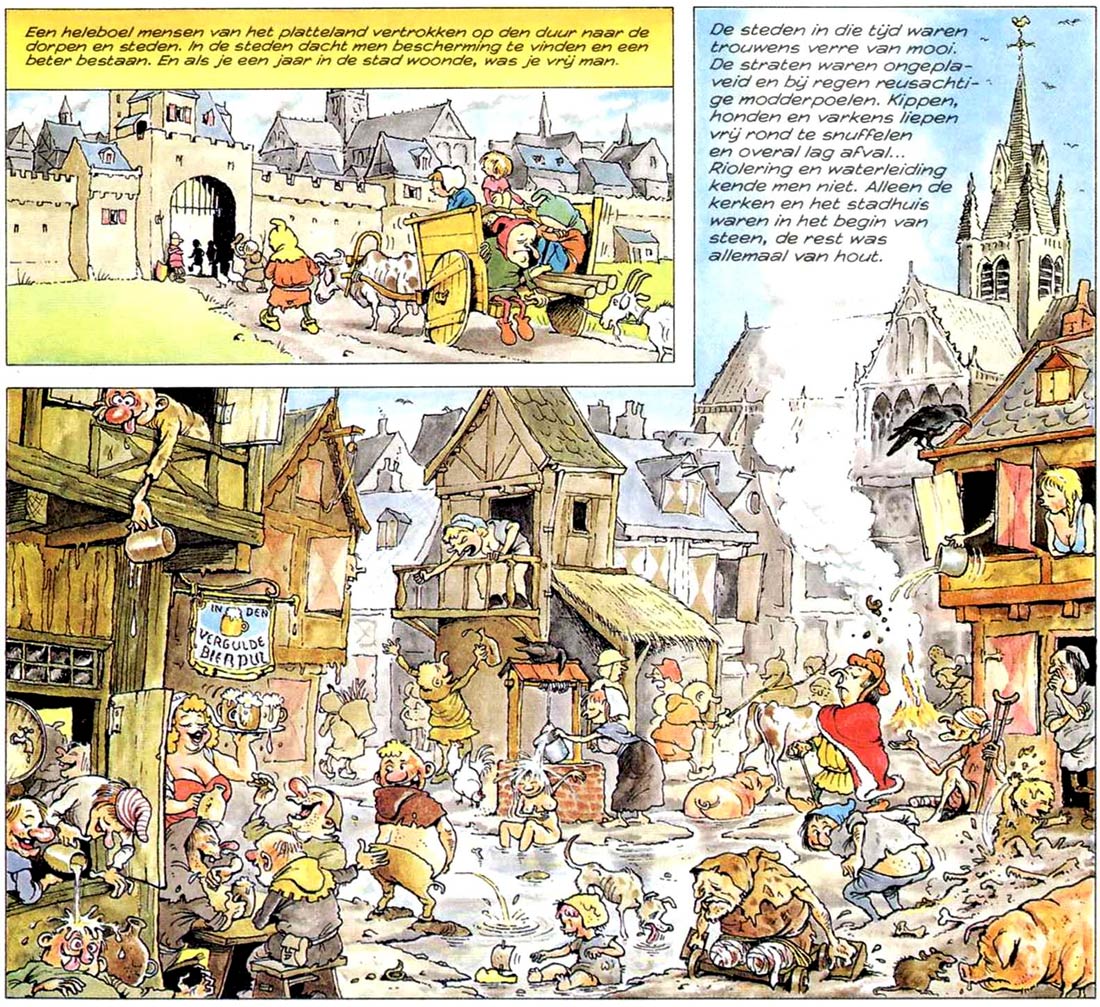
'Van Nul Tot Nu'.
Roep and Loerakker did a lot of research for 'Van Nul tot Nu'. They read various history books, while Loerakker gained access to the picture archives of the Haarlem-based publishing company De Spaarnestad, which owned thousands of photographs, copies and ancient engravings. They also checked out what kind of teaching methods were used in Dutch elementary schools. At the time, several Dutch schools used an experimental approach to teach history which didn't focus on chronological overviews but on overviews by topic, for instance: "transport throughout the ages" and "communication throughout the ages". Roep and Loerakker made a conscious decision to tell their comic book adaptation of Dutch history chronologically. First and foremost because this was how they learned it at school, but also to avoid giving children the exact same thematic history they already heard about in class. As it turned out, this decision showed clever foresight, because a few years later Dutch schools actually abandoned their thematic history lessons since pupils were unable to pinpoint in which century certain historic events happened. Several schools even started using 'Van Nul tot Nu' in class to repair the damage done. Roep even received requests from people from the United Kingdom, Denmark and the Dutch Antilles to do the same thing for their country's history. Two Dutch national institutions, airline company KLM and railroad company NS, asked the same thing.
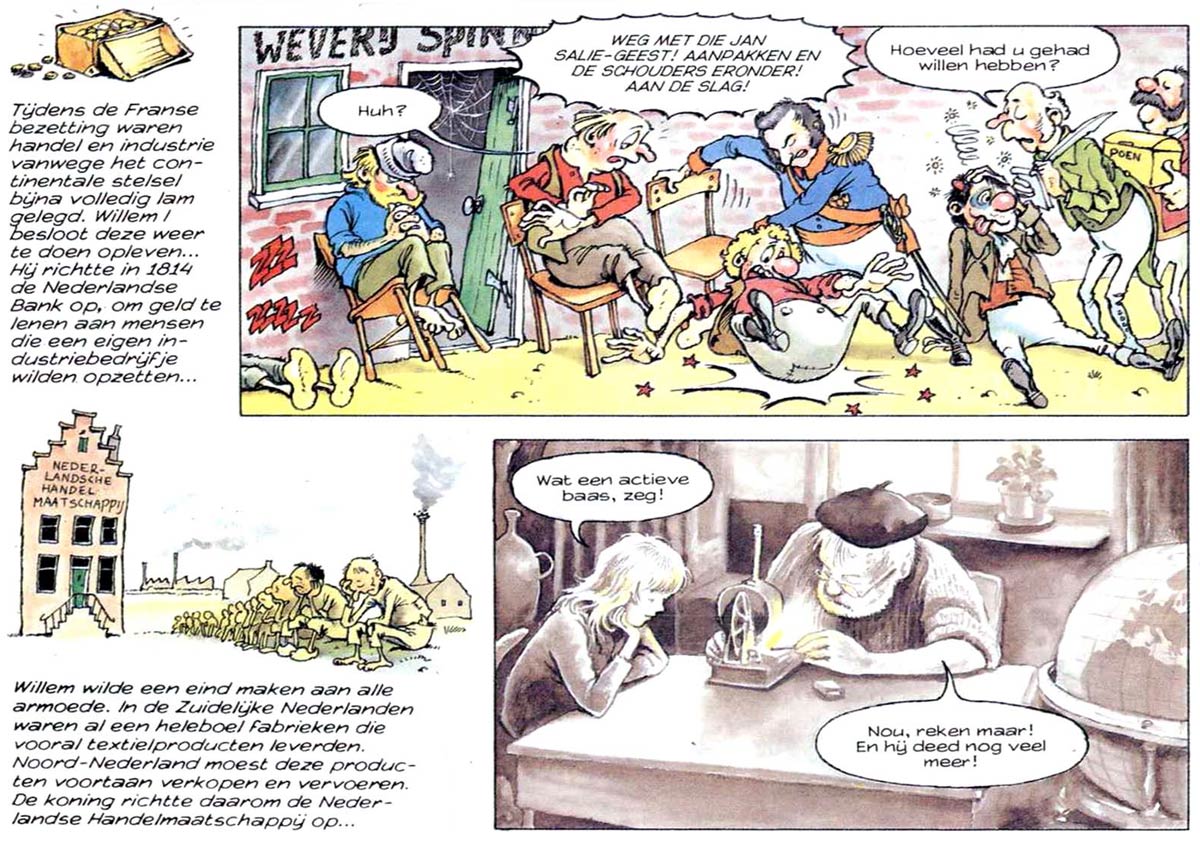
'Van Nul Tot Nu'.
Another way of distinguishing themselves from a schoolly approach was the use of comedy. Yet Roep was aware that children needed to be aware which things were actual facts and what was meant as a joke. He created a framing narrative set in the present time. It centers around a young girl, Ankie Verhagen, who receives private lessons in history from an old, sympathetic and wise man named Methusalem de Tijdt and who is strongly implied to be Father Time. The scenes between Ankie and Methusalem are mostly serious in tone and therefore drawn in a semi-realistic style. Everything he tells her are actual historical facts. The historic events themselves are drawn in a more comedic style, with several (visual) gags, corny puns and nods to other comic series like Carl Barks' 'Uncle Scrooge', Hergé's 'Tintin', Willy Vandersteen's 'Suske en Wiske', Morris' 'Lucky Luke', Martin Lodewijk's 'Agent 327', Reg Parlett's version of 'Billy Bunter' and René Goscinny and Albert Uderzo's 'Astérix'. That way readers could easily distinguish fact from fiction. The use of a narrator also made it possible to avoid coming across as an illustrated essay, which 'L'Aventure des Belges' essentially was. As Methusalem talked, Ankie could make remarks and ask questions, which kept a child's point of view in check. It was also a handy way of criticizing certain historical characters and events that had often been presented as heroic throughout the ages, but could use a little old of the traditional "Dutch soberness" when reflecting on their questionable deeds.
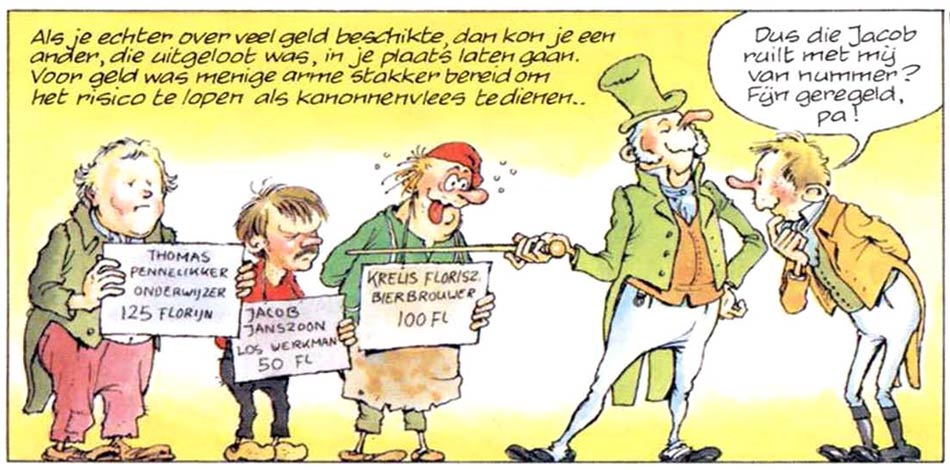
Thom Roep and Co Loerakker have cameos as Thomas Pennelikker and Jacob Janszoon in the second volume of 'Van Nul Tot Nu'.
The original series of 'Van Nul tot Nu' was published in four volumes by Oberon between 1984 and 1987, and later republished by Big Balloon. The first volume covers prehistory until 1648, the year of the Treaty of Münster, which ended the Eighty Years' War between Spain and the Netherlands. Roep attributed this overwhelming condensation of thousands of centuries' worth of history to their naïve idea that they could fit it all in one book. Luckily, readers responded so enthusiastically to the comic that their publisher saw no problem in completing the project with extra volumes. This made Roep and Loerakker take a slower pace to tell next centuries' events. The second volume covers all events from 1648 until the founding of the Dutch independent state in 1815. The next volume collects all Dutch history from that date until the start of the Second World War in 1940, while the fourth and final volume encapsulates the Second World War and the rest of the 20th century. This specific volume is notable for having more scriptwriting input by Loerakker, who was not only three years older than Roep but also more interested in this part of history. When the volume was updated and expanded in 1999 and 2003, Loerakker once again took over the majority of the script. He added more scenes about events in the late 1980s until the late 1990s and removed some timely dialogue. In 1994, a fifth volume came out, about the history of daily life. This collection of shorter, self-contained stories tells the history of food, houses, writing, crime and sexuality. Because Big Balloon had taken over the book publishing activities of Oberon, these installments were published in Big Balloon's magazine Sjors & Sjimmie Stripblad. Except for the history of sexuality, which had more mature content. The remaining pages were filled with two-page illustrations depicting various moments in history, including the Stone Age, Roman period, Middle Ages, baroque, the Industrial Revolution and our age. These drawings were originally published in Donald Duck and also made available as a calendar.
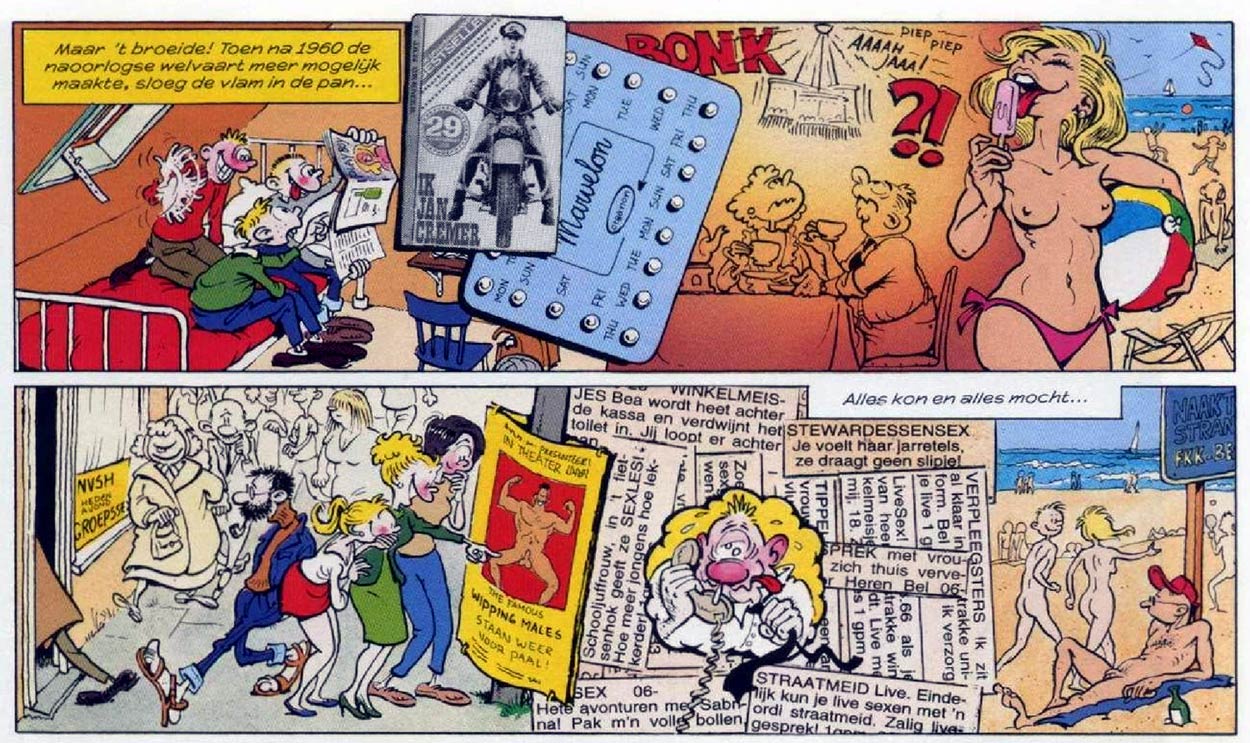
'Van Nul Tot Nu' special installment about sexuality (from: Van Nul Tot Nu #5). With a reference to Jan Cremer's novel 'Ik, Jan Cremer'.
While 'Van Nul tot Nu' met with a general positive reception and was a genuine bestseller, there were a few minor criticisms. Apart from predictable nitpicking from historic experts over certain visual details, there were also some religious people who objected to certain humorous scenes. Roep and Loerakker refused to change a scene where Martin Luther hits his thumb, while nailing his 95 theses against the church wall of Wittenberg. But they did change a line about Charles Darwin, implying that he "claimed" rather than "discovered" that man and ape have a common ancestor. These minor incidents aside, 'Van Nul tot Nu' is one of the few educational comics to be taken seriously by teachers. It has also set the standard for later educational comic books. Margreet de Heer has stated that her 'Discovery in Comics' series owes a lot to Roep and Loerakker's work. Skelte Braaksma, who makes comics about the history of the Dutch province Frisia, has also cited 'Van Nul tot Nu' as an influence. Strangely enough, the title and the lay-out of the two-volume book set 'Van Toen Tot Nu' (2013) is quite similar to that of 'Van Nul Tot Nu'. It was a joint production between Studio Stampij and Big Balloon, and contained artwork by Robbert Damen.
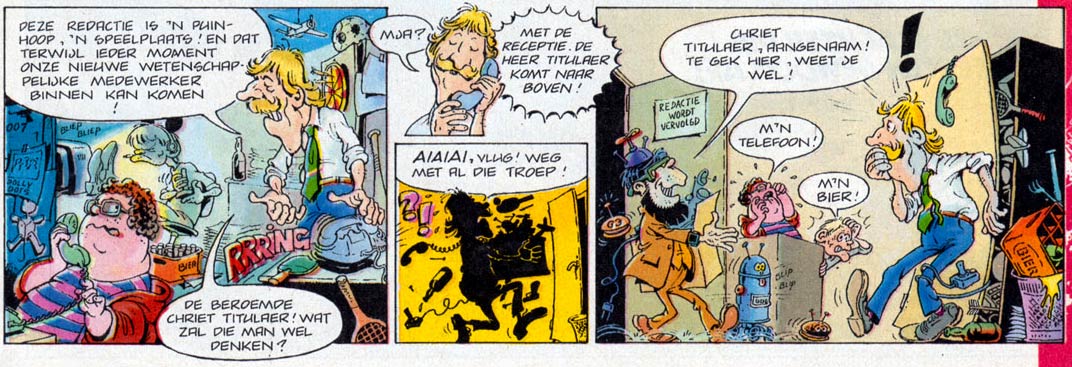
'Wondege Wegeld' strip for Eppo/Wordt Vervolgd (#1, 1985).
Later magazine work
Among Co Loerakker's other work for Oberon was the editorial strip in Chriet Titulaer's section about science and technology, 'Wondege Wereld', in Eppo Wordt Vervolgd (1985-1988). Written by Piet Zeeman, the strip not only starred the Dutch astronomer and popular science writer, but also chief editor Peter van Leersum and characters from other comics. During the 1990s, Loerakker was also an illustrator for the popular science magazine Kijk. Most of his later output has remained dedicated to Donald Duck. Co Loerakker has been retired since the early 2010s.

Self-portrait of Co Loerakker (right), with Thom Roep (left).