

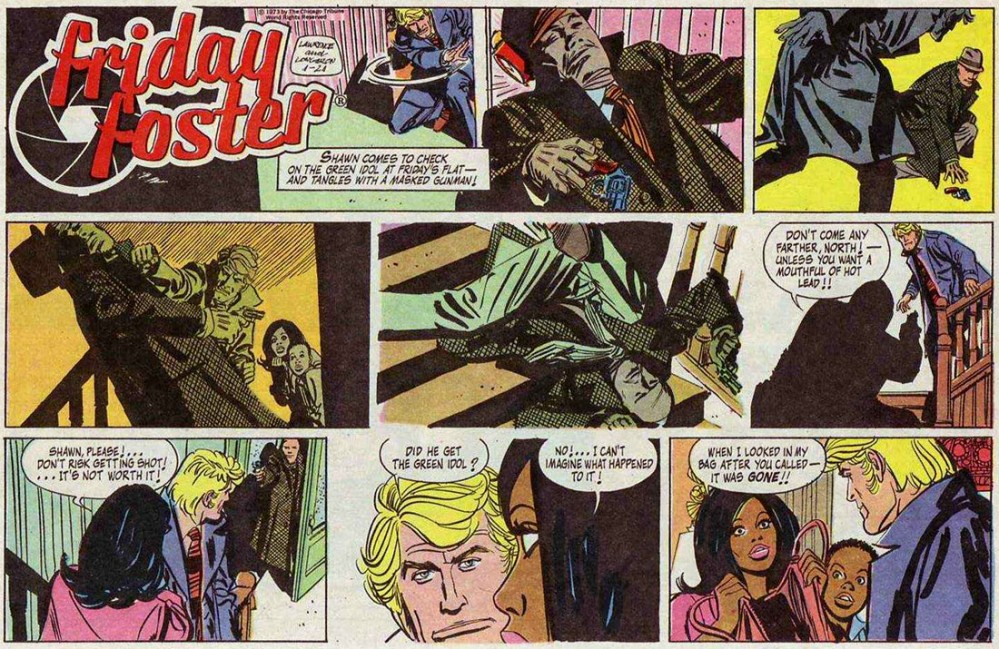
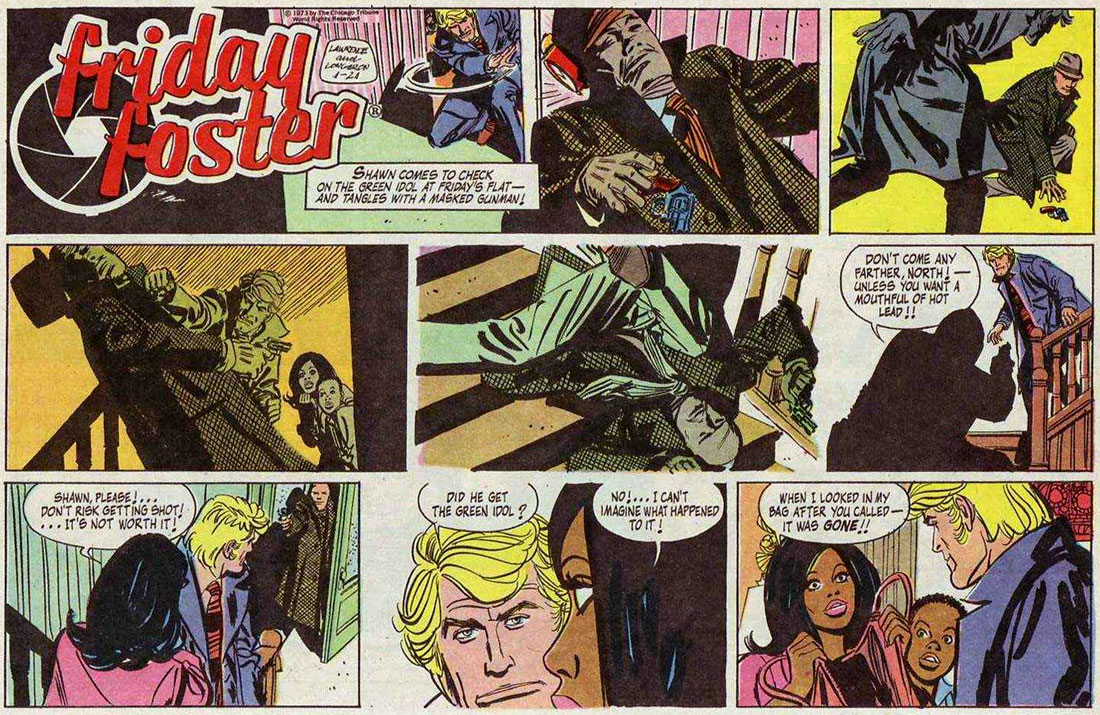
'Friday Foster' (24 January 1973).
Jordi Longarón was a Spanish comic artist, book cover illustrator and painter, mostly known in the USA as Jorge Longarón. In his home country, he worked on children's magazines as well as several digest-sized war and western comic books, mostly for publisher Toray. From the 1950s on, he did agency work for international publishers, contributing to the British romance comic magazines and war-themed anthology series of publisher Fleetway, and making illustrations for Swedish women's magazines. With writer Jim Lawrence, he created the groundbreaking American soap opera newspaper comic 'Friday Foster' (1969-1974), starring an African-American woman active in the world of fashion. A large part of Longarón's career was dedicated to making book cover illustrations for a variety of international publishers.
Early life/Children's comics
Jordi Longarón i Llopart was born in 1933 in Barcelona, Spain. He got interested in drawing comics through Jesús Blasco's 'Cuto' strip and the work of US masters like Milton Caniff, Alex Raymond and Frank Robbins. He started his career as a commercial illustrator, and, at age 15, made his debut in the Spanish comic industry. He initially contributed to fairy tale/storybook collections aimed at children, such as 'Cuento de Hadas' (Fabregat/Emege, 1948), 'Cuentos de la Abuelita' (Toray, 1949) and 'Azucena' (Toray, 1950). He also contributed to Toray's children's magazines Chispa and Garabatos. For the first, he made the feature 'Arsénico Lupin' (1948), spoofing the popular gentleman-thief character Arsène Lupin by novelist Maurice Leblanc. For the latter, he created the humor feature 'Chan-Chu-Llo' (1950-1951).
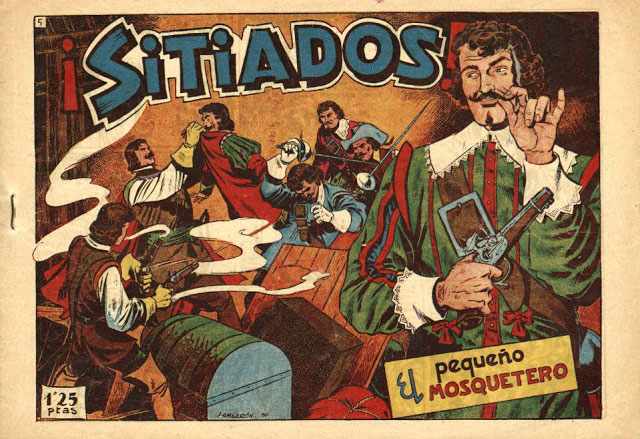
'Sitiados'.
Editorial Toray
Throughout the 1950s and 1960s, Jordi Longarón continued to work for the mainly landscape format-shaped comic books published by Ediciones Toray in Barcelona, training his skills under the company's lead artist Boixcar. He drew stories in several genres, but was a longtime regular for the publisher's war title 'Hazañas Bélicas' (1950-1958). With writer Salvador Dulcet, he made the well-documented 21-issue historical comic book series 'El Pequeño Mosquetero' (1951), about a musketeer during the reign of the French King Louis XIII. Laterin the decade, he was the artist for the twelve issues of. Other Toray titles that featured Longarón interior art were 'Selecciones de Aventuras' (1950), 'Brick el Indomable' (1951), 'El Mundo Futuro' (1955) and 'Hombres de Accion' (1959). He additionally drew issues for the buccaneer comic book 'El Caballero Negro' (1950), published by A. Fabregat.
By the late 1950s, Longarón was promoted to Toray's cover artist, painting the covers for 'Narraciones y Aventuras de Davy Crockett' (1958-1959), and digest-sized collections as 'Hazañas Bélicas' (1961-1967), 'Hazañas del Oeste' (1962-1965), 'Sioux' (1964-1969), 'Novelas Gráficas Clásicas' (1960), 'Salomé' (1962) and 'Relatos de Guerra' (1963). For the war title 'Hazañas Bélicas', he also notably created the cover logo.
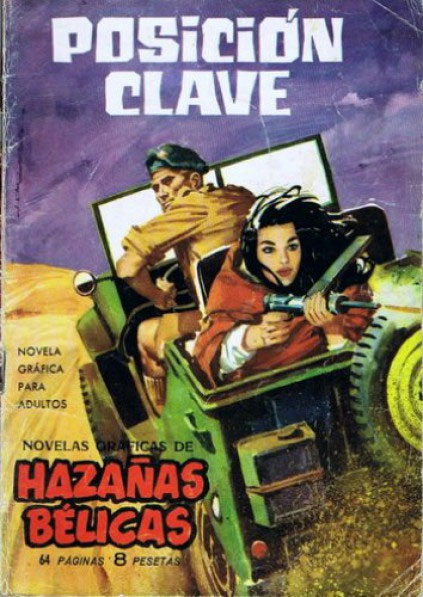
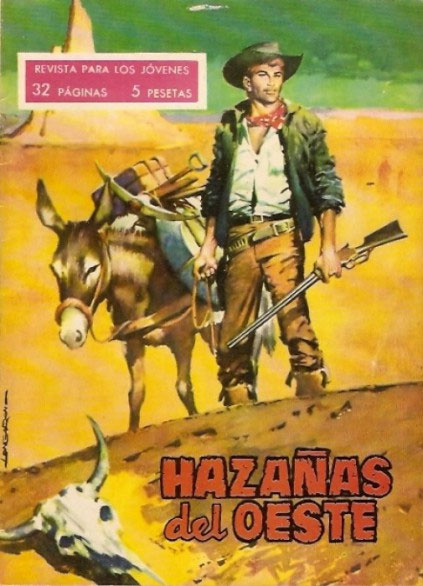
'Hazañas Bélicas' and 'Hazañas del Oeste'.
Selecciones Ilustradas
Like many of the Spanish comic artists of his generation, Jordi Longarón gradually switched to doing agency work for international publishers. By 1956, he was associated with Josep Toutain's Selecciones Ilustradas, and, together with José María Miralles, largely responsible for the typically Spanish drawing style which dominated the British romance comics throughout the 1960s. In the period 1957-1967, his art appeared in Fleetway's romance titles Valentine and Roxy, for which he drew short stories based on popular songs by Elvis Presley, Tommy Steele and other singers from that era. He additionally worked for similar titles, such as Marilyn and Serenade. Longarón's skills as a cover painter were much in demand, as he contributed frequently to the war anthology series 'Commando', 'Battle' and the 'War Picture Library'.
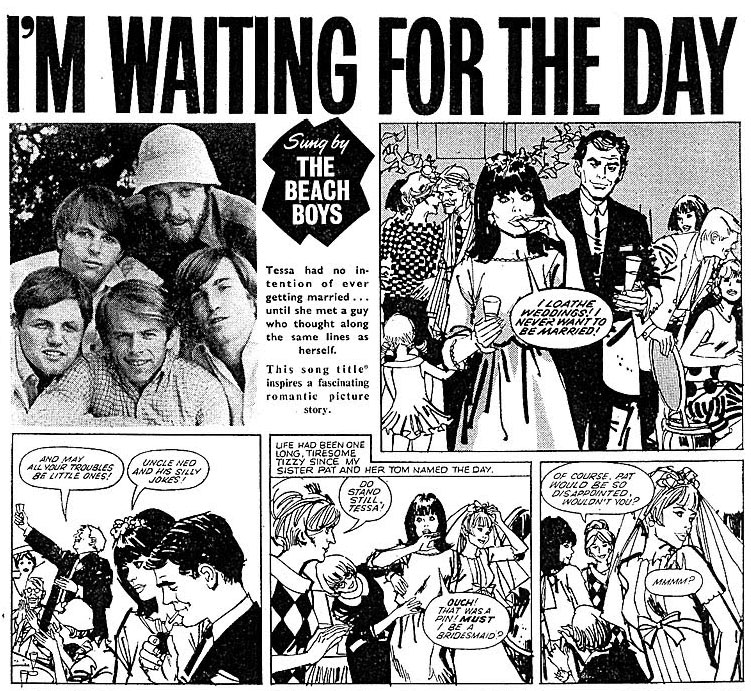
'Valentine', 29 October 1966.
Bardon Art
By the mid-1960s Longarón moved over to Bardon Art, an agency operated from both Barcelona and London. By then, he dropped his comic book work and made mostly illustrations for Scandinavian women's magazines. In 1964, his longtime association with the French publisher Gerfaut started. Over the next two decades, he created over 500 cover illustrations for the publisher's war and espionage paperbacks. In the late 1960s, he returned to the comics medium, when he was asked to illustrate the American 'Friday Foster' newspaper comic for the Chicago Tribune Syndicate.
African-American comic book characters
In 1968, veteran comic writer Jim Lawrence ('Joe Palooka', 'Captain Easy') noticed that U.S. comics only featured white male characters in starring roles. Female African-American characters weren't totally absent, but over the decades they usually were nothing more than side characters and, to add insult to injury, stereotypes, like the "mammy" housemaids Bella Donna in Arthur Momand's 'Keeping Up With the Joneses' (1913-1918) and Rachel in Frank King's 'Gasoline Alley' (1918- ). A notable exception had been 'Torchy Brown' (1937-1940), which starred a positive depiction of a black female character and was drawn by an actual African-American female cartoonist, Jackie Ormes. But 'Torchy Brown' had only a limited circulation since many U.S. newspapers didn't dare to run it and so remained rather obscure. Around the same time, Robert Crumb created a few comics starring a satirical portrayal of an outdated black female African native stereotype named Angelfood McSpade (1968), but these appeared only in underground magazines and on an irregular basis.
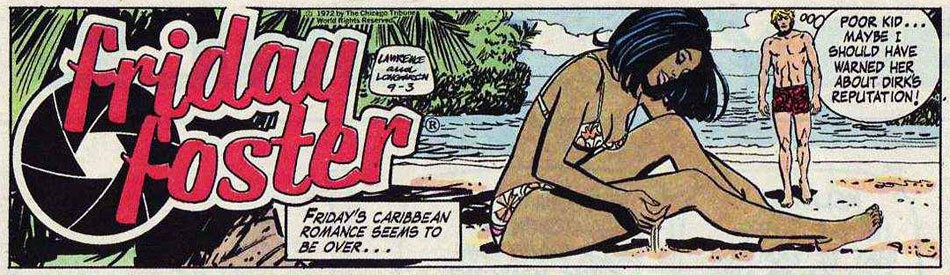
'Friday Foster' (3 September 1970).
Lawrence wasn't the only one who felt that more African-American female protagonists were needed. The Chicago Tribune-New York News Syndicate had already created a 1968-1972 newspaper comic by Roy Doty based on the popular TV sketch show 'Rowan Martin's Laugh-In', which occasionally featured African-American side characters. But this was more of a stand alone gag-a-day comic. The syndicate asked Lawrence to develop a serialized comic strip with a continuous narrative starring an African-American character which. In search for a proper artist, Lawrence contacted Bardon Art and selected Jordi Longarón for the job. When Longarón traveled to New York City to sign his contract, Lawrence took the opportunity to take him to the Harlem neighborhood to photograph the streets for documentation. To avoid trouble, a police officer advised them to take these pictures from inside a taxi. Longarón also collected a lot of U.S. magazines with neat photographs and articles about the African-American community.
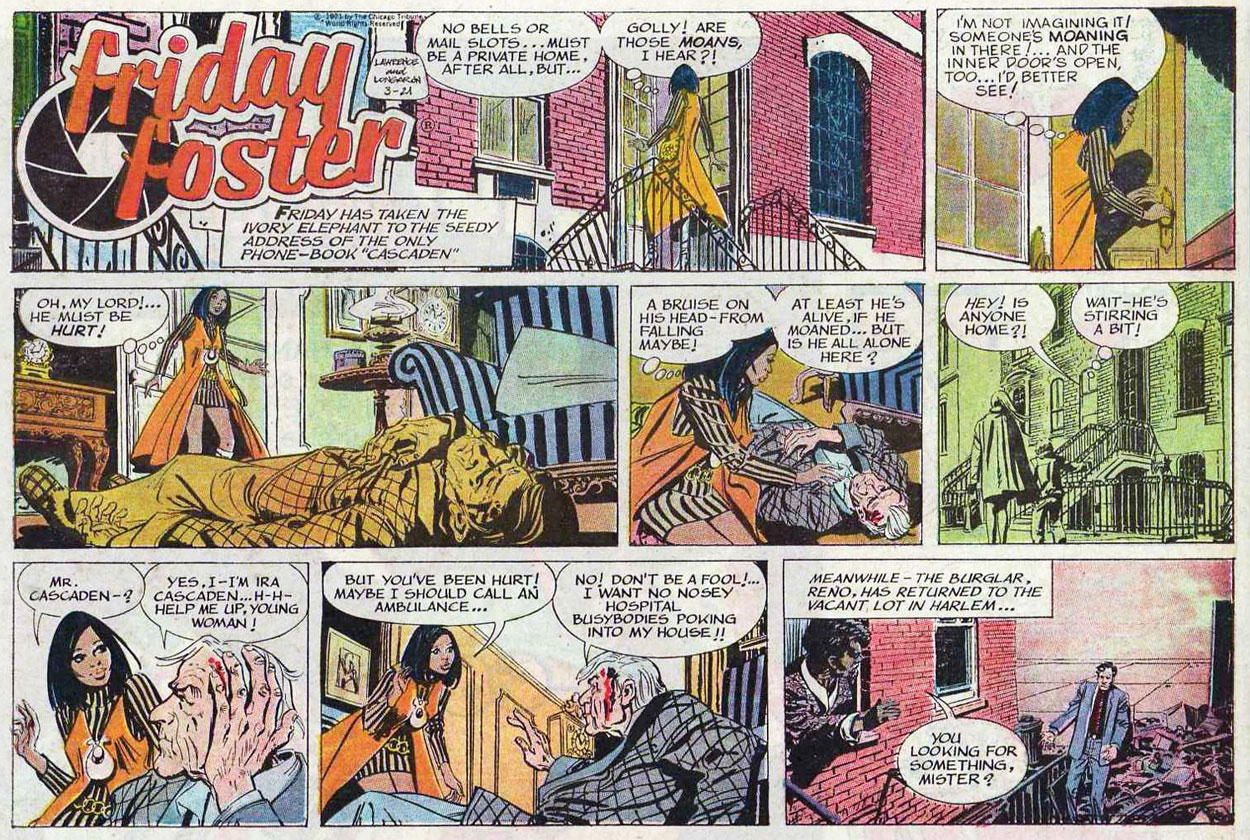
'Friday Foster' (21 March 1971).
Friday Foster
Designing the protagonist was another difficult task. Longarón couldn't rely on previous African-American female comic characters, because most were drawn as racial stereotypes. Even though many black women wore Afro haircuts at the time, the artist didn't want their protagonist to sport one, since it would again look too stereotypical. During a broadcast of a TV interview he noticed Donyale Luna, the first black supermodel, who gained some fame as an actress in arthouse movies like Federico Fellini's 'Fellini: Satyricon' (1969) and the underground films of Andy Warhol. As Luna had straight hair, he gave his comic strip protagonist this coupe. She received the name Friday Foster and on 18 January 1970 her first adventure went into newspaper circulation. Allthough this first African-American female comic character broke new ground, there were still some newspapers in the U.S. South that refused to run the series.
Friday Foster is an African-American fashion photographer, who, as an assistant to white photographer Shawn North, worked her way up from a harsh youth in the Harlem district of New York City. She eventually became a fashion model herself, traveling all over the world and finding the man of her dreams. 'Friday Foster' was drawn in a realistic style, with Longaròn spending much detail in his backgrounds, particularly when Friday visited cities like London, Paris, Hong Kong or Africa. The writing of Jim Lawrence was comparable to a romantic soap opera. Interviewed by David Moreu on 17 January 2015 for the website museumofuncutfunk.com, Longarón only remembered one instance of censorship. In a particular episode, Shawn Forth travels to Harlem, where a black teenage gang threatens him with a knife. The syndicate removed the weapon, making many readers wonder what was actually going on in this scene. In the same interview, the cartoonist remembered receiving praise from the director of the Metropolitan Museum of Art for depicting the museum in the series. Pop singer Tom Jones once requested to buy an original panel, as he was given a cameo in one episode.
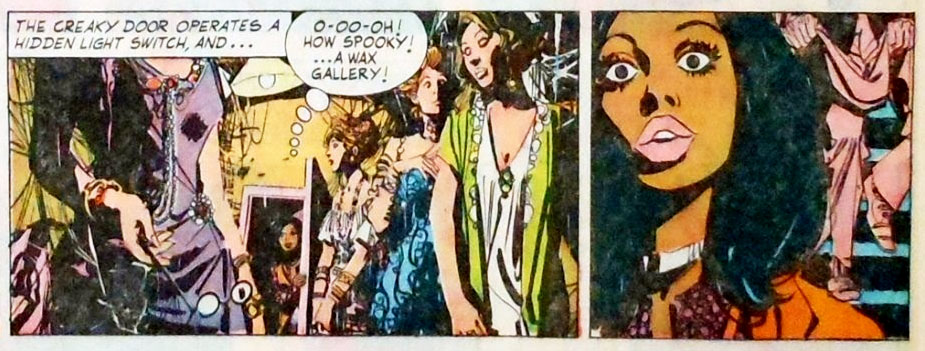
'Friday Foster' (18 April 1971).
Collaboration with Lawrence and other artists
For three years, Jordi "Jorge" Longarón and writer Jim Lawrence maintained their long-distance professional collaboration. Lawrence wrote his scripts in New Jersey, after which Longarón turned the mailed-in written pages into full-blown newspaper comic panels from his home in Spain. Delays in the delivery sometimes caused him to fall behind with his deadlines. With help from fellow artists Alfonso Font and Victor Ramos Santos, he sometimes made it, but when the pages didn't arrive in the USA on time, the Chicago Tribune called in help from U.S. cartoonist Frank Springer (best known for 'Phoebe Zeit-Geist') to ghost a few episodes.
Tying in with the newspaper strip, a one-shot comic book issue of 'Friday Foster' by Dell Comics (October 1972), written by Joe Gill and drawn by Jack Sparling. By late 1973, the series lost popularity and Longarón's interest. In December 1973, he was succeeded by Gray Morrow, who received assistance from Howard Chaykin and Dick Giordano. Nevertheless, in May 1974 the 'Friday Foster' strip was canceled.
Movie adaptation
Although 'Friday Foster' was terminated in 1974 and no longer as popular as it used to be, it still inspired a movie adaptation a year later. Arthur Marks, best known for blaxploitation pictures like 'Detroit 9000' (1973), directed a 1975 'Friday Foster' film, starring Pam Grier, Eartha Kitt and Scatman Crothers. The picture added a crime narrative with sleazy violence and eroticism, all a far cry from the comic strip's original tone and set-up. The movie flopped at the box office and has faded away into obscurity since. Longarón once watched the movie, but only liked Pam Grier as the casting choice.
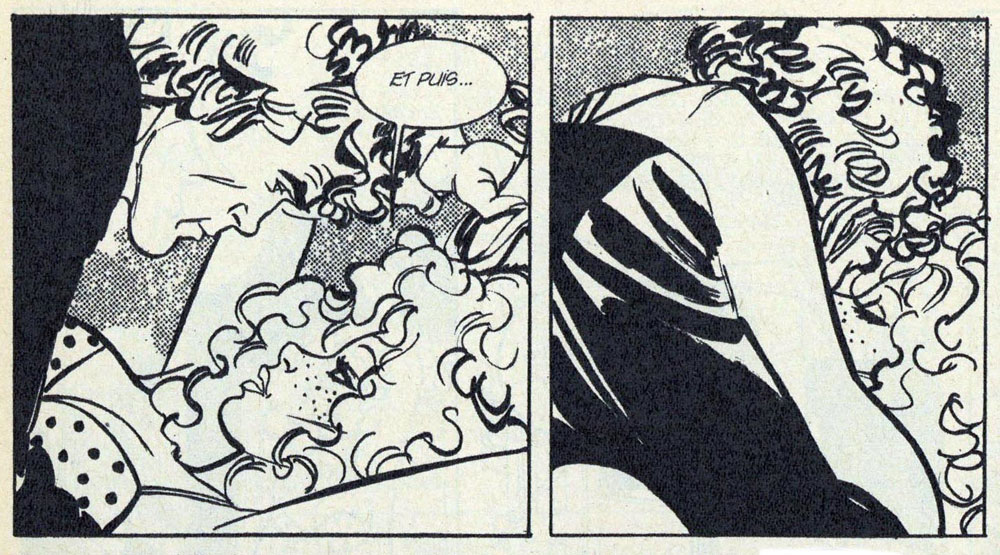
'Fourre-Tout et Cie' (Pilote Mensuel #5, 1974).
Later career
After quitting 'Friday Foster', Jordi Longarón appeared in the French magazine Pilote Mensuel with two short stories of 'Fourre-Tout et Cie' (1974, 1977), written by Victor Mora, and another one-shot story, 'Ronde de Nuit' (1975), written by François Truchaud. Through the Norma agency, Longarón continued to make cover illustrations for publishers in the USA (Signet), France (Gerfaut), Germany (Pabel, Bastei), the UK (Sphere), Scotland (DC Thomson) and Italy (Mondadori). Between 1979 and 1990, he notably illustrated the covers of fantastic and historical novels published in Italy by Mondadori for the collections 'I Romanzi' and 'Biblioteca dei Romanzi', and additionally worked on many German crime, horror and western pulp books. He also illustrated the covers of Jim Lawrence's mid-1970s series of novels about 'Dark Angel', an attractive African-American woman inspired by Friday Foster. In Spain, his illustrations based on western themes graced the covers of magazines like Cimoc, Dossier Negro, Bluejeans, Bumerang and Hunter. His last comic strip was the 'Sherlock Holmes' adaptation 'Une Étude en Rouge' (1995) by writer Sylvain Ricard, published in France by Éditions Joker and in Germany by B&L.
Final years and death
In 2007, Jordi Longarón made his final commercial assignment. By then, he had already shifted to painting, specializing in depictions of the Catalan countryside, U.S. South-West and nudes. For his entire body of work, Longarón received the 2011 Grand Prix of the Saló del Còmic de Barcelona. This would be the only comic award in his career. Jordi Longarón passed away in Barcelona in 2019 at age 86.
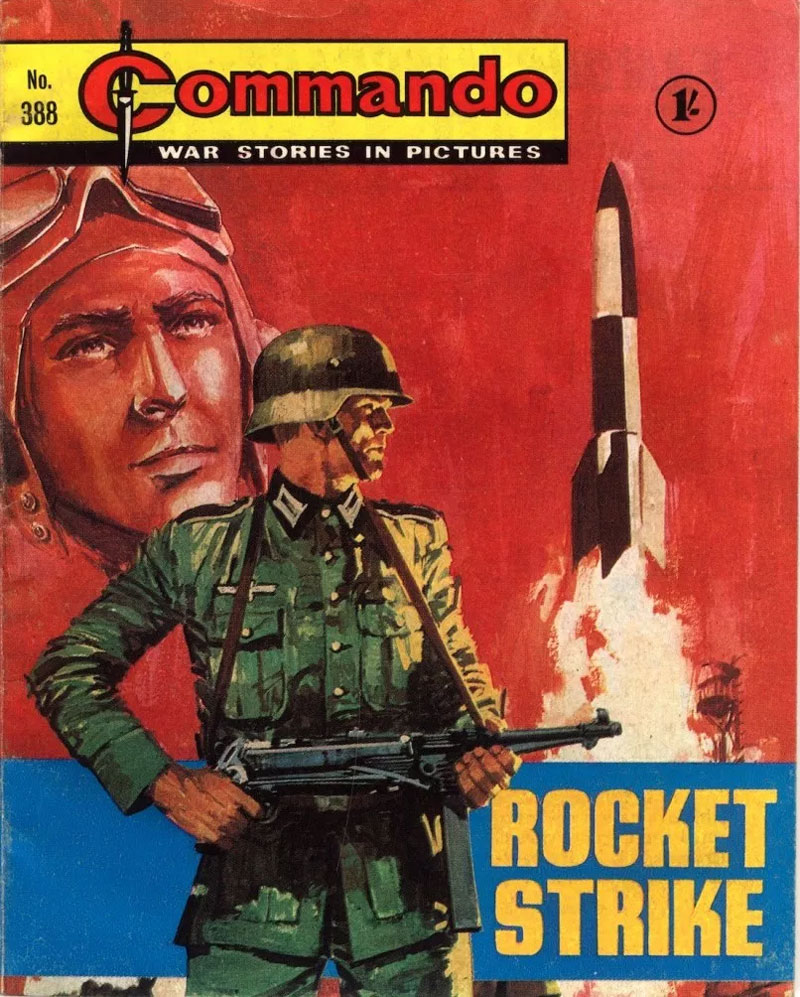
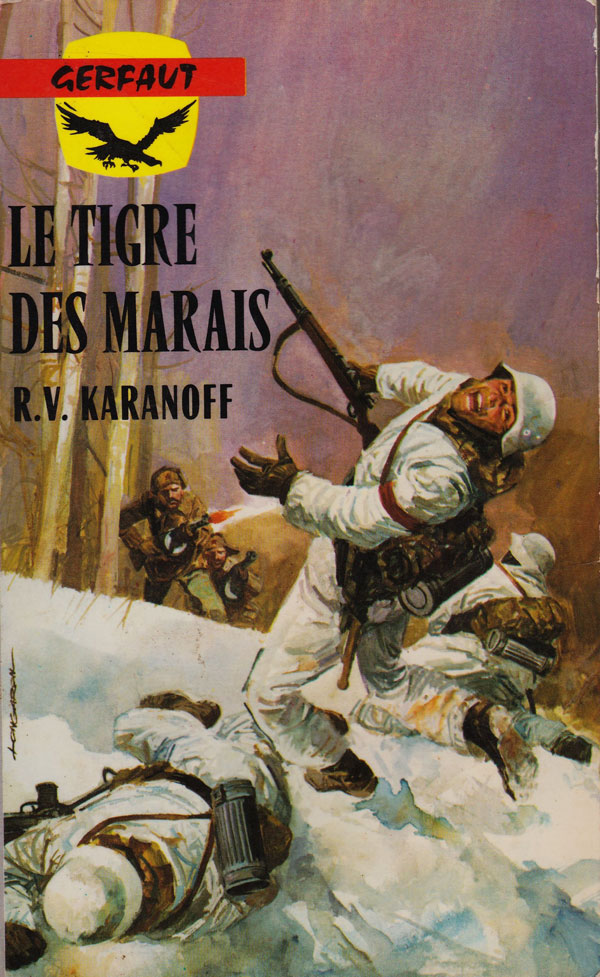
Cover illustrations for Commando and 'Le Tigre des Marais'.