


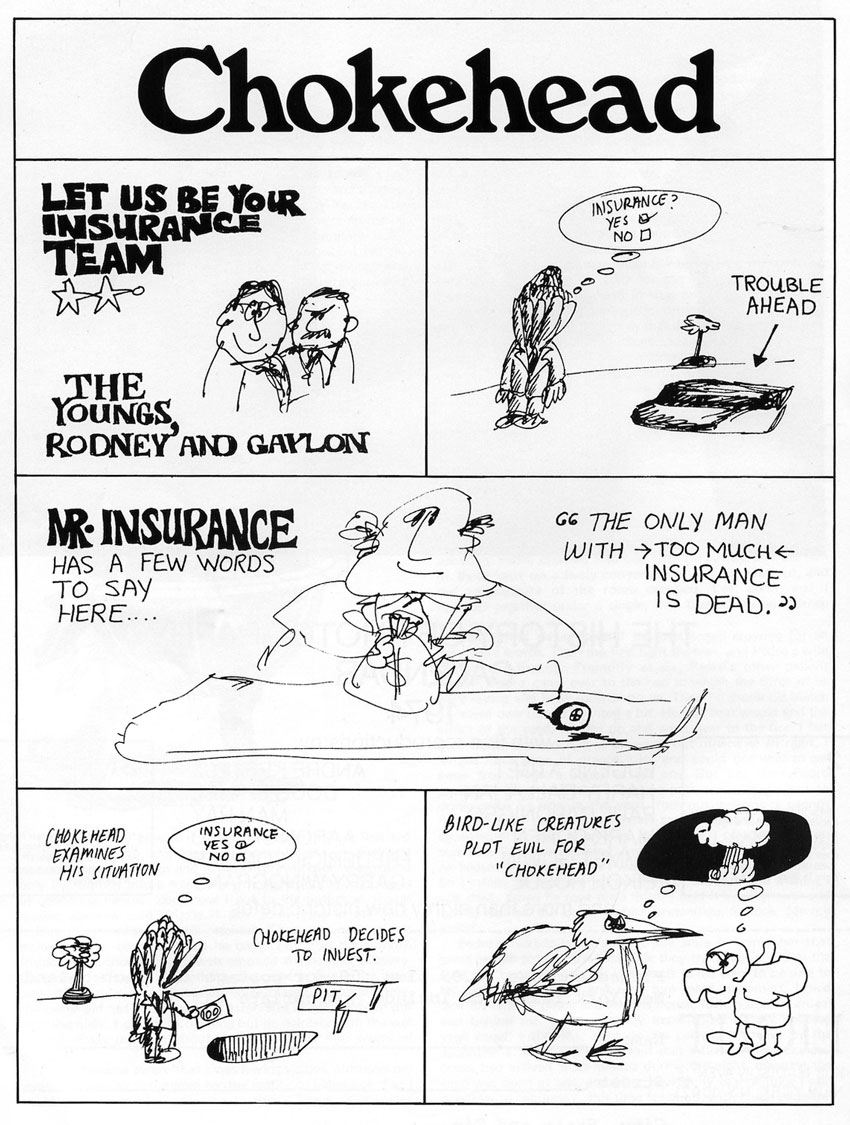
'Chokehead', from The Real World.
David McClelland was an American cartoonist and writer, whose work combined humor with a stong social and ecological engagement. During his short life and work, he was a contributor to his university magazine, before becoming a regular in the pages of The National Lampoon and The Real World.
Early life and career
David C.K. McClelland was born in 1947 in Detroit, Michigan as the son of a businessman and a housewife. His father was a great music lover, who knew many jazz musicians during his lifetime; his mother was an amateur singer and devoted art lover. His maternal great-uncle was the water colorist and photographer Thomas Morrison Marker (1901-1978), whose works are in the Cleveland Museum of Art and other museums. McClelland's maternal grandmother Janet Marker Kiskadden was a singer, poet, and composer of a number of works for voice and piano. All three McClelland siblings pursued careers in art. While David ventured into cartooning, his brother Tim became a noted jeweler and designer, and his brother William a composer and pianist. In 1969, David McClelland graduated summa cum laude from Harvard University with a B.A. in Celtic Languages and Mythology and Folklore.
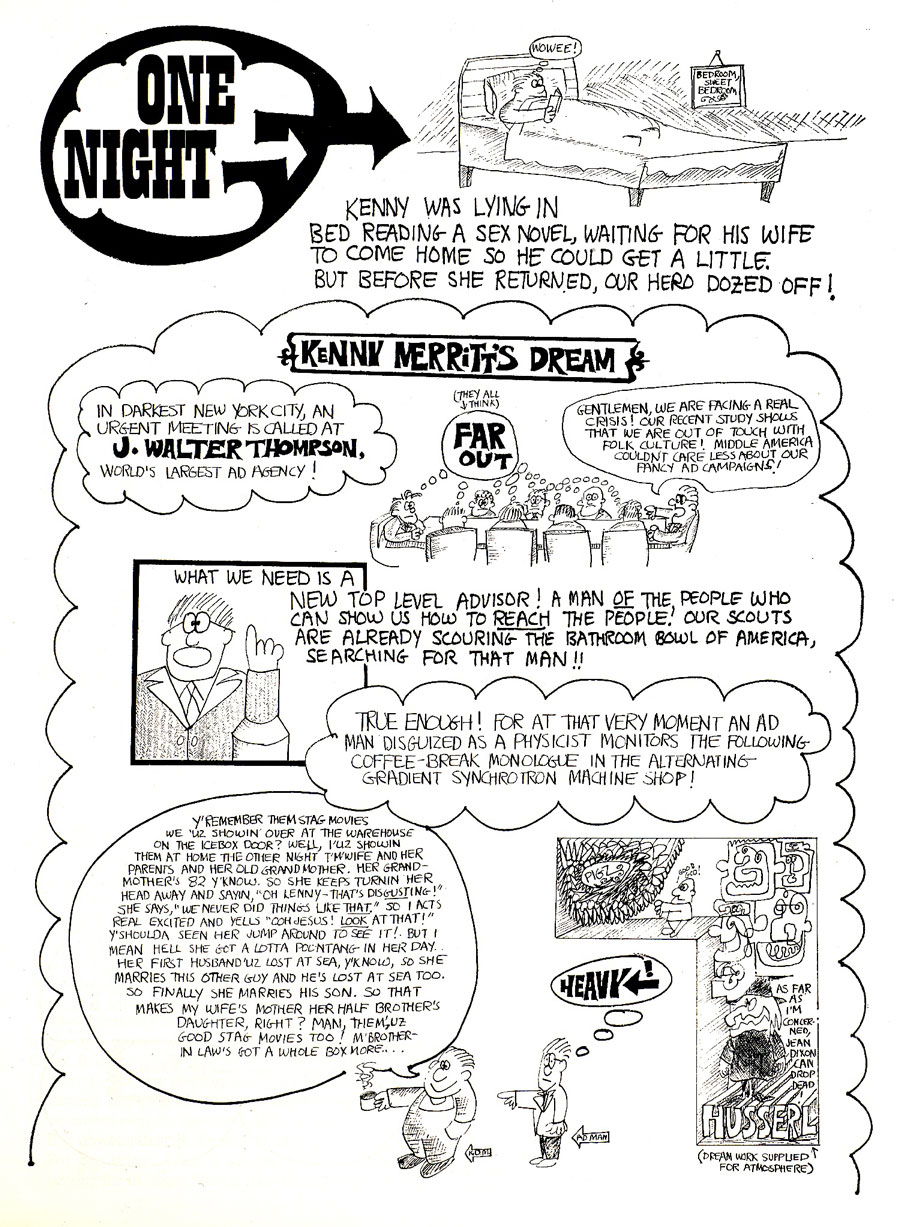
'Kenny Merritt's Dream' (The Harvard Lampoon).
As a cartoonist, McClelland had many influences, including George Herriman, Walt Kelly, Walt Disney and his artists, and Don Martin of Mad Magazine. As a humorist, he was inspired by the comedians Jonathan Winters, Ernie Kovacs, Soupy Sales, Ken Nordine, Bob & Ray and many others.
Cartoonist
At Western Reserve Academy in Hudson, Ohio, David McClelland was the staff cartoonist for his high school newspaper, The Reserve Record. While studying at Harvard between 1965 and 1969, he made many comics and covers for The Harvard Lampoon, the university's humor magazine. While still at Harvard, he also published a number of sequential comics in Grump Magazine, published by Roger Price in the period 1965-1967.
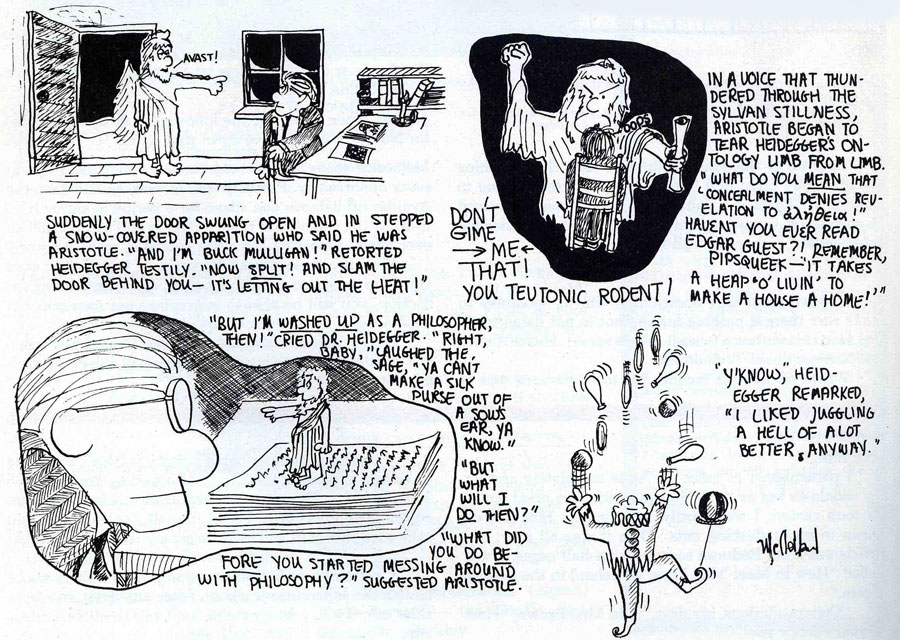
'The Adventures of Martin Heidegger', from Grump Magazine.
After graduating from college, McClelland moved to New York City, where he began contributing cartoons to National Lampoon, starting with the magazine's first issue in April 1969 and continuing in many subsequent issues. Most of his works were humorous, but many had a serious edge, such as his July 1970 'Ecolo-Bummer' piece in National Lampoon, which commented on ecology and the environment. Other comics were parodies of the philosopher Martin Heidegger and artist Johannes Vermeer. One of his other notable creations for the Lampoon was a two-page fold-out cover entitled 'The Bayeux Travesty', a parody of 'The Bayeux Tapestry', the famous 11th-century tapestry depicting the Norman invasion of England.
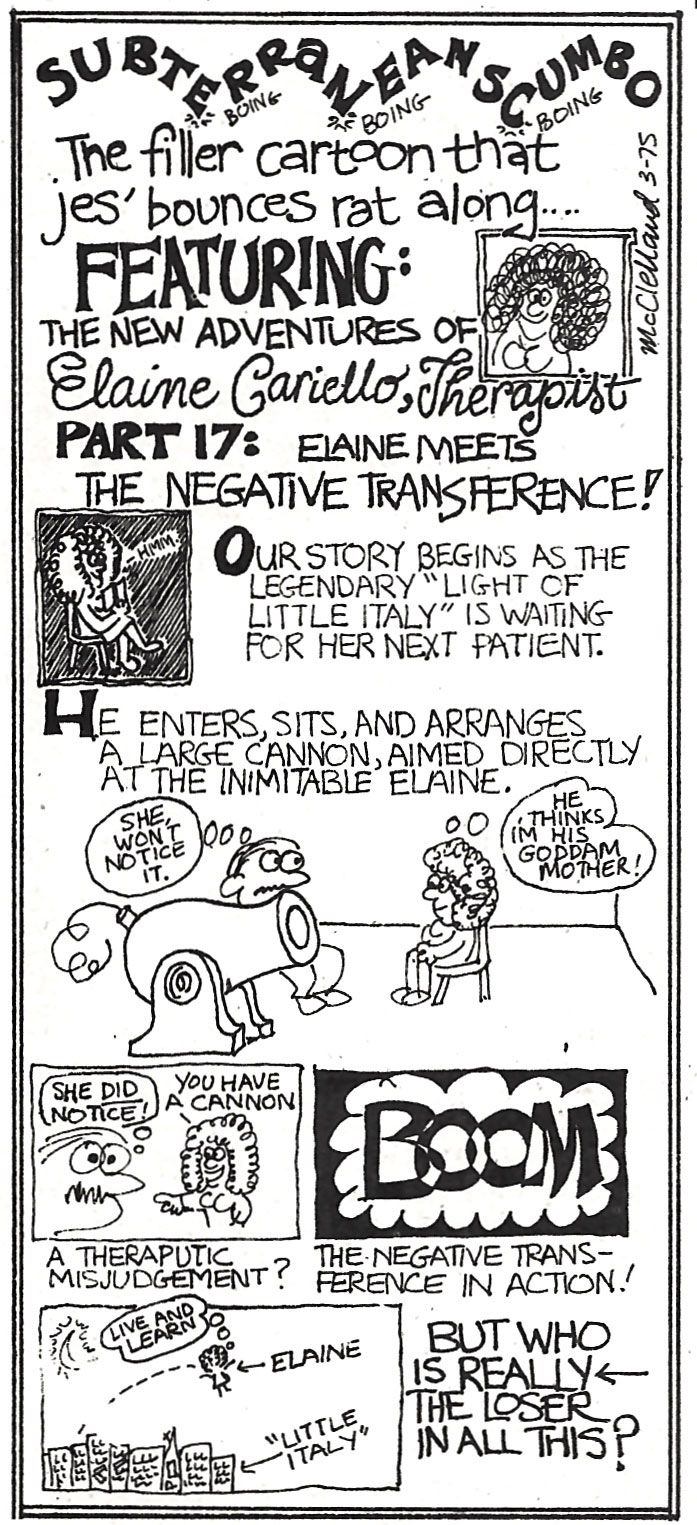
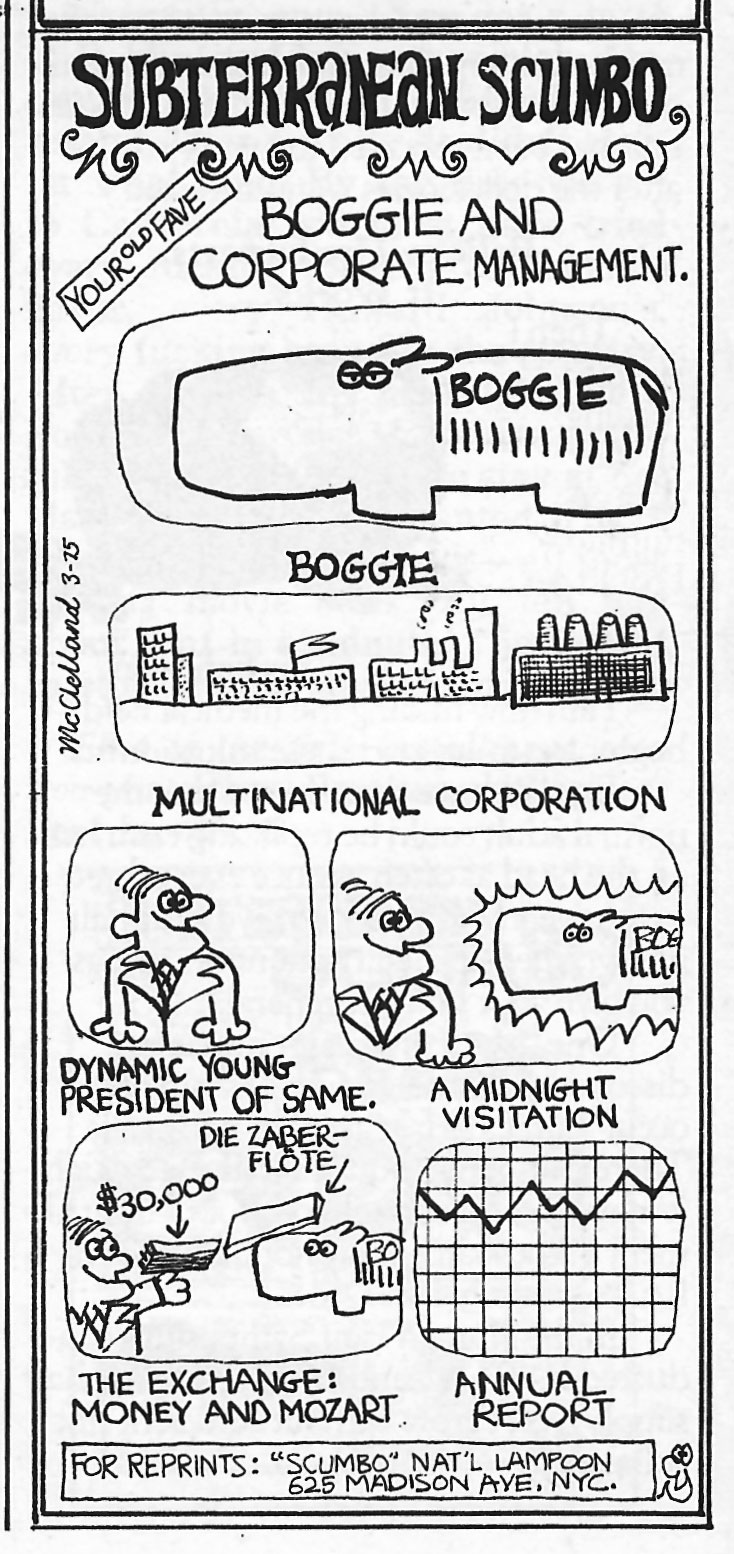
David McClelland's 'Subterranean Scumbo' features from the October and December 1975 issues of National Lampoon.
Other activities
In the early 1970s, McClelland co-founded and contributed to the New York City magazine The Real World. In addition, McClelland wrote articles on a variety of subjects for magazines like The New Yorker magazine, Harper's magazine, The New York Times Magazine and other publications. On top of that, he was a calligrapher and diarist. He created many posters for different performing events as well as works for friends. His calligraphic works included illuminated manuscripts of quotations from authors and poets including Christopher Smart, William Butler Yeats, Wallace Stevens, Jalal al-Dan Rumi, John Berryman and many others.
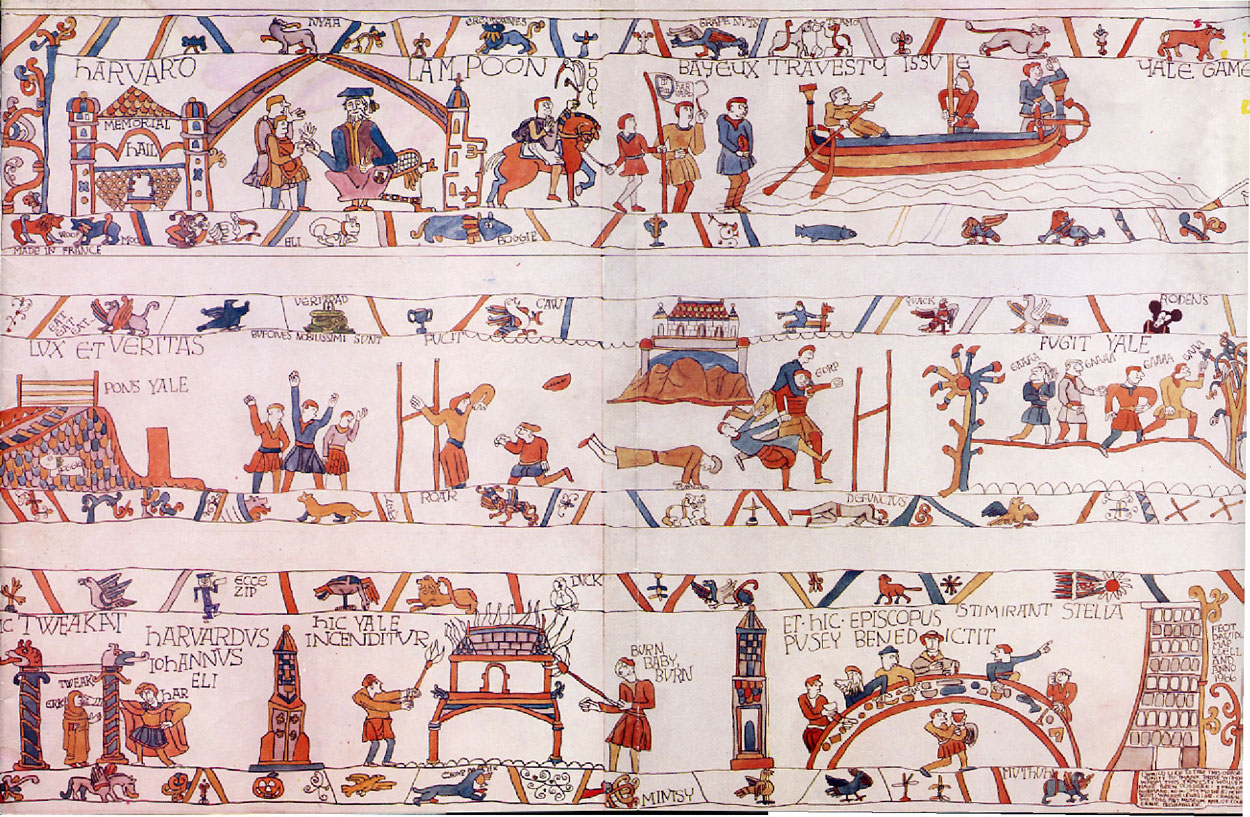 'The Bayeux Travesty', parody of the Bayeux Tapestry, made for a fold-out cover of National Lampoon.
Death and legacy
Diagnosed with bipolar disorder since 1966, most of David McClelland's adult life was troubled by mental illness, resulting in his untimely death in 1976 at at age 29. His work is now in the archives of the Houghton Library at Harvard University. In 2019, McClelland's family and friends published a book, 'The Inspirations of David C. K. McClelland', which included essays about him and his art, as well as reproductions of his work. At his 50th class reunion in 2019, a celebration of David McClelland's life was held at Harvard's Signet Society.
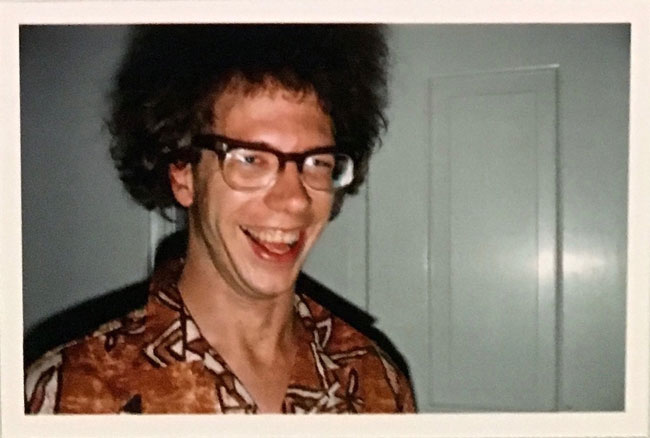
David McClelland in 1973. Photo: Stephen Shore.