
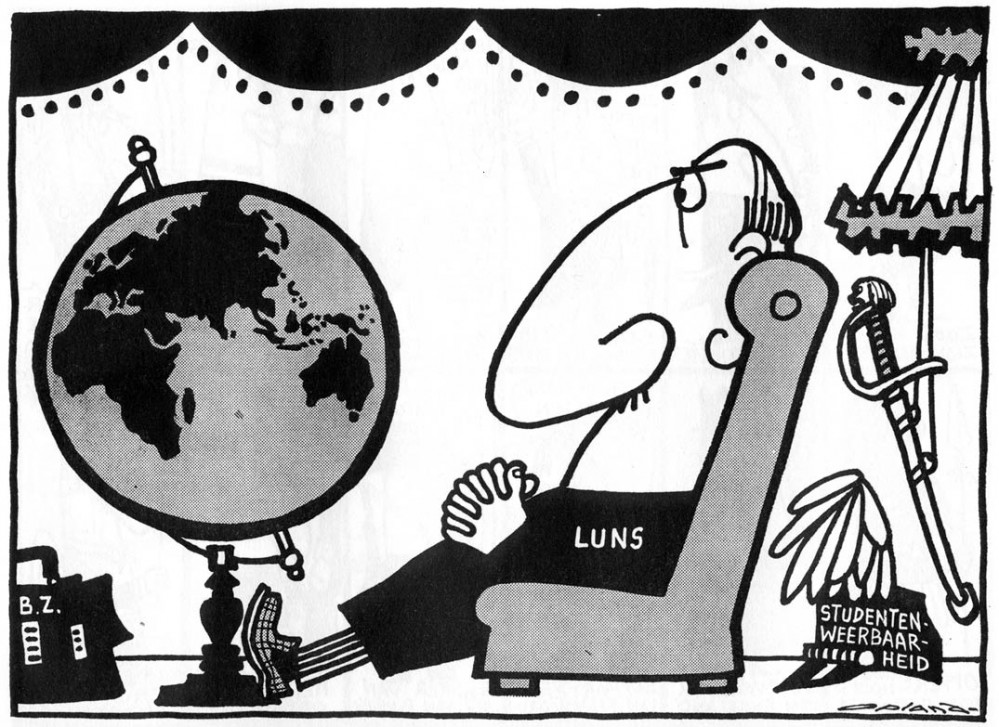
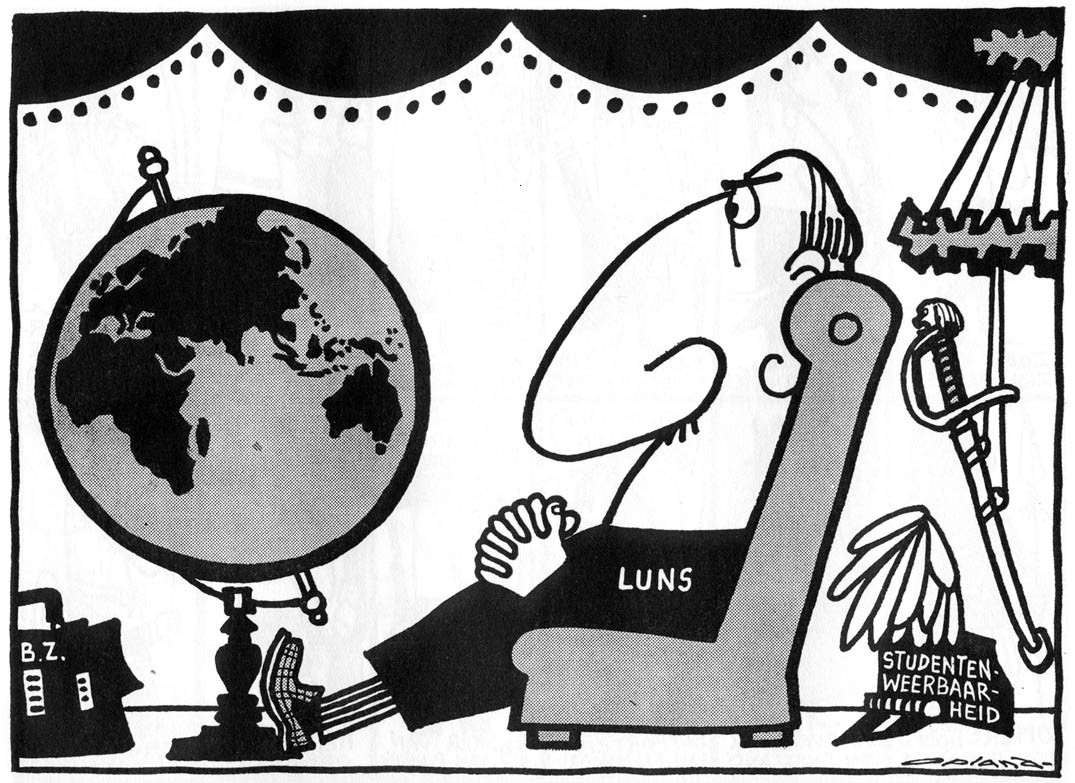
Caricature of Dutch Secretary of Foreign Affairs and later NATO secretary-general Joseph Luns.
Opland was one of the most notable Dutch political cartoonists during the second half of the 20th century. Between 1947 and 2001, he drew countless cartoons for the opinion weekly De Groene Amsterdammer and the newspaper De Volkskrant. At the start of his career, the 18-year old was the youngest Dutch cartoonist. By the time of his death at age 73, he was coincidentally also the oldest. In the meantime, he had broken with every tradition and innovated Dutch political cartooning with his trademark humor and visualizations. In thick lines with clever use of black-and-white, he managed to reduce his targets to cartoony characters, with grotesque noses and stylized other features. Also remembered for his socially conscious posters, Opland's most iconic drawing supported the 1980s anti nuclear missile movement and depicted a tiny woman kicking a missile away. On occasion, Opland's cartoons made use of sequential images, but only once he created an actual text comic, the apolitical humor strip 'De Wonderlijke Avonturen van Anna' (1979-1980).
Early life and career
Opland, real name Robert "Rob" Wout, was born in 1928 in Amsterdam as the second son of a book keeper. His mother died in 1948, when her son was only 20 years old. Wout's parents were members of the Restored Evangelical Lutheran Church, and his father later ran a boardinghouse for the elderly at 78 Vondelstraat in Amsterdam, advertizing with the slogan "Men wordt stokoud in Pension Wout" ("People grow very old at Pension Wout"). As a youngster, Rob Wout had his drawings printed in the school newspaper, or he pinned them on the school's bulletin board. Because he wanted to see more of the world, he enrolled at the Facultry of Political and Social Science of the University of Amsterdam, as their curriculum contained a foreign service.
To pay for his education, Wout got a job as assistant at the printing block department of the magazine Vrij Nederland. In addition, he made drawings for the propaganda magazines of the socialist party (PvdA), Paraat and Met Volle Zeilen. Other early artwork appeared in the leftist weekly De Vlam and Nieuw Utrechts Dagblad. However, a bout of pleurisy forced him to end his studies before he could be sent abroad. This prompted him to dedicate all his time to cartooning. While Opland wanted to make cartoons for his employer Vrij Nederland, he instead found a regular spot in another opinion weekly, De Groene Amsterdammer.

First Opland drawing in De Groene Amsterdammer, 22 February 1947.
Political cartoons
On 22 February 1947, Opland saw his first political cartoon published in De Kleine Krant, a section of the opinion weekly De Groene Amsterdammer. Because he was still a student and the time and didn't want to get into trouble with his professors, he signed his work with the pseudonym "Opland", a contraction of the names of two school friends, Eddy van Opzeeland and Klaas op 't Land. At the time, Opland was 18 years old, making him the youngest Dutch political cartoonist to debut in a national title, a record that still stands today. Through his boss at Vrij Nederland, Ed Hoornik, he also got in touch with the newspaper De Volkskrant. Initially, Opland was in doubt if he would want to work for this more conservative Catholic newspaper, since he was a non-Catholic and mostly associated with progressive leftist magazines. However, chief editor Joop Lücker found him the best political cartoonist around, and hired him anyway. Starting on 26 June 1948, the cartoonist's drawings appeared in De Volkskrant, initially under the pen name Tobias, later also under his regular Opland signature. Opland continued to work for both De Groene Amsterdammer and De Volkskrant throughout his further career.
His regular spots in these two titles allowed him to quit his day job and dedicate the rest of his life to full time cartooning. As a cartoonist, Opland was completely self-taught. While his early drawings showed influences from other cartoonists like the Australian-British David Low, he quickly developed his trademark stylized way of working. Opland drew in a simple, linear style, with characters having a somewhat naïve, almost child-like look. Often, his targets were reduced to the bare minimum, but achieved maximum effect. Never before in Dutch editorial cartooning were politicians depicted with such immense noses and almost ideographic features. Still, he managed to capture their essence with archetypical details, for instance German chancellor Konrad Adenauer with his hexagon head, French president Charles de Gaulle with his long legs or the hairdo of US President Ronald Reagan. The Dutch Prime Ministers were also recognizable by specific features, Willem Drees by his glasses, Joop den Uyl by his nose Ruud Lubbers by his chin. They operated in flat, two-dimensional images, stylized in ornamental black-and-white compositions. Nevertheless, there was a graphic distinction between some of the work he published. For De Groene Amsterdammer, he worked in a sober and schematic style, while in De Volkskrant his art had a more exuberant look, with panels crowded with characters and details.
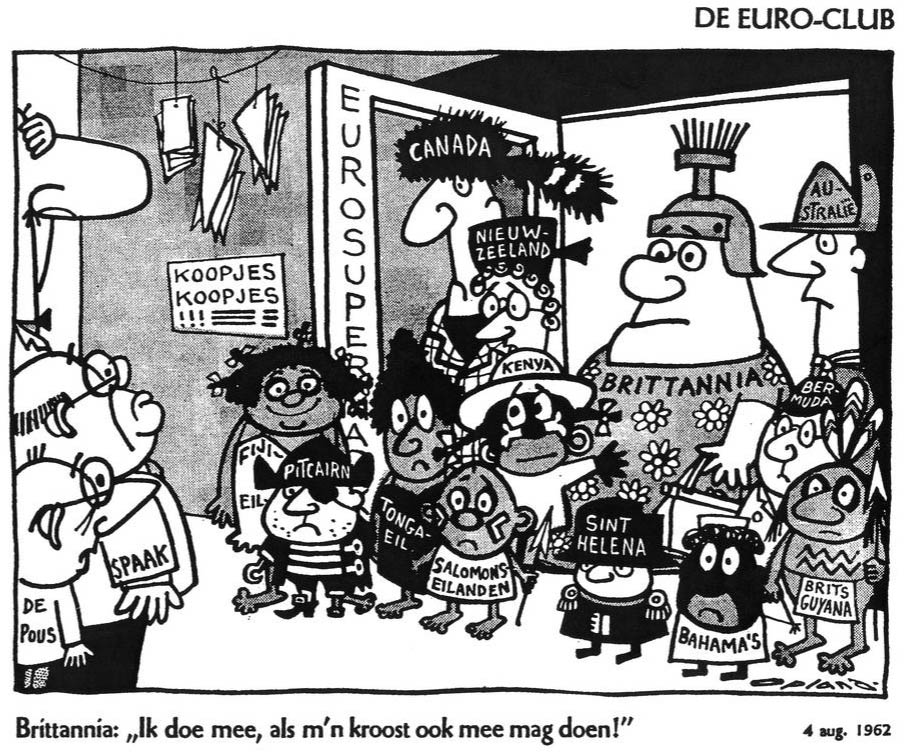
Cartoon by Opland, 4 August 1962, about Great Britain considering joining the European Union. The caption reads: "I'll join, if my children can join too" (the children being the colonies of the Commonwealth). The three politicians who look on in exasperation are NATO secretary-general Joseph Luns, Belgian Minister of Foreign Affairs Paul-Henri Spaak and Dutch Minister of Economy Jan de Pous.
From the start, Opland's new way of cartooning shocked the nation, and Dutch politicians in particular. As the youngest in his trade, he broke with every tradition, both in art style and in humor. In Het Parool of 5 December 1964, fellow cartoonist Leendert Jordaan said of him: "Opland is pre-eminently the man of the direct, ruthless attack, in which the absence of a clear political or philosophical stance assures him the widest possible scope." In a television portrait, broadcast on 2 July 1962, Opland himself described his task as political cartoonist: "You are administered your daily dose of indigestible world news, and you have to process it. (...) It is the task of the political cartoonist to make it digestible for a whole lot of people who otherwise wouldn't understand any of it at all." He realized that, compared to essays and articles, his role was brief: "On the world stage, I am the man who comes to deliver the letter. I am the figure who is on stage for half a second, and then quickly leaves again through the first door on the left." In the short report, Opland expressed both his sympathy for the common man and a cynical world view: "There is nothing to change in this world. 30 percent of humanity bleeds the other 70 percent dry. And maybe it is 5 against 95 percent." At least he hoped his work could stir things up: "A political cartoon is a fairly sharp sword, but it is allowed to have a few dirty burrs on it; then at least it leaves a very painful wound."
In 1964, publisher De Lanteern released the first Opland cartoon collection, 'Te Kijk bij Opland' (1964). After that new collections were published by De Harmonie, subsequently 'Jui-Huich Ik Aan Het Vlà-hà-hàkke strand' (1971), 'Wegwezen' (1972), 'St. Joop en de Draak' (1977), 'Buitenlandse Zaken' (1977), 'St. Dries en de IJsheiligen' (1978), 'Het Hof' (1980), 'Blablablonië' (1981), 'Mijn Mémoires, Gijs van Aardenne' (1986), 'Joop' (1988) and 'Dag Ruud' (1994). Opland remained active as a political cartoonist until his death in 2001. By then, he was, at age 73, the oldest Dutch cartoonist who was still active in the press.
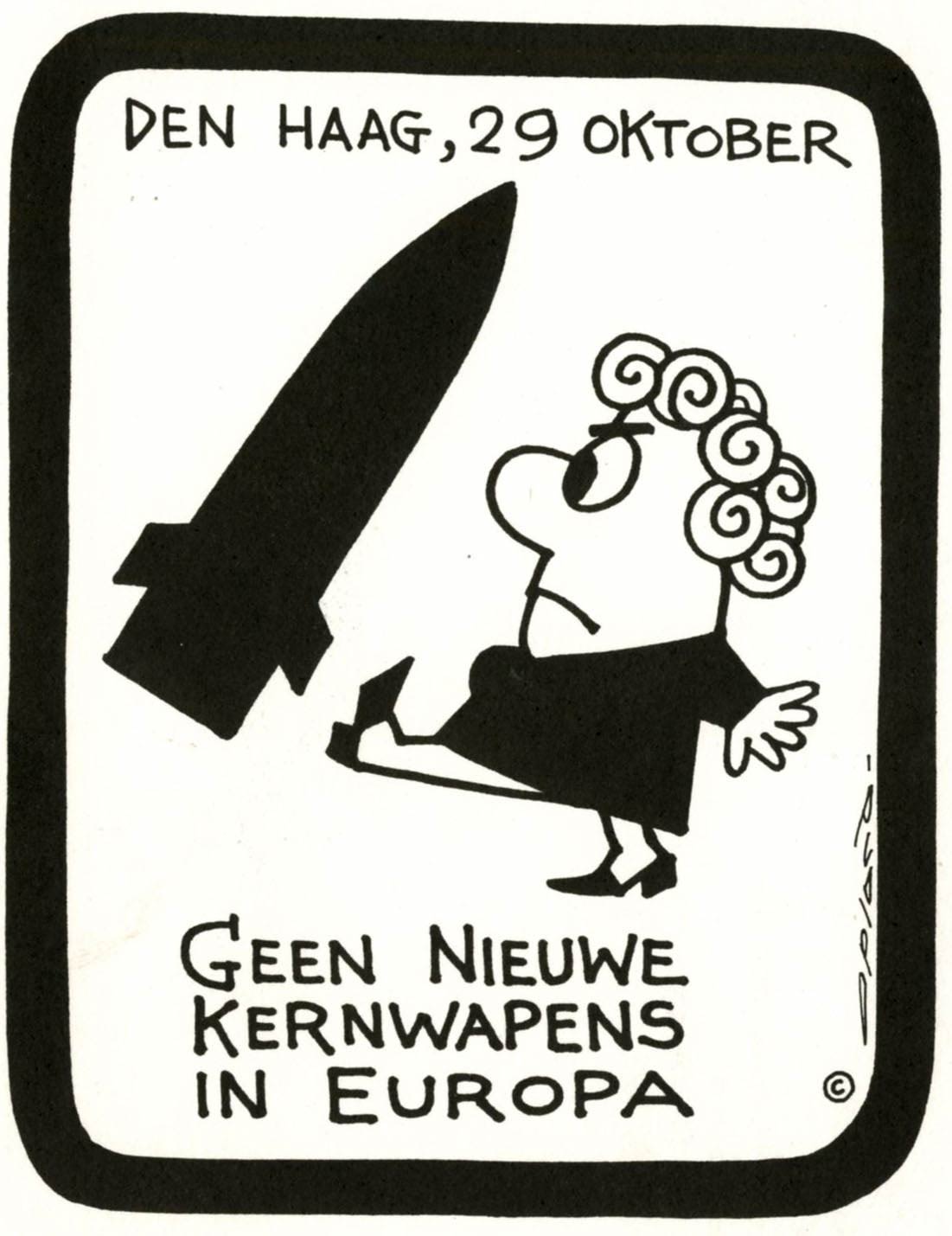
Opland's iconic logo for the anti-nuclear missile movement.
Activism
Like any good political cartoonist, Opland was a socially conscious person. In 1963, after learning that German rocket and bomb experts were active in Egypt, he wrote a letter to German chancellor Konrad Adenauer with the request to "curb his fellow countrymen to prevent them from returning to their natural anomalies". He made several posters, logos, flyers and pamphlets to support the feminist movement Dolle Mina, the legalisation of abortion and to promote medical aid for the victims of the Vietnam War. His cartoons also protested against the Greek colonel regime, the Pinochet junta in Chile, apartheid, racism and, his most famous cause, nuclear missiles. For the action group "Komitee Kruisraketten Nee", he designed a tiny, but feisty woman who kicks a missile away. During the early 1980s, at the height of the anti-nuclear missile movement, the image could be seen on many signs and posters during protests in Amsterdam and The Hague. The nameless woman was eventually adopted as the official mascot of the international movement against nuclear missiles. Soon, Opland's logo appeared all over the globe, making it his most widespread piece of art.
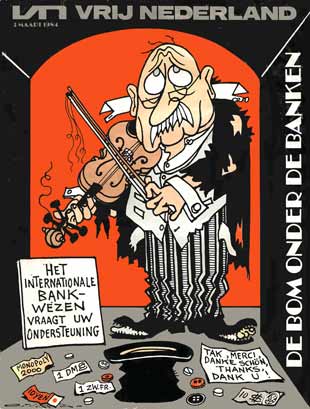
Cover for Vrij Nederland, depicting a bank manager begging for financial support.
Controversy
As can be expected, Opland sometimes caused outrage. On occasion, his cartoons were rejected by his editors, although he addressed in a 9 April 1987 radio interview that he generally had good relationships with them. In 1965, Princess Beatrix (the later Queen Beatrix) announced her engagement to the German diplomat Claus von Amsberg. In the post-war Netherlands, many citizens felt their princess shouldn't marry somebody from a country that, only two decades earlier, had occupied and terrorized their home country. Opland made a cartoon depicting Prime Minister Jo Cals as a scout who helps Claus cross the street, now that "the light has turned orange" (in reference to the Netherlands' national color orange). Editors of De Volkskrant were offended because Claus was drawn wearing a German military uniform. They rejected the cartoon, but on 30 October 1965 it did appear in print in Het Parool.
In 1969, Dutch radio journalist G.B.J. Hiltermann named De Volkskrant "antisemitic", because they criticized Israel's war politics, citing an Opland cartoon about the matter as an example. De Volkskrant brought the matter to court. The judge ruled in their favor and Hiltermann had to apologize for his harsh accusations. Hans Wiegel, a relatively young politician compared to his colleagues, remarked that he strongly disliked the way Opland drew him as a young boy with snot dripping from his nose. Nevertheless, he kept all his cartoon portrayals and accepted it as the prize of fame. Fellow politician Harm van Riel once praised Opland with the hidden insult: "Politically he means nothing, but he is a great artist." D66 politician Hans van Mierlo and former Prime Minister Dries van Agt expressed an even stronger dislike of Opland's work. However, in the 1987 radio interview, Opland remarked that Van Mierlo and he were friendly when seeing each other in one of the Amsterdam bars. Considering Van Mierlo had a background in journalism, Opland had the impression that the D66 politician was more open to criticism. When Opland died, Dries van Agt was asked for a reaction, but he simply claimed "he had no time for that."
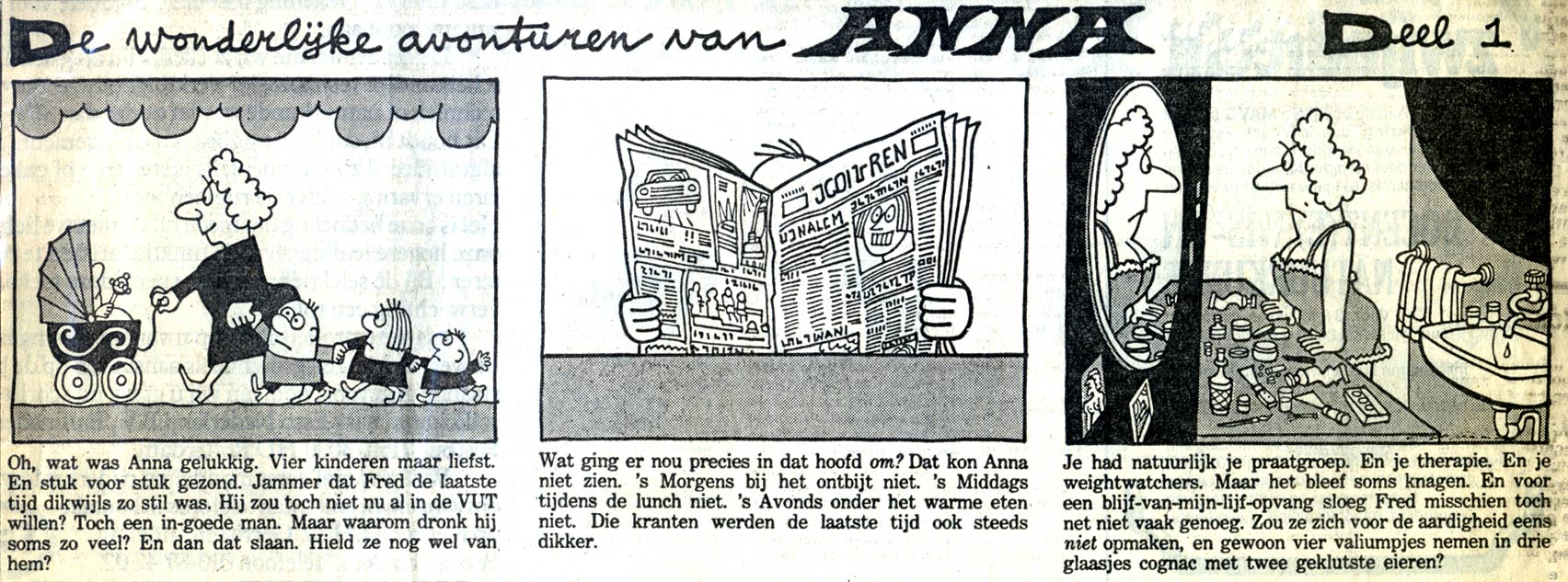
The first episode of 'De Wonderlijke Avonturen van Anna', 1979.
Comics
Opland was mostly an one-panel cartoonist, but occasionally made use of comic strip formats too. A 1957 cartoon satirized the downfall of Soviet politician Dmitri Shepilov in the style of a text comic. In 1973, he made a comic in color, 'Spoken Op het Catshuis' (1973), in which Prime Minister Joop den Uyl and his wife wake up at night because they hear a strange noise. They fear it might be ghosts, but they turn out to be members of the opposition making a rumble. An oddity in Opland's career is 'De Wonderlijke Avonturen van Anna' (1979-1980). This text comic ran in De Volkskrant and was Opland's only attempt at creating an actual adventure comic starring a fictional character of his own. The story follows a mother of four children, Anna, whose husband is an abusive drunk. Wanting to change her life, Anna then has a fantasty adventure with a happy end.
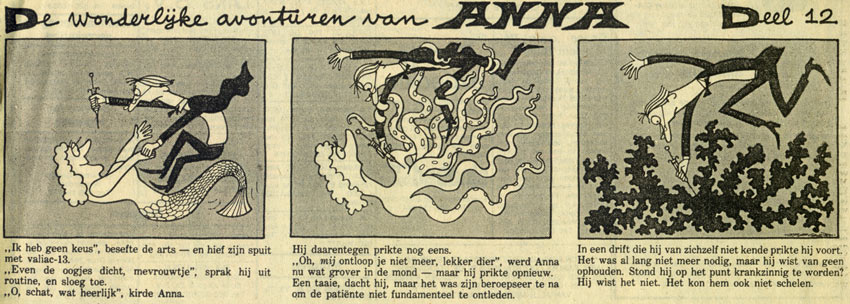
'De Wonderlijke Avonturen van Anna'.
Opland also created sketch books about his holidays. Some of these, like a 1981 report about his trip over the Atlantic Ocean, were drawn in the style of a comic strip. In November-December 1964, he also participated in a comic special by the literary monthly Ratio, which also featured work by artists like Peter Vos, Rupert van der Linden, Guus Boissevain, Marten Toonder, Frank Lodeizen, Frits Müller, Hugh Jans, Wibo, Thé Tjong-Khing, Waldemar Post and Peter van Straaten.

Comic page for Ratio magazine (November-December 1964).
Graphic and written contributions
Apart from political cartoons, Opland made illustrations, for instance for Jeanne Roos' column in the newspaper Het Parool. In 1962, these columns were compiled in book format. De Groene Amsterdammer additionally published poems by Opland under various ludicrous pseudonyms, including Adje Beenhakker, Tarquinia Edelstein, Hermine Troosteloos, Abraham Heenvliet and Pjotr Primsey Primakof. During the World Exhibitions in respectively Brussels (1958) and Montréal (1967), Opland was in charge of decorating the walls of the Dutch pavilion. For the walls of the Amsterdam metro station Wibautstraat, opened in 1977, Opland designed the mural "Newspapers and letters", as the neighborhood had been the homebase of several newspaper offices.

Mural designed by Opland for the Wibautstraat metro station. Source: Stadsarchief Amsterdam.
Opland also wrote and illustrated two children's books for his daughter. They appeared in print as 'De Sneeuwpop' (De Harmonie, 1980) and 'De Muts Van De Keizer' (De Harmonie, 1980). More in line with his political work were the designs he made for parody board games, for instance his 1963 goose board about Dutch politics and a 1975 game that satirized conservatism. The latter game starts at the final numbered space and moves backwards to the space with the word "Start" on it. In his spare time he was also active as a painter.


In 1971, Opland drew a series of advertisements for Drum tobacco.
Recognition
Still, Opland's work was respected by many other people too, including politicians Norbert Schmelzer, Hans Wiegel, Ed Nijpels and former Prime Minister Piet de Jong. Schmelzer and De Jong even collected his cartoons. They once asked Opland to sell some of his originals to them, which he flat-out refused, since he didn't like praise from politicians. Nevertheless, in 1964 an exhibition was built around Opland's cartoons, with a companion book which had a foreword by Dutch Secretary of Foreign Affairs (and later secretary-general of NATO) Joseph Luns. The expo was inaugurated by famous Dutch novelist Godfried Bomans. A 1981 overview exposition of Opland's work at the Amsterdam Binnengasthuis was opened by former Prime Minister Joop den Uyl. When the cartoonist shook hands with the politician, the media was outraged: it was not done for a political artist to associate with authority figures.
In 1970, Opland received the Lofprijs voor de Nederlandse Journalistiek ("Praise Award for Dutch Journalism"), because the organization regarded him as a journalist who just happened to work in a "visual" medium. In 1988, he also received the H.M. Werkmanprijs for his entire body of work. Opland also won the Inktspotprijs in 1995 for a cartoon which ridiculed Christian-Democratic politician Elco Brinkman of the CDA.
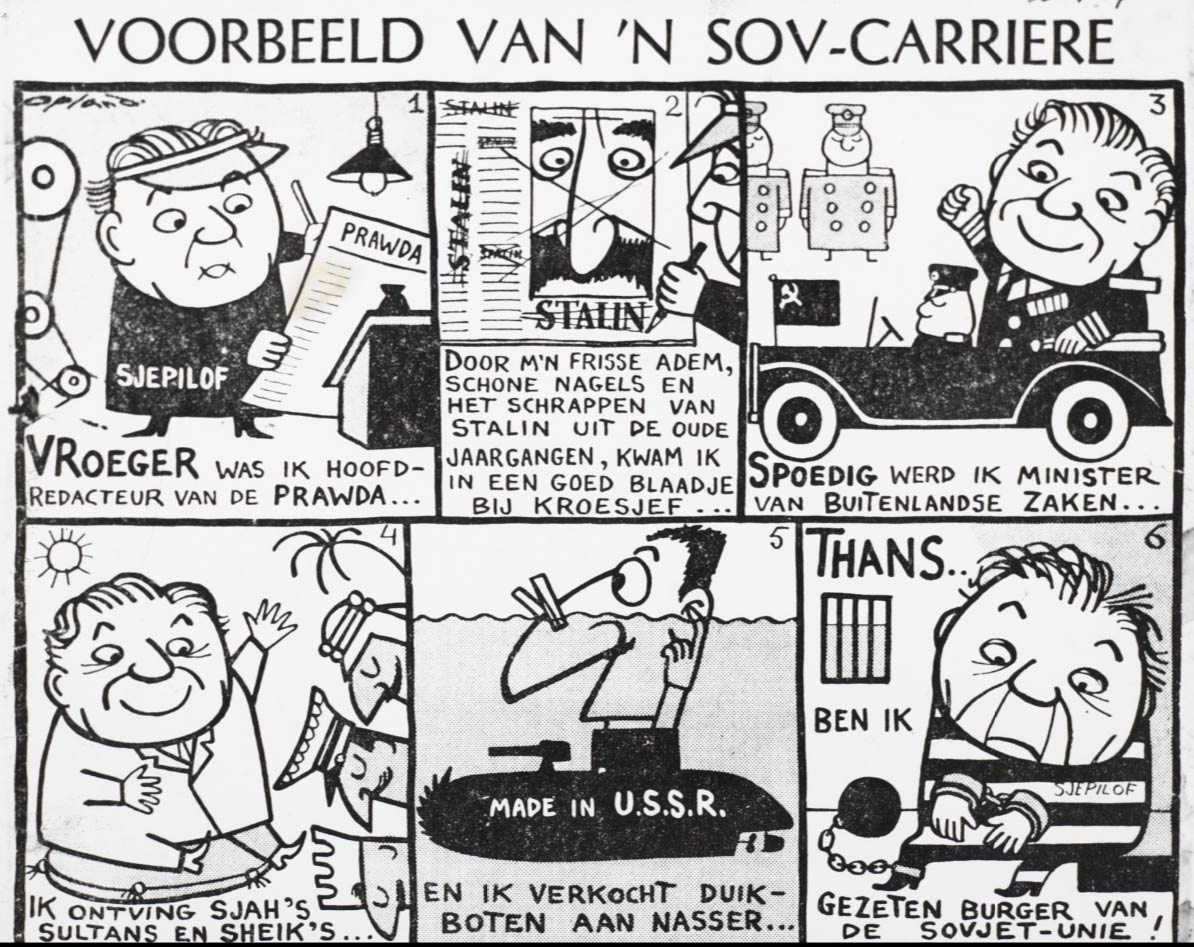
'Beeld van een Sov-carrière' ('Image of a career in the Soviet Union'). A 1957 cartoon depicting the rise and fall of Russian Minister of Foreign Affairs Dmitri Shepilov, who was forced to resign over a failed coup against head of state Nikita Khrushchev. The final panel sarcastically claims he is now a "respected seated member of the U.S.S.R", showing him on a jail bench.
Later years and legacy
Based in the more lively areas of Amsterdam, first in the De Wallen district and then in the Jordaan, Opland was a familiar face in the city's night life and intellectual circles. He was known as an exuberant entertainer at parties and gatherings, either at the café Américain, at the newspaper office or at the cultural society De Kring. In his circle of friends were writers, journalists and fellow artists, for instance Wim Boost, Eddy Posthuma de Boer, Jean-Paul Franssens, Frits Müller, Waldemar Post and Peter van Straaten.
By the 1980s, Opland became aware that he had become part of an older generation. In a 1981 interview, he said that when he started at De Groene he was a child, and now an old fart. He described his new editors at the time as "serious, dry-eyed bespectacled people". Nevertheless, he continued to work until the very end. When he reached the retirement age of 65 in 1993, Opland reduced his De Volkskrant output to one drawing per week. For the occasion, a career-spanning overview book was released by De Groene Amsterdammer and Uitgeverij Jan Mets, 'Het groot Opland boek' (1993).
In 2001, Opland passed away from bone cancer, just one day after his 73th birthday. In late 2004 his work was exhibited in the Belfort in Brugge, Belgium, together with work by Belgian cartoonist Marec, after which the exhibition could be viewed in Historical Center Het Markiezenhof in the Dutch village of Bergen op Zoom until the late summer of 2005.
Books about Opland
For those interested in Opland's life and career, the 2004 exhibition catalog, 'De Wereld (1947-2001) Volgens Opland', by Johanna Jacobs, Geert Mak and Koos van Wering is highly recommended.

Opland (left) with politician Joop den Uyl on the opening of his 1981 overview exposition at the Amsterdam Binnengasthuis. Photo: Hans van Dijk/Anefo. © Nationaal Archief, CC0.