
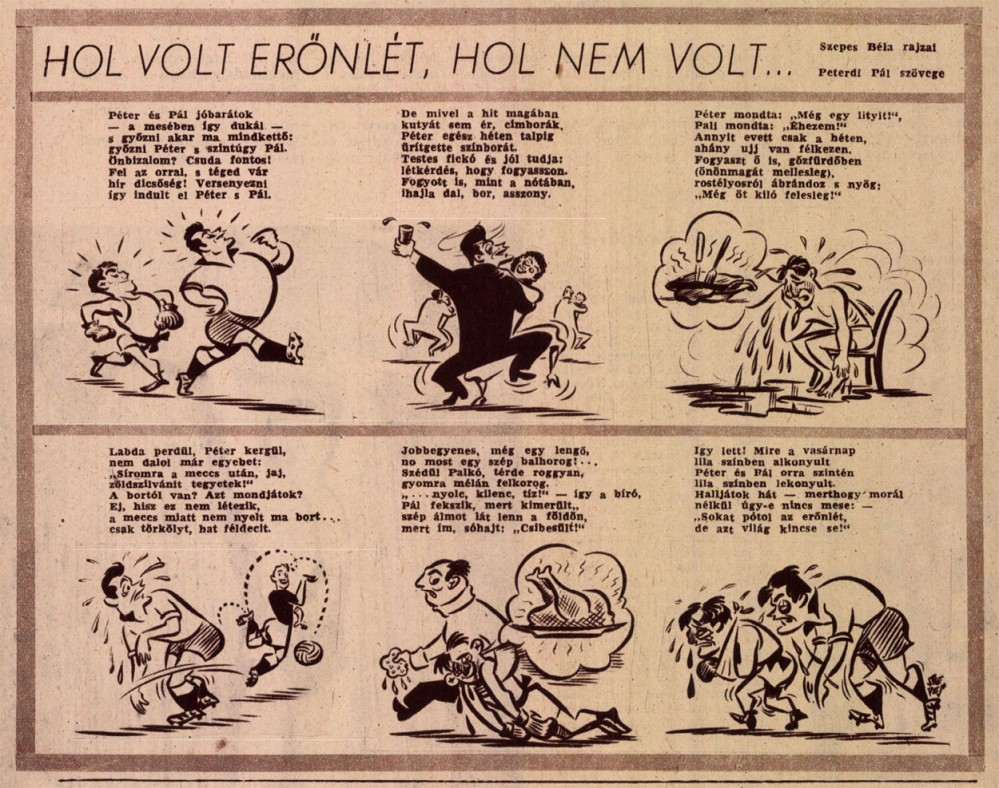
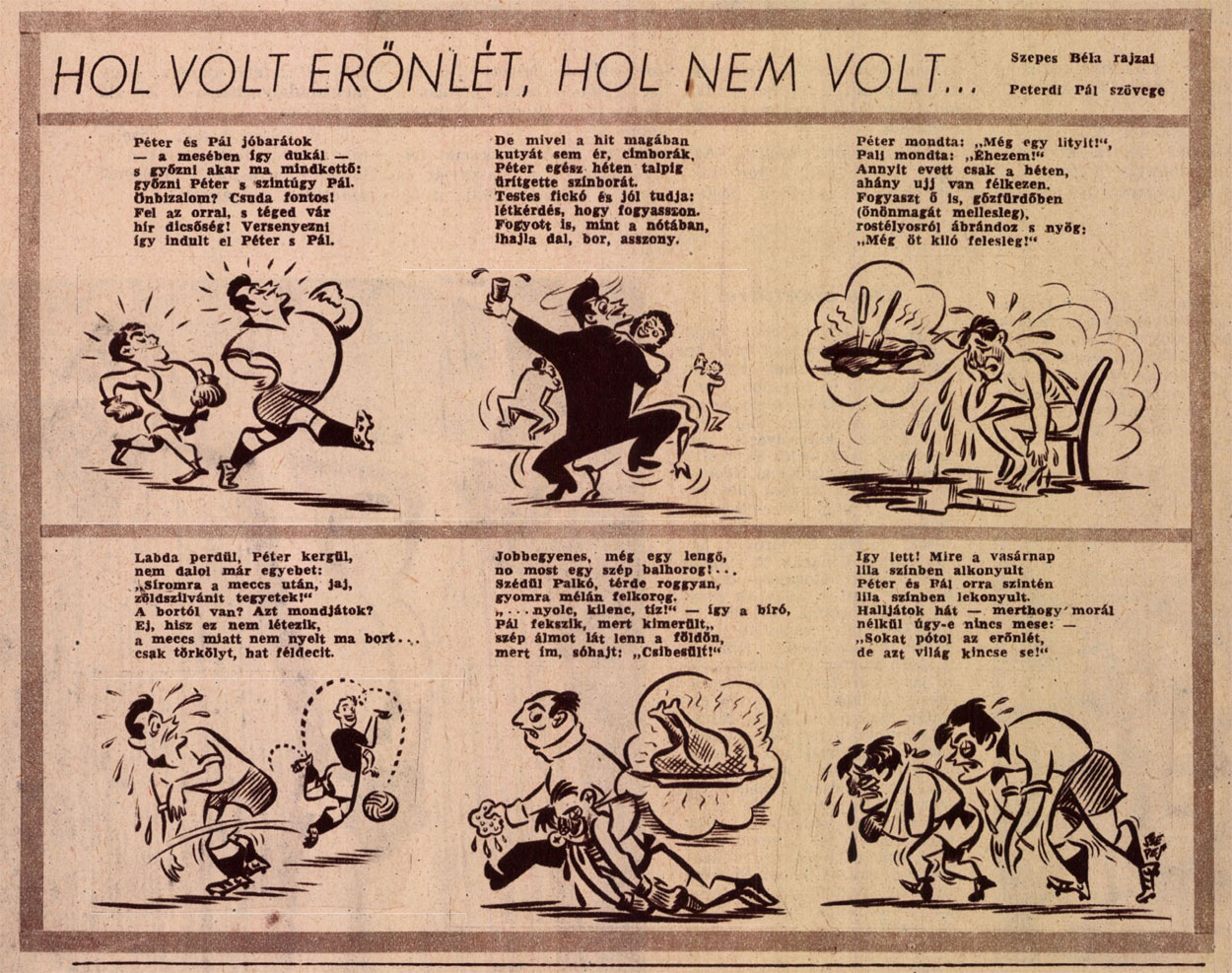
Sports comic by Béla Szepes.
Béla Szepes was a Hungarian skier and athlete, famous for participating in the 1924 Winter Olympics and the 1928 Summer Olympics. He won several gold medals and later worked as a ski instructor, sports journalist and cartoonist. Apart from several sports-themed cartoons and caricatures, Szepes also drew the comic strip 'Pimf Pali' (1950). Later in his career, Szepes was active as screenwriter, assistant-director and sports award designer.
Early life and sporting career
Béla Szepes was born in 1903 in Igló (present-day Spišská Nová Ves), then a town in the Austro-Hungarian Empire, but nowadays on Slovakian soil. By 1918, he picked up skiing through the Hungarian Tourist Association. As a ski jumper, he broke the Hungarian record six times until 1927. In 1923, he won the first ever ski jump championship in Hungary, and in the following year he participated in two cross country skiing races at the 1924 Winter Olympics, but didn't finish. Szepes was equally successful as a javelin thrower, being a member of the Hungarian Athletics Club (MAC) from 1919 to 1931. He won the Hungarian championships seven times in a row (1925-1931), and the British Athletics Championships three times (1925, 1927, 1929). Szepes participated in the 1928 Summer Olympics in Amsterdam, where he came in second in javelin throwing.
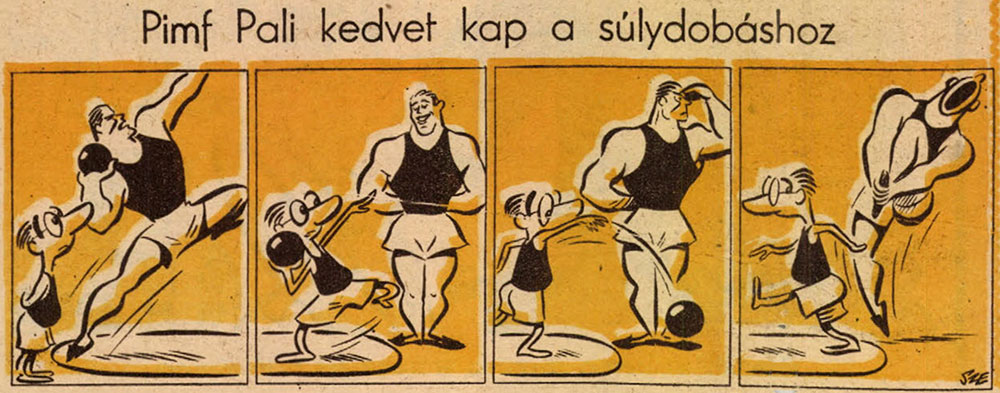
'Pimf Pali', from Lúdas Matyi #15, 1950.
Early cartooning career
While Szepes had chosen a scientific direction at Toldi secondary school, Szepes later enrolled at the University of Arts and Design in Budapest. After his graduation in 1926, Szepes spent five years in Berlin, working for several newspapers as a journalist and cartoonist. Back home, he became a ski instructor and later the coach of the Hungarian athletics team (1937-1944), while continuing his career in journalism and cartooning in Hungarian publications. After 1933, his sports cartoons and articles appeared in Nemzeti Sport (1933-1941), Sporthírlap, Utazás és Sportrevü, Tükör and Délibáb. During World War II, Szepes was a reporter and editor for Képes Sport, and in 1944 he was present in the short-lived, satirical magazine Pesti Posta, making a powerful stance against fascism, alongside Victor Vashi and other cartoonists.
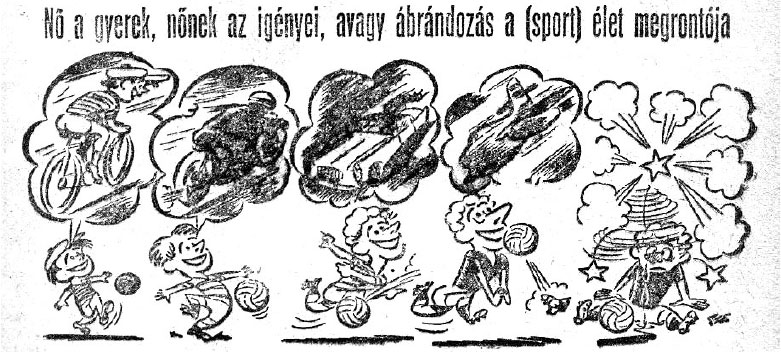
Comic strip for Füles #3, 1958.
Post-war career
After World War II, Szepes continued to make regular cartoons for magazines such as Népsport, Képes Sport, Labdarúgás and Sport, as well as the satirical magazine Lúdas Matyi and Füles. Sports-related comic strips by Béla Szepes appeared irregularly in Képes Sport, Esti Budapest and Füles. For Lúdas Matyi he made a short-lived comic strip about a clumsy sportsman, called 'Pimf Pali' (1950). He also designed book covers and posters. Cartoons by Béla Szepes were collected in the books 'Így gyöztők ti' ("So You Win", 1957), 'Gólkirályok labdaművészek a futballvilág hősei' ("'Goal Kings and Ball Artists are Heroes of the Football World", 1957) and 'Sztárparádé Sporttörténelmi Arcképcsarnok' ("Celebrity Parade Sports History Portrait Gallery", 1987, written by Pál Peterdi). Some of his cartoons also appeared abroad, for instance in the US Communist newspaper The Daily Worker.
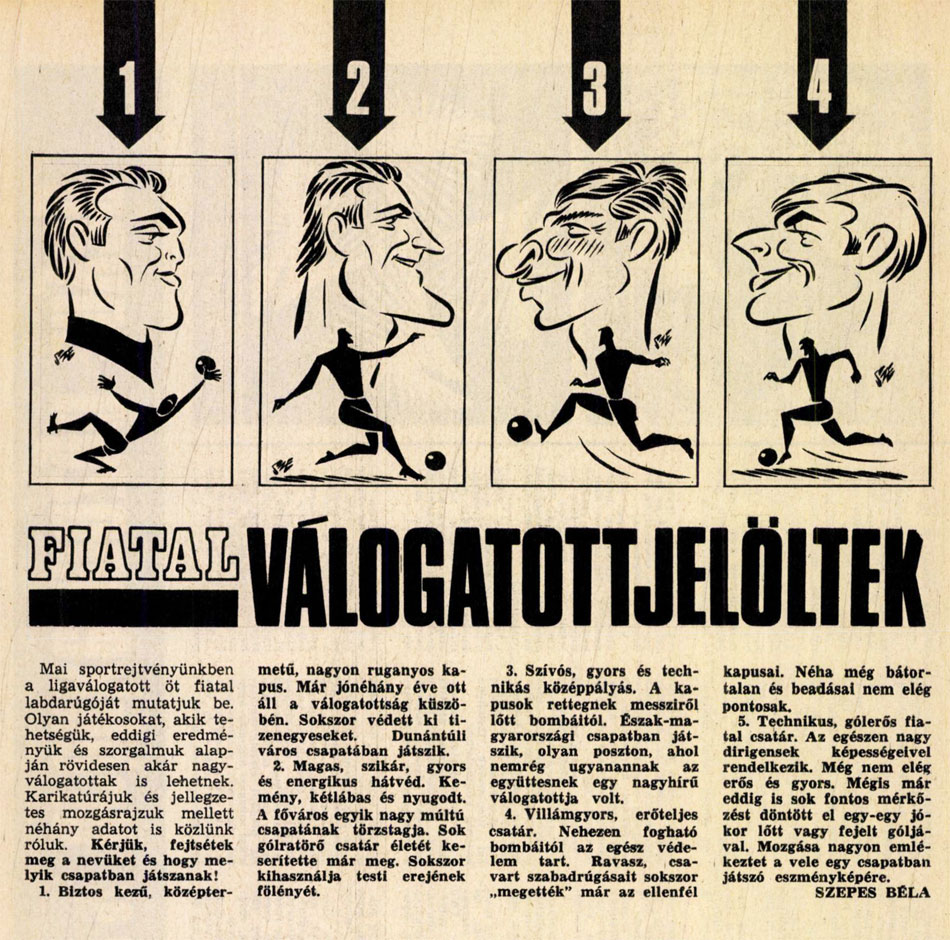
Football star caricatures illustrating an article written by Béla Szepes.
Other activities
In the second half of the 1930s, Béla Szepes tried his luck in the Hungarian movie industry. With Pál Vári, he wrote the script for the comedy film 'Méltóságos kisasszony' (1937). Around the same time, he was assistant director to Béla Balogh on the films 'Úrilány szobát keres' (1937) and '300.000 pengö az utcán' (1937), and to to Andor Pünkösti on 'Álomsárkány' (1939). '300.000 pengö az utcán' was co-written by his wife Mária Szepes (1908-2007), who in the following decades became a well-known figure in the field of hermetic philosophy.
Final years, death and legacy
From the 1960s on, Szepes turned to sculpting. He notably designed sports awards and trophies, for instance for the Athletic European Cup (1965) and the Fair Play Award of West Germany (1972). He passed away in Budapest in 1986, at age 82. His caricatures, graphics and posters are still on display in the Physical Education and Sports Museum in Budapest, Hungary.
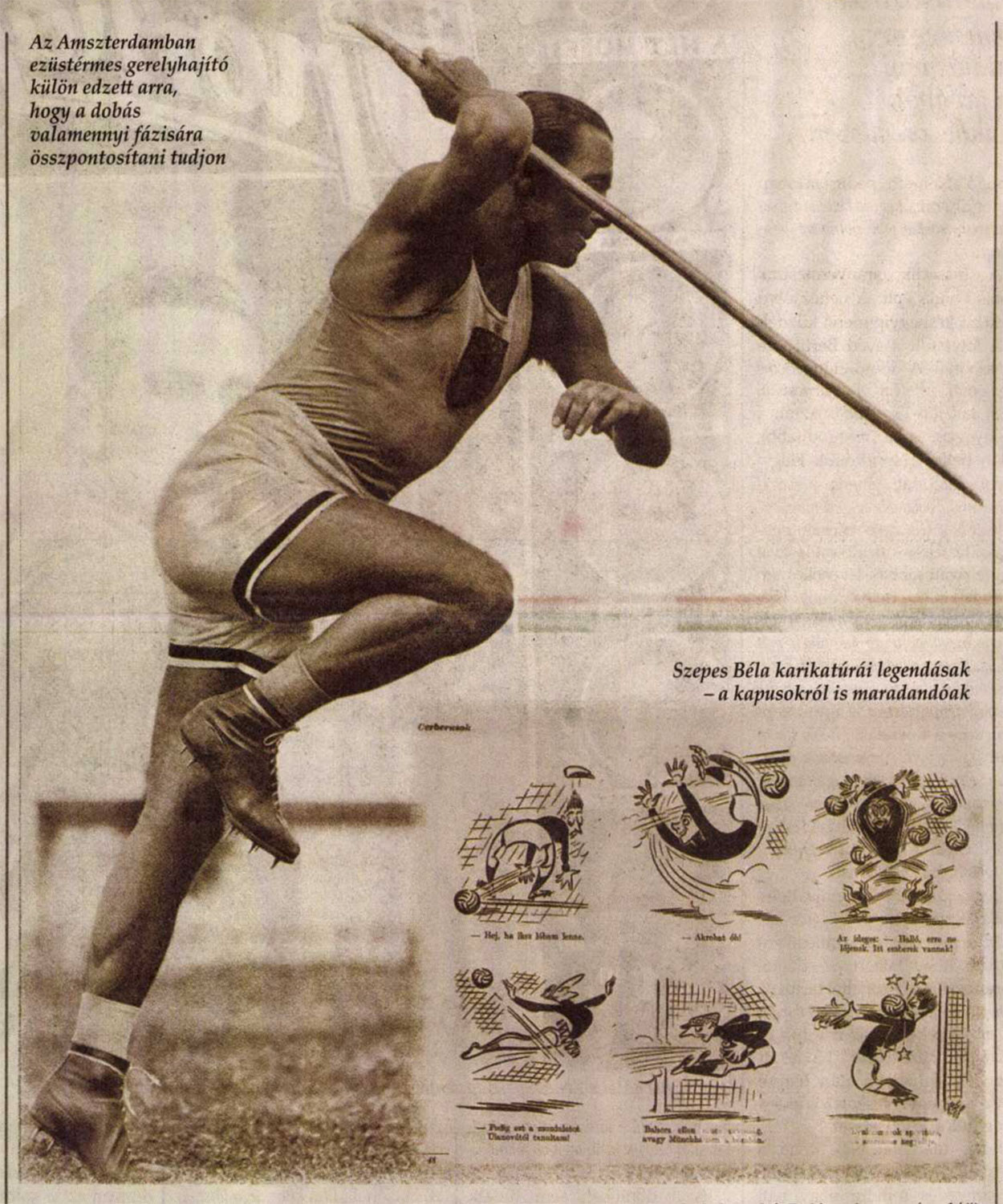
Béla Szepes at the 1928 Olympics (from a 2018 article in Nemzeti Sport).