


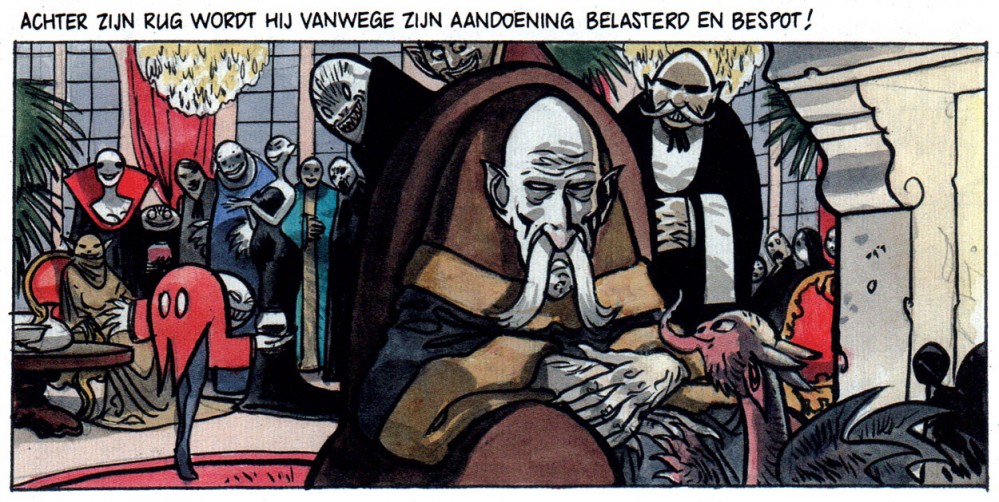
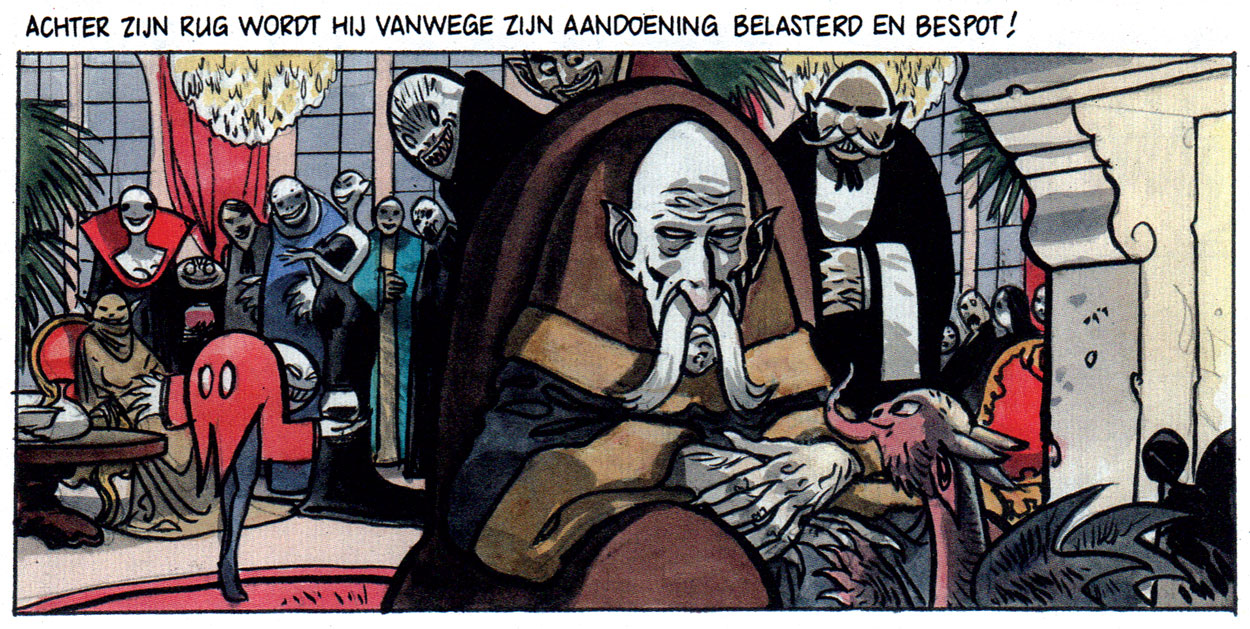
'Phaedra' (Zone 5300, August 2000).
Erik Wielaert is a Dutch children's book illustrator, plastic artist and comic artist. He spent many years working in the Dutch small press scene, with stories published in Incognito and Zone 5300, and has been one of the driving forces behind the regional Groningen comic magazine GR'NN since its inception in 1996. In his solo comics, Wielaert is known for evoking magical fantasy worlds, full of mythical creatures who can be cuddly and eerie at the same time. With Belgian cartoonist Willy Linthout as scriptwriter, he drew the humorous crime thriller series trilogy 'Het Laatste Station' (Standaard, 2007-2008).
Early years and influences
Erik Wielaert was born in 1957 in Amersfoort and was partially raised in Leiden and Assen, before eventually settling in the northern Dutch city of Groningen. According to a 2004 interview with the Dutch comics portal StripSter, his interest in drawing was fuelled at age 4, when his mother took him to the zoo. Back home, the boy instantly began drawing the animals he saw. Later came other characters, while the boy enjoyed comic magazines like Donald Duck and later Pep. In high school, he and a friend already made one-page comics, but his focus eventually shifted towards music and painting. Wielaert studied printmaking and painting at the Art Academy Minerva of Groningen, graduating with landscape etchings and paintings in 1982. At the academy, Wielaert became heavily inspired by 20th-century visual art for his own fine art projects. In terms of comics, his graphic influences have been Moebius, Lewis Trondheim, Charles Burns, Milo Manara, Nicolas de Crécy, Jacques Tardi and Mike Mignola. His passion for fantasy and science fiction is reflected in his work through his many depictions of fairy tale worlds with elves, trolls, fairies and monsters.
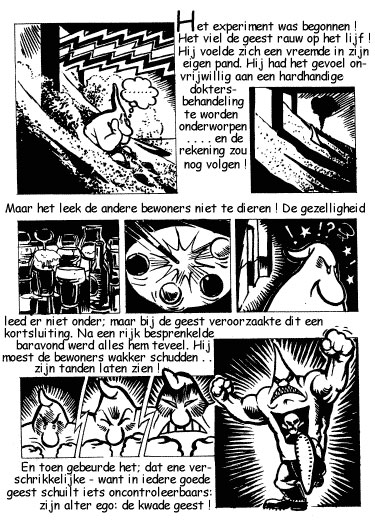
'De Geest van het RKZ'.
Early career
Originally, Erik Wielaert mostly made fine art, exhibited in alternative galleries. When his abstract canvases became too large to complete in his studio, he decided to switch to illustration. As a breadwinning, he decorated the pages of schools book. In addition, he drew for the house magazine of Het Oude RKZ, an old hospital turned into a squatters' location, and designed posters for their annual parties. Two years after it was turned into a legal housing place, Wielaert made his first comic book, 'De Geest van het RKZ' (1988), about the history of the building. The text was written by a fellow occupant, Martin Zwiers. His next comic booklet, 'Bauknecht - Renovasie zonder weerga', followed in 1992 to accompany an exposition of an artists' collective.
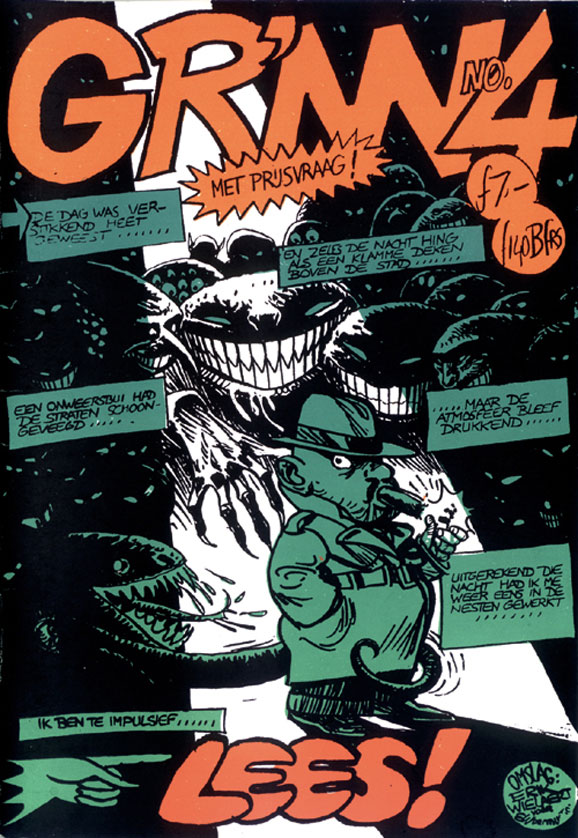
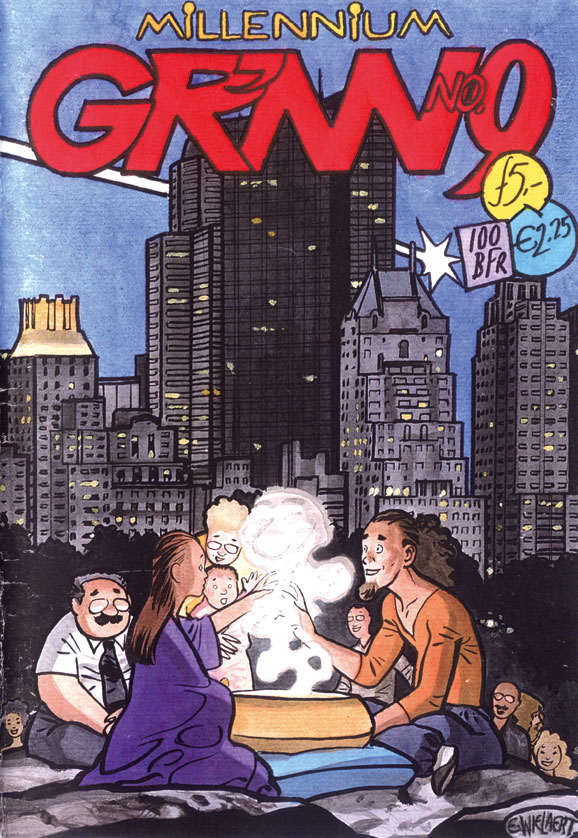
Cover illustrations for Gr'nn.
GR'NN
During the second half of the 1990s, Erik Wielaert began publishing his comics in Dutch indie comic magazines. Wielaert's passion project is GR'NN, a small press comic magazine circulating in Groningen. Initiated in 1996 by Edmond Spierts, AKA Vlerk, Wielaert was one of the original artists and editors, and has remained a loyal contributor to all of GR'NN's bi-annual publications. Each issue is built around a theme, and invites comic creators from the Groningen region to contribute a short story. A contributor to all the issues, Wielaert's stories were a showcase for his interest in parody, science fiction and fantasy. Among the core contributors to GR'NN, besides Wielaert and Vlerk, have been Diderik van Dijken, Erik Snelleman, NAAM (Bastiaan Hooimeijer) and Bafuss. New regional talent was also welcomed in its pages; in later years Dim Junius and Ruben Dimitri became GR'NN regulars. The group has also worked on other collective projects, such as expositions and installations. A highlight of their existence was the traveling "suitcase exhibition" to celebrate their 15th anniversary. In 15 Dutch cities, exhibitions were held in libraries and galleries (for instance Gallery Lambiek in Amstedam), with comic-related installations involving suitcases, every time featuring a local guest artist.
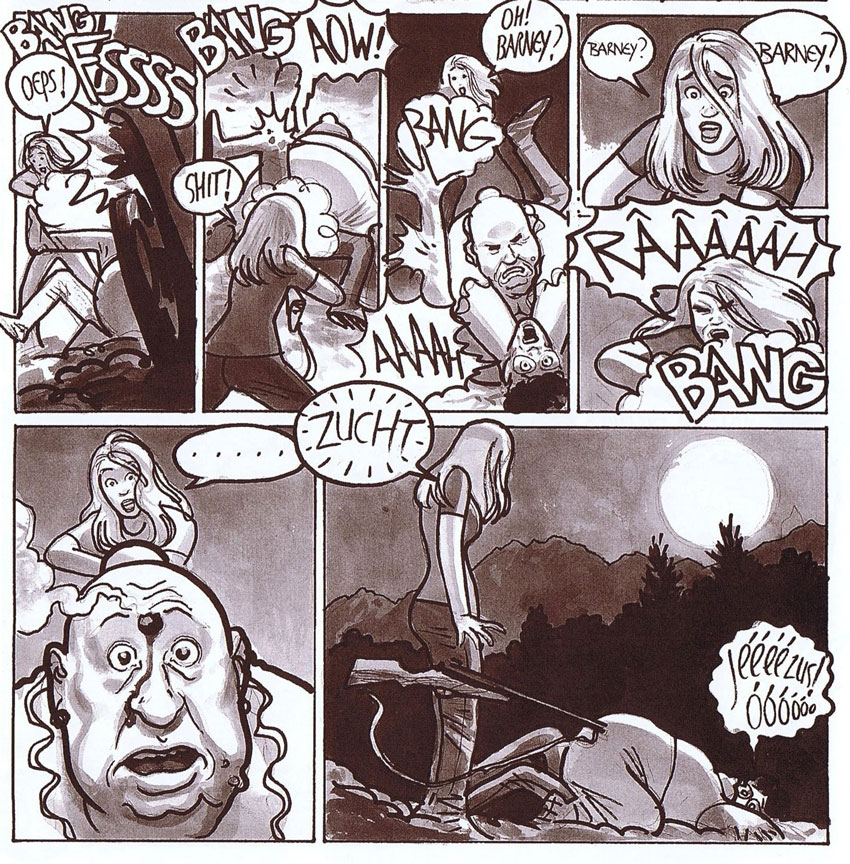
'Nachtschade'.
Incognito and other small press comics
Between 1998 and 2003, Erik Wielaert additionally made several one-shot comics for Robin Schouten's small press magazine Incognito and its companion comic book collection. Among them were 'Nachtschade' (2000), a series of three black comedy horror stories, and 'Waanklanken' (2001), which consisted of two short stories, namely the horror tale 'Met De Muziek mee...', and 'De Tol van de Roem' about the side effects of a djinn fulfilling the three wishes of an amateur rock band to become famous. Also for the Incognito collection, Wielaert drew the noir detective story 'De Zwarte IJscoman' (2003), scripted by Robin Schouten in what was his debut as a scriptwriter, though the title itself was thought up by Lode Devroe. The story was set in 1947 and unfolds as a film noir about a black ice cream salesman.
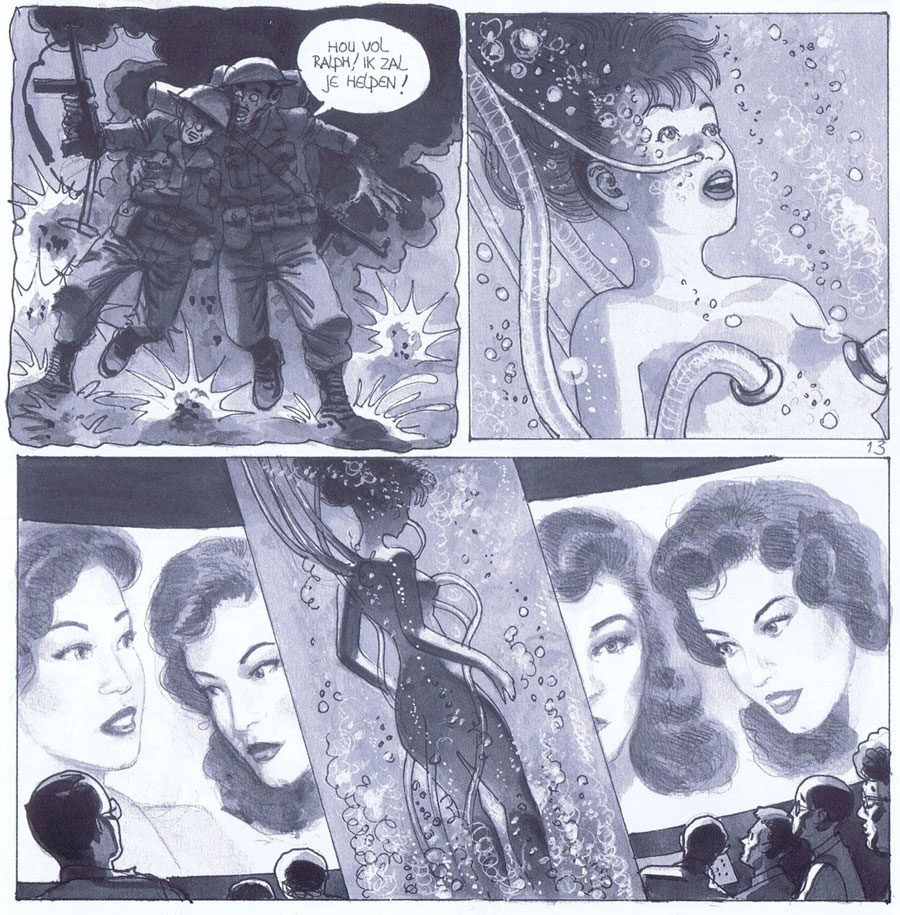
'De Zwarte IJscoman'.
Besides Incognito and GR'NN, stories by Erik Wielaert have appeared in Zone 5300, Lustre and MYX Magazine, and on the comics portal Stripster.nl. In 2006, Sherpa released 'Nacht en Ontij', a collection of 16 black-and-white short stories by Erik Wielaert from small press magazines. A typical showcase of Wielaert's crude sense of humor and parody was the story 'Kleine Dolf de Weerwolf, about a little wolf cub who accidentally tears his classmates to shreds. His sense for realism and horror was exemplified in the story 'Kommer en Kwel', a grim strip in which a man is harassed by an ever-growing group of beggars. In 2024, Erik Wielaert released the small press comic booklet 'Kosmisch gebeuren', which was nominated for the Cross Comix Small Press Award.

'Antropomorf' (Zone 5300, 2024).
Het Laatste Station
In 2007 and 2008, Erik Wielaert worked with the Flemish cartoonist Willy Linthout on the humorous police thriller 'Het Laatste Station'. The trilogy followed inspector Vandermeulen, who is struck by bad luck. He can't get along with his colleagues, his car breaks down and his mother lives in a retirement home where she can't cope with the death of her husband. He tries to find a mysterious serial killer who calls himself "the Monk" and who conducts a killing spree in the red light district until Vandermeulen realizes he too is a personal target.
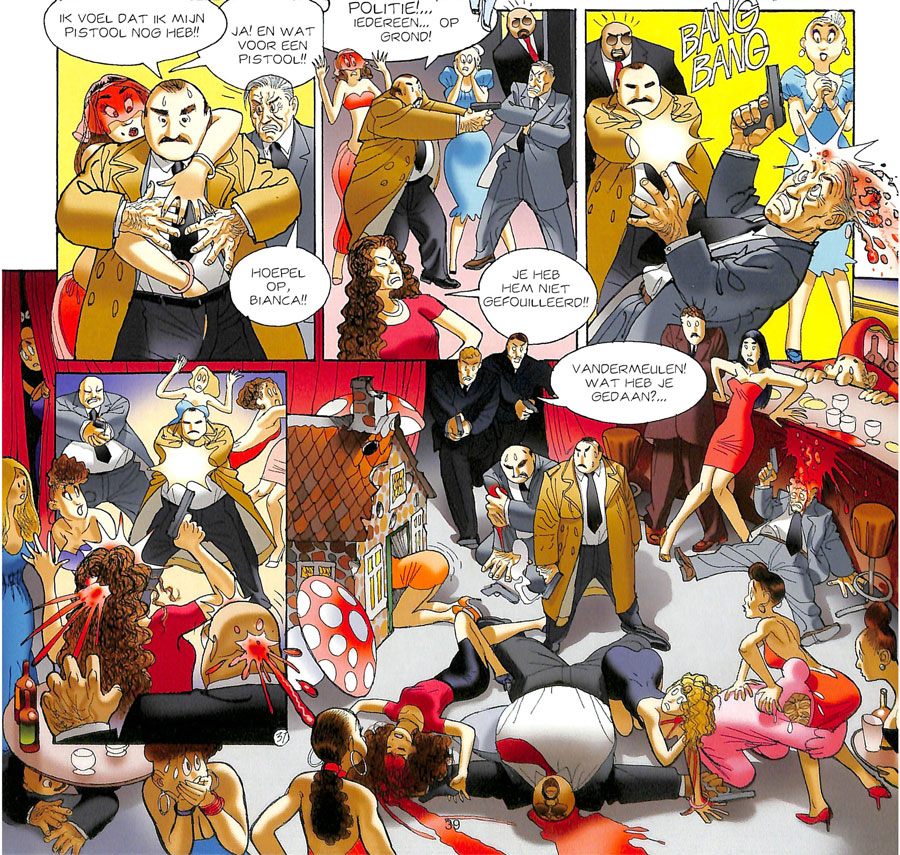
'Het Laatste Station' #2.
The subplot around the suicide of Vandermeulen's father was motivated by Linthout's grief over his 21-year old son, who also committed suicide. 'Het Laatste Station' was notable as Linthout's first attempt at more serious and dramatic storywriting, as the cartoonist was previously best known for parody comics and his comedic comic series 'Urbanus' and 'Roboboy'. Almost simultaneously, Linthout created the touching graphic novel 'Het Jaar van de Olifant' ('Years of the Elephant', 2007-2008), which expressed his grief over his son's untimely death more openly. Standaard Uitgeverij initially intended 'Het Laatste Station' as a diptych, but Linthout managed to persuade the publisher to make it a trilogy. This, however, resulted in a lower page rate for the third book, but Wielaert continued with the project because it was such an important story for Linthout to tell.
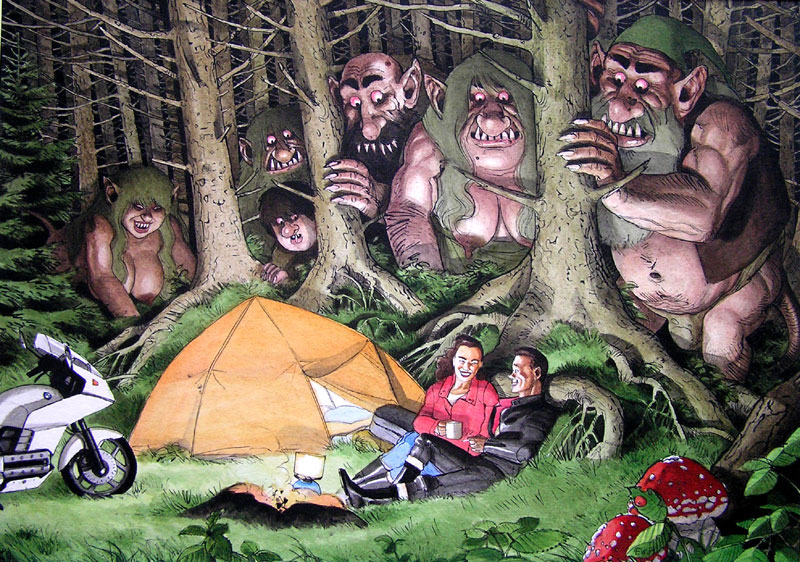
Illustration by Erik Wielaert, 1994.
Other work
Between 1997 and 2000, Erik Wielaert illustrated the serial 'De Kletter' in the university paper of the University of Groningen (RUG). At the same university, he also illustrated a promotional survey about comics by professor Rudi de Vries, a teacher of Business Management and Arts, Culture and Media. In the Belgian alternative comic magazine Parcifal, Wielaert illustrated Stefan Nieuwenhuizen's text story 'Ans en Greet en de Geheime Deur'. As an illustrator, Wielaert has made artwork for Minke van Dam's 'Sprookjes' (Noordhoff, 2016) and Richard Backers's juvenile educational book about pirates, 'Piraten' (Noordhoff, 2017). The artist is also known for designing new year's cards, T-shirts, party posters and beer labels.
On 1 September 2011, an exposition of Wielaert's work opened in Galerie Lambiek, and was on display throughout the entire month.

'Antonius & Cleopatra', for the 2024 edition of the Shakespeare magazine WILLIAM.
Graphic contributions
In 2006, Erik Wielaert contributed the story 'De Vampier van het Westerkwartier' to 'Groningen Bij Nacht' (2006), a collection of dark, short stories set in Groningen and written and drawn by artists hailing from that city. In 2007, Menno Kooistra's horror comic anthology Bloeddorst included his short pantomime comic 'Lamia'. In 2025, Wielaert also appeared in the second 'Bloeddorst' volume with the story 'Chimera'. In addition, Wielaert was one of the contributing artists to 'Mooi is Dat' (2010) and 'Filmfanfare' (2012), two anthologies with comic interpretations of Dutch literary works and movies, respectively. For years, Erik Wielaert has contributed comic stories to WILLIAM., the annual glossy magazine of the Shakespeare Theater in Diever.

One of a series of prints made by Erik Wielaert with Griffioen Grafiek in Amsterdam (2002).
In 2012, Erik Wielaert was the third of five comic creators to make a mural decorating the construction fencing surrounding the new buildings on the Grote Markt market square in Groningen. Each installment addressed the changes in the Groningen city center, linked to the construction status at that moment. The other installments were made by Sam Peeters, Barbara Stok, Bart Nijstad and Maria van Driel.

Erik Wielaert at work, photographed in 2006 by Robin Schouten.