
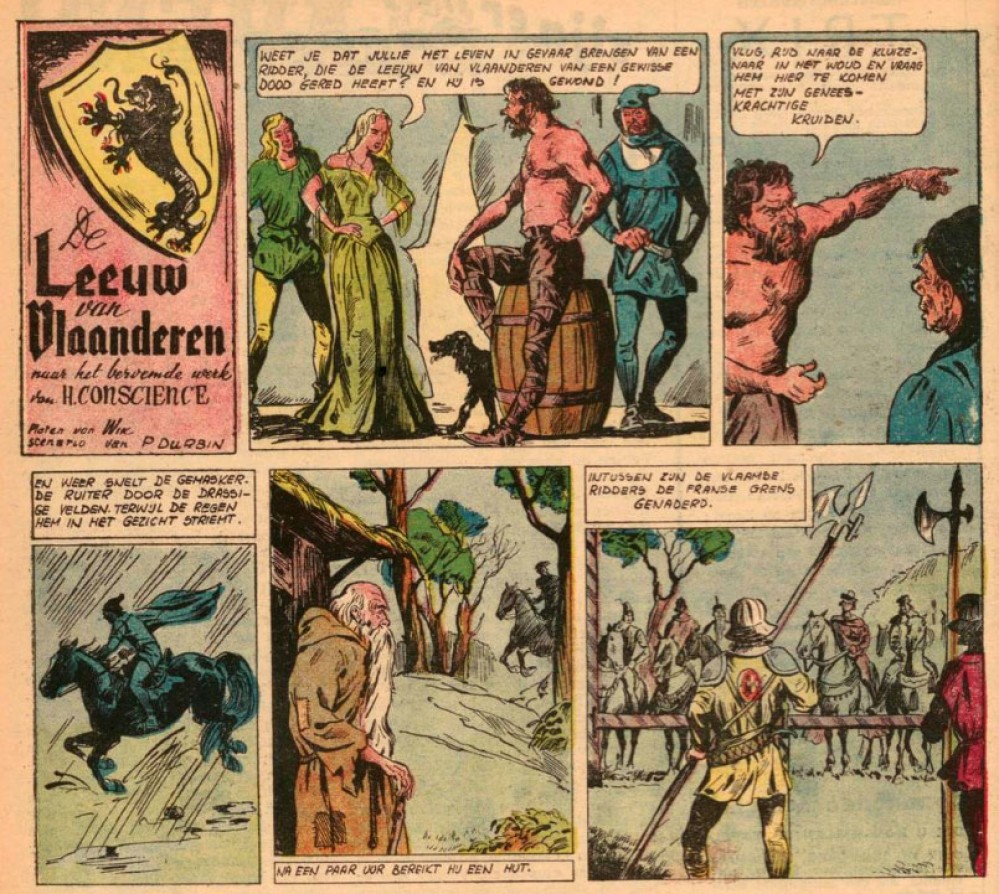
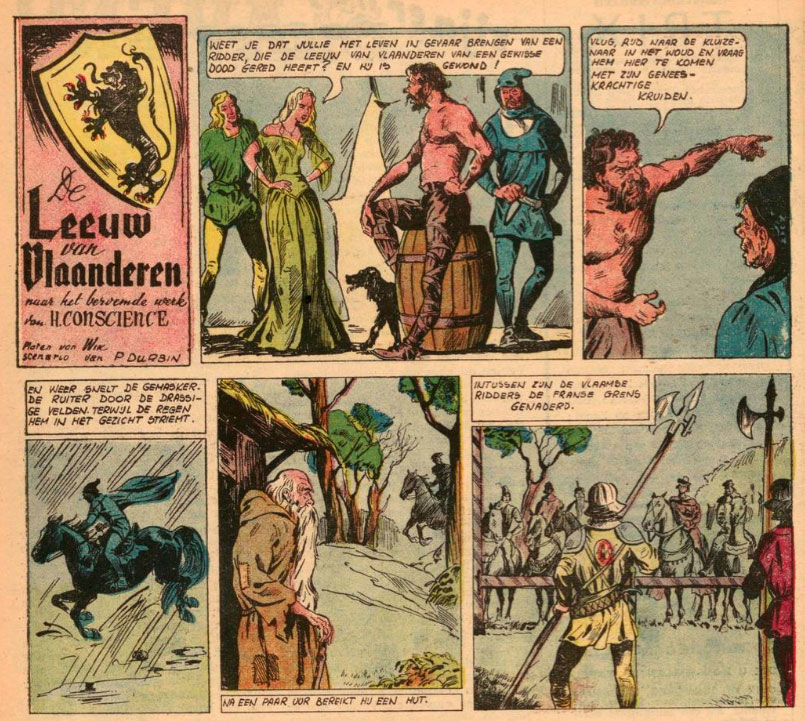
'De Leeuw van Vlaanderen' (Robbedoes #503, 17 November 1949).
Ludwik Cieślik was a Polish commercial illustrator and film poster designer, who came to Belgium as a refugee after World War II. There, he continued his poster work, using the abbreviated signature of "Wik". Between 1949 and 1951, he also tried his hand at comics, adapting Hendrik Conscience's book 'De Leeuw van Vlaanderen' in Robbedoes magazine. In his home country, Cieślik is also noted for his drawing capturing the suffering of the people of Warsaw during the Nazi occupation and the Warsaw Uprise.
Early life and career
Even though he went by the name of Ludwik Cieślik for most of his life, he was born in 1904 as Ludwik Heller into a wealthy Jewish family in Przemyśl in southeastern Poland. His father had made his fortune selling typewriters to the garrisons of the Austro-Hungarian army. As a child, Ludwik's was quickly pushed towards art, largely because of the drawing classes of the renowned Przemyśl expressionist painter Adolf Bienenstock.
After high school, in 1923, Heller enrolled at the Jagiellonian University in Kraków to study German, while moving in with his sister and her husband. In the city, he got involved in local art circles, but didn't stay in Kraków for long. After three years, his family sent him to Antwerp, Belgium, to study economics. The original plan was that he would go and work for his uncle Samuel in the United States, but this fell through due to his uncle's sudden death. Instead, Heller finally went for an artistic career and spent five years studying at Antwerp's Royal Academy of Fine Arts.
Returning to Poland in 1934, Heller settled in Warsaw, where he began his career as a film poster designer. Throughout the rest of the 1930s, he made local posters for movies from the American studios Metro-Goldwyn-Mayer and Warner Bros, as well as the popular Polish comedy 'Jadzia' (1936). During one of his trips to Lviv, he met the artist Temka Kritz, who became his wife on 3 September 1939.

'Suffering Warsaw 1944'.
World War II
After the Nazi invasion of Poland in September 1939, Ludwik and Temka Heller escaped to Lviv, which soon fell under Soviet occupation. There, Heller worked as a decorator at the local Grand Theater and a cartoonist for the Polish-language satirical magazine Krokodyl na Zachodniej Ukrainie ("Krokodyl in Western Ukraine", a local version of the Russian satirical mgazine Krokodil). When the Nazis invaded Lviv in 1941, the Hellers fled again, first hiding out in rural areas. In exchange for food and shelter, they performed painting and conservation work in churches. Eventually, the couple ended in Warsaw again, where they stayed in the Żoliborz district from 1941 to 1944. To hide their Jewish origins, Ludwik Heller and Temka Kritz became Ludwik Cieślik and Łucja Kastory, names they would keep for the rest of their lives.
During these years, the couple earned a living by drawing and selling postcards. After the capitulation of the 1944 Warsaw Uprising, they were expelled, along with the civilian population, to a transit camp in Pruszków. With the help of the friend, Ludwik was able to feign injuries to his head and avoid being sent to a concentration camp for forced labor. Instead, he and his wife were sent to Nasiechowice in Lesser Poland, where they stayed until the arrival of the Red Army.
In 1945, they moved to Kraków, where Cieślik found employment as a decorative painter at the Juliusz Słowacki Theater. During this period, he also created a portfolio of twenty-one drawings entitled 'Cierpiąca Warszawa r. 1944' ("Suffering Warsaw 1944"), published by the Kraków-based Franciszek Dabioch Graphic Works in 1946.


Belgian movie posters by Wik for 'Abbott & Costello Meet Captain Kidd' (1952) and 'Fortunella' (1958).
Move to Belgium
In 1945, Ludwik Cieślik and Łucja Kastory emigrated to Brussels, Belgium, where they were granted UN refugee status. There, Cieślik resumed his work as a commercial artist, establishing his own firm, Créations Publicitaires WIK SPRL - Affiches D'Art. His work included designing advertisements and, his old craft, posters for films shown in Belgian cinemas. During the rest of his career, he designed over a thousand film posters, singing them with the abbreviation "Wik". His designs included posters for Polish films such as Andrzej Wajda's 'Canal' and Jerzy Passendorfer's 'Assassination', as well as international hits such as Federico Fellini's 'La Strada' and Alfred Hitchcock's 'Vertigo'.
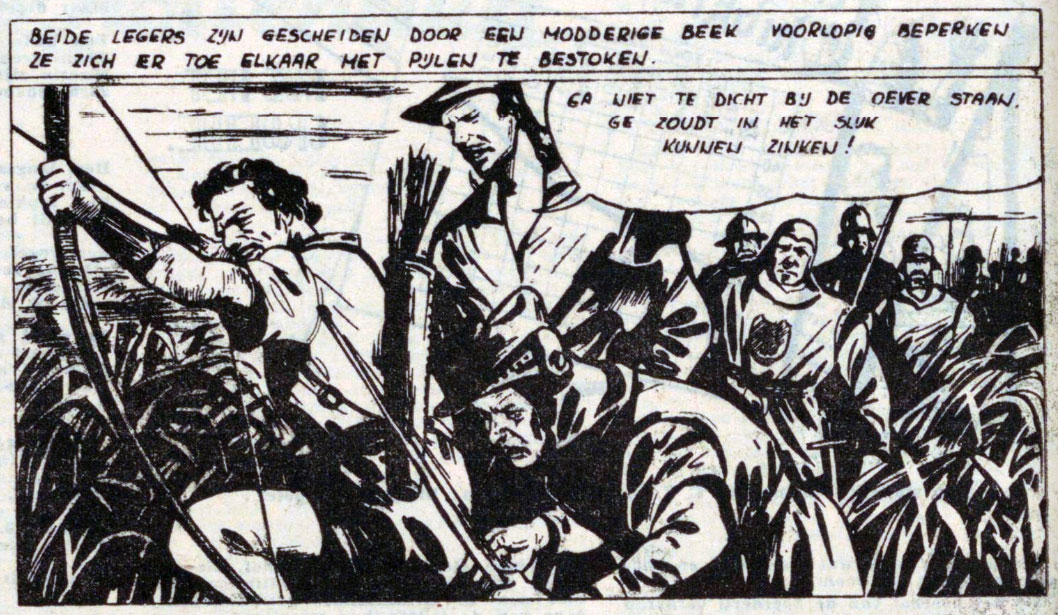
'De Leeuw van Vlaanderen' (Robbedoes #576, 12 April 1951).
De Leeuw van Vlaanderen
Besides posters and ads, Cieślik also made book illustrations, portraits and oil landscapes. For a short while, he also dabbled into comics, appearing in the pages of Robbedoes, the Flemish edition of Spirou magazine. During a period of almost two years, from 22 September 1949 through 16 August 1951, Robbedoes magazine ran Wik's comic serialization of Hendrik Conscience's 1838 historical novel 'De Leeuw van Vlaanderen' ('The Lion of Flanders'). The book was a romanticized account of the Battle of the Golden Spurs (1302), when Flemish troops won a victory over the French armies. At the time of its original release, Conscience's novel helped revive interest and pride in this almost forgotten medieval event. His book became a bestseller and the battle date itself (11 July) a national holiday for the Flemish community. In 1934, it was first turned into a comic story by Eugeen Hermans, also known as Pink.
The artwork of the comic version of 'De Leeuw van Vlaanderen' in Robbedoes was credited to Wik, while P. Durbin was mentioned as the writer. The latter was probably Paul Durbin, a writer/journalist for Humoradio, another magazine of the Dupuis publishing house. Remarkably enough, the story ran exclusively in Robbedoes, and not in the French-language parent magazine Spirou. The serialization was most likely an attempt by publisher Dupuis to boost the sales in the Dutch-speaking regions of Belgium, by running a comic with a strong appeal to Flemish readers. Almost in exactly the same period, Spirou's main competitor Tintin ran Bob De Moor's adaptation of the same book in its Dutch-language edition Kuifje. But while De Moor's version has become a classic of Belgian comics, the Wik-Durbin adaptation has faded into obscurity.
For a long time, it was unknown who the creator behind the signature "Wik" was. In hindsight, it is remarkable that the artist of this Flemish-nationalist novel was actually a Jewish-Polish immigrant.
Later life and legacy
In 1968, Ludwik Cieślik returned to the theme of the Warsaw Uprising during World War II, creating a series of lithographs entitled 'Warsaw 1944'. He continued his work as an illustrator until the late 1970s. It wasn't until 1988, at the age of 84, that he obtained Belgian citizenship. Two years later, Ludwik Cieślik died in 1990 in Brussels.
The artist's son, Stanislaw Cieślik was born in 1948 in Belgium, and was for a long time not aware of his full family story, including their Jewish roots. Only after his father's death in 1990 did he begin to uncover family secrets. Since then, Stanislaw Cieślik has been dedicated to commemorate his father's work by organizing expositions in Poland and abroad. With his involvement, the National Museum of the Przemyśl Region in Przemyśl organized two exhibitions devoted to the work of Ludwik Cieślik: 'Ludwik Cieślik (Heller) (1904–1990): The Sleeping City' in 2022 and "WIK: Ludwik Cieślik's Film Posters" in 2024.

Ludwik Cieślik in 1958. Photo from the collection of Stanisław Cieślik.