



'Persepolis 2'.
Marjane Satrapi was an Iranian-French comic artist and film director, who received global acclaim with her autobiographical comic books. Her debut 'Persepolis' (2000-2003) chronicled her life in Iran under the regime of the Shah, Khomeini and Khamenei, simultaneously reflecting on the spirit and rebellion of ordinary Iranian people. Over the years, 'Persepolis' has won several awards, was translated in many languages and adapted into an animated film, but also banned in Iran, Lebanon and some U.S. school districts. In addition, Satrapi drew two more modest graphic novels, 'Embroideres' ('Broderies', 2003) and 'Poulet Aux Prunes' ('Chicken With Plums', 2004), covering memories of her relatives. A vocal political-social commentator, Satrapi frequently made headlines with her belligerent criticism of religious fundamentalism, racism, war, nationalism and the prejudices regarding women. From the late 2000s on, Satrapi was mostly active as a director of live-action films, some being adaptations of her own comics.
Early life and career
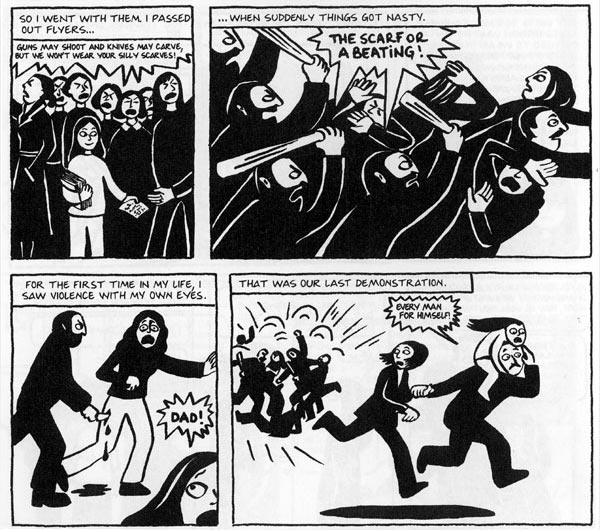
Marjane Satrapi was born in 1969 in Rasht, Iran, as Marjane Ebrahimi. She was the daughter of an engineer, and her mother was a dress designer. Her maternal great-grandfather was Nasser-al-Din Shah, emperor of Persia (1848-1896), making her grandfather a prince. But since Nasser-al-Din Shah had 100 wives, these blue-blooded roots were really not all that special, as Satrapi herself remarked. Satrapi was raised in a progressive, socially conscious and secular family. Her parents often went to demonstrate against the dicatorial regime of Shah Mohammed Reza Pahlavi, which had many citizens arrested, tortured and executed. One day, she went along with them, but had to flee once the armed forces beat back.
When Satrapi was nine, in 1979, the Shah was ousted in a coup. Political dissident Ruhollah Khomeini became ayatollah and established an even more repressive dictatorship with stronger emphasis on Islamic principles. From one day to another, all schools became Islamic, separating boys and girls in different buildings and submitting all the students to a dress code. Satrapi's uncle from her father's side, Anoosh, was a resistance member who lived in the Soviet Union for a while. When he returned to Iran, he was arrested and sentenced to death. The night before his execution, he was allowed to see one visitor and he chose his niece Marjane, with whom he had always been close. Many of Marjane Satrapi's other relatives and friends were either arrested or murdered, or decided to immigrate. Apart from turning into a Muslim-fundamentalist dictatorship, her country was also dragged into a long war with Iraq (1980-1988). Satrapi was 13 when a neighbor's house was bombed. In the rubble, she saw a schoolfriend's ripped off hand.

'Persepolis 1'.
Satrapi's parents feared for their daughter's safety. In 1984, 14-year old Marjane was sent to Vienna, Austria, for four years, where she studied at the local lyceum. Her mother had always stressed the importance of being economically independent, so she wouldn't have to rely on a husband. Interviewed by Emma Watson (Vogue, 1 August 2016), Satrapi explained that in the sexist culture of Iran, women are more determined to study and as a result two-third of them end up being more educated than their own father, husband or brother, giving them the possibility of working for a living and, if necessary, get a divorce: "First you have to have economic independence of women, and then we can talk about the freedom of women. If women are educated, they will be economically independent and they will just accept less shit. That is the first step toward democracy." Still, as a child, Marjane misinterpreted her mother's good advice and thought she insinuated that she was too ugly to get married, so she at least could try to be bright.
Vienna was a bit of a culture shock for Satrapi. She had a hard time trying to fit in, facing prejudice and misunderstanding. Hanging around with the wrong kind of friends, she started dealing weed and had a relationship with a student whom she eventually caught cheating on her. Around the same time, she ran out of money and was kicked out of her student home on the false accusation of theft. For three months, Satrapi lived on the streets, until a severe case of pneumonia almost ended her life. Luckily she was found and hospitalized, allowing her to make some necessary phone calls so she could fly back to Iran in 1988.

'Persepolis 2', English-language edition.
Although the Iranian-Iraqi War had ended, many of her friends and relatives had perished. The identity crisis that plagued her as a student in Vienna simply continued in a different form. In Austria, she was an insecure adolescent succumbing to a marginal lifestyle, feeling as if she had disrespected her relatives and the values they had taught her. Back in Iran, many of her former school friends now regarded her as a decadent, immoral westerner. After a failed suicide attempt, she found new energy when she tried to get accepted at the Islamic Azad University of Tehran. Despite being required to be well-versed in Islamic teachings, she admitted at the ideological test exam that she wasn't very devout and didn't understand enough Arabic to read the Koran in its original language. Much to her surprise, her honesty was appreciated and she was accepted. She even started a romance with one of her fellow students, but since guards could arrest any couple without a marriage licence, they had to keep their relationship a secret. At age 21, she eventually married her boyfriend. Right after the ceremony, Satrapi instantly felt confined to a life she didn't actually want. After three years, the couple divorced.
Having tasted freedom in Europe, Marjane Satrapi felt life in Iran had become unbearably authoritarian. In her opinion, she had to follow ridiculously specific dress codes and even more absurd art lessons, where all female models had to be veiled, while she and the rest weren't even allowed to look at the male models. Speaking up, she was granted permission to seek and design a compromise in the official school dress code. To enhance their drawing skills, Satrapi and other students also organized their own private, uncensored sketching sessions at home. Regardless of these minor victories on the system, life remained hard. Because she was a woman, Satrapi had a second-class citizen status. When the police raided one of their secret house parties, one of her friends tried to run away on the rooftop and fell to his death. An art project she worked on for months and which had received good grades couldn't be exhibited because it didn't fall in line with government guidelines. After graduation, Satrapi found a job as illustrator with a financial magazine in January 1994. Yet two months later, two of her colleagues were arrested for drawing "subversive" cartoons", with one of them mysteriously "disappearing".

'Persepolis 4'.
In September 1994, Satrapi left Iran for good, fed up with being held on an ever-tightening leash that might as well one day turn into a noose. She moved to France, studying at the École Supérieure des Arts Décoratifs in Strasbourg. To support her studies, she taught languages, since she spoke French, German and English, as well as her native Farsi (Persian). Later, she could also add Italian and Swedish to her vocabulary, after marrying the Swede Mattias Ripa, with whom she moved to Paris. For a while, she also taught aerobics, though she looked back on this job with the intriguing question: "What was I thinking?"
After the success of 'Persepolis', Satrapi brought more global attention to her country and herself, but simultaneously made it even more impossible to ever return to Iran, where she was considered a persona non grata and where her books are banned. Interviewed by CBC (21 September 2011), Satrapi said that she misses "the snowy mountains of Iran, the pollution of Tehran and the humor of the people." Yet, she didn't consider herself to be nationalistic, because "I think one of the sicknesses of the human being is being too patriotic. There is only one identity, and that is human identity." During her life, she learned to appreciate elements of various countries and people for different reasons.

'Embroideries'.
Comics career: style
In Iran, comics were available during Satrapi's youth, but there wasn't a genuine homegrown comics culture. Her cousins read Hergé's 'Tintin', Albert Uderzo's 'Astérix' and other translated foreign comic books, but most didn't interest her, since they lacked female protagonists. At age 7, she and her younger cousin read a 'Dracula' comic book and pretended to be able to read the English dialogues. She fantasized that "eating raw chicken" was recommended to become "like Dracula". By the end of the summer, they were diagnosed with worms. Satrapi stated that this was probably the main reason why she had no fond memories of comics. The only one she remembered reading all the way through was a moralistic comic book her parents gave her, titled 'Dialectic Materialism'.
In 1995, while living in Paris, Satrapi received Art Spiegelman's 'Maus' for her birthday. After reading the book, which dealt with the past of Spiegelman's father as a Holocaust survivor, she was impressed that a comic book could deal with such heavy-handed subject matter. It inspired her to make an autobiographical book of her own. While she could have simply written a book, she opted for a comic, as she considered drawing more universal, because people made figurative paintings before writing was invented. A drawing is abstract and an interpretation of reality, which helps people all over the world identify with the emotional content, regardless of language. Interviewed in Literal Magazine, Satrapi dismissed the term "graphic novel" to describe what she perceives as just a snobby term for "comic book" : "I chose (...) comics (...) because it belongs to the popular arts. I didn't want to make any artistic work that would only be conceivable by the elite. I wanted people to have access to it." Later in life, Satrapi also expressed admiration for Joe Sacco and Chris Ware.
Marjane Satrapi applied a simple and minimalist graphic style. Interviewed by Charles Burns (not the comic artist) for The Independent (1 October 2006), she stated: "I've learnt to communicate emotion using very little detail. (...) You can spend 300 million dollars and produce a crock of shit like 'Titanic'. Truffaut made wonderful films with small budgets. It's the same with graphic novels. You get artists who are basically showing off. 'Just look how I've drawn this arm – you can actually see the veins! Marvel at my virtuosity.' That's not me." Interviewed by Review Graveyard (18 August 2008), Satrapi attributed her global success to her "abstract, black-and-white drawings. I think this helped everybody to relate to it, whether in China, Israel, Chile or Korea, it's a universal story. 'Persepolis' has dreamlike moments, the drawings help us maintain cohesion and consistency, and the black-and-white (I'm always afraid color may turn out to be vulgar) also helped in this respect, as did the abstraction of the setting and location."
All three of Satrapi's released comic book titles dealt with personal (family) history and memories. Nevertheless, interviewed by Emma Watson (Vogue, 1 August 2016), Satrapi said she didn't consider her work autobiographical, because "(...) an autobiography is a book that you write because you hate your family and your friends and you don't know how to say it to them, so you write a book and let them read it themselves." Rather than tell a full-blown, detailed, long-winded story about herself, she selected small, but representative and relatable anecdotes that help the reader understand a more complex series of events. Paraphrasing Leo Tolstoy, Satrapi summarized :"If you want to talk to the world, talk about your village." For the same reason, she also uses humor in her work to lighten up some of the tragic events: "I am completely convinced that all human beings will cry for the same reasons. Around the world, we will all cry because our father is dead, our mother is sick or our child has a problem. However, we don't laugh for the same reasons. To me, laughter is the height of the understanding of the other. It's touching the spirit of the other. (...) It's more of an abstract notion, and to be able to laugh at people is not instinctive at all."

'Persepolis 1'.
Persepolis
Titled after the capital of the Persian Empire, 'Persepolis' is a four-volume autobiographical graphic novel, published between November 2000 and 2003 by the alternative comics imprint L'Association. The series covered Satrapi's lifestory, which she wanted to put on paper for two main reasons. First, to end all the repetitive questions she received from people about "what it is like growing up in Iran". Secondly, to show foreign readers that the Middle East, and Iran in particular, is often misrepresented in the media. Interviewed by James Mottram (List, 2008), she stated: "The image in the media - calling people terrorists, fanatical, etc. - is extremely condescending. It is dangerous when you start calling people from one part of the world terrorists or fanatics, and you reduce them to some abstract notion. If evil has a geographical place, and if evil has a name, that is the beginning of fascism. Real life is not this way. You have fanatics and narrow-minded people everywhere." To make 'Persepolis', Satrapi went to a comic studio in Paris, used by L'Association members, since her friend David B often worked there. In this environment, she didn't have the distractions she faced at home and more incentive to continue drawing.
The first two volumes of 'Persepolis' follow Satrapi's childhood and early puberty in Iran. At first, she is a typically naïve child who doesn't fully understand how she is subjected to government propaganda. Growing older, she learns from her parents how the Shah is not a "divinely chosen monarch", but has persecuted many people, including several relatives. When Khomeini transforms Iran into an Islamic-fundamentalist state, the repression becomes even more rigid. People aren't allowed to dance, own card games or chess board sets and have to wear specific, "non-revealing" clothing. The young Satrapi is critical of these religious dogmas, but also questions why their house maid isn't allowed to dine with them, nor marry men of higher social class. As she grows into a teen, she becomes more rebellious, often getting into trouble with teachers, guards and self-righteous passers-by, who scold her and others for "not following the rules."
Simultaneously, Satrapi's book offers a look at Iran's strong family culture and the daily lives of the common people. Despite the dictatorship, some people show defiance against the oppression. The black market thrives and she buys many illegal books, videos and records there. Her parents smuggle rock posters for her from Turkey. Secret alcohol-fuelled dance parties are held. Satrapi also showed that many women do have a mind of their own and some dare to take a stance. One of her aunts on her mother's side was, for instance, a confident single woman who preferred having affairs over being forced into marriage.

'Persepolis 3'.
In the third and fourth installment of 'Persepolis', Satrapi covers her wandering years as a foreign-exchange student in Vienna and her equally alienating return to Iran. Portraying her as a young adult, both books address her identity crisis, facing prejudices in Europe for being "an Arab", while being criticized as a decadent and promiscuous "Westerner" among some of her fellow Iranians. Interviewed by Annie Tully (2004), Satrapi explained: "(...) When you are going to a new culture and you absolutely want to adapt yourself, and you absolutely want to be integrated: you have to forget about your own culture first (...) because culture takes all of the space inside you. If you want to have another culture come into you, it's like you have to take out the first one, and then choose what you want from the two and swallow them again. But it's the moment you look at everything that it's this lack of identity. You don't know anymore who you are. You want so badly to be integrated, but at the same time you have a whole thing that is inside you. (...) I'm a foreigner in Iran (...) It's a good thing to not belong to any place anymore, at the same time it's a hard feeling."
Looking back at the events that shaped her life, Satrapi said in the aforementioned interview with The Independent: "When you're dropped in a pile of shit, so to speak, you have to decide - either add to the pile, or use it as fertilizer, and grow flowers." There were many traumatic moments that she really wanted to forget, but had to include to give an honest portrayal. Interviewed by Emma Watson (Vogue, 1 August 2016), she recalled writing her first draft but being too full of hate and anger. Realizing this made her exactly like the people she disliked, she took some time to cool down and understand what happened, helping her to analyze it better.

'Persepolis 4'.
In 'Persepolis', Satrapi portrayed herself as a strong-willed individual, rebelling against people and systems she regards as unfair. At the same time, she didn't pretend to be a role model. Often she loses her temper, is impatient or too outspoken for her own good. She gets into arguments, is thrown off school and can sometimes be naïve, or in self-denial. An enthusiastic chain smoker, she succumbed to drug dealing in Vienna and lived on the streets for three months, grabbing food from garbage containers. Some of the risks she took in Iran almost got her into trouble and she was arrested a few times. Once she quickly distracted a guard by accusing a passer-by of having tried to assault her. Afterwards, her grandmother scolded her for doing something so irresponsible and refused to speak to her for days. Interviewed by Dave Welch (Powells.com, 17 September 2004), Satrapi explained: "I consider myself a nice person, but even I could do that out of fear. I was trying to say that what you have to be scared of is the fear itself. Nothing but that. When you are scared, it's your muscles that get completely stuck, but also your brain. You don't think properly." All-in all, 'Persepolis' became an honest portrayal of Satrapi's lifestory, told in a captivating, sometimes funny, other times disturbing, but always moving manner.

From the 'Persepolis' film.
Persepolis: success & film adaptation
Before L'Association picked it up, 'Persepolis' was rejected by several publishers. The art director of a prominent French publisher hated her work so much that he told her it had no style and went in all different directions. After being published in 2000, 'Persepolis' became a bestseller, was translated in several languages and won many awards. Satrapi met the publisher who rejected her before and, ironically enough, now praised her "stylistic versatility". Satrapi reminded him that he told her the opposite, but he didn't remember her. Nevertheless, since she was not a vengeful person, they did end up working together.
In 2007, 'Persepolis' was adapted into a feature film by Marjane Satrapi and Vincent Paronnaud, with whom she once shared a studio. It was decided to make the film animated, because with live-action it would have made the story too exotic and distant, losing the universal appeal. One of the artists who collaborated on the film was the comic creator Winshluss. Marc Jousset served as its artistic director. The visual design was inspired by German expressionism, shaping backgrounds into stylized objects that reflect the mood, while the fast pace was influenced by Martin Scorsese's 'Goodfellas'. For Satrapi, it was a bewildering and sometimes emotional experience, since the animators worked with model sheets based on herself, family members and friends, some of whom had died. She talked about them as if they were characters of fiction, because if she would have gotten worked up about it, the animators wouldn't have been able to do their jobs. Satrapi was thrilled that she could get two legendary French actresses, Danielle Darrieux and Catherine Deneuve, to voice respectively her grandmother and mother. Deneuve's fame had reached even Iran, parallelled only by Brigitte Bardot. In the English-language version, Uncle Anouche was voiced by Iggy Pop, her favorite musician, whom she deliberately mailed to ask him to play this part. Satrapi later returned the favor by designing the cover of Iggy Pop's French-language cover album, 'Préliminaires'.
Predictably, the 'Persepolis' film was banned in Iran and Lebanon, while the Iranian government also registered official complaints when it was screened at the Festival of Cannes and selected for the Academy Awards. Under pressure from the Iranian embassy, 'Persepolis' was withdrawn as the opening film at the Bangkok Film Festival. The picture nevertheless won the Cannes Jury Award, the Gat Perich International Comedy Award and two Césars for "Best Debut Film" and "Best Screenplay Adaptation". It was also nominated for an Academy Award for "Best Animated Feature", but lost to Disney/Pixar's 'Ratatouille'. Eventually Lebanon undid the ban on 'Persepolis' and Satrapi's comics in 2008. 'Simpsons' creator Matt Groening named 'Persepolis' one of the best animated films he had seen in years. The film was parodied in 'The Simpsons' episode 'Angry Dad: The Movie' (2011) at an animation festival where Bart Simpson is present. Satrapi was also "special guest voice" in the episode 'Springfield Splendor' (2017).
Between 12 and 25 October 2022, original pages of 'Persepolis' were auctioned at Sotheby's in London. Another Iranian graphic novelist who made a book about her experiences growing up in Iran is Mansoureh Kamari, with the comic 'Ces Lignes Qui Tracent Mon Corps' (Casterman, 2025). Another critically acclaimed autobiographical comic series dealing with the author's early years under a totalitarian regime was 'L'Arabe du Futur' ('The Arab of the Future', 2014-2022) by Riad Sattouf.

'Embroideries'.
Embroideries
In 2003, Marjane Satrapi made 'Embroideries' ("Broderies"), a more modest and intimate graphic novel about a custom she observed many times in Iran. Every afternoon, after lunch, while men take a tiny siësta, women clean off the table and have a little chat over tea. In 'Embroideries', she depicted such an event, portraying herself amidst her grandmother, mother and girlfriends. Her specific task was usually to prepare the samovar to boil the tea and water. In this cosy atmosphere, with no men around, women feel more open to share secrets, confess problems and ask for support and solutions.
Although this description makes 'Embroideries' seem anecdotal (especially after the four-volume 'Persepolis'), Satrapi used this tea chat as an allegory. She brought all her memories of these chats together in one, long hypothetical conversation with flashbacks. This set-up lead to a more revealing contemplation on the lives of women in traditional Iranian culture. A recurring topic was the women's love lives or, better said, the lack of it. Several of them had been forced into weddings. Their "purity" was so valued that they had to keep any previous relationships or sexual intercourse a secret, out of fear of being accused of "dishonoring" their families. Some even underwent surgery to change their nose or reconstruct their hymen. Their stories are sometimes funny, other times more tragicomic, like the mother of five who has been so shielded from nudity that she confessed never having seen a penis, since she and her husband always have sex with the lights off. While Satrapi made the institutional sexism and sexual repression in Iranian society more tangible, 'Embroideries' also reveals how women deal with these obstacles. Satrapi's aunt is uncompromisingly independent, while Satrapi's wise grandmother knows a solution to every problem. 'Embroideries' has been translated into English, Dutch, German, Spanish and Portuguese.

'Chicken With Plums'.
Poulet Aux Prunes
In 2004, Satrapi released 'Poulet Aux Prunes' ('Chicken With Plums'), a story about her relative Nasser Ali Khan, who was active as a musician. Khan played a variation of the lute, named a "tar". One day, he died for reasons that always remained unclear. This gave Satrapi room for personal interpretation. As the graphic novel visualizes, Khan's instrument is broken after an argument with his wife. He tries in vain to get it repared, but it never sounds the way he wanted again. Severely depressed, Khan decides to no longer come out of his bed and die from starvation. In Satrapi's book, the last week of Khan's life is presented. Hallucinating from hunger, he reflects on his life and the events that shaped it. Interviewed by Chris Mautner for The Patriot-News newspaper (nowadays PennLive) in 2006, Satrapi said her version of Khan is a mixture of many anecdotes about people she used to know.
'Poulet Aux Prunes' is a melancholic story about depression, artistic choices and people wasting their anger and energy on things that seem trivial to others. Satrapi recognized a lot of artists, including herself, in Nasser's personality. Interviewed by Simon Hattenstone (29 March 2008), she explained: "He is completely unbearable, narcissistic, egocentric, but also lovely and charming. That's actually how I see myself. You have to be narcissistic to be an artist. You have to think you are the centre of the whole thing, otherwise why do you create? The only thing is to recognize it, and then you make the best of it." Indeed, much of Khan's depression isn't so much that he grieves over his instrument, but more over his unhappy marriage and bad life choices. In his obsession, he also doesn't look at what he does have. Nasser, for instance, feels that his children don't respect him, even though they are simply showing their young age. At the same time, he fails to realize that his younger son actually looks up to him.
Satrapi always felt 'Poulet Aux Prunes' was her best book. In 2010, she adapted it into a live-action comedy film, co-directed by Vincent Paronnaud. The role of Khan was played by Mathieu Amalric, whom Satrapi felt had "incredible, perfect eyes" for the role. A main difference between the graphic novel and the comic book though, was that the tar was changed to a more common violin. A French-Belgian-German co-production, the film co-starred a few internationally famous actors in supporting roles, namely Isabella Rossellini (who plays the role of Parvine) and of 'Pulp Fiction' fame, Maria de Medeiros (Faringuisse).


Posters for Marjane Satrapi films.
Film career
Despite being a successful and globally praised comic artist, in the late 2000s Marjane Satrapi's interests shifted more towards film. She even announced that she wouldn't make new comics again. Interviewed by Publisher's Weekly, she elaborated: "That chapter of my life has been left behind me. I've always been like that - I'm like a car that can't go backward. Making comics isn't difficult, because I know now how it's done. My life is nothing but searching, I don't want to feel at ease. I love chaos. I'm not going to live another 300 years. I have to explore everything I can before I die."
After her acclaimed animated feature adaptation of 'Persepolis', Satrapi directed a live-action comedy film, 'La Bande de Jotas' (2013), about two friends in Spain who, after mixing up their luggage, get involved in an intrigue where they are shadowed by the maffia. Notable roles in the film were portrayed by Satrapi herself, and by Maria de Medeiros (of 'Pulp Fiction' fame). Her next film was the horror comedy 'Les Voix' (2014), a German-U.S. co-production based on a screenplay by Michael R. Perry. The plot revolved around a schizophrenic man (played by Ryan Reynolds) who thinks his pets talk to him and starts a killing spree. The picture received the Jury and Audience Award at the International Festival of the Fantastic Film in Gérardmer.
In 2019, Satrapi made her first film adaptation of another comic creator's work, 'Radioactive', based on Lauren Redniss' graphic novel 'Marie & Pierre Curie: A Tale of Love and Fallout', about chemist and physicist Marie Curie (played by Rosamund Pike). She read the script before knowing it was based on a graphic novel. Curie was, along with Simone de Beauvoir, one of the women Satrapi's mother admired. As a child, Satrapi wanted to become a scientist, "like Curie", but saw her dreams destroyed when the Iranian government closed down the universities in 1980. Satrapi admired Curie for defying the sexism of her era, while her husband, Pierre Curie, stood by her side. Originally standing in Pierre's shadow, Marie Curie eventually grew more famous than him to the point that Curie's granddaughter personally asked Satrapi to not forget to acknowledge his achievements too. Satrapi acknowledged that Marie Curie wasn't a perfect person (which she doesn't believe exists anyway) and her discovery of radium both led to use beneficial to mankind (cancer radiation treatment) and atrocious abuse (nuclear bombs).
The last film Satrapi directed was 'Paradis Paris' (2024), a story following various characters in the French capital whose lives are intertwined by the city and death. Monica Bellucci played the role of Giovanni Bianchi, while Satrapi herself had a small role as a film director. Satrapi also had a small role in the film 'Les Beaux Gosses' (2009), directed by comic artist Riad Sattouf, in which she played a music store saleswoman. In 2026, not long before her death, Satrapi established a foundation at the Parisian Academy of Fine Arts to help foreign students with audio-visual projects.

'Femme, Vie, Liberté'.
Political-social activism
An articulate artist, Satrapi frequently criticized Iran's political leaders, both under the Shah and the ayatollahs who followed. After the Iranian elections (2009), she and film director Mohsen Makhmalbaf (best-known for 'Kandahar') made an appearance in the European Parliament to present a document that proved that politician Mir Hossein Mousavi, in favor of reform, had actually won these elections. In Shanghai, two young Iranians using the pseudonyms Sina and Payman asked Satrapi permission to make a protest video against the fraudulent election results, based on her drawings from 'Persepolis'. Titled 'Persepolis 2.0', it was posted on www.spreadpersepolis.com.
On 8 March 2023, a group of young women in Tehran were arrested because they had danced in public and hadn't worn their headscarfs. They were pressured by the Iranian government to offer public apologies. Footage was shown of the girls dancing to 'Calm Down' by Rema. Satrapi joined several people in a protest march in front of the Iranian embassy in Paris, where they danced to the same recording.
Satrapi organized the collective comic book 'Femme Vie Liberté' (L'Iconoclaste, 2023), based on a real-life 2022 incident in Tehran, Iran, where another young woman, Mahsa Amini, was arrested by the police for "not wearing her headscarf correctly". They obtained and tortured Amini causing her to fall in a coma for three days and die. Her death sparked huge demonstrations in Iran, with many women deliberately not wearing their head scarves. But, as always, the government oppressed the demonstrators with bloody force. 'Femme Vie Liberté' contained articles by politicologist Farid Vahid, journalist Jean-Pierre Perrin and historian Abbas Milani which explained the circumstances of Amini's death and Iranian politics in general to Western readers. The artwork was provided by Bahareh Akrami, Bij, Patricia Bolaños, Coco, Deloupy, Hamoun, Hippolyte, Catel Muller, Pascal Rabaté, Paco Roca, Joann Sfar, Touka Neyestani, Lewis Trondheim, Nicolas Wild and Winshluss. Satrapi herself also contributed a few illustrations. 'Femme Vie Liberté' has been released in several languages, including in English (as 'Woman Life Freedom') and in an online Persian version that can be downloaded for free. The Iranian government went so far as to put a propaganda book online under the same title, to confuse readers into thinking they had downloaded Satrapi's book.

Exclusive comic strip by Marjane Satrapi for The New York Times, 28 May 2005.
Although Satrapi was frequently interviewed to give her opinions about politics and culture in Middle Eastern countries, she was not somebody to be easily pigeonholed. She acknowledged the macho culture in Iran, where women are forced into submissive role patterns, but has pointed out that men too suffer under this repression, albeit in a different way. Many boys are expected to join the Iranian army and serve the country. Just like women have to be veiled, men aren't allowed to wear short sleeves. Satrapi was concerned about women's rights in many countries, but at the same time didn't agree with all principles of feminism. She wasn't opposed to the veil, but more against women being forced or forbidden to wear it.
Satrapi also criticized the United States and European countries in their warfare and anti-immigration politics. In her opinion, there was no difference between the religious fanaticism among Islamic regimes in the Middle East and the same rhetoric by the US Presidential administration, who also claim God is with them to justify wars. Interviewed by Matt Anderson (25 January 2008), Satrapi pointed at centuries of colonialism and three generations of Arab immigrants in France still being referred to as "Arabs" and not being able to rise above poverty as the real reason why so many are frustrated and angry. She also added that it was sad that she had to point this out, since she didn't come from a poor background at all: "It's just a question of decency and thinking. Just think of what you have done to these people." Precisely because she didn't want to be exploited into black-and-white discussions, she refused to participate in TV debates, where there is often not enough air time to give a nuanced opinion and even these brief comments are presented out of context anyway.
Controversy
As a critic of Iran's regime, Satrapi's books are mostly banned in Iran. The film adaptation of 'Persepolis' met with the same fate, while she also received death threats. However, the book also met with controversy in some US states. On 15 March 2013, the district of Chicago commanded several schools in the city to remove 'Persepolis' from libraries and classrooms for "graphic language and images" that are inappropriate for their pupils. After many protests, the Chicago Public Schools rephrased their statement, claiming that it was "only" directed at classrooms in the seventh grade, not libraries. But Stephanie Gadlin of the Chicago Teachers Union pointed out that about 160 elementary schools in Chicago don't have libraries. Their financial secretary Kristine Mayle stated: "The only place we've heard of this book being banned is in Iran." She also insinuated that the districts' real concern wasn't nudity and violence, as they claimed because "a book like this (...) is about questioning authority, class structures, racism and gender issues. There's even a part in the book where they are talking about blocking access to education. So we can see why the school district would be alarmed about students learning about these principles." Satrapi herself also reacted to this censorship in the Chicago Tribune, calling it "shameful" and pointing out that the so-called "powerful images of torture" are "black-and-white drawings": "Seventh graders have brains and they see all kinds of things on cinema and the Internet." The same year, 'Persepolis' was also challenged in school districts in Oregon and Smithville, Texas. On 16 March 2022, the Franklin School District of Pennsylvania also announced that 'Persepolis' would be retrieved from high schools, after complaints from parents about the book's language and depictions of violence and torture.
One Chicago student, Jarrett Dapier, filed a Freedom of Information request in 2013 to allow 'Persepolis' back on the state's book shelves. The ALA gave him the John Phillip Immroth Memorial Award for "defending the principles of intellectual freedom." In 2023, Dapier also wrote a graphic novel about the Chicago schools' fight against censorship, 'Wake Now In Fire' (Chronicle Books, 2023), drawn by Aj Dungo.
Marjane Satrapi frequently criticized religion, politics and nationalism, which generalize other people as groups who are "different", uniform masses. Satrapi, who travelled the world a lot and had friends of different ethnicities, nationalities and religions, said frequently that people have different points of view: in every group you find fundamentalists and more moderate, open-minded people. Interviewed by Joshuah Bearman for The Believer (1 August 2006), Satrapi said that humans share many cultural similarities, but the biggest problem is that there's no empathy. "Nobody puts themselves in the place of others. Everyone thinks they are the only one to suffer. (...) What looks like ethnic problems are really economic issues. If you look closely at all these conflicts around the world, they come down to poverty and economics and resources. The more poverty, the worse the war."

Comic strip for Le Monde 2, commenting on "French exceptionalism" at its peak once the summer ends, with falling leaves, an unbearable waiter and strikes. (Le Monde 2, 8 October 2005).
Magazine work
To the 26 September 2004 issue of the literary magazine La Règle du Jeu, Satrapi contributed the short comic story 'Mon Voyage en Amérique', recounting her arrival in the United States to present her book 'Persepolis'. During the 2000s, she also contributed illustrated columns to the op-ed section of The New York Times. In June 2005, both Marjane Satrapi and the anthropologist Fariba Adelkhah were invited to contribute to Le Monde's weekly magazine supplement Le Monde 2, and comment on the first of the Iranian presidential election that would bring Mahmoud Ahmadinejad to power for eight years. Later that year, she reappeared in Le Monde 2 with 'Ma Semaine' ("My Week"), a comic strip in the form of a personal column. For two months, she discussed French politics, Lance Armstrong's doping scandal, the global economy and other subjects.

Cover art for Iggy Pop's 'Prelimaires' album.
Graphic and written contributions
In 2003, Satrapi designed the cover for 'Reiser Forever' (Denoël, 2003), a collective homage comic book in remembrance of cult cartoonist Jean-Marc Reiser, who passed away 20 years earlier. Satrapi illustrated the sleeve of Iggy Pop's album 'Préliminaires' (2009) and additionally contributed graphic columns to The New Yorker. She collaborated with Lila Ibrahim-Ouali and Bahman Namwar-Motalg on 'Sagesses et Malices de la Perse' (2001). Satrapi also wrote and illustrated a few children's books, like 'Les Monstres N'Aiment Pas La Lune' (2001, in 2006 translated into English as 'Monsters Are Afraid of the Moon'), 'Ajdar' (2002) and 'Le Soupir' (Bréal, 2004). Since it is an innocent and apolitical children's story, 'Ajdar' is her only book available in Iran.

'École des Filles', painting by Marjane Satrapi.
Recognition
In 2001, 'Persepolis' received the Coup de Coeur award at the Comic Festival of Angoulême. A year later, she received the award for "Best Script" for the second volume of 'Persepolis' at the same festival. In the USA, the book received a Harvey Award for "Best American Edition of Foreign Material" and an Alex Award from the American Library Association. In 2003, 'Embroideries' received the Swedish Urhunden Award for "Best Translated Foreign Comic Book". In 2005 'Poulet Aux Prunes' won "Best Comic Book" at the Festival of Angouléme.
In 2005, an asteroid was named after Satrapi. The same year she was named Chevalier dans L'Ordre des Arts et des Lettres, followed by the titles Officer (2015) and Commandeur (2022). In 2008, she received the "Lulu of the Year Award" from the Friends of Lulu group. A year later, she was named doctor honoris causa at the Free University of Leuven/Louvain-La-Neuve, Belgium. In Spain, she received the 2024 Princess of Asturias Award for Communication and Humanities.
In 2025, Satrapi learned that she was selected for the Légion d'Honneur. However, on 14 January of that year, she rejected it out of protest against the French government's "hypocritical attitude regarding Iran". She particularly criticized the fact that children of Iranian oligarchs were more likely to receive visas instead of ordinary young Iranians, dissidents and artists.
Satrapi was also active as a painter, citing Balthus, Paul Gauguin, Henri Matisse and Piet Mondriaan as her inspirations. For her, painting was a therapeutic experience, since it allowed her to capture all the memories that were taken away from her. All the people in her paintings were women, either self-portraits or people she used to know in her family or friends. Interviewed by L'Orient Le Jour (4 October 2020), she joked that "men are ugly to draw, with that unshaven skin. The male peacock is prettier than the female one, but with people women are far more beautiful!" In 2013, her acrylic paintings were exhibited in the Galerie Jérôme de Noirmont in Paris. Between 29 October and 28 November 2020, her work was exhibited in the Galerie Françoise Livinec in Paris.

Sequence from 'Embroideries', with what Satrapi considered her best self-portrait.
Death, legacy and influence
Marjane Satrapi was in a relationship with the Swedish-born economist Carl Mattias Ripa, whom she met when they were students in Paris. It was such love at first sight that they married a year later. He worked with her on several of her films, as co-writer, actor and producer. When he passed away on 8 April 2025, she was struck with such grief that she too died little over a year later, on 4 June 2026. She was only 56. According to her relatives, her sudden death was attributed to sadness in mourning. Many comic fans, all over the world, were shocked. Some pointed at the similarities with another relative of hers, Nasser Ali Khan, as portrayed in her graphic novel 'Poulet Au Prumes' (2004), who also reportedly died from depression. Satrapi's funeral was attended by many people, including her parents, journalist Tristane Banon, presenter Enora Malagré, Minister Delegate for the Armed Forces Alice Rufo, comedian Sophia Aram and actresses Catherine Deneuve, Charlotte LeBon and Golshifteh Farahani. She was cremated at Père-Lachaise in Paris.
In some interviews Satrapi said that one of the reasons she was so preoccupied with many different projects was because she was certain that she wouldn't grow old and therefore didn't want to "waste time." In a radio interview with journalist Philippe Vandel, she said that she had prepared notes with revelations that would create "too many enemies" if she made them public now. She didn't care about her "legacy", because she preferred to "live on by not dying, instead of leaving books. When I die, I die." She joked: "That's why I leave these revelations behind and rush out like a coward."
The French actress Catherine Deneuve once named Marjane Satrapi her "favorite author". US writer Sandra Cisneros stated that 'Persepolis' "gave me hope for humanity in these unkind times." Belgian-Iranian comedian Dena Vahdani read 'Persepolis' at age 14 and said it changed her life. Before, Vahdani felt embarrassed by her status as an Iranian immigrant's child, but after reading it, she better understood why her parents fled their home country. Vahdani became more proud of who she was and regarded Satrapi as her idol, whom she also met twice. Dutch-Iranian poet Nafiss Nia also strongly identified with Satrapi's work, while the comic author also received praise from Lebanese novelist Hanan Al-Shaykh, British novelist Philip Pullman and US feminist activist Gloria Steinem. In the United States, Marjane Satrapi influenced Tessa Hulls, Amy Kurzweil, Mimi Pond and Dana Simpson. She also found followers in Belgium (Judith Vanistendael) and The Netherlands (Joost Verweij). Her work has been praised by veteran artists Ernie Colón, Matt Groening, Françoise Mouly, Joe Sacco and Art Spiegelman.

Self-portrait.