

'The Fabulous Furry Freak Brothers'.
Paul Mavrides is a U.S. alternative comic artist, most notable as a longtime collaborator on Gilbert Shelton's signature series 'The Fabulous Furry Freak Brothers'. Their crowning achievement was the epic storyline 'The Idiots Abroad' (1984-1987), nowadays regarded as the best Freak Brothers story. Together with Jay Kinney, Mavrides made the weekly satirical comic 'Cover-Up Lowdown' (1976- ), poking fun at conspiracy theories, and the irregularly appearing anarchist comic book series 'Anarchy Comics' (1978-1987). He is additionally notable as one of only two comic artists publishing in the later publications of the classic and long-running underground comix series Zap Comix. Mavrides also designed the famous film poster of the classic documentary 'Comic Book Confidential' (1989) and various rock concert posters. But perhaps the maverick cult artist's greatest contribution to the medium of comics was his lengthy court case against the sales tax that the California State Board of Equalization wanted to impose on comics, which he managed to overturn in 1997. Mavrides was co-founder and contributor to the religious cult parody Church of the SubGenius.
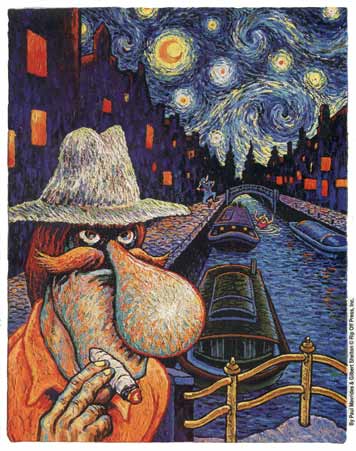
'Starry Night in Amsterdam' (cover drawing for High Times magazine (November 1990), parodying Vincent van Gogh's painting 'Starry Night'.
Early life and career
Paul Mavrides was born in 1952 on the East Coast of the USA, as the child of Greek-American parents. His father was a communication theory teacher at universities, and his job required him to travel around the country. Interviewed by Gary Groth for Comics Journal issue #167 (April 1994), Mavrides remembered the civil rights protests at the University of Fisk in Nashville in the late 1950s, because his babysitter attended the demonstrations, pushing him around in a stroller, until they were both arrested. In 1960, the Mavrides family settled in Akron, Ohio. As a child, Paul was particularly fond of the EC Comics horror stories, Mad Magazine and the early Marvel Comics by Stan Lee, Jack Kirby and Steve Ditko. He singled out Ernie Bushmiller, Al Capp, Will Eisner, Chester Gould, Harvey Kurtzman and Wallace Wood as his strongest earliest influences. By the time he entered junior high school, Mavrides lost interest in comics for a while, only to have it reignited when he discovered underground comix. Their taboo-breaking stories and thrilling counterculture edge strongly appealed to him. He singled out Robert Crumb and Gilbert Shelton as his strongest influences. In the aforementioned Comics Journal interview, Mavrides referred to Crumb as the only comic artist he would consider a "genius": "(....) He's got an insight that I think puts his work above that of most others – historically you'll look back and (...) everyone else will be forgotten, footnotes if we're lucky. Crumb is really a once-in-a-lifetime person – as far as his work goes." Through reprints in The East Village Other, he also discovered Winsor McCay's classic newspaper comics, while admiring Ron Cobb's political cartoons.
One time, In junior high school, Paul Mavrides was sent to the principal's office for drawing a caricature of the teacher. Yet he later printed the same caricature in the school paper, where, much to his surprise, both his teacher and the principal could see the humor in it. Together with some high school friends, Mavrides made their own alternative magazine, The Crocus, which they distributed underground at their school. In the tumultuous 1960s, he grew more socially conscious, supporting the civil rights movement, opposing the Vietnam War and writing about the FBI and schools keeping illegal files about anti-authoritarian students. In 1967, he was part of a group wanting to occupy their local draft board, because as teens they wouldn't be prosecuted like adults. Their plan had an even better outcome when the civil servants saw their crowd arriving and locked the doors out of precaution, and the draft board remained closed for two days.
As a youngster, Mavrides had many arguments with his father. He couldn't understand his son's hippie clothing, atheism, criticism of "the system" and disrespect for authority. Due to his anti-war activism and defiance in school, the FBI already kept a file about him, according to Mavrides. When he turned 18, his father gave him 20 dollars and told him to move out. After crashing at a friend's place for a while, Mavrides took a job, saved money and hitchhiked to Boston, Massachusetts, where he lived for a year. He escaped the draft by being declared "permanent 4-F", since he was an obvious anti-war activist. By 1973, he and his girlfriend moved to Tucson, Arizona, where he worked as staff cartoonist for the alternative magazine The Arizona New Times.
In 1974, Mavrides and his friend Gary Hughes found Jack Kirby's address in a phonebook and decided to call him up. To their delight, they were invited over to the legendary creator's home. Interviewed by Gary Groth for Comics Journal issue #167 (April 1994), Mavrides recalled that it was a fun and interesting conversation, until he asked Kirby how he felt about DC Comics cancelling his series 'New Gods'. Kirby flew into a raging fury and his wife had to calm him down. Mavrides reflected that he was just naïve about the comic industry at the time and didn't know about Kirby's bitterness regarding the way he had been treated by his former employers. The veteran advised Mavrides to become an illustrator, since "comics would just break your heart." More encouraging advice came from another creator, Rick Griffin, who suggested Mavrides should move to San Francisco, the heart of the U.S. alternative comics scene. Mavrides took it by heart, but in 1975 first lived in the smaller Californian city of Berkeley, working in a restaurant. After feeling mentally and financially ready to move to a huge city like San Francisco, he went.


'Cover-Up Lowdown' episodes, parodying Lee Harvey Oswald and the 'Esso' tiger.
Cover-Up Lowdown
In the fall of 1976, Paul Mavrides collaborated with Jay Kinney on the weekly one-panel cartoon series 'Cover-Up Lowdown', published in The Berkeley Barb. The series dealt with conspiracy theories, but presented in a satirical and deliberately absurd fashion. Kinney and Mavrides alternated on script and artwork, agreeing that if one of them objected to an idea, it wouldn't be used. Through Gilbert Shelton's Rip Off Press Syndicate, the comic was carried by many other alternative magazines throughout the USA and also collected in book format by Rip Off Press in November 1977.

'Kultur Dokuments' (Anarchy Comics #2, 1978), a parody of Bob Montana's 'Archie Comics'.
Anarchy Comics
Also with Jay Kinney, Mavrides launched 'Anarchy Comics', an anthology comic book series published by Last Gasp (1978-1987). Four issues were published within a small decade, with the final edition being edited by Mavrides alone. Each issue was a combination of reprints of pamphlets, essays and articles and comics. Some comics were adaptations of texts by famous anarchists, like Emma Goldman or Pierre Proudhon, while others visualized famous revolutions from the past or biographies of activists like Buenaventura Durruti. Other material was of a more satirical and iconoclastic nature, like Kinney and Mavrides' 'Kultur Dokuments' (Anarchy Comics #2, 1978). Presented in a pictogram style, the comic follows a group of pictogram people living in Dullsville until they undergo a radical and graphic change to become leftist, politically active guerrillas. Embedded in the story was also a parody of the popular teen comic book character 'Archie' (created by Bob Montana), named Anarchie.

'No Exit' (Anarchy Comics #3, 1981).
Rather than just challenge the system, some content in Anarchy Comics questioned anarchy as philosophy. In the Kinney and Mavrides story 'No Exit' (issue #3, 1981), for instance, a punk rocker finds himself in a future where the revolution has been achieved. Everybody has now adapted to anarchic ideas, which have benefited society into a paradise. Having nothing left to rebel against, the punk feels extremely distraught.
Anarchy Comics featured contributions by U.S. cartoonists J.R. Burnham, Norman Dog, Harry Driggs, Matt Feazell, Melinda Gebbie, Clifford Harper, Greg Irons, Jay Kinney, Steve Lafler, Dave Lester, Marian Lydbrooke, Gary Panter, Ruby Ray, Spain Rodriguez, Sharon Rudahl, Gilbert Shelton, Steve Stiles and Byron Werner. Foreign reprints were included too, including work by artists like François Dupuy & Yves Frémion (A.K.A. "Épistolier and Volny"), Albo Helm, Pepe Moreno, Peter Pontiac, Donald Rooum, Gerhard Seyfried and Michel Trublin. In 2012, all issues were compiled into the one-volume 'Anarchic Comics: The Complete Collection' (PM Press, 2012).

'The Fabulous Furry Freak Brothers' by Shelton & Mavrides.
The Fabulous Furry Freak Brothers
As a teenager, one of Mavrides' favorite underground comix series was Gilbert Shelton's 'The Fabulous Furry Freak Brothers', about a trio of stoners and their cat, trying to stay ahead of the law. Yet he would have never believed that one day he would actually write and draw for this humor comic. Between 1974 and 1978, Shelton already worked with Dave Sheridan as an assistant, but he left to concentrate on other projects for a while. Mavrides already regularly frequented Shelton's publishing company Rip Off Press and he was simply the first person Shelton asked whether he would be interested in replacing Sheridan. From 1978 on, Mavrides started out as an assistant on background art and secondary characters, while Shelton focused on the main characters and provided lettering. After a while, Shelton no longer regarded him as an assistant, but as an equal, and so he was allowed to write gags and narratives and sometimes draw entire panels on his own. Mavrides always enjoyed their collaboration, saying that the only constraint was that they had to draw in the same style to achieve "something seamless." Nevertheless, few readers could tell their work apart. Perhaps the finest compliment was paid when Mavrides went to a punk concert, where the crowd was stirred up to express their hatred of hippies. Yet when he was brought on stage and introduced as one of the artists behind 'The Fabulous Furry Freak Brothers', it turned out that the punks were all big fans of this comic, despite it starring hippies.

'The Fabulous Furry Freak Brothers' by Shelton & Mavrides.
In 1979, Shelton signed a deal with Hollywood for a movie adaptation of 'The Fabulous Furry Freak Brothers' and used the money to travel to Europe. Unavailable for a long while, he sent new scripts from Barcelona to the Rip-Off Press offices in San Francisco, which often caused delays. Since Mavrides also wanted to bask in the Spanish sunlight, he suggested to Rip Off publisher Fred Todd that it might be more beneficial if he went to Barcelona in person to "help" Shelton work faster and more efficiently. He thought that Todd would see right through this obvious excuse, but the man actually agreed and soon Mavrides found himself in Barcelona, working alongside Shelton. In the early 1980s, Dave Sheridan also came back on board as a third co-worker, until tragically dying from cancer in 1982.

The Fabulous Furry Freak Brothers: 'The Idiots Abroad'.
The Idiots Abroad
The death of Dave Sheridan brought everybody at Rip Off Press in a state of deep grief. To give the team some emotional distraction, Mavrides suggested making a more ambitious 'Fabulous Furry Freak Brothers' comic. Most stories up to that point had been either one-page gags or short stories of six or more pages. Being fed up with always drawing Franklin, Phineas and Freddy in their shabby house or in U.S. suburbs and cities, he wanted to send them off on a grand exotic voyage. Their recent travel experiences in Europe could serve as a good inspiration. Gilbert Shelton felt this was an interesting idea and soon the duo crafted what is widely considered the series' masterpiece: 'The Idiots Abroad'. Working on the story arc from 1984 to 1987, they spread the group's adventures over three books, volumes #8,# 9 and #10. Guy Colwell provided coloring, but one day left suddenly to travel, leaving it to Mavrides to finish 30 uncolored pages himself and going through great lengths to make sure the difference in color quality wouldn't be noticed. From that moment on, Mavrides became the series' official colorist too.
'The Idiots Abroad' starts off with Phineas, Frank and Freddy planning a voyage to Colombia in the hope of buying dope at a cheap price. They split up, getting each on a different plane, but ending up at wrong destinations. Frank gets the closest to their destination, finding himself in Latin America, but the wrong country, namely Nicaragua. There, he has to flee from Communist guerrillas in a direct reference to the Reagan administration's funding of the Contras troops in Nicaragua who tried to overthrow the Communist Sandinista government. Freddy gets stuck in Europe, wandering through France and ending up as far as Moscow. Phineas discovers he has landed in Mecca, where he starts his own cult that soon becomes one of the major global religions. 'The Idiots Abroad' is an entertaining, well-written epic tale, full of funny twists and turns. The detailed background art provides a picturesque view of the trio's travels, from the busy airports and city streets to parch-dry deserts and tropical jungles.
Mavrides and Shelton continued 'The Fabulous Furry Freak Brothers' until 1992, when the 12th issue of the trio's adventures was released. This installment featured graphic contributions by longtime German fan Gerhard Seyfried. As a tribute to Mavrides, Shelton modelled the saxophonist in the comic series 'Not Quite Dead' (scripted by Shelton and drawn by Pic) after him.
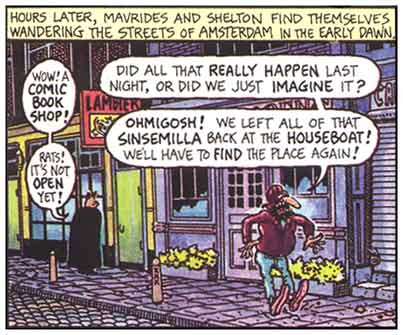
'The Adventures of Mavrides', featuring a cameo of the Lambiek comic book store in Amsterdam.
The Adventures of Mavrides & Shelton in Amsterdam
In November 1990, Gilbert Shelton and Mavrides made a three-page comic for High Times Magazine, which actually starred themselves. In 'The Adventures of Mavrides & Shelton in Amsterdam', they are invited to be the judges for a marijuana grower's contest. Interviewed by Elliot Elam (The Comics Journal, 15 February 2013), Shelton confirmed that it was actually based on a real-life anecdote: "(...) When we arrived in Amsterdam they gave us each 30 samples to smoke in five days. Six per day. By the time I'd smoked three puffs of the first one I was so stoned that I couldn't tell the difference and I gave them all the same score. But Mavrides smoked all of the samples and wrote a lengthy critique of each one." The story is notable for featuring a cameo of the Fabulous Furry Freak Brothers and of Kees Kousemaker's Amsterdam comic book store Lambiek.

'The L.A. Performance Scene' (American Splendor #14, 1989).
American Splendor
In addition to working with Gilbert Shelton, Mavrides was also a notable contributor to Harvey Pekar's 'American Splendor', a comic book series about relatable slice-of-life moments. He illustrated several of Pekar's scripts, among them 'Inky: The Not So Cool Cat' (issue 13, #1988), 'The L.A. Performance Scene' (issue #14, 1989) and 'Mr. Boats on Longevity' (issue #17, July 1993).

Paul Mavrides art from Zap Comix #14 (1998).
Zap Comix
In 1968, Robert Crumb had launched Zap Comix, an underground comic book that influenced thousands of alternative comic artists to do their own thing and publish it independently. Many issues followed over the decades, featuring an exclusive clique of seven permanent contributors: Crumb, Rick Griffin, Victor Moscoso, Spain Rodriguez, Gilbert Shelton, Robert Williams and S. Clay Wilson. It wasn't until Griffin suddenly died in 1991, that a newcomer was allowed in its pages, namely Paul Mavrides. Together with Aline Kominsky, he was the only later Zap Comix contributor to receive this honor. His contributions can be found in issue #14 (1998) and #15 (2005). Crumb, already disinterested in Zap since 1970, was always pushed by the others to join in again. This became the subject of a series of short comics in issue #14, in which every Zap contributor offers their own point-of-view of how they approached Crumb. Mavrides' version was arguably the wittiest, with Moscoso murdering Crumb with a Rapidograph pen in a spoof of Fritz the Cat's murder in Crumb's 'Fritz the Cat Superstar' (1972).
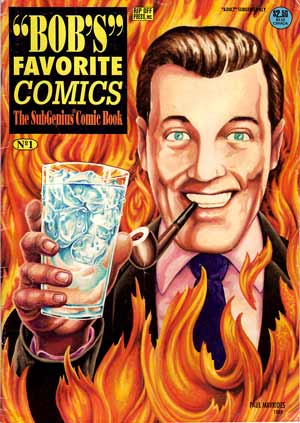
'Bob's Favorite Comics'.
Church of the Sub-Genius
In 1979, Ivan Stang, Philo Drummond and Paul Mavrides established the "Church of the SubGenius" in Dallas, Texas. This so-called organization was a parody of cults and organized religions, complete with their own worshipped figurehead, J.R. "Bob" Dobbs. Looking like a cheery, pipe-smoking father from a 1950s sitcom, Dobbs was designed by Stang. The SubGenius Church had a ludicrous creation myth, held mock ceremonies and sermons and celebrated "cool" characters and personalities from popular media by giving them unofficial holidays, including Dracula, Klaatu (from the SF film 'The Day The Earth Stood Still') and the members of Monty Python. Mavrides has often created artwork for the SubGenius Church, including a poster made in collaboration with Stang. In 1989, he also designed the cover and drew some interior comics for 'Bob's Favorite Comics' (Rip Off Press), a thematic comic book built around J.R. Dobbs. Among the contributing artists to this comic book were Mavrides (as Palmer Vreedeez), Harry Robins (as H. Robins), Jay Kinney (as Senator Kidney), Gilbert Shelton, Robert Williams, John Hagen-Brenner (as Satellite Weavers), Carol Lay (as Dona Sangre), Ivan Stang, Xandy Smith and Byron Werner. In 1990, Mavrides held an art show devoted to their cult at the Psychedelic Solution Gallery in New York City. Mavrides was also co-author of the book 'Revelation X: The "Bob" Apocryphon: Hidden Teachings and Deuterocanonical Texts of J.R. "Bob" Dobbs (Fireside Books, 1994).
In the previously mentioned Comics Journal interview, Mavrides considers the SubGenius Church a genuine religion in the sense that it also grabs symbols, attaches meaning to it through a philosophical framework and applies a philosophy, attracting followers: "We're more valid than the competition because we don't even ask for a tax break from the government." In his opinion, they try to make people think how inane the idea of an organized religion is, asking people for money. He also pointed out that even a simple joke can eventually turn into a "totalitarian nightmare".

'Care Dog Meets Pee Bear' (Bob's Favorite Comics, 1989).
Sales Tax law case
In 1991, the California State Board of Equalization planned to levy a sales tax on comic strips and comic books, under the idea that original artwork was merely "printer's aids" instead of a literary manuscript, and the artwork in itself only an illustration and so commercial art. Following this bureaucratic logic, comic creators were not authors and therefore don't share the rights and exemptions of authors. Mavrides strongly disagreed with this condescending opinion and challenged the law directly in interviews and other media releases. He felt the law proposal overlooked the fact that comics follow a narrative and are therefore closer to literature than an advertisement. It also didn't take into account comics for free publications and would simply tax these too, even though no actual sales transaction took place.

Strip by Paul Mavrides about the proposed California sales tax, published in The Comics Journal #167 (April 1994).
Mavrides stressed that this excessive taxation could not only drive cartoonists into bankruptcy, but also make publishers consider dropping them, since they wouldn't consider comics profitable any longer. All that while comic artists already earned far less than publishers. In the long term, Mavrides feared that comic artists would not only lose respect and status, but also their freedom of speech, since their work would no longer be regarded as creative expression. If the law would be instated, Mavrides foresaw a probable destruction of the alternative comics publishing industry in California, a loss of legal literary status for comics as a whole, the possible removal of fundamental speech rights for creators involved in censorship cases and new creators' careers truncated by financial hardship. In its wake, the law could also hurt the field of children's books.
Mavrides received support from the San Francisco Cartoon Art Museum, the San Diego Comic Convention and individuals like Kevin Eastman, Matt Groening, Denis Kitchen, Art Spiegelman and Larry Welz. Backed by the Comic Book Legal Defense Fund, he took the case to court. In 1997, the judge ruled in his favor and the law didn't pass.

'Grass'.
Film contributions
Mavrides has occasionally helped out with documentaries made by Ron Mann, both of which received Genie Awards for "Best Documentary". In 1989, Mann made 'Comic Book Confidential' (1988), about the history of comics and the passion it evokes among fans. The docu was notable for interviewing an impressive variety of famous comic writers and artists, apart from Mavrides himself: Lynda Barry, Charles Burns, Sue Coe, Robert Crumb, Will Eisner, Al Feldstein, Shary Flenniken, William M. Gaines, Bill Griffith, Jaime Hernandez, Jack Kirby, Harvey Kurtzman, Stan Lee, Frank Miller, Victor Moscoso, Françoise Mouly, Dan O'Neill, Harvey Pekar, Spain Rodriguez, Gilbert Shelton, Art Spiegelman. Footage with Carl Barks, Julius Schwartz, Trina Robbins and even Frank Zappa was also shot, but as the first draft was four hours long, their contributions were cut for the final 1.5 hour edit. The promotional poster of 'Comic Book Confidential' presented the interviewees as a series of comic strip panels, with each person as their own individual vignette. Although the panels appear to be lifted from various original comic panels by the artists themselves, they were actually all drawn by Mavrides, mimicking each artist's individual style. In the opening credits, Mavrides can be seen making the poster and then pretending to accidentally spill his inkpot over the finished page. This scene was also used in the movie trailer.
In 1999, Mavrides also provided art direction and animation for Mann's 'Grass' (1999), a documentary about the history of marijuana, with narration by actor Woody Harrelson.
Graphic contributions and other works of art
Mavrides made contributions to 'Real War Stories' (1987, 1991), a comic book series adapting real-life anecdotes of U.S. war veterans, published by Eclipse Comics. He was also one of several cartoonists to help out with the collective comic book 'Strip AIDS' (1988), of which the profits went to AIDS research. Mavrides additionally designed the cover of Dennis P. Eichhorn's 'Real Stuff' issue #20 (October 1994).
Mavrides has been active in many different creative disciplines. He has made radio shows, constructed artistic installations and brushed velvet paintings. On 22 November 1979, he and Doug Wellman held a controversial exhibition at a Jetwave gallery, with John F. Kennedy's assassination as the main theme. Visitors could gaze at various artefacts supposedly related to the murder, including blood-soaked pillows and an electric race car track where people could shoot a miniature limousine with a pocket-side JFK and Jackie Kennedy Onassis inside. Mavrides wanted audiences to think about the mysteries surrounding the murder and particularly the way it was mediatized. Mavrides was delighted that even Paul Krassner, editor of the satirical magazine The Realist, felt it was "in extremely poor taste". Between 4 January and 15 February 2014, Mavrides held a solo exhibition at Steven Wolf Fine Arts in San Francisco, titled 'Art Makes You Free'.

Cover design for 'Electriclarryland' by The Butthole Surfers (1996).
Music-related work
Mavrides has been a prolific album cover designer. He designed the sleeves for various punk band records, for instance for 'The Nuclear Beauty Parlor' (1983) by Re Styles and the Final Rinse, 'Ain't Love Grand' (1985) by X, 'Garibaldi Guard' (1996) and 'Never Mind the Opened Minds' (1997) by the U.S. Bombs, 'Straight Outta Madrid Live At The Revolver Club' (1995) by Chris Wilson, Danny Mihm and James Ferrell, and, perhaps his best-known album cover, 'Electriclarryland' (1996) by The Butthole Surfers. At the time, 'Electiclarryland' was the group's best-selling record, thanks to the hit single 'Pepper'. Mavrides also designed the covers of the compilation albums 'Marilyn Records: The Electric Radio Sampler Music Test' (1993) and 'Old Skars and Upstarts' (1999). In 1995, the musical art collective The Residents released 'Bad Day on the Midway' (1995), a CD-rom video game that came with a musical soundtrack album and a 2012 novel. Mavrides was one of several artists to contribute visual designs to this CD-rom.
Together with Gilbert Shelton, Mavrides designed the cover for Grateful Dead Comix #4 (Kitchen Sink Press, 1991), a series of comics about the cult rock group The Grateful Dead. Mavrides has also played in a band himself, namely The Band That Dares Not Speak Its Name, of which Jay Kinney is also a member.
Books about Paul Mavrides
For people interested in Mavrides' artwork, the rare sketchbook 'Skull Farmer' (Tundra Publishing, 1991), is highly recommended.

Parody of the 'This is your brain on drugs' public service advertisements, 1992.